Monthly Archives: May 2020

Arkansas

Kyle (Liam Hemsworth) and Swin (Clark Duke, who also directs) are bottom-tier drug dealers who are glad to be promoted to wholesale distribution by their kingpin (a man they’ve never met).  They are on their way to their first wholesale dropoff when they’re suddenly rerouted by Ranger Bright (John Malkovich) to his trailer park in Arkansas.  Bright also works for the same kingpin, who apparently has reconsidered Kyle and Swin’s promotions.  Kyle and Swin try to settle into the Arkansas chapter of this drug ring, but things soon go sideways when a rival lowlife follows them back to the trailer park after their first drop-off, and his robbery attempt leaves two people dead.
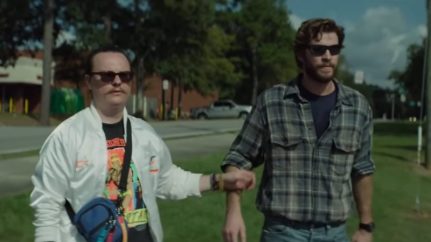
arkansasVince Vaughn and Vivica A. Fox also make appearances in Arkansas as Kyle and Swin make enemies at every turn.  The saddest part is that their attempts to lay low end up creating, then escalating, a conflict between them and Frog, who can’t figure out whether the two are trying to steal from him or whether they are completely inept.  As with most things, the answer ends up being a bit of both.

For the most part, Arkansas is a character study, which is highly problematic when the lesser Hemsworth is your lead.  Liam’s brother Chris clearly got all the family’s charisma, and Kyle’s only observable character trait is an unexplained limp.  All in all, there’s really nothing coming from Hemsworth to keep the viewer interested.  Swin is not worse but he’s hardly better, as he remains a complete mystery through to the end, leaving Hemsworth to carry most of the load.

Casting better lead actors may not have saved this one, because the film’s ending is a jumbled mess as all those left standing must fight for control of Frog’s drug ring.  But with better leads, Arkansas would at least have been a more interesting journey.  As it stands, Arkansas is a boring film with no real payoff.  I would much rather have followed the supporting characters’  stories (especially Ranger Bright) than have to spend so much (or really, any) time with Kyle and Swin.

Home For Christmas Day

Betsy (Matreya Fedor) is a high school student, a choir soloist, a horse lover and wannabe vet, a diner waitress, and about half a year away from college, so this is potentially her last Christmas while living at home with her mother. Betsy is a good kid with a clear path toward her goals, but when a handsome soldier walks into the diner one day, things get rearranged. She and Tyler (Anthony Konechny) fall in love despite an imminent tour of duty, and despite her mother’s stern disapproval.

Betsy’s mother Jane (Catherine Bell) isn’t normally the wet blanket type, but thanks to long, lingering shots of a framed photo, we get the hint that her own soldier boy, Betsy’s father, was killed in action long ago. Might this possibly be the source of her concern?

It’s definitely the source of her concern, but teenage love thrives when it’s forbidden, and not even the hunky diner owner (Victor Webster) can distract Jane from her objection, driving a wedge between her and her daughter during a time they should be treasuring as the last of its kind.

Home For Christmas Day follows all the familiar Hallmark beats, and director Gary Harvey know how to make the most of his modest budget, tapping Fedor’s talent as a singer for a do-it-yourself music montage that pays for itself, although I did question the need for a montage summing up a relationship that had, at that point, existed for literally all of 2 days. I get it though: your first love feels like it’s bigger and more important than the whole world. Plus, a montage is a great way to pad out a movie; 84 minutes can feel like a lot of time to fill when everyone already knows not only the destination, but also the the well-worn path of the journey.

John Henry

John Henry is an African American folk hero. He is said to have worked as a “steel-driving man”—a man tasked with hammering a steel drill into rock to make holes for explosives to blast the rock in constructing a railroad tunnel. According to legend, John Henry’s prowess was measured in a race against a steam-powered rock drilling machine, a race that he won only to die in victory with hammer in hand as his heart gave out from stress. 

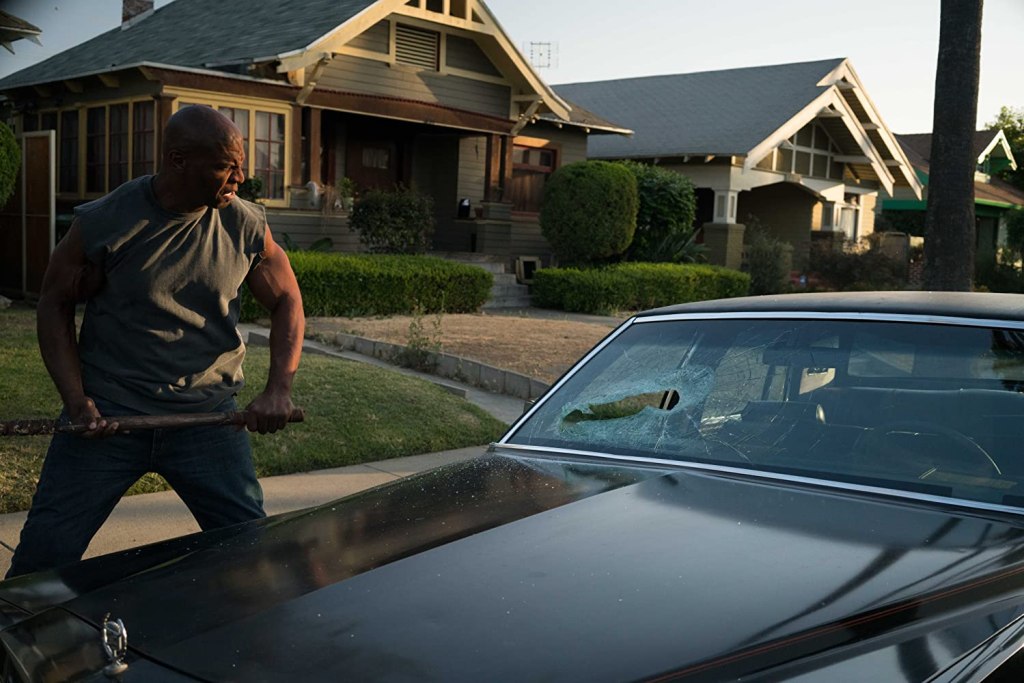
The new film recently released on Netflix stars Terry Crews as Henry, and drags this legend into the 21st century. This John Henry lives a quiet and peaceable life after an accident with a gun convinces him to retire from gang life and loaded weapons forever. Now it’s just him, his sweet dog, and his disabled dad (Ken Foree). Until two immigrant kids on the run from his former South Los Angeles gang leader stumble into his life, that is. That kind of puts a bit of a crimp in the old laying low lifestyle. Plus his honour code pretty much forces him to jump back into the fray on their behalf but because of his no gun policy, he’ll have to face off against an entire gang armed only with his big hammer. Yeesh.

I very much enjoyed watching Terry Crews flex his acting muscles for a change but the actors are pretty much the only thing that works in this movie. Director Will Forbes relies too heavily on violence to cover up his uncertainty. His shifts in tone are pretty wild and disorienting, and the editing makes it feel like large chunks of the movie were left on the cutting room floor. This movie is about as subtle as the sledgehammer John Henry carries.

In 2018, Netflix announced that Dwayne Johnson would portray the character in a film intended to be the first installment in a shared universe that centers around heroes of legend and folklore, from various ethnic groups and cultures. This is NOT that movie: it’s a different script and a different director. But that one, titled John Henry and the Statesmen, even had a teaser trailer. In 2018 they claimed it was “coming soon” but no word since on where it’s ended up (to be fair, Johnson and director Jake Kasdan have been making a lot of Jumanjis), but whether or not their Avengers-style folk legend shared universe takes off, it’s probably safe to say that Will Forbes’ is dead in the water.

Sorry To Miss You

Director Ken Loach has dedicated his career to shining a spotlight on social injustice and lifting up working family. I was very much moved by his last effort, 2016’s I, Daniel Blake, which was one of my favourite movies that year. I knew going in that Sorry To Miss You was unlikely to be the cheeriest of views and you know what? I was right.

Ricky (Kris Hitchen) and Abbie (Debbie Honeywood) have been struggling to make ends meet since the economy crashed in 2008. They have two kids, Seb (Rhys Stone), who struggled just to stay in school and is increasingly rebellious, and sweet Liza (Katie Proctor), who senses that her family is in crisis.

Hoping that “self-employment” can solve their financial woes, Ricky gambles the family’s last asset, the family car, to buy a van to make deliveries. But the truth is, Ricky still works for a boss, one who can severely impact his earning potential on any whim, one who takes no risks himself, provides no protection whatsoever. This has become an increasingly common form of employment – no benefits, no sick days, and no access to employment insurance. Welcome to the gig economy, which is slang for labour exploitation.

Loach argues that working people’s struggles are inherently dramatic. “They live life very vividly, and the stakes are very high if you don’t have a lot of money to cushion your life. Also, because they’re the front line of what we came to call the class war. Either through being workers without work, or through being exploited where they were working. And I guess for a political reason, because we felt, and I still think, that if there is to be change, it will come from below. It won’t come from people who have a lot to lose, it will come from people who will have everything to gain.”

Sorry To Miss You is, in fact, quite dramatic. When you’re living paycheque to paycheque, you are teetering dramatically on the edge of disaster and ruin. And guess what? Ricky and Abbie are about to get pushed definitively over it. It doesn’t take much.

So yes. This movie will make you feel awfully guilty about all the one-click ordering and same day delivery you’ve been enjoying (just me?). It’s extremely well-made, with anxiety-inducing performances and a strong message. It is dramatic, filled with angry, shouty parents, hair-tearing over bills, precarious health, stressful shifts, uneasy family dynamics, creepy bosses, literal poop, and always, always a sense of impending doom. The one thing it’s not is a fun watch.

Becoming

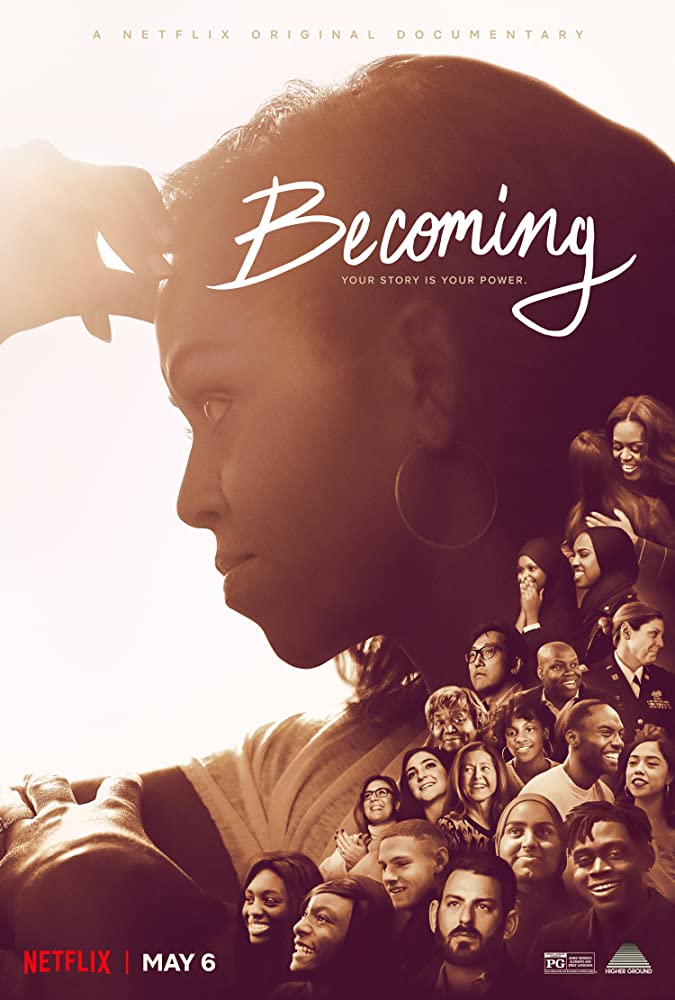
Michelle Obama’s post-White House memoir Becoming explored her roots and the path she followed to become the formidable woman we know and respect today. Her new documentary on Netflix, also titled Becoming, shadows her on her massively successful book tour, and focuses more on the role and the identity she’s forging for herself as a former First Lady who still has a lot to give.

Director Nadia Hallgren crafts the sort of documentary that will have you asking why this incredible woman won’t just run for President herself – but if you’re paying attention, Michelle Obama answers that question in every word and sigh. It’s clear that her eight year sentence in the White House has taken its toll. For America’s first black First Family, the presidential spotlight meant constant scrutiny and a constant need for carefully modulated perfection. The First Families that preceded and succeeded them have been allowed far less criticism for far greater blemishes. The Obamas knew that theirs would be treated differently and they played the part. But while Michelle Obama’s poise seemed effortless, Becoming shows the emotional impact, even the trauma, incurred for an accomplished and intelligent woman to mute her voice. And while she was a beloved First Lady for her husband’s entire term in office, it’s clear that she has now stepped confidently out of his shadow, and that the country, and even the world, has a thirst and a fervor for this new, less filtered, more authentic Michelle Obama.

While the documentary isn’t revealing any deep dark secrets, it does allow Michelle Obama to let down her hair – sometimes literally, into luscious curls, and to step out of the First Lady’s shoes – carefully curated by a stylist who understood her White House role as a costumer projecting class and elegance and respectability – and into gold, glittery, thigh-high boots, if that’s what she wants. The White House has changed her but it hasn’t silenced her. It hasn’t convinced her mother to stop favouring her brother, or her staff to stop teasing her, or her daughters to stop needing her. Seeing her nestled amongst any and all of these people gives us a clearer sense of who she is. And while those of us on the outside can’t help but respect and admire her, we see how much that holds true, and in fact truer, for those who know her more intimately.

The American Nurse

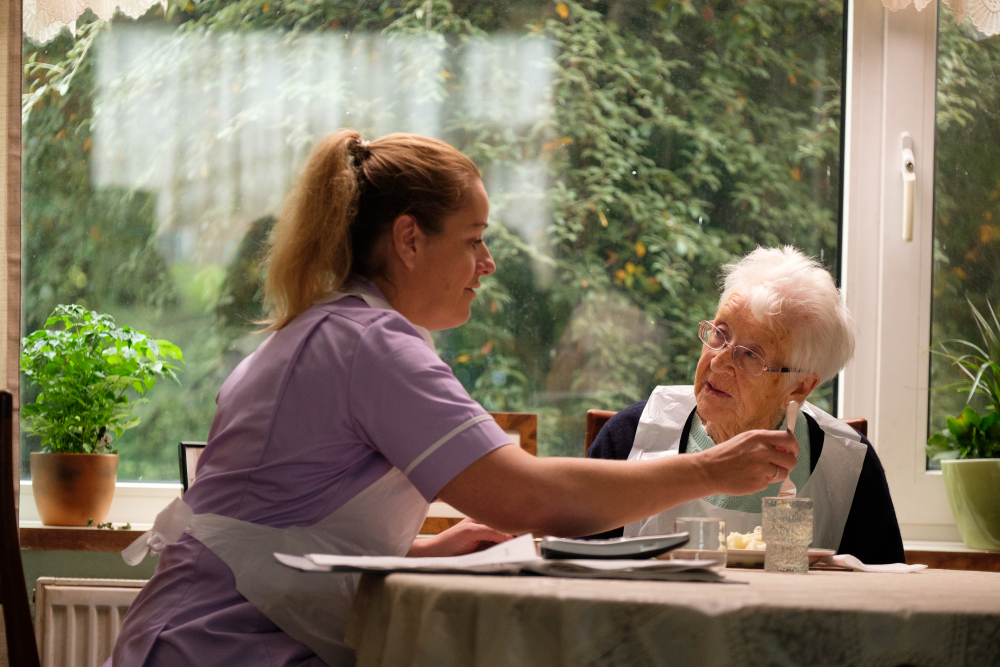
It shouldn’t take a global pandemic to appreciate the nurses who have been working fairly tirelessly and devotedly all along and yet we all too often take them for granted.

Today, May 6th, is National Nurses Day in the U.S. while internationally it is celebrated May 12, Florence Nightingale’s birthday. The interim between the two is usually called Nurses Week and if ever there was a time to make it a week-long act of gratitude and commemoration, it’s now. The International Council of Nurses picks a theme each year and for 2020 it’s ‘Nursing the World to Health.’

Florence Nightingale is largely credited with founding what we think of as ‘modern nursing.’ Her emphasis on proper hand washing alone saved countless lives (literally countless – think about that), beginning on the battlefields of the Crimean war. It is remarkable that in 2020, we are fighting an epic battle against a virus wherein hand washing again is the most important weapon.

The American Nurse is a 2014 documentary by Carolyn Jones who explores aging, war, and poverty through the work and lives of 5 working nurses. The camera follows them through a typical day’s work while we consider what it truly means to care: to care with our hands, with our hearts, with experience and knowledge, with commitment and dedication.

And now nurses are again at the forefront of the meanest and most threatening bug we’ve faced in a lifetime and we’ve been unable to provide them even the most basic personal protective equipment necessary for providing the care we’re demanding. Not only are healthcare workers more at risk for contracting the virus due to repeated exposure, they’re also more likely to have life-threatening symptoms (perhaps because they’re exposed to a much higher dose, or to multiple strains, but science has yet to confirm the reason). I know a nurse who works in mental health who spent the early days of lockdown seeing patients with no PPE at all as they’d all been locked away for when they were “really needed.” Now she gets 1 per day, which means she’s eliminated coffee, water, and food before and during shifts because going to the washroom would contaminate them. And at any time she faces redeployment to the E.R. even though she hasn’t practiced that kind of nursing in a decade. She has young kids at home, which means after a long shift she can’t hug or kiss them until after she’s stripped and scrubbed. And then the fun of homeschooling begins. She was telling me about a local grocery store that allows healthcare workers to skip the line. She would never accept, of course, because she’d feel like a jerk – lots of people are pulling double duty these days, and everyone would rather not be there. But also because standing in line 6 feet apart at the supermarket is the quietest and easiest part of her day.

COVID or not, The American Nurse is a well-made, interesting documentary which you can watch here for free. It gives us a little insight into what it takes to heap the world’s healing upon your shoulders, to run towards the crisis instead of away from it, to feel compassion for others when you could use some yourself.

Thank you, nurses.

The Stand At Paxton County

Imagine Erin Brockovich if she was more brash, less sexy, and instead of being pro health and corporate responsibility, she was anti animal rights. Sound like your cup of tea?

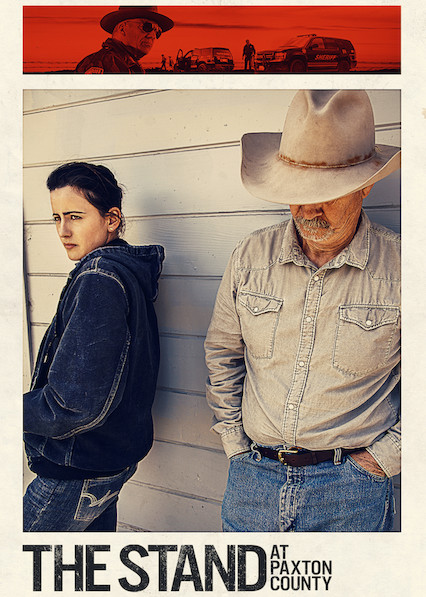
I don’t even drink tea and this still wasn’t my cuppa. But not because of how I’ve misleadingly described it. Janna Connelly (Jacqueline Toboni) is a military medic who’d rather be at war in Iraq (don’t quote me on that – it could have been any other recent skirmish) than at home on the ranch with her dad, Dell (Michael O’Neill). Even his heart attack isn’t much of an incentive but she reluctantly gives up being elbows-deep in the chest wounds of young men who didn’t sign up for this, and finds the family ranch in sad neglect. She and ranch hand Hudson (Tyler Jacob Moore) commit to fixing the place up but before they can make any changes, the town sheriff (Christopher McDonald) comes sniffing around with some vaguely qualified officials, based on an anonymous complaint about animal abuse.

Here’s the rub: some shady company has convinced the state senate to pass a bill (I’ve very likely gotten that process wrong, so just fill in the appropriate blanks or focus on the meat rather than the potatoes) that can confiscate a rancher’s entire herd on the word of a single vet’s assessment after an anonymous complaint. When that vet, that sheriff, and that company are in cahoots, it means a very cheap and easy way to come into many herds of cattle and strings of horses, which are quite lucrative on the resale. This company is not above manufacturing or planting evidence because they can hide behind the bill while the ranchers have little recourse, and the animals are gone by the time they can object in any case. It’s a tidy little scam that looks superficially legal and ruins a lot of innocent ranchers.

The movie is based on a real practice that does affect all kinds of American ranchers. Politicians are persuaded or duped into voting for a bill that sounds like a good thing – preventing animal abuse, but was always intended to provide legal cover for basically stealing someone’s valuable assets.

Unfortunately, director Brett Hedlund is no Steven Soderbergh. He struggles to make any of that sound interesting, making for a pretty slow and dry film, except for the parts where the script has overcompensated with cringy, unnecessary violence.

I suppose none of the actors are especially egregious but nor are they much good. The movie’s pretty bland and feels of a made-for-TV quality, and no, I don’t mean HBO. I mean Lifetime. But it does have the dubious honour of having premiered at the Black Hills Stock Show and been reviewed by Beef Monthly, for whatever that’s worth.

To learn more about this movie and others like it, find us here.

Like A Boss

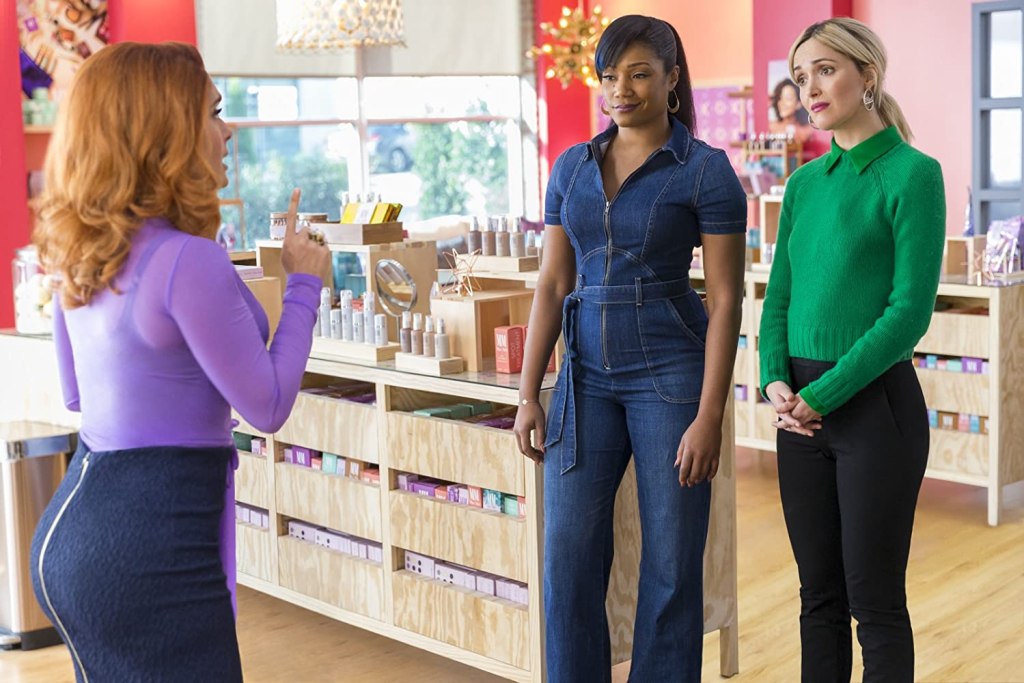
Mia (Tiffany Haddish) and Mel (Rose Byrne) are best friends since middle school. They started a beauty company together in a garage and grew it into a beautiful storefront location. Mia is the creative one, hands-on with customers and bursting with ideas, but there’s no structure to her process and it can’t be rushed or quantified. Mel takes care of the books and the logistics. She makes sure things run smoothly so that Mia can continue to create. But they’ve yet to recoup their costs from the storefront opening and they’re running quite a deficit. Mel doesn’t like to be the bearer of bad news and Mia doesn’t like to hear it, so Mel’s been carrying that burden alone and is relieved to hear that beauty giant Claire Luna is considering investing in their company. It sounds like the lifeline they’ll need to survive.

But while Mel is relieved and excited by the offer, Mia disdains it. They started their own company so they’d never have to work for anyone else again, and Claire Luna (Salma Hayek) has been pretty clear that her influx of cash comes with plenty of strings. In fact, when Mia and Mel reluctantly accept having not much of a choice, we the audience know something they don’t: Claire intends to sow discord among them to ultimately break them up so she’ll have controlling share. She’s pretty ruthless.

She’s also the only thing worth watching in this hot mess, although not necessarily in a good way. Hayek’s character is so baffling she’s hard to look away from, her complete lack of grounding or humanity make her unpredictable but also uninteresting. Which is still better than Haddish, who is too much, and Byrne, who is far, far too little. I have confirmed that this was in fact intended as a comedy, possibly because there is no genre for “just a group of people doing stuff of no particular value to no discernible effect.” There are better movies about business partners. There are better movies about friendship. Heck, there are better movies about eating something way too spicy.

Like A Boss cannot live up to its own title. It’s a bottom of the barrel comedy and director Miguel Arteta couldn’t find a joke if his mummy put it in a brown paper back with his name on it.

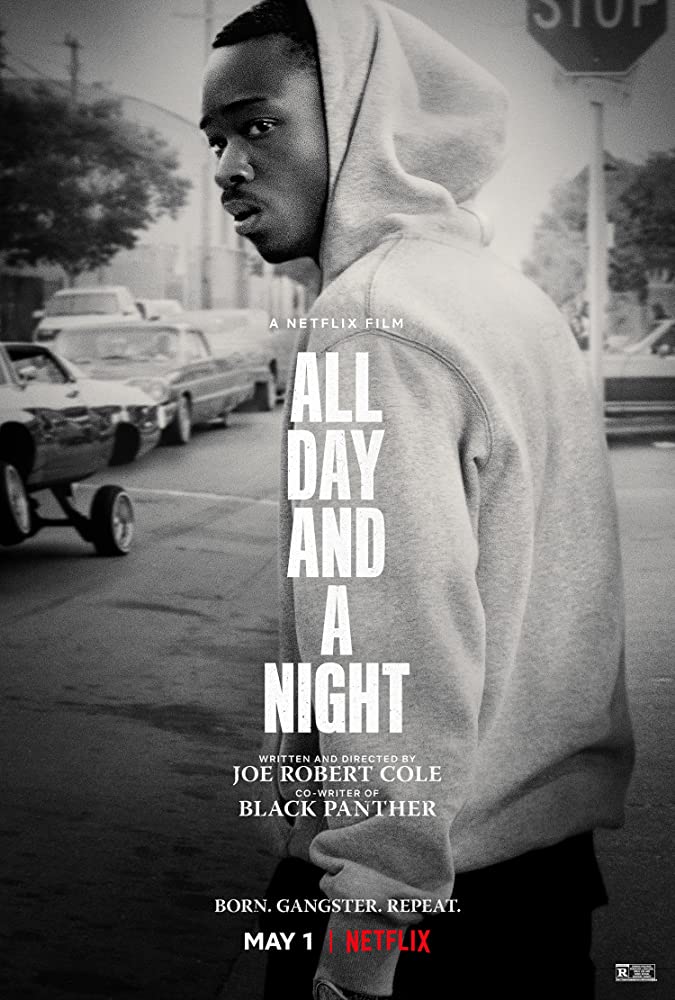
All Day And A Night

Soft-spoken Jahkor Lincoln (Ashton Sanders) struggles to keep his dream of rapping alive amidst a gang war in Oakland. It’s hard to have dreams in his neighbourhood. It’s hard to see outside the box you’re born into, to believe there are options for you, to believe your life isn’t fated by the colour of your skin. But no matter how hard he tries, his responsibilities seem to push him further and further across a line he never wanted to cross.

Jakhor lands in prison beside his father J.D. (Jeffrey Wright), the man he spent his whole life never wanting to become. But prison gives him lots of time to reflect, to explore the ties that bound them inextricably, and to dream of ways to beak the cycle for his own newborn set, whom he’s never met.

All Day and A Night is a title I still haven’t figured out and a film that’s a bit of a mixed bag. It slides backwards and forwards through time, which can get a bit sloppy. And it recycles a lot of material about young black lives that we’ve seen before. But it gets a few things really right – the sense of foreboding, for one, almost of inevitability that is heavy and depressing, and I’m just watching a film, not trying to live my life. Writer-director Joe Robert Cole clearly has a lot to say on the subject but I almost feel it was several movies’ worth, making this one a little disjointed. For example, there’s a very powerful scene in which Jakhor is visiting a friend in the hospital, a friend who will never walk again after a stint in the army. Jakhor is wearing a jersey, the NFL logo visible just below his pained face, reminding us of not one but two institutions that eat up and spit out the bodies of young black men.

I’ts not a perfect film but it has a voice and it has intention and if it’s not a string of hits, at least it’s a string of meaningful swings, and that’s a lot more than the other new releases on Netflix this week. All Day And A Night co-stars Isaiah John, Kelly Jenrette, Shakira Ja’Nai Paye, Regina Taylor, Christopher Meyer and Yahya Abdul-Mateen II.

Lady Driver

Okay, let’s just get this out of the way at the top: the title. It’s a god-awful title that has no business being attached to a movie released in 2020. It sounds like the kind of thing a racist grandma would whisper to you, rolling her eyes, “Lady doctor” she’d say, as if that put her whole cancer diagnosis into question, like maybe that lady doctor was just on her period or something. Lady driver? As if she could barely handle the steering wheel with those delicate hands of hers, as if her stilettos would make for awkward working of the pedals, as if her manicure might chip from too much shifting. As if she doesn’t even have space in her undersized brain for anything other than making babies and making sandwiches. Lady Driver? Lady Driver? The only way this makes any sense at all is as an attempt to recall the excellent film Baby Driver, which only means that I’m further inflamed, as a woman and as a movie lover. In fact, you are encouraged to call female doctors ‘doctors’ and female firefighters ‘firefighters’ and female drivers ‘drivers’.

On to the movie. Which is about a girl, Ellie (Grace Van Dien), who learns to drive. As you do when you’re 16. And then she proceeds to steal the shop class car and run away from home, to “Uncle Tim,” her dead dad’s brother, long since estranged from the family. Ellie and her mom are having some pretty major conflicts so it’s agreed that she’ll stay with Tim (Sean Patrick Flanery) for the summer, working in his mechanic auto-shop. Except under a dusty tarp in the shop is a race car, and Ellie is drawn to it like her bra is lined with magnets. Sure she just got her driver’s license yesterday and she’s never seen a stick shift before – is that a reason she can’t race? Nope! She’s a lady driver after all. She just has to keep it secret from her wet blanket mother who’s a little touchy on the subject since “it’s dangerous” and “you’re a child” and “that’s how your father died” and similar lame mom excuses.

Anyway, if you’re willing to accept in your heart that driving is genetic and that girls can do it too, this movie is probably still not for you. It’s just not very good. But if you like dirt tracks and low expectations, this movie is “free” (with paid subscription) on Netflix so your risk is low. Perhaps not low enough, and that’s a totally understandable position to take, particularly if your worldview is already wide enough that you already think of lady drivers as just “drivers” in your head.