Author Archives: Jay

The Jane Austen Book Club

I didn’t think I needed The Jane Austen Book Club in my life. Hollywood has taught me that movies based on book clubs just don’t really feel cinematic. But I saw that it was early (2007) Emily Blunt and I was tired of searching for something better, so I settled.

Lesson #1: trust your instincts.

Jocelyn (Maria Bello) has just lost her best friend and life partner, who happened to be a dog. Some may think the funeral is a little over the top, but Jocelyn’s grief is real, and her friends have gathered round to help her through a difficult time – only Sylvia’s husband MV5BMjMzNDc0MTI4M15BMl5BanBnXkFtZTYwNTAxMzc3._V1_Daniel (Jimmy Smits) can’t seem to keep the snide comments to himself. Turns out, that’s not the only thing he can’t keep to himself as he soon confessed to Sylvia (Amy Brenneman), devoted wife of a quarter century, mother of his children, that he’s seeing another woman and that leaving the other woman is non-negotiable. So. Jocelyn sets aside her own grief to take care of her flailing friend. Sylvia’s daughter Allegra (Maggie Grace) moves back in so she’s not alone and pal Bernadette (Kathy Baker) has the genius idea to establish a Jane Austen book club to provide a distraction. Since there are 6 novels to discuss, they’re in need of 2 more members. Bernadette brings aboard Prudie (Emily Blunt), an unfulfilled French teacher yearning for more than this provincial life, and Jocelyn recruits a young man and virtual stranger, Grigg (Hugh Dancy), as perhaps bait to liven up Sylvia’s gloomy divorce.

You can already tell that the book club is mostly an excuse to bitch about men (and women), and then we occasionally follow the women home to watch them make their various mistakes in real time, which is charming. Hint: that was sarcasm. The ensemble work between the women is actually pretty good but it’s an otherwise formulaic, sentimental, maudlin piece of crap pushed by Big Kleenex to turn women into weepies. Plus, it can’t help but be compared unfavourably to the Austen works discussed in the film. And that they should have seen coming.

The Legend of Cocaine Island

If you’ve ever lived in a small town, then you probably know how it goes. There’s a story that everyone knows. It gets passed around the way stories do: neighbour to neighbour, senior to freshman, longtime customer to grizzled waitress, bored shopkeeper to just-browsing customer, and every single damn time there’s beer or coffee involved. The story, whether it is strictly true or not, is a fact. A fact of life, a way of life. It’s how small-town people connect.

The Legend of Cocaine Island is such a story, and you can tell by the title that it’s a pretty good one. It gets passed around central Florida, and the whole gang – a real cast of characters, believe me – is reunited to pass it on to us.

One of the guys tells us: “A northern fairy tale goes ‘Once upon a time…’ but a southern fairy tale starts ‘Y’all aren’t going to believe this shit.'” This is how our documentary starts, so gather round, get close to the fire, pour a little spirit into your coffee, and listen up.

The local barefoot hippie always tells the same story: he lived in Puerto Rico once, 15 years ago, maybe 20. One day, walking along the beach, he saw something large bobbing along in the water. It was a carefully water-proofed package. He opened it up, hoping for cash, but instead he found 35kg of cocaine. Nervous, and not trusting the cops, he hid the cocaine, and then hid it again, and again, until finally he buried it. And presumably, that’s where it is now. Worth, what, 1 or 2 million dollars? Just sitting in the ground.

All the locals knew the story; the hippie was fond of repeating it. But it wasn’t until the recession hit that it started to sound more like an action plan than a fairy tale. This is life-changing money to people who have been foreclosed and they’ve slid from the American dream down to a trailer park of disappointment.

But, okay, even if they did some how find the coke and smuggle it home – what then? These weren’t drug dealers. How do you get rid of the stuff?

Well, the story snowballs into an open invitation to get rich quick. And pretty much a middle-aged dad gets in WAY over his head. He’s living his biggest Scarface fantasy. What can go wrong?

You have to watch this movie yourself, and it is eminently watchable. Director Theo Love weaves a very compelling narrative; this documentary tells a heck of a story. Is there actual buried treasure in Puerto Rico? Is it retrievable? Is this a terrifically terrible idea? Would greed and stupidity make criminals out of all of us?

Paper Man

Richard Dunn (Jeff Daniels) is a failed writer, and perhaps just a failure, period. His successful surgeon wife Claire (Lisa Kudrow) has rented him a little writerly cottage in Long Island and gifted him a laptop as well as the time and space needed to get to work on his second novel. Despite that sounding like absolute pure heaven to most of us, Richard doesn’t manage a shred of gratitude. Instead he wonders if this is in fact a trial separation in sheep’s clothing.

So I guess that’s why he doesn’t feel particularly guilty when he spends this time not at his desk but getting to know a teenage girl named Abby (Emma Stone). Abby is a lonely, solitary sort of person, despite the fact that she has a devoted friend and a bad boyfriend. She and Richard are practically kindred spirits, which they discover when he repeatedly hires her as a babysitter despite the fact that he has no kids. Yes, it plays as creepy as it sounds. And yet a friendship blooms in this unlikely, inhospitable place.

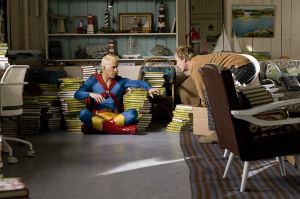
Despite Richard’s middle age, he is a child. He is petulant. Self-indulgent, he sees only MV5BMTMyNTk2MjcwNl5BMl5BanBnXkFtZTcwOTMyNzUzMw@@._V1_SY1000_CR0,0,1501,1000_AL_his own need and sorrow. This is further indulged by his imaginary friend, Captain Excellent (Ryan Reynolds, before he played Deadpool or even Green Lantern), a super hero type in cape and tights who tells him what he wants to hear.

You can imagine what it might be like to be married to a Richard. This is a coming of age tale for a man who is way too old to need one. A late bloomer or just too pathetic for words? Richard straddles that line, uncomfortably. But he’s reaching out, so not all hope is lost. He’s perhaps reaching out to the wrong person, to an inappropriate person. How is this relationship likely to be interpreted – by his wife, or her parents, for example? And yet this is what it is to be human. It’s all about the connection. Richard and Abby can truly be themselves around each other in ways that they haven’t achieved anywhere else.

Jeff Daniels continues to be good in dark roles. Emma Stone is vulnerable and feverish. They’re a couple of wounded characters and they ooze their indie drama. There’s a danger of drowning in all the mutual wallowing. For all its quirk, Paper Man might be lumped into those “man-child-struggling-to-grow-up” films (coming of middle age?), but it is saved by some very compelling performances.

Mary Queen of Scots

This is the story about the crazy relationship between two cousins, both queens. And the jealousy and the machinations between the two – one, the Queen of Scotland, who perhaps believed she should also be the Queen of England and everything else as well. But while this movie is obviously about politics, it’s more importantly a movie about gender politics.

Short history lesson:

Queen Elizabeth I was the daughter of King Henry VIII (the guy who liked to behead all his wives) and Anne Boleyn, who suffered her execution just two and a half years after her daughter’s birth. Their marriage thus conveniently annulled, Elizabeth was declared illegitimate, and when her father died, it was a half-brother, Edward IV, who claimed the throne. Not for long, though, and somewhere down the line, the crown did land on 25 year old Elizabeth’s head. Sometimes called the Virgin Queen, Elizabeth I was probably not a virgin, but she never married, and she never bore a child.

Her cousin, Mary I, became Queen of Scotland when her father King James V died when she was just 6 days old. 6 days old! Regents, including her half-brother, ruled in her stead. When she was 6 months old, King Henry VIII proposed (eventual) marriage between her and his son and heir, Edward, thus uniting Scotland and England under one crown, but when Scotland protested, a war dubbed the “rough wooing” ensued. To protect their young Queen, 5 year old Mary was sent to live in France, where that King also decided to unite France and Scotland under one crown by betrothing his 3 year old heir to Mary. They married when she was 15; he became King of France and royal consort of Scotland, but he died shortly after and she went home to Scotland to finally, officially, sit on its throne (and marry twice more). By this time her cousin Elizabeth I was also on her throne over in England, but there were some sticky points in the wills and order of succession, and it was always a thorn in their relationship that perhaps Mary had a claim to that crown as well.

Back to the movie.

MV5BN2FjNmUxNDUtZWIxMy00MmI1LWJkMDMtOWQ5NzgwOWI3NDVkXkEyXkFqcGdeQXVyNTc5OTMwOTQ@._V1_Elizabeth I (Margot Robbie) and Mary (Saoirse Ronan) are not that different. Elizabeth is said to have ruled by “good counsel,” relying on trusted advisors. History depicts her as moderate, cautious, and perhaps indecisive. Mary, on the other hand, was more forward, and clever, not that that stopped her own regents of plotting against her. She pushed Elizabeth to name her England’s heir presumptive. Elizabeth retaliated by proposing her trusted childhood friend as Mary’s next husband; Elizabeth felt she would be able to control him. Mary was too savvy to refuse outright but the relationship came to nothing.

Mary sought to strengthen her crown my marrying smart and creating alliances. And yet she understood that any man who married her would eventually try to steal her crown for himself. Still, producing a (male) heir would also strengthen her position, so marriage must be tolerated. Elizabeth, meanwhile, felt that marriage was too great a risk to her crown – that would only encourage plots against her. Of course she was expected to marry and produce an heir, but she refused.

The movie reminds us that in the 1500s, it sucked to be woman so much that even being the queen was not enough. Still the men would plot against you – your own sons, husbands, and brothers. Mary’s husband(s) and brother(s) both plotted against her. Her third husband was her second husband’s murderer, and her rapist. She was forced to abdicate in favour of her one year old son, James. Elizabeth, by contrast, ruled for 44 years, until her death. At which point the crown went to – yes, that’s right, it went to Mary’s son James. So this weird relationship exists between the two – they are sisters and rivals. No one else can understand this unique pressure to rule a kingdom as a woman with all the vulnerabilities that that entails.

While the movie may have benefited from a more focused approach to narrative, I found this endlessly fascinating and frustrating. I very much enjoyed the performances from both Robbie and Ronan, and I very much approved the race-blind casting. There are people of colour in the English and Scottish courts; this is a rather novel idea for a period film, but director Josie Rourke has a lot of experience in the theatre where this type of colour-blind casting is much more popular. As well it should be. We’re telling old stories, but those stories should be told by people representative of today.

I had not heard great things about this movie but I think people have just been watching it wrong. In 2019, women are still wondering if they can “have it all”: work, family, mental health, balance. In 1568, Mary and Elizabeth wondered if they could have it all: respect, religion, the freedom to marry whom they chose, agency over their own lives, and the ability to cut off each other’s heads if it came to it (and it always did).


 

Mortal Engines

I can see how this might be a pretty cool idea on paper, and might have succeeded as a novel, or better yet, a graphic novel (in fact it’s a whole series). But as a movie, it’s really just a bloat of CGI and very little narrative. In the years beyond civilizations collapse (presumably), London is now a predatory city on wheels. So, you know, a very large monster truck of a city that…eats other hapless cities? The why and when and who and how are all vitally important but completely neglected. We’re simply thrown into a story already in progress with all the juicy details left out. Even Michael Bay devotes a full 30 seconds of exposition about where the Transformers come from and why they care so much about dumb little Earthlings. This movie just drops you into the middle of a battle scene expecting you to care but not really caring itself whether or not you do.

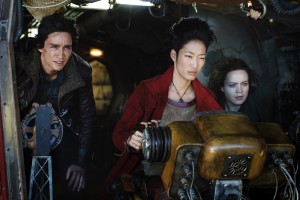
Film Title: Mortal EnginesHester Shaw (Hera Hilmar) is a young woman with a scar and a secret. When her little city is devoured and destroyed by London, you might think she’d be crushed herself -emotionally if not physically. The rest of her citizens become refugees on London, but it turns out London was Hester’s destination all along, and she’s come to strike down its primary architect and greatest celebrity, Thaddeus Valentine (Hugo Weaving). We don’t know why Hester is so dead set against the celebrated Valentine, but her cause is joined by nerdy Tom (Robert Sheehan) and a dangerous outlaw named Anna Fang (Jihae).

Mortal Engines is crowded with visuals but devotes no time to character or theme. It’s so busy setting itself up for future sequels it forgets to be good right now. The actors aren’t bad but they’re main preoccupation is jumping over steampunk set pieces, with little else to work with.

Mortal Engines wants to be, and could have been, like Mad Max meets Snowpiercer, except those movies are good and this one is just 129 minutes that would have been better spent feeding quarters into a broken vending machine.


The Highwaymen

In 1934, the infamous criminal duo Bonnie & Clyde were seemingly unstoppable. Their crime spree was turning more serious and their body count higher each day. Though they enjoyed almost movie-star status in certain circles, they were an embarrassment to the law enforcement they continued to evade – including Hoover’s FBI men.

The Texas Rangers have long since been disbanded – too lawless, too unsupervised. But Lee Simmons (John Carroll Lynch) manages to convince Texas governor Ma Ferguson (Kathy Bates) that since her new police force has proved ineffectual, perhaps what is needed is just a couple of highwaymen, doing things the old fashioned way.

Frank Hamer (Kevin Costner) chafes in his retirement, and though he hasn’t even held a MV5BMjM2NDg5NjQzMV5BMl5BanBnXkFtZTgwMzMyNzI5NjM@._V1_SY1000_SX1500_AL_gun in his hand in years, he doesn’t take much convincing. Maney Gault (Woody Harrelson) is a little more reluctant but pride is a tricky thing.

Following Bonnie & Clyde’s bloody trail is a complicated thing. These criminals are hailed as heroes by some, protected by family and friends. The men discuss whether they could shoot a woman, if it came to that. Neither really want it to come to that, but a job is a job is a job. It’s morally muddy ground maybe, but the script is a little shy about saying so, so it merely tiptoes around these dirty puddles, relying too heavily on the grizzled buddy-cop dynamic of Costner and Harrelson. And it’s not a bad dynamic at that: the two do a good job of seeming beaten down by their lives and their choices. But the movie plays it safe, and frankly, sometimes boring. Well, not boring, exactly, but not nearly as jittery and exciting as you might think literally any movie remotely associated with Bonnie & Clyde would be. But that’s the rub, isn’t it? Police work isn’t all car chases and whizzing bullets. Nor was Bonnie and Clyde’s life of crime nearly as glamourous as it was made out to be at the time. The actual truth is lost to us – no witnesses are alive today, and those that talked at the time tended to conflict each other’s stories quite a bit.

I imagine this movie will appeal most to a certain demographic: those inclined to beaten-up recliners and canned nuts. It’s a bit of a dad movie.

The Dirt

You may not even believe that the dudes of Motley Crue are literate, but in fact, they released their Confessions of the World’s Most Notorious Rock Band in 2001. The chapters (because yes, of course I’ve read it, I’VE READ EVERYTHING) alternate between the guys, and everyone’s got a version of the story they’re selling. Lots of the details conflict. In fact, lots of the big stuff conflicts too, but that’s part of the book’s charm. The guys sort of interact within its pages, rebutting each other’s alternate versions and extolling their own. The Dirt is even dirtier than you’d imagine.

So it’s kind of surprising that it took someone this long to make a movie out of it, but Netflix has, and it’s ripe for the streaming. 

The film alternates its point of view between the band members but the story is a little more cleanly told than it is in the book. And while almost by definition the antics are somewhat toned down, you’ll still get plenty of the sex, drugs, and rock n’ roll that Motley Crue was known for. In fact, you won’t have to wait more than 3 minutes to see a woman squirting. Stay tuned for the heroin overdoses, vehicular manslaughter, and anonymous head.

Nikki Sixx (Douglas Booth), Tommy Lee (Machine Gun Kelly), Vince Neil (Daniel Webber), and Mick Mars (Iwan Rheon) have some stories to tell. Tommy’s wholesome upbringing contrasts sadly with Nikki’s, while the other two get lost in the dust. The truth is, the 107 minute run time is brisk, and gives more screen time to trashing hotel rooms than it does to insightful backstory, because this is what draws the audience to any Motley Crue show: not the lessons learned or the underdog story, but the fights fought loud and proud and bloody. You come for the famous girlfriends and the venereal disease and the mountains of dope and the increasingly inventive use of leather. And fear not: director Jeff Tremaine delivers. He does best with those scenes of complete debauchery than he does with stitching them together into some cohesive story. And weirdly, the music is very nearly an afterthought. But if you’ve come for The Dirt, I promise you, you’ve found it.

Something Borrowed

Rachel (Ginnifer Goodwin) and Darcy (Kate Hudson) are lifelong best friends. Rachel is the goodie two shoes, the more reserved, quiet, wallflower of the two, and Darcy is of course attention-seeking and wild. But Darcy is, nevertheless, the one who is getting married to Dex (Colin Egglesfield), Rachel’s friend and secret crush from law school. No matter how many study sessions they enjoyed together, Rachel could never bring herself to make a move, but the minute Dex and Darcy meet, it’s fireworks, and the far more forward Darcy seals the deal and he is hers, forever. Rachel is left to quietly pine in the arms of her strictly platonic friend Ethan (John Krasinski).

It’s not really worth reviewing a movie like this because you get what you deserve. It’s a love triangle romantic comedy that’s gross and predictable and paints so carefully by the numbers that Bob Ross would burn in shame.

The only thing about this movie that I feel moved to comment upon is the friendship, the female friendship that is central to this movie and its premise. Rachel and Darcy are best friends. Except Darcy is routinely selfish and she’s completely dominant. MV5BMTM0NjI4MTk4Nl5BMl5BanBnXkFtZTcwMTA2NjE5NA@@._V1_SY1000_CR0,0,1503,1000_AL_Sometimes she’s mean to Rachel but mostly she just doesn’t really consider her feelings. At all. Even Darcy’s boyfriend seems embarrassed by this, and their mutual friend Ethan comments on it constantly. But Rachel is a pushover. She gives in to Darcy as if she’s a petulant child who must be tolerated and indulged. She gets nothing out of this friendship for herself. And you know what? I’m tired of Hollywood portraying female friendship in such a toxic way. A real woman would dump Darcy’s ass. But of course, the writer needs the audience to not hate Rachel too much when she steals/sleeps with Darcy’s boyfriend. Darcy is a bitch, so she deserves it. Never mind asking ourselves what kind of person Rachel is – a woman too passive to own her feelings, too insecure to insist on healthy relationships, too blind to see the hunky guy she’s friend-zoned, yet still an immoral homewrecker. Nice.
And while shitty people do exist, there is a huge gulf between the reality of this character and her questionable behaviour, and how she is presented as this cute, underdog, girl-next door heroine. So now we’ve got two weak and thoughtless women starring in a film marketed toward women. And that’s just gross.

Who is a Producer & What Does She Do?

I have often wondered what exactly makes up the difference between a producer and an executive producer, and now that I know, I’m passing it along to you, in case any one else dared wonder the same thing.

An executive producer is not really involved in the day to day of the film. Their role is mostly served well before a movie even begins filming. You pretty much get an automatic Executive Producer credit if you helped secure at least 25% of the film’s budget. You have to be a very well-known and well-respected producer to do that – you have to have a lot of hits under your belt. OR you have to be a big movie star with a guaranteed draw, and you have to be willing to be really attached to this film – no dropping out due to scheduling conflicts, even if your dream job opens up, no just showing up to the set for filming either, you have to actually go to all those boring pre-production meetings about money and where to find it and how to save it. You might also get an Executive Producer credit for coming through on some key thing without which the movie would not have been made – maybe you’re the one who secured the source material (ie, bought the rights to a book or a life story, for example), or maybe you had an in with the Pope, which allowed the movie to shoot inside the Vatican for a week. If your contribution was big enough and rare enough, they might repay you with an Executive Producer credit.

The producer, on the other hand, is actually intimately involved with the movie, working alongside the director. The producer is the person who actually handles all the money. They executive producer gets funding, and the producer spends it. And not just spends it, but allocates portions of the budget to all the departments, and tries her best to make sure everyone sticks to that budget. The producer is therefore involved right from the beginning; they will oversee writing and hiring and assembling the whole necessary crew. Then the producer becomes the time manager (or perhaps micromanager). The average Hollywood film has about 600 people working on it. A big-budget, effects-heavy movie like Avengers will have probably more than 3000. Budgeting for all of those people falls to the producer, and so does keeping them all on schedule. The average movie budget is $65 million to make, and another $35 million to market and distribute. And a producer has to know where that money has gone, down to the penny. She likely also has to fend off a director who constantly wants more more more, and sometimes has to go back begging to an executive producer for more cash if the movie is in danger of not getting made without another injection of funds. It is the movie’s producers who accept the Oscar for Best Picture when it wins.

Some of the top producers include

Kevin Feige: Feige producers the Marvel movies so he’s made a crap tonne of money. I mean, he’s done ALL of them, all the way back to Iron Man, so he’s got a well-oiled machine. Avengers: Infinity War had a production budget of 300 MILLION DOLLARS and went on to make 2 billion at the box office. So. Why has he been so successful? Well, he had a vision for the shared Marvel universe from the get go; he has allowed the movies to capitalize from being interconnected. He has kept in touch with the Marvel fandom but he’s grown his audience by making movies that people want to see, regardless of whether they were previously super hero fans. And he’s done it even with lesser known heroes, like Black Panther and Guardians. Plus he’s given the reigns to exciting new directors like Ryan Coogler and the Russo brothers, which has allowed him to make 3 Marvel movies every year, so he’s growing the talent pool and developing new voices.

Kathleen Kennedy: Kennedy has such a great story. She was hired in 1971 by Steven Spielberg to be a secretary on the production of 1941. Both agree that she was a lousy typist but had great production ideas. She came on to 1981’s Raiders of the Lost Ark as an associate and got her first producing credit in 1982 on a little low-budget movie called E.T. She co-founded Amblin Entertainment with Spielberg and fellow producer/future husband Frank Marshall, where she worked with Martin Scoresese, Robert Zemeckis, and Clint Eastwood. She has produced 8 Best Picture-nominated films: E.T., The Color Purple, The Sixth Sense, Seabiscuit, Munich, The Curious Case of Benjamin Button, War Horse, and Lincoln. She was Executive Producer on Best Picture winner, Schindler’s List. In 2012 she became co-chair of Lucasfilm with George Lucas, and she took over as president when it was sold to Disney, so she’s the brilliant mind behind all the recent prequels, sequels, and spinoffs. She is without a doubt the most powerful woman in Hollywood.

True Grit

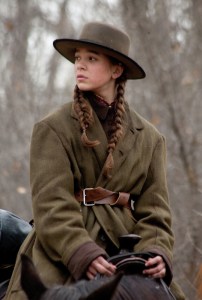
Mattie Ross (Hailee Steinfeld) is just 14 years old when her father is murdered by the coward Tom Chaney. It should not fall to her to avenge his murder, but it does, and Mattie proves more than up to the challenge. Though not particularly skilled with guns or wilderness, she and her quick wit are nonetheless game when both are required as the search for Chaney takes her into Indian land. She hires Rooster Cogburn (Jeff Bridges), supposedly a man of true grit, to get the job done; Rooster is none too pleased to find a little girl as his sidekick, but the money’s too good to turn down. Mattie, however, is the one who ends up disappointed when she quickly learns that Rooster is a slothful drunk. Neither is she pleased when Texas Ranger LaBoeuf (Matt Damon) joins the fray – he’s after Chaney (Josh Brolin) for his own ends, but Mattie insists that he will hang for no other crime but her own father’s murder. It’s a fine point, perhaps a moot one, but to Mattie, it’s the whole point.

3688_truegrit1825 was not a great time to be female. LaBoeuf feels entitled to both kiss and spank Mattie, a 14 year old girl mind you, at his will and against hers. Most other men just discount her completely. But this is a story of true grit, and so it must involve a woman. Joel and Ethan Cohen edge the spotlight over to Mattie, where it belongs, which is what makes this film even stronger than the original. Which is not to say that Rooster and LaBoeuf are lost. Indeed they are not. The Cohens can write like the dickens (or, perhaps, like Dickens), and they’ve found a way to sharpen up a very interesting little triangle. Hailee Steinfeld was 13 when she was cast, but she acts alongside of Damon and Bridges like a gun toting, horse riding champ, and it earned her an Oscar nomination (which she lost, of course – True Grit got 10 nominations and 0 wins, which is what the french call “not right.)

True Grit is gritty, but it’s beautifully made. I love the snappy, tongue-twisting, quotable script, I love Roger Deakins’ gorgeous cinematography, I love the actual wild of the wild west, I love the slapdash feel of the gun fights, I love the sound of beans cooking in their can, I love the gleaming buckles on Matt Damon’s hat and the way he talks after losing his tongue. It feels improbable, and maybe even impossible, that you could take a beloved American classic and actually improve upon it, but credit the Cohens – they have, and they’ve made it look effortless.