What to lead with?
a) The Oscars were boring as hell without a host.
b) Green Book is NOT my best picture.
Although the Oscars did see a modest bump in audience this year, it is not likely to  have converted any of the first-time watchers as the show felt listless and low energy without a host or opening number. Many of the presenters were good – I like the John Mulaney-Awkwafina pairing, and of course Amy Poehler, Maya Rudolph and Tina Fey, though I think the win goes to Melissa McCarthy and Brian Tyree Henry who really went balls-out in paying tribute to costumers (and kudos to the costume designer in charge of her cape who actually got every single one of those bunnies to stand up).
It was a great night for women, and for women of colour in particular. Rachel Carter and Hannah Beachler became the first ever African American women to win in their categories – costume design for Carter and production design for Beachler. They’re the first African American women to win in a non-acting category since 1984, when Irene Cara won for cowriting Flashdance. Both wins come courtesy of juggernaut Black Panther, which may be the actual best picture of 2018, trophy or not. “Marvel may have created the first black superhero, but through costume design, we turned him into an African king,” Carter said in her speech. “It’s been my life’s honor to create costumes. Thank you to the academy. Thank you for honoring African royalty and the empowered way women can look and lead onscreen.” Beachler, meanwhile, paid it forward “I give the strength to all of those who come next, to keep going, to never give up. And when you think it’s impossible, just remember to say this piece of advice I got from a very wise woman: I did my best, and my best is good enough.”
Regina King, Mahershala Ali, and Rami Malek all earned the Oscars they were expected to in the top acting categories. I have trouble calling Ali’s performance a 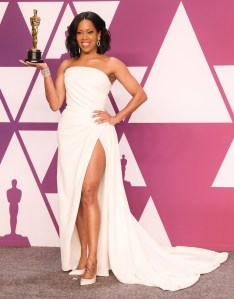 supporting one since he has pretty equal screen time to Viggo, but his award is deserved – not only was it the best and only good thing in an otherwise shitty movie, he ran a very gracious and thoughtful campaign. So did Malek, which is probably what pulled him out ahead of Christian Bale, who probably turned in the more effortful performance as Dick Cheney in Vice but didn’t campaign at all. Olivia Colman pulled out the night’s biggest upset (well, one of them) with her best actress win over the favoured Glenn Close (clearly not The Favourite though, haha, movie puns). Close is great in The Wife, which is not a good movie. Colman is great in The Favourite, which is an exceptional movie. Again, you can’t and shouldn’t really call hers the leading performance above Emma Stone and Rachel Weisz when all 3 ladies get equal screen time, but thanks to wonderful editing, her story line acts as
  the emotional anchor. And oh boy is she emotional! It’s such a forceful, impassioned performance. Truly deserving, even if poor Close has now lost 7 times and won 0 – a dismal track record, and she’s the got the dubious title of most nominated but never winning actor – male or female.
Spike Lee finally won his Oscar, for BlackKklansman‘s best adapted screenplay. A tough category, which makes it exciting. You could have had heaps more in there 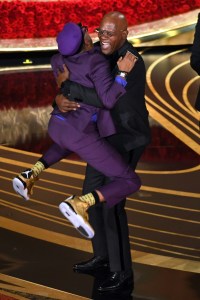 for sure. I think If Beale Street Could Talk and Can You Ever Forgive Me? were just as good (and so different!) but I’m glad Lee won, and super glad that pal Sam Jackson was there to tell him the good news. Their on-stage celebration was one of the highlights of the night. So, by the way, was Barbra Streisand telling the audience the many things she and Spike have in common – including (but not limited to) their love of hats. God bless her!
Alfonso Cuaron won best director, as he should, from great friend and last year’s winner, Guillermo del Toro, who got out of his sick bed to do so. And Cuaron accepted Roma‘s award for best foreign language film on behalf of Mexico. And he won best cinematography, the first DP to win who also directed the movie.  Interestingly, the American Society of Cinematography gave its highest award to Cold War’s Łukasz Żal, but that’s because Cuaron, a director, is not a part of this guild. Cuaron is the first person to be personally nominated for 4 Oscars for a single film (best foreign language is not personal, but awarded to a country), the fourth being for his original screenplay, which he lost in a tragic incident I don’t even want to get into. Anyhow, in presenting the award for cinematography, Tyler Perry noted it was a pleasure to do so “live on
  camera, not during the commercial break. Thank you, Academy.” You may recall that just a few weeks ago, the Academy said it would hand out several awards, including this one, during commercial breaks, but had to rescind its decision due to the wrath of nearly everyone.
It used to be that best director and best picture often went hand in hand, which makes sense. But in the past 10 years, since the Oscars opened up the best picture category to a potential 10 nominees, things changed. Now it uses a “preferential ballot” system, which means the most liked movie wins – but not necessary the most popular, which could explain the now 50%  discrepancy between best picture and best director wins. Members are asked to rank the best picture nominees from best to worst. This year there were 8 nominees, so the accountants made 8 piles and sorted all the ballots according to their #1 choices. If no movie has more than 50% of the votes, and with more than 5 nominees that’s practically impossible, then the smallest pile is removed. Let’s assume that Vice had the smallest pile. Now all the ballots that listed Vice #1 are re-sorted into piles according to who their #2 pick was. You can see why canny members are now voting strategically, and how the movie with the most #1 picks won’t necessarily be the winner. The win could easily go to the movie with the most #2 picks, which is weird, but that’s also how Americans pick their presidents, and we all know how well that turns out. So Green Book is the Donald Trump of best pictures.
Green Book shouldn’t have been nominated. At best, it’s a pretty pedestrian movie. At best. But it’s also a movie about race relations that’s written and directed by white  men. Solely by white men. Which is why so many of the Academy’s old white men felt comfortable voting for it. They could pat themselves on the back for being ‘diverse’ while still rewarding the status quo – for reframing the story of a black man’s experience into the perspective of his white driver. Never mind that director Peter Farrelly has a history of consulting his penis during meetings. And that writer Nick Vallelonga has said some weird Islamophobic shit, agreeing with Trump of all people, tweeting “100% correct. Muslims in Jersey City cheering when towers went down” – and that was still on his time line when he won the Golden Globe this year. Gross.
Meanwhile, Roma is a work of art from start to finish. I’m so proud that a black and white movie, with subtitles, with no stars or recognizable names, about society’s less visible women, is such a huge deal, so gorgeous and relatable. What a win for  Netflix, and for taking chances. And If Beale Street Could Talk is also completely worthy. It’s visual poetry. I was electrified, from the colours to the dialogue’s flow, and the story’s timeliness and timelessness. Perfection. And there are many other terrific movies besides: The Favourite is funny and incisive and beautifully acted; BlackKlansman is galvanizing wizardry; Sorry To Bother You is risky and bold; Blindspotting is culturally significant; Spiderman: Into the Spider Verse is ground breaking; Eighth Grade distills a moment in time, taking us back while pinning us in place with its precise observation; Black Panther elevates the super hero game and asks more of us as an audience and a culture; Can You Ever Forgive Me? is funnier than almost any comedy released this year but the humour comes from a dark and interesting place, a true voice for society’s losers; Leave No Trace is heart breaking in its truth and simplicity; First Man is cold and wonderful and ambitious and intimate; Crazy Rich Asians is visually stunning and a cultural milestone. I’m going to stop there, but you get my point. 2018 was a great year for movies. I was moved, I cried in utter delight, I was horrified and invigorated. I think Green Book is a step back. I wish it didn’t win. But instead of complaining about Green Book, I’m going to keep pushing forward the movies I love, because that’s what’s so great about cinema. You don’t have to like them all, but if you keep watching, you will find something to love.

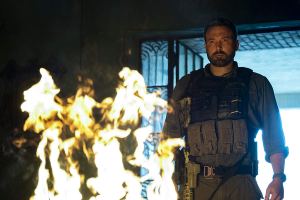 pulled back in. But a lousy real estate market and a newly separated household are drains on his bank account, and the money is highly motivating. Ironhead (Charlie Hunnam) is in it for brotherhood. His little brother Ben (Garrett Hedlund) is in it for adventure. And Catfish (Pedro Pascal) is the much-needed copter pilot rounding out their crew.
 thread, but the truth is, the first half is boring enough that I don’t care about a lost thread because the whole damn sweater is garbage and a waste of good yarn. You know? Like, Sia worked hard on these songs. And the movie is slick looking, with cinematography just dripping its luridness all over the screen. But damn is it pretentious in a deflated, empty kind of way. And then the last 20 minutes or so are just concert footage, just full on Natalie Portman in a spandex body suit not quite nailing her choreography all over a stage full of unconvincing dancers. Was my jaw completely unhinged watching this or did it just feel that way? I can’t be sure. Sean tried to watch this with me, but it wouldn’t play when we rented it initially and he was gone off to work by the time I went back to it, and bully for him. I’m the one who watched it, aghast. This is Natalie Portman’s follow-up to what probably should have been an Oscar-winning performance in
  Joe (Martin Starr) is a programmer who’s probably on the spectrum and self-soothes with obsessively quantifying his every thought and feeling. His wife, Emily (Mae Whitman), is a hotel concierge with theatrical ambitions. They are a loving couple; she supports him, literally lays atop him light a human weighted blanket, and he applauds her every written word.
 course, Jumbo Jr lives with his mother at the circus, where you’d think there’s be a value placed on things that are different and notable, rather than ridicule. But alas. Little Jumbo’s mum gets taken away from him when she rather violently defends him, and poor little Dumbo is basically all alone in the world except for a circus mouse who taps into the elephant’s true potential and helps inspire a flying elephant act that will win over the crowds.
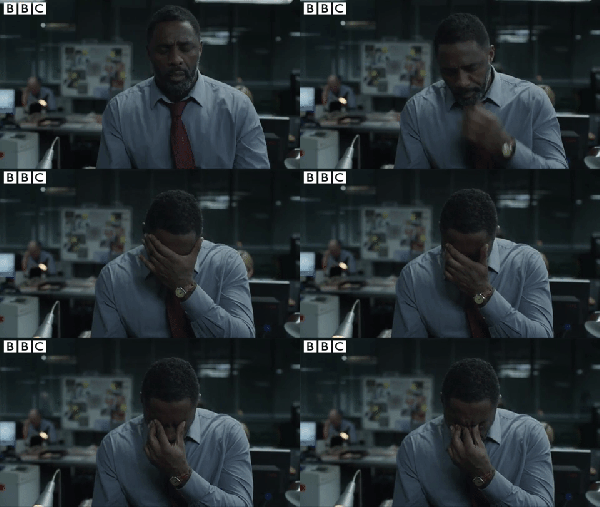 he can listen to crackpots blowing steam out of their ears without losing his mind. Oh, he gets riled up – that’s kind of the point – but it doesn’t make him lose his faith in humanity. I cannot say the same for myself, which is why I avoid indulging in or even acknowledging this stuff in the least. People who are willfully ignorant really get my goat. Sean knows this, and it was not without a gleeful glint in his eye that he proposed watching Behind The Curve, a documentary on Netflix about the flat earth conspiracy.
 general, share a common mistrust for authority. They’re a group of outsiders who find a brotherhood in “believing” this stuff. And I’m still not 100% certain they’re not just having us on. I mean, can they truly believe that the Earth is not a sphere? That Big Globe has been the sinister force behind science and reality for hundreds of years?
 reasonable human being to the murky world of hating science and believing in baloney. And what we uncover are basically just some sad and lonely people looking for connection, and maybe a moment or two in the spotlight. On the fringes of society, there aren’t a lot of options for these people. How fantastic that all it takes is inventing an inflammatory piece of fake news, and building a community around it. That’s all it is – that, and making a few coins from the merch, which seems to double as evidence as far as these people are concerned.
 crackerjacks who put a little too much value into Youtube and not enough into critical thought. It tells us how we contribute to the problem – and I think the message transcends beyond just the conspiracy nutters. I think it’s also a reminder on how to speak to anyone whose views are polarizing to your own. It gives us all something to aim for as we hurtle through space on our beautiful, round planet.
 In it, a straight-laced TV producer, Alison (Katherine Heigl), gets drunk and has sex with an improbable mate, stoner Ben (Seth Rogen), and though that encounter is destined to be a one-night stand, she gets pregnant and it forces them together way beyond what’s reasonable for a couple of opposites.
 Harold Ramis as Rogen’s father, who is a delight for every single moment he’s on screen. Leslie Mann plays Alison’s sister, married with kids, who were played by her real-life kids with writer-director Judd Apatow, Maude and Iris Apatow. Which is crazy because the kids are teeny tiny in this movie, but in 2019, Maude Apatow just went to the Vanity Fair Oscars party with her parents, looking very grown up. And we saw her last year at SXSW at the premiere of her mother’s movie,
  to Charlie but Tanya sees potential, and enlists Danica’s friend and coworker Kalli (Amber Riley) to help shake things up. So now Danica has a tough choice to make: the perfect on paper Charlie who she’s never even met, or the rough around the edges Frank who is kind to her but doesn’t meet all her requirements.
