Author Archives: Jay

West of Sunshine

A deadbeat dad picks up his son to spend the day. Scratch that: the deadbeat dad forgets to pick up the son, gets an irate phone call from his ex, and son reluctantly goes with him with dad finally shows up.

Of course, this day which must now be spent with his young son is also the day on which Jim has promised to pay back a loan shark. Jim has problems with dogs and casinos and gambling all his family’s money away. He’s not a great guy. And now he’s got to watch 35654-west_of_sunshine_1____photo_credit_thom_neal-h_2017Alex while also evading violent criminals. Instead of getting his son to safety, he drags him into all kinds of terrible scenarios which they often escape by the skin of their teeth. The thing about crazy loan sharks is that they don’t really allow for excuses. They don’t make special allowances for a child. It’s pretty clear that Jim doesn’t really rearrange his life for his son either. So that’s awesome.

Things don’t go well, and Jim gets increasingly desperate. Of course, I believed that things still went better than he had any right for them to. I wanted to see this guy crushed. The script seems to believe Jim is undergoing some sort of growth but I was just so steaming mad at the risk he took with his kid, the constant harm he dangled him in front of, I just couldn’t do it. I couldn’t forgive the guy.

Little Alex seems to lean toward forgiveness, and that made me mad too. Mad on behalf of all the single mothers who work so hard to provide a loving and stable life for their kids only to have their deadbeat exes waltz in when it’s convenient for them and fuck shit up. Not all dads are crap, but far too many are. They act like they can also divorce their kids. And the kids will still want to adore their fathers, because he’s dad, and isn’t he awesome? Meanwhile mom gets all the flack. Because life isn’t fair. This movie doesn’t bother to really point any of this out, but it’s my honest reaction to it and I never warmed to the film, or to the dad who never redeemed himself in my eyes. I am slightly endeared by the fact that Jim is played by Damian Hill and Alex is played by his real-life stepson, Ty Perham, a really cute kid with apparently no prior acting experience. I hope they had more fun making the film than I did watching it.

Invisible

Director Pablo Giorgelli has it in for us. His protagonist, Ely, is a marginalized teenaged girl who finds herself pregnant by  the adult, married son of her after-school employer. She’s brilliantly played  by Mora Arenillas, no small accomplishment because much of what is conveyed is done in total silence. Arenillas must constantly reach into her bag of tricks in order to portray the insight and the mental toughness, and the resilence shown by her character.

For his part, Giorgelli sets his gaze upon the social margins of Argentina with a sparse aesthetic that will test your limits. He likes agonizingly long, silent shots in which we contemplate our heroine as she stares out the window of a moving bus [which, by the 35482-invisible__2_way, why do movies always make this seem so peaceful? If you’ve ever rested your forehead on a bus window in real life, you’ll know it feels more like going through the wash with a bunch of rocks, but whatever, don’t mind my grumbling, that’s neither here nor there]. The point is: looooooooong shots with little to no action, little to no dialogue, little to no plot. The whole movie can be summed up as: She’s pregnant. Oh jeez. How to get an abortion in a country where abortion is illegal? It’s only 87 minutes long but it feels more like 87 hours. Case in point: Sean fell dead asleep.

Invisible is a love letter to spartan film making. Although Ely dominates the screen in almost every shot, the things that remain unseen are as significant. We don’t know much about her home life, and glimpses are enigmatic. Her living situation and long commute suggest poverty but Giorgelli doesn’t rub our noses in it. His lens is sympathetic but we get a sense of her loneliness as she faces the biggest decision of her life.

There’s no pointed political criticism to the film but Ely’s exploration of the underground abortion scene is chilling. She is so matter of fact, so responsible, it’s easy to forget that Ely is still a young student. The actress is formidable as she bravely, stoically faces down an impossible situation. But as interesting as I found the topic, I couldn’t forgive the long, boring stretches of just watching her mute in her daily routine. It felt stagnant, bled of life, like a carnival ride that pelts you with boredom.


Little Evil

Little Evil is not an exceptional entry into the genre, but it’s a quirky little horror-comedy hybrid that’s just clever enough. This film is of the ‘possessed child’ variety but the focus is on Gary (Adam Scott), the demon child’s stepdad. Step-parenting is hard, y’all! And it’s slightly harder when your new wife’s kid is the spawn of satan. You really get put through the ringer. And of course his Mom (Evangeline Lilly) is always going to take her darling son’s side – how dare you suggest that he might be, you know – a little evil? He’s an angel! Besides, how much trouble can a 6 year old really get into, even if he is the Antichrist?

99e58ff3fb9373b5bb8760617c7674f23bddd0d1Director Eli Craig clearly has some fondness for the genre, and little odes to other possessed-kid movies pop up from time to time. Another thing that pops up is Craig’s own mother, Sally Field, as a social worker who thinks Gary just isn’t trying hard enough. It’s a small but terrific role for her – possibly the kind of role only her son could ask her to play.

The film’s weakness is that it never fully embraces its own identity. It doesn’t go full goofy, but it can never be full horror. The result is perfectly watchable but a little frustrating knowing what it might otherwise have been. It also sort of neglects little Lucas (Owen Atlas, the titular Evil himself). We don’t know him well enough to judge whether he truly wants to bury people alive, or whether he’s just not fond of Mom’s string of boyfriends. Our early impression is that he likes to dress like he’s in ACDC and he’s mostly silent, only talking through a creepy goat hand puppet. He’s only just turned 6, still small enough for us to feel naturally protective over, so if you want me to contemplate stabbing him through his unholy heart, you’d better give me good reason and some to spare.

All in, this is a fairly throwaway movie. The beats are familiar, it’s just that Gary’s merry band of misfits consists of a step-dad support group. There are some laughs to be had here, and if you’re a fan of horror, it’s fun to play Where’s Waldo with the references. This is Netflix original content, and it’s streaming there right now.

The Leisure Seeker

This movie is about a couple of charming runaways on the lam. They haven’t committed any crimes but they’re keen to evade the responsibilities that weigh on them at home. We’ve seen lots of movies about people on the open road, but we’ve rarely seen a man beleaguered by Alzheimer’s helming a large winnebago while his cancer-stricken wife navigates and their adult children are panicking at home.

Ella (Helen Mirren) should be in the hospital receiving treatment, but instead she’s choosing this one last hurrah before Alzheimer’s has her husband John (Donald Sutherland) completely within its clutches. The Leisure Seeker is the name of their the-leisure-seekerbeloved RV, and this road trip is designed to trigger memories of happier times – their young family at play, their former selves in love. It’s obvious that the ‘in love’ part has never really faded for Ella and John, and maybe this is why it’s so hard for her to cope when he can’t remember who she is.

The pair hit the interstate armed with pecan logs, slides of old photos, and yes, a gun. This film is a moving eulogy to all the things that are slipping away – not just for John and Ella personally, but also perhaps on a more national scale (like a sense of community for one – though attempts to be any more political feel out of place). But as John’s moments of lucidity grow shorter and Ella’s anguish grows deeper. The Leisure Seeker is pointed toward Florida but we can’t deny what they’re truly headed for.

Mirren and Sutherland make the movie of course – the camera rarely strays from this couple so strongly bonded they can’t even bear to sleep in separate beds. Sutherland spins the dial on the many shades of dementia, his face quietly registering all of them. Mirren wears a cheerful mask but Ella’s pain and smouldering anger never disappear completely. This Brit and her Canadian costar make watching this American road trip movie worth while – even if their Italian director doesn’t quite get it right. The acting, however, is everything, and the casting is spot-on even if Mirren is inconsistent with her southern accent. Just as we’re meeting them, they’re getting ready to say their goodbyes. This is a bittersweet journey, and you’re welcome to tag along. You can leave your gun at home, but do pack some tissues.

Three Billboards Outside Ebbing, Missouri

Holy hell.

Writer-director Martin McDonagh has almost certainly reached the peak of his film making career with this film. It doesn’t get much better than this.

The three billboards in question have been rented by grieving mother Mildred Hayes (Frances McDormand) to accuse the town sheriff, Chief Willoughby (Woody Harrelson) of not having made any progress on the case since her daughter was brutally raped and murdered. Willoughby isn’t terribly pleased, but he’s got more important things to worry about – namely, terminal cancer. So it’s his racist, hotheaded, cruel officer Dixon (Sam Rockwell) who takes up his cause, torturing anyone he suspects of having helped.

MV5BZmMyMTg1NzEtNWZiZi00OTczLTg0NzUtNzFlNjI5YjJkMzkxXkEyXkFqcGdeQXVyNDg2MjUxNjM@._V1_SY1000_SX1500_AL_McDonagh uses lyrical language peppered with inspired cursewords; his heavy-weight cast punches it up with a surprising mixture of gravitas and black comedy.

Frances McDormand, national treasure, is of course fantastico. Wearing her ubiquitous coverall, she’s a no-nonsense woman who’s been through hell even before her daughter’s gruesome death. She is not without a softer side, though rarely seen. McDonagh gave her a couple of speeches that practically earned standing ovations at our screening. She walks a thin line between vengeance and justice but discovers she is not exempt herself. She’s got a terrific scene pitted against Willoughby that suggests these two have more history than we’re privy to. It’s a small town; there’s almost no vitriol without at least a measure of respect. As Willoughby, Harrelson once again reminds us he’s capable of almost anything. But, arguably, the man to watch is Sam Rockwell. He’s hateful, detestable, and yet we don’t quite hate him or detest him as we should. That’s sort of the miracle of McDonagh’s script – all of his characters are deeply flawed. Mildred is our protagonist but she’s no one’s hero. She makes too many mistakes. Dixon is all mistakes but for a small sliver of charm, and Rockwell exploits the hell out of it. He’s almost maniacal at times, and loads of fun to watch. Any time any of these power houses square off verbally, they’re shooting spitfire, and it’s even more entertaining to watch than a good old fashioned shoot out. And that’s not even mentioning a very capable stable of secondary characters that add dimensionality to the population of this small, insular town.

McDonagh’s world is not one of easy outs. It feels like he has asked himself – what would be most surprising here – and yet, despite a plot that constantly feels like it’s developing from the left field, it feels right.

I fully expect to see McDormand’s name on the Oscar ballot this year, in a race for Best Actress that’s already crowded (she’s the third name I’ve tossed out this festival alone). But Rockwell’s belongs there too – this is what Best Supporting aspires to be. Although conventionally shot, this is an extraordinary film, one I hope you’ll see and love when it comes out this November.

Our Souls At Night

Actor-comedian Patton Oswalt lost his wife suddenly in April 2016. He was very vocal in his grief following her death so it took people by surprise when he announced his engagement barely a year later. Some were critical. I, however, wish him nothing but the best, and I’d wish the same for Sean if he were ever in the same spot. I know a little about love and grief, and how they are not mutually exclusive. I’d also never want Sean to feel lonely.

That’s how Louis (Robert Redford) and Addie (Jane Fonda) are feeling when we first meet them – lonely. Both of their spouses are long dead and they’ve each been leading pretty Fondasolitary existences up until Addie gets up the courage to ring Louis’s doorbell and invites herself in for a chat and a little proposal. Why not sleep together, she suggests. No, not sex. Sex doesn’t interest her. But the nights are long. Very long. Couldn’t they come to some arrangement? After thinking on it, he agrees, so off he goes in his best blue plaid shirt, to have a platonic sleepover with a neighbour he’s lived alongside for decades but never really known.
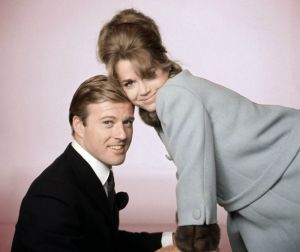
I’m often critical about movies starring senior citizens. So many feel demeaning, unworthy of their subjects, but I must admit, this new one from Netflix feels invigorating and authentic. Addie clearly has agency. They both have plenty to offer. Of course they’re not immune to aging but they’re also not done living, and that was fantastic to see on the big screen.

Jane Fonda and Robert Redford both accepted Lifetime Achievement awards here at the our-souls-at-night'-will-reunite-'barefoot-in-the-park'-stars-robert-redford-and-jane-fondaVenice Film Festival, in a ceremony preceding the screening of their new film. They’ve co-starred in movies before: The Chase (1966), Barefoot in the Park (1967), and The Electric Horseman (1979); this is their first in 38 years. To mark the occasion, Fonda said “It was fun to kiss him in my 20s and then to kiss him again in my almost-80s.” I have to say, it was fun for the audience, too. Yes, it’s great to see mature faces getting meaty roles, but you’re also getting a masterclass in acting. These two make it look easy. Their chemistry feels effortless.

nintchdbpict000349666861Of course, if you’re looking for classic, cheesy romance, this isn’t it. Louis and Addie are too wise for that. They have responsibilities, baggage, obligations. Kent Haruf, who wrote the novel upon which this film is based, knew a little about that. He wrote his book under a death sentence: he was 71, and he finished it just months before he died of lung cancer. The novel was published posthumously, so Louis and Addie are his legacy. Fonda and Redford would have made him proud.

This is an excellent movie from Netflix that will be available for streaming later this month.

Suburbicon

Sean and I are in Venice for the Venice Film Festival. Last week we saw and loved Guillermo Del Toro’s The Shape of Water, which had us appreciating not only the lushness of the period (circa 1962, I believe), but also Del Toro’s refusal to completely excuse it. The 1950s are often given the nostalgia treatment in movies, coated in a thick gloss of fond memories with a healthy dose of forgetting the grim realities. This is a time period that inspires idiots to spout slogans like Make America Great Again, because that time period was actually quite bad for quite a lot of people. Del Toro’s film included some subtle nods to that fact, but Suburbicon is the movie that blows the lid right off it.

Suburbicon is the name of a town founded on the principles of an idyllic setting with all the conveniences of the city but none of the sordidness. The sprawling neighbourhoods MV5BMjExMjE5MDE4NV5BMl5BanBnXkFtZTgwMzU0NTEwMzI@._V1_SY1000_CR0,0,1449,1000_AL_are safe, the schools are good, it’s a great place to raise a family. Except if you’re the Meyerses, who just moved in. They’re not welcome (being black and all). They’re apparently the very people all these “nice” white folk have moved away from the cities to avoid. The Meyers don’t do a darn thing to incur the slightest ill will, except have a darker skin tone, but still the wrath of the townspeople is rained down upon them. Determined to force them out, their white neighbours harass them and abuse them and generally make such a ruckus that no one notices the neighbours directly behind them.
In that house, Gardner (Matt Damon), his wife (Julianne Moore), his wife’s sister (also Julianne Moore), and his young son Nicky are being held hostage in a bizarre home invasion that leaves one dead and the whole family shattered. It’s just the beginning of a bloody series of events that get more and more lurid. It’s so suspicious that an investigator (Oscar Isaac) shows up at their door. But everyone else is so busy with their unrequited race war that no attention is being paid to the white family wreaking havoc.

It’s exactly the kind of satire-caper at which the Coen brothers excel. Incompetent criminals seem to be their specialty. Frequent collaborator George Clooney joins not only as a co-writer but as the director. He’s added a layer of social consciousness with deep, resonating roots. Suburbicon is slick and it entertains you to within an inch of your life. The cast is wonderful, and Clooney, being an actor’s director, elicits a startling performance out of Matt Damon, and a sterling one out of young Noah Jupe. This black comedy earned a lot of laughs at our screening – seemingly the darker things got, the more we laughed out of anxiety and relief. But this is a brutal story that rewards people justly for their crimes. At first it may seem like we’re flipping between two different movies – the obvious and the absurd – but upon reflection, I like what Clooney’s done with the juxtaposition.

Suburbicon is a little wild, a little uneven, but a whole lot of fun. It’ll be hitting theatres late October.

The Hippopotamus

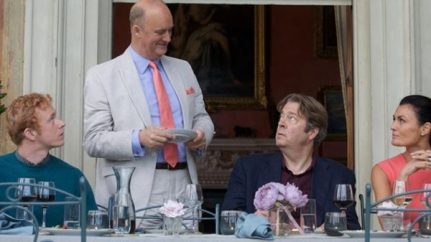
Based on Stephen Fry’s raucous novel, The Hippopotamus is about a drunken poet who hasn’t actually written a poem in decades. Spectacularly fired from his more recent newspaper job, Ted Wallace (Roger Allam) is hired by his ex-girlfriend’s daughter Jane to investigate a mystery.

Wrangling an invitation from his godson David (Tommy Knight) to Swafford Hall, Ted’s off to the English countryside to look into a strong of recent…miracles? Jane was on her 1227022_The-Hippopotamus-600x337.jpgdeathbed with cancer when she first went out to Swafford to convalesce in a peaceful setting. Instead, she experienced a miraculous recovery, her health and strength returning until she seemed to be in complete remission. She’s not the only one talking about these spiritual healings, so in addition to Ted, Swafford is welcoming all kinds of guests who are sneakily looking for their own miracles.

Turns out that it’s David who’s responsible for the “laying on of hands”, only he’s not just using his hands. The, erm, colourful assemblage of guests are pretty desperate and ready to swallow just about anything, so the whole household’s a twitter with whatever’s going on. Ted, ever the skeptic, is determined to get to the bottom of it. He’s sure it’s a hoax, but we’re sure he’s a drunk, bumbling fool, so who’s right?

Dubbed a “comedy of manners” it does have a distinctly English feel to it. I usually adore British comedies but I didn’t have the patience for this one. Sure there are some great zingers but it’s really kind of a mess and all the characters besides Ted are cardboard cutouts, which means tonnes of voice-over explanation is required, and that gets quite tedious. This film lacks energy and this viewer was left bored.

The Shape of Water

What did we ever do to deserve Guillermo Del Toro? The man is willing to crack his head open and allow his most beautiful dreams to spill out, onto the big screen, for our viewing pleasure. The Shape of Water, a delicious period piece with fantasy elements, is just about as sumptuous and satisfying as it gets at the movies.

Sally Hawkins, an inspiring casting choice, plays Eliza, a mute woman working as a cleaner at a top secret government facility. She and her cleaning partner Zelda (Octavia Spencer in a role she was born to play, because between Hidden Figures and The Help, MV5BZDU0NmU1NDUtNjMyNi00YTMyLTgwNWUtNTVmMzQ3NzJjNTJmXkEyXkFqcGdeQXVyNTk1MzcwNTI@._V1_she already has) stumble upon agent Strickland’s (Michael Shannon) latest capture, a humanoid sea creature reportedly worshiped as a god by the Amazonians. Set against the Cold War era, the Americans hope this scaly curiosity will give them a leg up against the Ruskies are and prepared to torture the secrets out of their prisoner – and worse. But sweet Eliza spots the creature’s humanity and her kind heart urges her to save him. She enlists a scientist at the facility (Michael Stuhlbarg) and her neighbour Giles (Richard Jenkins) in her daring escape plan, but Strickland isn’t going to let this career-defining prize slip through his rotting fingers.
The Shape of Water is poetic and beautifully stylized. I fell in love during the opening shot, an ethereal scene that establishes the fairy-tale quality of the story. The whole film is richly textured; it feels like a story book you’ll want to step inside. Full credit to production design and art direction for creating a living, breathing piece of art that feels grounded in reality but often has this other-wordly, heightened reality feel to it that you just don’t find in your average film. The script, a Guillermo-Vanessa Taylor hybrid, is a phenom. It so smartly sets up all that is to come with careful, quiet nods. This is a movie with many small pleasures, many delights to savour. Because our heroine is non-speaking, the score plays a major role, and composer Alexandre Desplat is more than equal to the task. Del Toro weaves magic into threads of monster movie – love story – musical – spy thriller – comedy. I’m not sure which of these is more surprising, but all are very welcome. You may hear from others that this is Del Toro’s best since Pan’s Labyrinth, but they’re lying. I believe this is his best, full stop.

The Shape of Water wouldn’t be nearly so special without Sally Hawkins’ grace and measured precision. She’s wonderful, full of light, communicating much with little. Eliza is a woman of small parameters. Her life is ordered and banal. She’s suffering in her loneliness when she meets her merman, and her outsider status allows her to view him not as a monster but as a kindred spirit. Richard Jenkins meanwhile is restrained as the starving artist next door. Michael Shannon is anything but as the man who gets the job done at any cost – unless his vanity gets in the way. He’s awfully fond of the trappings of success. You might be starting to get an idea of what makes this script so lush: all the characters are brought fully to life. This is the clown car of movies, a film filled to the gills with interesting ideas and perfect little moments and scene-stealing details.

You don’t just watch a movie like The Shape of Water, you feel it, you experience it. We saw its world premiere at the Venice Film Festival this week but it’s coming to a cinema near you this December, and you won’t want to miss it. Hawkins’s name will be on the Oscar ballot and I’m guessing Del Toro’s will be too – maybe even twice.

Downsizing

downsizingThe world is overpopulated and in the very near future it will become untenably crowded: fact. We don’t have enough space to comfortably house all these people, we don’t have the ecosystem to support them, or enough resources to fund the lifestyles to which we have become accustomed. The rate at which these 7 + billion people consume means we are making waste and pollution like there’s no tomorrow – and if we continue doing so, there won’t be.

Luckily for fictional Matt Damon, a Norwegian scientist will come up with a revolutionary bit of science that’s going to sound nutty at first, but hear me out. He calls it downsizing. A medical procedure will taking a willing human being and shrink him down, to about 5 inches. These small people will live in small towns – dollhouses, practically, taking up little space, generating little waste. A typical person might liquidate all his assets, pay off all his debts, and find that the $150 000 he’s left with is equivalent to about $12 million in the small world. Live like a millionaire by becoming a fraction of your former self!

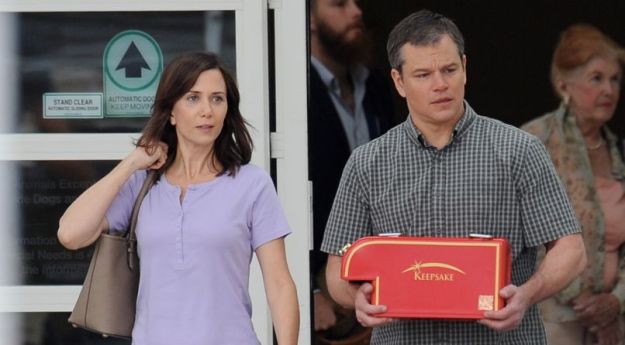
Occupational therapist Paul (Matt Damon) and his wife Audrey (Kristen Wiig) are the kind of people to whom this kind of deal appeals. They work but never seem to get ahead. Sure this downsizing is billed as a way to save the earth, but it’s also a way to personally wipe the slate clean, and live the life you could only dream of as a normally-sized person.

As you can imagine, being only 5 inches tall comes with perks, but also some drawbacks. As writer-director Alexander Payne imagines it, there are social and economic impacts to all these people retiring from “normal” society. Illegal immigration and terrorism are facilitated. Downsizing can be used as punishment, against someone’s will. And even if you’re one of those people living in luxury, you’re suddenly vulnerable to insects, birds, even high winds.

Downsizing is a well-timed satire, science-fiction that manages not to feel too fictiony. Credit Payne’s wit for packing as much detail as he does, and if sci-fi feels a little outside the wheelhouse of the guy who did Sideways and Nebraska, he actually manages it with a lot of humour and humanity. Though the film is at times unabashedly absurdist, it stays away from easy sight gags. This is a thinking film that abounds with ideas – you’ll need to digest afterward. It’s an indictment of the American dream, people so disenfranchised that they’re willing to undergo a risky procedure just to find fulfillment. But miniaturization isn’t really the answer it’s cracked up to be, with people’s problems seeming shrinking down to follow them.

Matt Damon is perfectly cast as a nice guy who’s just a bit of a loser. But for Sean, it was Christoph Waltz as his playboy neighbour who really stole the show. He plays a Serbian sleazeball who figures that what the small community needs is a small black market, and he’s there to profit. I, on the other hand, was blown away by Hong Chau as his cleaner, Gong Jiang, a one-legged Vietnamese dissident who shows Paul there’s more to life than just keeping up with the Jason Sudeikises (he’s the classmate at his high school reunion who inspired Paul to go for the Big Shrink). When Oscar season starts heating up, I hope her name is mentioned.

Downsizing is a unique film with a lot of style. Despite being the opening night film here at the Venice Film Festival, it likely won’t be a best-picture contender for me, but it’s a film full of ideas that I found immensely enjoyable.