Author Archives: Jay

The Breadwinner

Not all men are bad, not even all Afghan men. That’s important to remember. Not all of them want to treat women like garbage, but the taliban sure does. It’s not enough to cover women head to toe in burqas, but new rules in Afghanistan prohibit them from leaving the house at all, except in rare cases when accompanied by a father, husband, or brother.

Parvana’s older sister hasn’t left the house in so long she’s forgetting what it was like. Parvana is “lucky” because her father lost his leg in the war and his livelihood more recently, so she assists him down to the market where they try to sell their possessions in order to eat. Her father respects his daughters, educated them, and wants better things for them, things he can no longer give them with the oppressive taliban regime patrolling with guns and indignation. When the taliban inevitably hauls him off to prison for no reason, suddenly the family is left without an escape clause. Parvana’s mother andMV5BMDg0ODM5NTYtMjNkMS00NDQ3LWI5MGYtMDg3ZTQ5MDE0OTRlL2ltYWdlXkEyXkFqcGdeQXVyMjQ1NjA0ODM@._V1_ sister and baby brother could literally starve to death waiting for a man to come release them from their own home so Parvana does the only thing she can think of to save them: she cuts off her hair, wears the clothes of her dead brother, and to taliban eyes, becomes a boy.
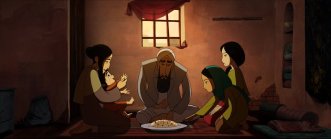
You may recognize The Breadwinner as a recent high-profile screening at TIFF; Angelina Jolie is a producer and her red carpet appearance really shined the spotlight on this important film. People were equally excited to celebrate it at the Ottawa International Animation Festival. It played to a packed house and I imagine it will again on Saturday so if you haven’t got your tickets, get on it!

The Breadwinner’s animation is stunning.  Stunning. Like, I want to get tattoos of it on my body. That’s really the highest praise you can give, or that I can give, an animated movie, a compliment I haven’t given before or even thought to. The story is kind of perfection. It’s by no means an exact replica of the book. It diverges significantly from it but still feels like an authentic and spiritual distillation of it.

If The Breadwinner isn’t talked about come Oscar time, I’ll be shocked and outraged. Not taliban guy seeing a woman “calling attention to herself” by merely being outdoors outraged, but outraged. It’s a great story coupled with the most amazing animation but it also could not be more essential viewing at this moment in time.
Lu Over the Wall

Greetings from the Ottawa International Animation Festival, which we’re always proud to cover because not only is it our hometown festival, it’s also a really great one – terrific movies, great venues, well-organized by staff and volunteers. It makes an Asshole proud!

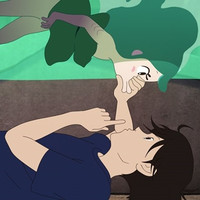
Our first stop at the festival was to the good old Bytowne, where all the best indie films get shown year-round. Lu Over the Wall is a Japanese film by director Masaaki Yuasa, and I have to say, I was pleasantly surprised by it.

The film is about Kai, a surly middle schooler who seems isolated from his peers until it 48a6ae418cf7ea14caa9daee89cfc4381491527985_largeis discovered that he makes really interesting beats with his computer, and he gets recruited into a band by Yuuho and Kuniko. The band practices on a deserted island away from the mainland so that Kuniko’s family won’t discover his dirty little secret (he’s destined to be a temple keeper, not a rock star). But out there they stir up the myth that has shrouded their town for decades: that of merpeople.
Turns out, merpeople are attracted to music, and that’s exactly what prompts Lu, a very cute little mermaid, to leave the water to sing and dance with them. Everyone else is terrified of merpeople, who, legend has it, eat people, among other atrocities, but Kai can relate to Lu and so they become friends. It’s a tricky relationship to navigate when half the townspeople want the merfolk dead and gone, and the other half hope to exploit them for money.

No, this isn’t an animated take on The Shape of Water, though it’s beginning to sound like it. But it is a story about looking beyond our preconceptions, a story made all the more palatable by its incredibly sweet animation. When it’s meant to, the joy practically leaps right off the screen. You’ll feel your heart tug upward. Lu’s happiness is infectious. I mean, what kind of a person isn’t completely bowled over by mermaids? Like, how black is your soul? And Lu is so bright and bubbly she makes Ariel seem like a puddle of puke. Lu Over the Wall is giddy, upbeat, and as you might have guessed, has a soundtrack bursting with J-pop. I love how the movie evokes emotion by changing up its animation style and if for some reason your inner darkness has been able to resist up until now, I’ll leave you with just one word, the only word this review really needs: mer-doggies.

TIFF: Lady Bird

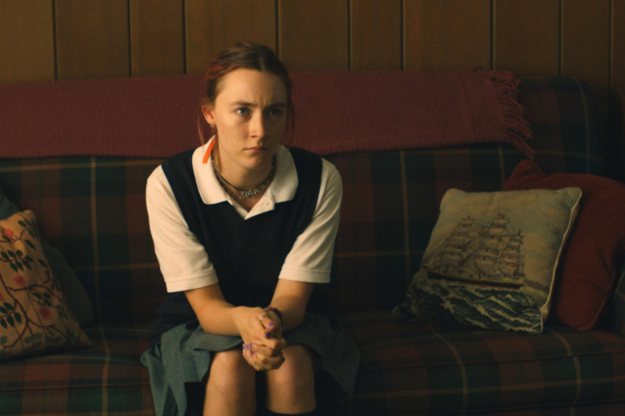
ladybird_01In making a coming of age film about a high school student, Greta Gerwig has come into her own – as a writer, as a director, as a woman with a voice.

Lady Bird is the name that Christine (Saoirse Ronan) has given herself. It’s her senior year of high school and all she wants is out. Out of Sacramento, out of her parents’ house, out of her own skin which doesn’t quite seem to fit anymore. Like most teenagers, Lady Bird is kind of a d-bag. She thinks she knows more than any adult she’s ever met. She’s self-centered and blind to the needs of others, but in the sympathetic hands of Ronan, we don’t hate her and we certainly never tire of her. Her flaws should push us away but instead they endear us – maybe even remind us of ourselves at that age.

Her relationship with her mother (Laurie Metcalf) is relatable as heck and among the best I’ve ever seen written or performed on the big screen. Their relationship is a series of clashes between pragmatism and whimsy. Lady Bird doggedly indulges one artistic pursuit after another while her mother does the precarious high-wire act of balancing the needs of an entire family. Ronan and Metcalf are incredible together, the chemistry is electric and complicated and feels so real you’ll intermittently want to send your mother a fruit bouquet of thanks, and a nasty hate letter condemning her every decision. Or was that just me?

But the real kicker is that Lady Bird is not just a mother-daughter movie. Lady Bird’s life is full of characters and it’s amazing how fully realized they all are. We spend time with her father, her brother, her best friend, and several love interests, and Gerwig’s fabulous writing doesn’t lose sight of a single one of them. And her cast – her cast! Have I said yet that Saoirse Ronan is a vision and she brings so much to the role and this is truly the best I’ve ever seen her? Fun fact: she and Greta first met at TIFF two years ago, and Gerwig couldn’t imagine the role going to anyone else. And even though the writing is so, so good, and the character is absolute perfection on the page, Ronan just makes it even better. Even wonderfuller.

And Metcalf. This is such a great role and she really makes it her own: loving, frustrated, conflicted, supportive, scathing. Goddamn. She plays opposite Tracy Letts, who plays her husband and Lady Bird’s dad. He’s the good cop parent but not without his own challenges – believe me, the script does not neglect him. Lois Smith, Timothee Chalamet, and Lucas Hedges all help bring Lady Bird’s world into bold, bright, living colour while also contributing a little of their own. I’m telling you, this has got to be a contender for best script. The layers are many and I have never wanted to peel anything faster in my life! For my money, though, the lovely, luminous Beanie Feldstein has got to be the breakout star here. She plays Lady Bird’s BFF Julie. Don’t mistake her for a second banana. She may have shades of wallflower but she never gives you a second to discount her.

Lady Bird is absolutely one to watch, so do.

TIFF: The Wife

I chose this movie because it’s based on a novel of the same name by a fantastic writer, Meg Wolitzer. I read it several years ago but I can confidently tell you it was an interesting and provocative read. Why then, did I feel the movie was kind of a bore?

It’s about a woman, Joan (Glenn Close), who is thinking maybe she’s had enough of her husband Joe (Jonathan Pryce) just as he’s about to win a Nobel prize for literature. She’s supported him and his career for years but being the supportive wife is just not a role she’s comfortable with anymore. It’s kind of bad timing, especially since they’re being trailed by a hungry writer (Christian Slater) gunning for juicy details for his unauthorized biography.

They say that behind every great man is a great woman. Being a woman, I absolutely MV5BY2E1ZDU1ZDEtNzRkMi00M2U1LWIzZTItZWU0YmFiYWQ5MDMzL2ltYWdlXkEyXkFqcGdeQXVyNTA0OTQ3NDY@._V1_loathe that sick expression, but you know who hates it even more? Joan. And you’re about to find out why. I won’t give anything away, but I think the “reveal’ (which is a bad word for what it actually is, but let’s just say there’s information being withheld) comes too late – it would be a way more interesting story if this little tidbit was part of the journey. What we do know is that she literally runs his life: she checks his beard for crumbs and sets his watch for pill time and does nose hair checks because she’s a goddamn boss and he doesn’t deserve her.

The truth is, this whole thing is a very weak. The story is so diluted that it lost all interest to me. Sean felt a smidge more positively about it, perhaps because he wasn’t comparing it to the book. The acting is good, very good actually, Glenn Close is a queen, which really just made me all the sorrier that this film couldn’t step up and be the thing she deserves.

I imagined that The Wife is perhaps a bit of a TIFF bookend, with Battle of Sexes being the other end. Bille Jean King is reminding people just how different it was for women when she was playing tennis. At the time (1973ish), women still couldn’t have their own credit cards – the applications needed a male signatory. In The Wife, too, women are being held back. Joan should have had her own career as a writer, if only editors, publishers, and critics weren’t all male. She was stifled, and that’s how she became merely The Wife.

The LEGO Ninjago Movie

Sean has a video game called LEGO Dimensions. You buy character packs, build them out of LEGO, and then you can play them in the game. The character packs come in all sorts of cool recognizable shapes and sizes: Sean has the Simpsons, and Back to the Future, and Ghostbusters, for example. He builds a Marty McFly, and a Delorean, and then he can go through the plot of the movie using those characters. It’s pretty cool. But as a completionist, he’s also bought character packs that we have no experience with at all, like Harry Potter, Adventure Time, Portal 2, and Ninjago. And while we knew that Harry Potter were popular books, and a franchise of films, we didn’t know Ninjago at all. In fact, we didn’t even know how to pronounce it correctly until Sean called it Ninja-go in front of his 4 year old nephew, who looked at him like he was a complete sack of shit. It’s pronounced Nin-jaw-go, for your information. And apparently it’s a TV show used to sell LEGO sets. But whereas Bill Murray was a real flesh and blood person rendered into a cartoon version of a LEGO mini figure, the Ninjagos were always LEGO. LEGO has sold over 100 different sets of LEGOs based on that show, so you can see how it’s a big money maker for them. The movie is a cog in their money making machine.

AmazeThe gist of the movie: Garmadon (Justin Theroux) is the bad guy threatening the world of Ninjago. But every time he tries to invade it for good, he’s thwarted by a band of teenage ninjas trained by his brother, Master Wu (Jackie Chan) and led by the son he abandoned 16 years ago, Lloyd (Dave Franco) though none bear any familial resemblance. Being the son of a noted bad guy is hard, and so is being the vaguely named “green ninja” in a crew of ninjas otherwise named for the elements – Cole\Earth (Fred Armisen), Jay\Lightning (Kumail Nanjiani), Kai\Fire (Michael Pena), Zane\Ice (Zach Woods), and Nya\Water (Abbi Jacobson). They get to ride around in really cool LEGO robots that can shoot things and fly, and I can totally see the toy appeal. Lloyd’s robot vehicle is a dragon that shoots missiles from every body part imaginable – what kid could resist? But the genius is that that they all have something different, so the potential for you to spend money is almost limitless.

Anyway, when Garmadon makes his most successful bid to capture the city (and a monster threatens to destroy it), Lloyd will have to learn now to harness his vague ninja powers, pull his team together, and also bond a little with his bad guy dad.

Yes, it’s all a big ploy to get into your wallet. But like the other LEGO movies that came before it, it’s also shamelessly fun. But this one is the weakest of the three, in part because it only appeals to the kids who know and watch the show. The other two movies preyed on adult nostalgia and reminded them of the toys they played with as kids. The only thing this movie might remind you of is the sharp little buggers that get lost in your carpet and hurt like hell when you step on them at night on your way to the bathroom. LEGO knows what it’s doing: the butt joke ratio is extremely high, and the kids laugh every damn time. So go ahead and take them to it, as long as you understand that it’s likely to cost you more than just the movie tickets.

Loving Vincent

Loving Vincent lives up to its name: a team of over 100 artists hand-painted each and every frame in this beautiful animated film. What better way to pay tribute to one of the most iconic artists the world has ever known?

The film takes place a year after Van Gogh shot himself and died of the wounds. In life, Van Gogh had painted a portrait of his post master. After his death, a letter of his, perhaps the last he’d ever MV5BNzFhNTMyYTYtYjBkNC00MTIwLWJhMDktZGI0NWZiNWIxYjYzXkEyXkFqcGdeQXVyNjg4MjE2MzU@._V1_SY1000_CR0,0,1383,1000_AL_written, was returned, so the post master sends his son to deliver it. The post master is fully aware of the special relationship between Vincent and his brother, Theo, and is adamant the letter be placed in his hands, or in the hands of the doctor who cared for him in the last months of his life.

The young man’s special delivery unearths the events that led up to Vincent’s death. His suicide seems to have caught most who knew him off guard – he’d seemed particularly well right before it happened. The story unfolds in beautiful images done in Vincent’s own familiar, fanciful style – over 65 000 oil paintings were made for the film over seven years. That’s quite an act of love, and the first of its kind.

The movie is augmented with excellent voice work by Saoirse Ronan, Douglas Booth, Aidan Turner, Chris O’Dowd and more. The neat thing is the artists have incorporated their likenesses into the film without losing the authenticity of the characters who peppered Van Gogh’s life. The actors actually were filmed playing their parts, and all of this informed the artistic process. This is a really lovely film that treats its subject reverently, with the same sensitivity embodied by the man himself. There was so much more to him than what history remembers, and this movie restores some of what’s owed to his legacy.


Buster’s Mal Heart

Buster is a mountain man on the run from authorities. He survives the cold winters by breaking into vacation homes and living off the spoils. He’s pursued by the police but also by flashbacks to his prior, family-man life, and by persistent daydreams of being adrift at sea. He calls radio shows to warn others about the impending “Inversion”.

The film, which eschews conventional story-telling, seems to have three distinct time lines, if I may call them that. 1. Buster (Rami Malek) as an overworked father and husband. He works as the night manager at a creepy hotel and the shift work is killing him. He lives with his in-laws, which might be killing him too, come to think of it. At the MV5BMzgzNjFhMmUtZDNmYy00N2M2LThiMzMtYjkwMjA4NjlkZjIwXkEyXkFqcGdeQXVyNjUxMjc1OTM@._V1_SX1777_CR0,0,1777,735_AL_hotel he encounters a drifter (DJ Qualls) begging for a room for the night, and this encounter will change the course of Buster’s life forever. 2. With matted hair and a dirty beard, Buster’s mind appears to be cracked. He lives off grid, barely surviving, almost no semblance to his former self. 3. He is half-starved, lost at sea in a small rowboat, sending letters in bottles overboard. We don’t know how long this has gone on for.

How many, if any, of these time lines is real? Are they manifestations of his wormhole conspiracy theory, or the product of a mind broken with grief and guilt, or just the insomniac’s daymares? That’s for you to figure out, without much help from director Sarah Adina Smith, who is perfectly comfortable with an audience full of head-scratchers and what-the-fuckers. In fact, she’s going to throw in a whole bunch of biblical allusions just to fuck with you some more.

One thing’s for sure: Rami Malek is ready to be a leading man. His minimalist style still conveys mental instability and eccentricity across all timelines. He contributes to the film maker’s ruse by making each version of Buster equally believe and unbelievable. All three feel authentic but all three cannot be. He gives away nothing. And in the end, if you’re going to enjoy this movie at all, you’ll have to be comfortable with that, with not getting any answers. By having bold questions shoved in your face and living with just discarding them. Is any version of Buster a real person, or are they all just metaphors for disillusionment? Or am I, the viewer, the one who’s disillusioned?


The Dinner

As a book, I very much enjoyed The Dinner. It’s fascinating and controversial but hard to talk about without giving everything away. Same goes for the movie I suppose, but the most important takeaway is that the movie is very, very bad. Read the book. It’s a gut punch page-turner. The movie fucks it all up.

First, the book is Dutch. The movie of course makes the characters and setting American (even though half its stars are Brits). It’s about two couples who meet at a very fancy schmancy restaurant to discuss their problematic children. Paul (Steve Coogan) is a history teacher with some mental health problems; his wife Claire (Laura Linney) is a cancer survivor. It’s hard to say who is more protective of whom. Paul’s older brother hero_Dinner-2017Stan (Richard Gere) is a politician poised to become an even more powerful politician, as evidenced by the aides who can’t quite allow him a moment of peace or privacy during the dinner (not that he objects); his wife, aka, his second wife, Katelyn (Rebecca Hall) raises his kids so that he can govern unencumbered and expects to be rewarded. Their sons have recently been involved in a crime that is making its way around Youtube. They are thus far unidentified but now the parents must decide how to handle things should they found out – or should they remain undiscovered.

The dinner is filled with tension, not just because of what their boys have done, but because of the strained family dynamic between Paul and Stan. And because Paul is uncomfortable with all the pomp and circumstance surrounding the haute cuisine. The dinner is constantly interrupted by flashbacks, many of which actually detract from the story. The book is really about morality and the thin veneers we hide behind in “civilized” society, and the tension ratchets up as more and more secrets explode like bombs dropped among the gold-rimmed china. The movie doesn’t manage to retain much of what makes the novel great. The characters are repugnant because they’re stripped bare of any pretense. The worst has happened, their primal, parental instincts have been activated – anything can happen.

But the movie just drops the ball. It’s a complete waste of time that doesn’t even know what to do with itself. It has maybe the worst, most abrupt ending that I’ve ever encountered, and it made me want to interrupt their dinner by swinging an angry cat around by its tail. Fuck y’all.

TIFF: Unicorn Store

Full disclosure: I own a unicorn named Mindy. She’s magical. She’s a goddamned magical creature. She’s also inflatable but don’t you DARE call her a pool toy. You can, however, call her the centre of attention, which is exactly what she was when I threw a goddamned magical unicorn party earlier this summer. I sent unicorn invitations. I had unicorn party hats, a unicorn pinata, and unicorn names for all the guests. I even made a unicorn cake. No, that’s not true. I actually made TWO unicorn cakes because Sean smashed the first one about 30 seconds after I finished it. And when you throw a unicorn party, people bring you unicorn presents, which is why I own unicorn slippers and a unicorn tape dispenser named Stuart and briefly had unicorn-coloured hair. This either makes me uniquely qualified to review this film, or I should recuse myself for the glaring conflict of interest.

I’m not actually obsessed with unicorns, but you know who is? Kit. Kit (Brie Larson) has literally been obsessed with unicorns her whole entire life. And after painting yet another unicorn-as-self-portrait, she’s unceremoniously flunked out of art school and returns home to mope in her parents’ basement (Joan Cusack, Bradley Whitford). In an effort to Not Be A Disappointment to them, she takes an uninspired job with a temp agency and just when it seems the world might be ready to beat the whimsy right out of her, the universe sends her a pop-up store that only sells unicorns, and only to her, run by a tinsel-afroed Samuel L. Jackson, of naturally. Turns out that owning a unicorn is something you have to earn, so Kit sets about getting her life unicorn-ready, and that’s going to take some major changes. But is unicorn ownership really the cure to what ails a directionless, fully grown woman who seems stuck in a perpetual unicorn phase? Isn’t there more to life than glitter and rainbows?

Samantha McIntyre’s script is winkingly funny. For some odd reason neither Sean nor I had gone into this expecting it to be funny, and yet the audience was in stitches. McIntyre has a very quirky style that endeared itself to me immediately. She creates sparks in the smallest little details. I also have to send a shout-out to costumer Mirren Gordon-Crozier who must have combed the known universe to find THE most fanciful pieces of clothing ever produced. Kit wears her personality on her body. Her shirt collection is all blue skies and rainbows. It reminded me of Kimmy Schmidt in that way, who is always seen in sunshine yellows and bright fuchsias. Their clothing is a reflection of who they are. That said, it might be Samuel L. Jackson’s suits that make the biggest and brightest wardrobe impression in this movie.

But the real rock star here is Brie Larson, who makes her directorial debut. She’s just finding her voice as a director so her style isn’t quite as quirky as the tone of the movie, but considering how much it shifts around, I think she handles it well, and I already can’t wait to see what other stories she’ll tell. She assembles a really great cast who are a lot of fun to watch. Cusack and Whitford are everyone’s embarrassing parents, and Mamoudou Athie as The Guy Who Will Build a Unicorn Stable Even Though He’s Not A Carpenter is a particular stand-out.

I really enjoyed Unicorn Store; it’s a sweet reminder that growing up doesn’t necessarily mean giving up on childhood dreams. Underneath the glitter there’s a message about conformity and how women are told to pull away from “girlish” things in order to fall into one of two male-approved categories: the drab, grim businesswoman, or the oversexualized dreamgirl. Anything seen as overtly feminine is assumed to be less serious, and even women themselves can internalize this notion. Not Kit. Brie Larson flexes her comedic chops by playing her as earnest but not naive. In a world where every man’s inner child is constantly catered to with movies about super heroes, robots, pirates, and zombies, this one, finally, is just for us.

TIFF: Soldiers. A Story from Ferentari

Ferentari is an impoverished ghetto of Bucharest. Adi, an anthropology student, moves there to work on his thesis on manele pop music. He soaks up the local culture at a seedy bar where he meets a guide, Alberto. Alberto is a colourful character, to put it politely, a gregarious man with a gambling addiction and 14 years of prison under his belt. Alberto knows how to work Adi, scheming for drinks and smokes on top of cash payment. He’s got the whole neighbourhood figured out.
The relationship between the two blossoms curiously; Soldiers is an exploration of the soldiers_story_from_ferentari_02tough and the tender, the blurring of the line between the two. Adi (Adrian Schiop) is a fish out of water, and Alberto (Vasile Pavel), rough as heck around the edges, provides interesting if skewed insight. Soon their companionable partnership turns into something sexual, quasi-romantic. It’s a quite modern gay love story from behind the poverty line and director Ivana Mladenovic’s lens is intimate and gritty.
Soldiers is Mladenovic’s feature length debut but her work is already assured and distinguished. Based on the fictionalized biography of screenwriter (and actor) Adrian Schiop, the story follows the two lovers as they move from friendship to lust to love, but it’s when things start to turn sour that the movie really has something to say. The cultural, ethnic, and economic power dynamics become unmistakable as we glimpse a side of Romania we don’t often consider.