
It’s been a decade since David Fincher graced cinemas with Zodiac, which means it’s been 10 years since it climbed its way to the top of my favourite David Fincher films list, and remained there.
Zodiac is about the 1960s\70s manhunt for the San Francisco-area Zodiac Killer, who went on a murder spree-media frenzy, terrorizing people in several Northern California 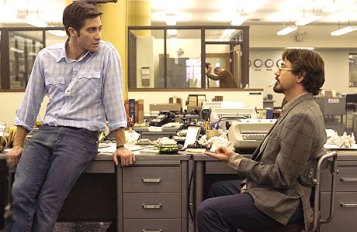 communities but evading police and justice to this day. The Zodiac Killer had held a dimming spot in our collective conscious for years when David Fincher got his hands on the material (a new book on the case by Robert Graysmith was the inspiration, though not terribly well-written) and turned a tired story into something that could take your breath away.
There are several brilliant strokes that make this movie more than just a movie.
- It focuses on Robert Graysmith, a cartoonist at a San Francisco newspaper (played by Jake Gyllenhaal) and Paul Avery, a reporter (Robert Downey, Jr.), who became obsessed with the case and played armchair detectives. This was effective story-telling be because Graysmith and Avery are just like us: outsiders. They have no business “detecting.” They have no privileged information. They’re just interested, and it makes us interested.
- That said, this is a serial killer movie without the serial killer. The crimes were never solved. At best, he’s a shadowy figure in the movie (and brilliantly, Fincher had several different actors play this shadowy figure so we always feel a little off-kilter). This truly is about the regular people (and Inspector Toschi, a cop frustrated by the case’s dead ends – played by Mark Ruffalo), feeling more like Spotlight than Seven.
- Although the movie works very well strictly as crime drama, that’s really just a superficial reading of Zodiac, the tip of the iceberg with a whole lot more waiting to be discovered underneath. The film’s tone lulls us into a trance. The score, the pacing, the editing, it all works together to draw us into this hyper-awareness that heightens everything, so that we watch raptly, watching office scenes with trepidation equal to the creepy, cob-webby basement scenes. We start to realize that the serial killer is not what’s threatening Graysmith; it’s the search for truth that’s ripping his life apart. Now that little nugget comes with a whole lot more cynicism that mere murder can provide.
- The case and the film each build consistently, unrelentingly. You get pulled into it, dragged along. It’s not about the violence and blood (there’s very little of either), but about relentless pursuit, without resolution. That’s hard to maintain and in less capable hands, this could easily have been a dry and boring movie. But Fincher bring the suspense, and without us realizing it, he infuses that suspense into every scene. The suspense never lets up. It becomes an ache, one achieved not with fancy car chases or dramatic shootouts, but through methodical police work, the film as detail-oriented as the director himself.
- There’s no ending. Or no satisfying one, at least. That goes against what usually makes a Fincher film great, those memorable last lines, a Beatles tune playing over the credits. But Zodiac goes without, because in real life, the Zodiac Killer got away. Maybe we know who it is. Maybe. But no arrest was ever made, no one ever served time. The film reflects this truth and denies us catharsis and our “Hollywood ending” as we understand them. The Zodiac murders weren’t just a news item, it was The Case for a generation, one that never got wrapped up. Fincher was part of that generation, and grew up in the area. It obviously stuck with him. In many ways, Zodiac is his most personal film, so he made it not about the killer, but about the people chasing him. The people trying to solve the ultimate puzzle, and paying the price when justice is ellusive.
Because life is cruel, Zodiac was NOT a hit at the box office, making a paltry $33M in the U.S. against its $65M budget. It was never going to be a hit. It’s not lurid or bloody. It’s an ode to method. And while today we’ve become obsessed with this method (Making A 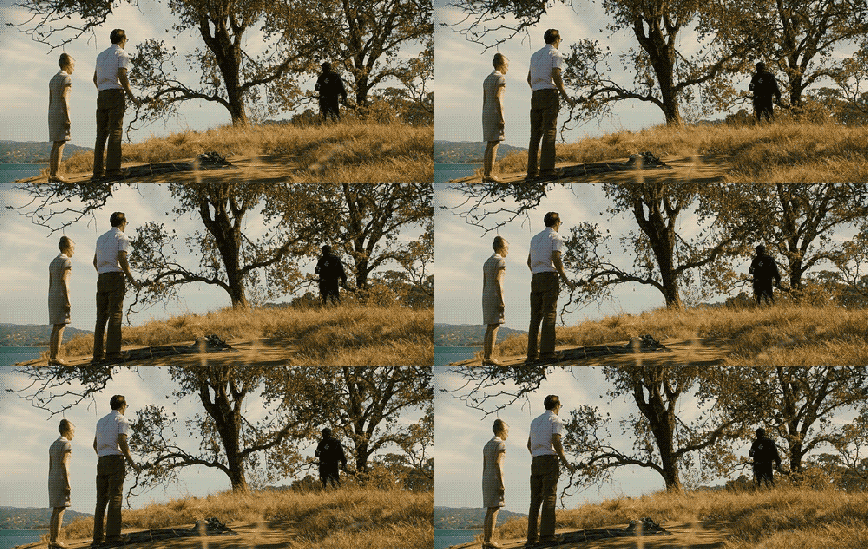 Murderer, OJ: Made in America), 10 years ago it was unknown. Maybe it was Fincher who invented it. He definitely perfected it, and without an entire season’s worth of episodes to devote to his subject, he imbues each scene with loads of meaning, making each one impactful and riveting. Maybe not as riveting as Wild Hogs, that atrocious piece of shit starring Tim Allen, John Travolta and Martin Lawrence (it opened the same weekend and beat Zodiac by about 30 million dollars), but in the past decade, it has impressed nearly everyone who’s sought it out. The cast is splendid, the script smart, the direction thoughtful and meaningful. But it did not win the Oscar. Know why? BECAUSE IT WASN’T EVEN NOMINATED!
 movies that mix fantasy and historical.” Sean let out a breath. “You’re going to hate this.” He was right. I kind of knew it too. But as soon as I’d said those words, I realized they were too general. I can’t think of anything off the top of my head, but I’m certain there are plenty of movies who get it right. I know I was thinking of
  knows that only his nephew will be able to handle it, so he rounds up all the age-appropriate young men in the kingdom and eventually Arthur (Charlie Hunnam) is revealed. And then it’s game ON. Arthur isn’t really motivated to do battle with his ruthless uncle, but a beautiful mage (Astrid Berges-Frisbey) persuades him that it must be so.
 cheap booze. Between men they live out of their piece of shit car. They have almost nothing going for them but Rita makes keeping Ruthie out of child services her top priority, and so far, she’s always succeeded.
 who will strike you as half bumbling fool, half savant. His partner Fleur (Natasha Lyonne) is more interested in getting laid and his superior (Amy Sedaris, playing delightfully against type) is a stranger case still. Not to mention the fact that Handsome is in charge of “detective school,” training up the new recruits, not all of whom are destined to become ace detectives. So he’s got his hands full when a decapitated body is found on the manicured lawns of a minor celebrity (Steven Weber), splayed out in the shape of a Star of David. Handsome tracks down all of the dead girl’s known associates, including his own beautiful new neighbour, in order to crack the case.
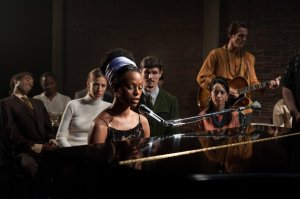 Mary J Blige was originally cast but had to drop out. Nina herself had hoped that it would be Whoopi who’d portray her on screen. Instead director Cynthia Mort went with Zoe Saldana, and thus created a furor. With Dominican and Cuban ancestry, Saldana identifies as a black woman, but critics felt she was not black enough. Not black enough? The notion makes me queasy. But when Saldana said she was honoured to play Simone, the Nina Simone Foundation nastily replied “Dear Zoe, please keep Nina’s name out of your mouth for the rest of your life.”
 (an old friend of his son’s) and the two of them roll their way through grief and loss. Vicky is as disapproving as you might imagine, but she’s not exactly smoothly sailing through this period either. Her grief is just as bumbling, if more sober.

 Film maker Chris Kelly follows three people over the course of 6 years to get a grip on their experiences. Toul Srey Pov and Tep Vanny are two young mothers who allowed their land on the Boeung Kak Lake to be measured by the government, supposedly to receive accurate land titles. Instead, the government leased their land to a private company, Shukaku, which “happens” to have ties to the Prime Minister. Shukaku is dumping sand into the lake, flooding the streets of Boeung Kak, forcing people from their homes. These women are too poor to abandon their homes. The compensation offered by Shukaku is laughable, insufficient to start over elsewhere. But those who stay risk their lives – already 3 have died by electrocution alone.

