
The year is 1941. Prew (Montgomery Clift) has requested an Army transfer and ended up in Hawaii. His new captain, Holmes, knows his reputation as a keen boxer and is anxious to get him on the company team. Prew refuses, he’s given it up, but Holmes isn’t used to being told no and enlists all of his subordinates to make his life hell until he relents.
There’s more to it though: turns out a certain smoldering sergeant Warden (Burt Lancaster) starts seeing the captain’s wife (Deborah Kerr). Prew’s  friend Maggio (Frank Sinatra) keeps running into trouble with a stockade sergeant (Ernest Borgnine) with a mean streak. And Prew himself is falling in love with Lorene (Donna Reed). It might seem like normal every day stuff, except you and I know what’s coming: Pearl Harbor. It’s awful to know what’s around the corner for them, how petty all of these problems will seem soon enough, if any of them are left to still have them.
Montgomery Clift really threw himself into the role, learning to play the bugle and taking up boxing, and this in turned forced better and better 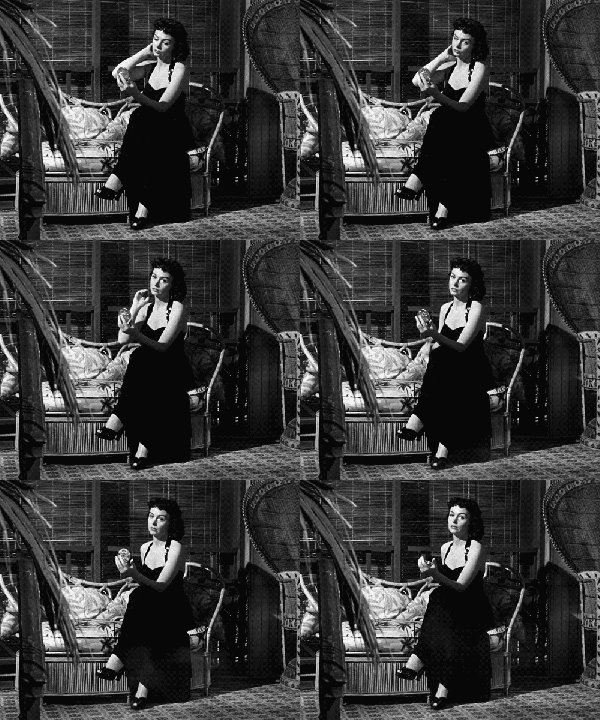 performances from his cast mates. Burt Lancaster was so nervous to act alongside him he’s visibly shaking in their first scene together. Sinatra was just grateful for the part. You may know that Mario Puzo fictionalized his movie career in The Godfather; a certain studio exec is convinced to hire him after finding his prized horse’s head in his bed. In real life, it was a lot less dramatic: Sinatra was married to Ava Gardner at the time, and she happened to have some pull with Columbia. Or at least that’s the version everyone agrees to.
The now-famous scene of Burt Lancaster and Deborah Kerr (who were romantically involved in real life) rolling around on the beach was banned by the MPAA for being too erotic. If you were lucky enough to see the scene included in the movie at the theatre, it was probably foreshortened because  lots of naughty projectionists would cut out a slice to keep as a souvenir. Censors demanded that Kerr’s swimsuit be skirted so as not to be too “provocative.” And that wasn’t the only modification made. In the book, the captain’s wife gets gonorrhea from her philandering husband, but that part is conveniently edited out. And in the credits, Donna Reed is credited as a “social club employee” which is 1950s code for hooker. And the military had their own standards to contend with: you couldn’t portray military sloppiness, hypocrisy, brutality…or homosexuality. Not to worry. The gay stuff was also left out, along with all the other juicy bits that led to the novel being called From Here to Obscenity by some. But that scene. The scene on the beach. Makes me want to recreate it when we’re in Oahu today (it was in Halona Cove), but only if I can find a modest skirted swimsuit.
 and no healthy relationships. But then he starts collecting pudding. It’s only half as strange as it sounds: he discovers a contest loophole where if he buys an enormous amount of pudding, he gets to fly for free. This is the only bright spot in his world of self-loathing until two people pull his life in different directions.
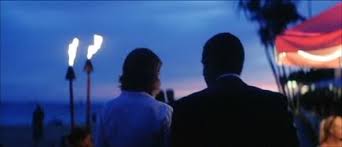 directing, and Sandler would go on to be nominated for a Golden Globe. Anderson had become somewhat known for his multi-character films and wanted his next work to subvert expectations, and boy did he. He was the first director to cast Adam Sandler and expect great things from him. He gave him real material to work with and Sandler rose to the occasion.
 during the film’s music. The score’s unusual tones and sounds would then be played on set, influencing the atmospheric tone of the film. Anderson brought it Gary Rydstrom on sound mixing, an atypical move as Rydstrom, the chief sound editor for Pixar, normally works on big special effects movies, like Spielberg’s Jurassic Park and Saving Private Ryan. All of these abnormal pieces form a whole that’s off-kilter and intoxicating.
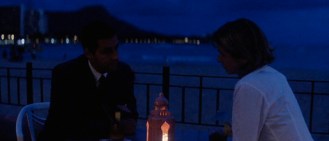 bought a lot of pudding in order to see the world? The first place he goes is to Hawaii. His Hawaiian trip, inspired by love, is the first self-actualized thing he does for himself. The framing and composition open up as Barry steps outside of his comfort zone, and the confines of his loneliness. Barry is often shown wearing blue, a blue boy wearing his depression, but in Hawaii, pink becomes the colour of prominence, the colour of sweetness, empowerment, and romance. It literally chases the blues away. Although, to be fair, I think Hawaii has the tendency to do that for everyone.

 surviving only because of his wife’s coma. His 17 year old daughter Alex (Shailene Woodley) has been sent off to boarding school due to bad behavior but she returns as her mother is declared brain dead to reveal the nature of the fight she’d had with her mother. It’s all a lot more than Matt feels he can handle, especially now that he’s effectively a single parent.
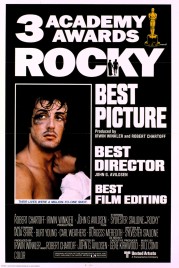 Network though that all but cleaned up in the acting categories – Peter Finch for best actor (he was the first actor to win posthumously); Faye Dunaway for best actress, and Beatrice Straight for best supporting actress. The fly in their soup was Jason Robards for All the President’s Men – poor Ned Beatty was shut out. In an upset, Barbra Streisand’s Evergreen (Love Theme from A Star Is Born) won best original song over Gonna Fly Now from the Rocky soundtrack but I don’t need to tell you which has had the more lasting impact culturally.
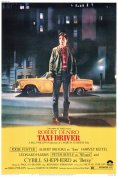 starring Bruce Dern. And Freaky Friday with Jodie Foster. And Scorsese’s Taxi Driver. And To Fly!, a documentary about the history of flight produced by the National Air and Space Museum that was the second-highest grossing film the of the year and was the highest grossing documentary of all time until Fahrenheit 9/11 in 2004.
 Murphy. Benedict Cumberbatch. Audrey Tautou. Colin Farrell. Happy 40th to all.
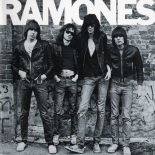 born. Apple was founded by a couple of punks you might have heard of, Steve Jobs and Steve Wozniak. The Ramones released their first album and the Sex Pistols play their first shows, but it’s (Peter) Frampton Comes Alive! that tops the charts. The Boston Celtics defeated the Phoenix Suns in triple overtime in Game 5 of the NBA Finals – still considered the greatest game of the NBA’s first 50 years. The CN tower, then the world’s tallest free-standing structure on land, opened to the public. Jimmy Carter defeated Gerald Ford. Megamouth sharks are discovered off Oahu, Hawaii
 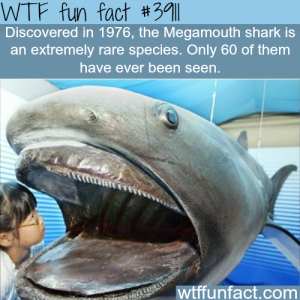 (nothing to be concerned about Sean, I’m sure it’s just coincidence you’re both turning 40 in the same place). Bob Marley survived an assassination attempt. California repealed their sodomy law. Peyton Manning was born. And Ronaldo. And Mark Duplass, just a day after Sean. And as much as I love me some Duplass, Sean is still my favourite thing from 1976, and I’m so glad I get to spend the day looking for megamouth sharks on a submarine ride on the ocean’s floor with him.
 Just Go With It was worth another trip to the islands – Maui, to be specific. Well, the movie is deliberately vague, because sometimes they’ll start out on the island of Maui and then magically end up in Kauai: the magic of Hollywood, folks!
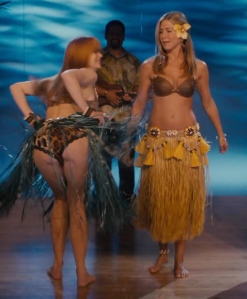 she really makes you remember what fine comedic timing she has. So while this in no way is a good movie, it’s kind of enjoyable if you squint hard enough. Actually, my favourite part is when Aniston and her college arch-nemesis played by Nicole Kidman do a hula-off. You could watch that scene, have a laugh, and not feel too bad about yourself.
 corrections work on Rikers Island. But then the music business started paying attention and audiences marveled at her powerful energy and her joyful performances. Touring with her band, the Dap-Kings, Jones’s career was taking off when she was suddenly diagnosed with pancreatic cancer in 2013. Director Barbara Kopple is with Jones during her treatment, and Miss Sharon Jones! is a testament not just to the music, but to the immense effort Jones goes through in order to make it.
 recounting, it’s more about facing down death with graciousness, gratitude, friends, and yes – music. Always music. It’s clearly Jones’ passion and her greatest motivator. But the people she plays it with and shares it with are just as important, perhaps even more so as her health fails and her recovery is rocky. There is a stark contrast between her life as a performer and that as a cancer patient, and the best parts of this film are found right in that crack, where Miss Jones is unafraid to be honest, and to share this journey with her fans just as she shares her music, and her best self on stage, where Jones is really, truly alive.
 picking up the pieces of her middle age and trying to formulate some acceptable version of the future for herself. She’s disconnected from her youth and perhaps her old passions, but she’s not done, far from it. The film, and Huppert’s performance, has a stiff upper lip: she submits to a series of diminishments with cool detachment, but we watch as these changes slowly affect her relationships, even the one she has with philosophy.
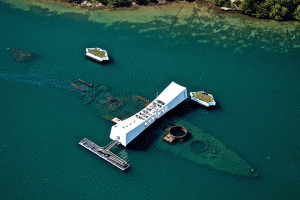 sure. But beautiful too, in its way. There’s a floating memorial right over top where the USS Arizona lays beneath the ocean. You take a small shuttle boat over to it, and you can walk around on the very spot where it happened. It’s a lovely memorial, sobering as it is built right over the battleship, where 1102 of the 1177 crewmen killed still rest. In aerial shots, you can make out the outline of the ship. Lots of quiet moments to think about this loss of life.
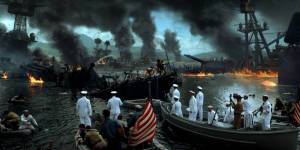 Plus, war and love make us do crazy things. Michael Bay, however, is just the worst choice to convey those things. The 40 minute action sequence: superb. Very Michael Bay. Very explody. It’s even in the Guinness book of records for movie with most explosives used. There’s one shot of 6 explosions in “Battleship Row”, which was staged on real Navy ships. 6 ships, 600 feet each, rigged with 500 bombs on each boat, using 700 sticks of dynamite, 2000 feet of cord and 4000 gallons of gasoline. It took 7 months of coordination, a month and a half to rig them, permission from the government of Hawaii, the EPA, and the Navy, plus 100 extras on hand and 6 planes flying overhead, and 14 cameras to film it and in the end, it was a 7 second explosion that was stretched to 12 seconds on screen. That’s how Michael Bay do.
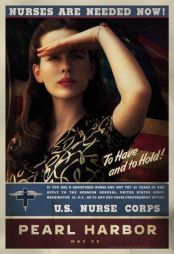 Wouldn’t you like to see Michael Bay and Clint Eastwood in a flag-off? Who would drop first? Pearl Harbor manages to make a spectacle out of a profound moment in history, where blood was shed by real people embroiled in their own acts of love, intimacy, bravery, fear, courage, and duty. But those stories never get told. Instead, Michael Bay offended the Japanese by upping the “barbarism” of the whole thing, which also insults American vets, who would be right in thinking the real event was bad enough. A better tribute to those who died, and those who survived, is found at the memorial, where a 23 minute documentary is shown, and manages in those 23 minutes to be more honest and more informative than Bay’s 183.
 Weirdly, both Bill Murray and Jack Nicholson hoped for the role before committing to other projects. Billy Bob stepped into the title role (which was translated as “Santa is a Pervert” in the Czech Republic) and to this day he lists the filming as one of only 3 time periods he’d care to revisit (the other two being the Alamo, and 1979, when he worked for the Arkansas Highway Department. He’s a weird guy.).
