Author Archives: Jay

Supporting Characters

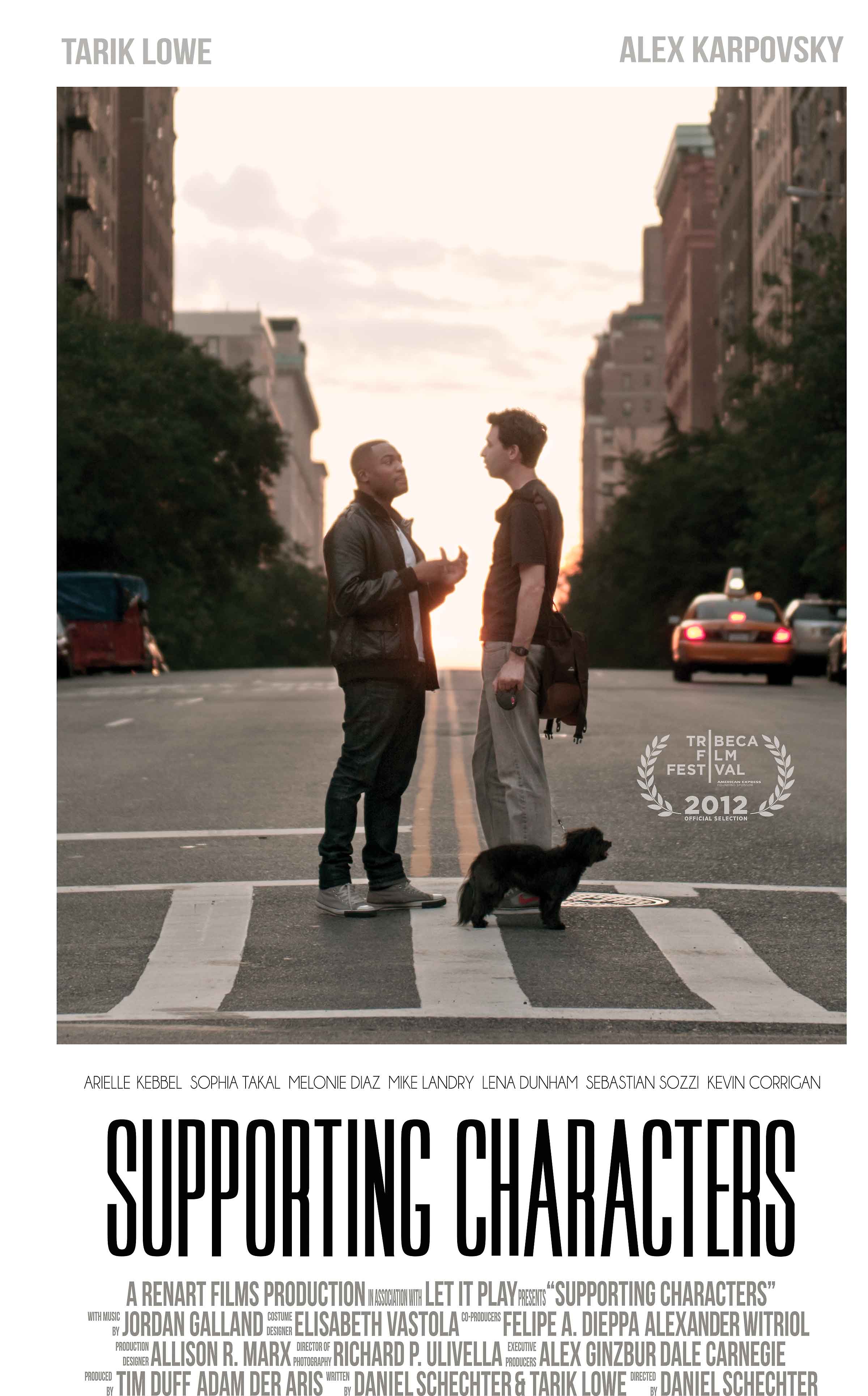
A perfectly fine little indie film starring Alex Karpovsky and Tarik Lowe about co-editor buddies who work together to save movies and relationships in crisis. They’re more successful at one of those things than the other.supporting-characters

It’s very bromantic. The dialogue is snappiest between the bros, and the chemistry works best between them too. The movies is well aware of this. When the buddies each take their respective girlfriends on a double date, one girlfriend asks “So how did you two meet?” and the buddy isn’t sure whether she’s asking how he and his girlfriend met, or he and his buddy. In any case, he prefers to tell the story of the buddy meet-cute, it’s the better story, and, frankly, the better relationship.

The movie is no-budget, ugly to look at, but comes to life when the grumbly Karpovsky and charming Lowe have only each other to pick on. I nearly turned the thing off after about 20 minutes because while nothing was wrong or offensive about it, it just wasn’t that interesting to watch. We left it on but my original impression was confirmed. Just not that into it.

What movies bore you?

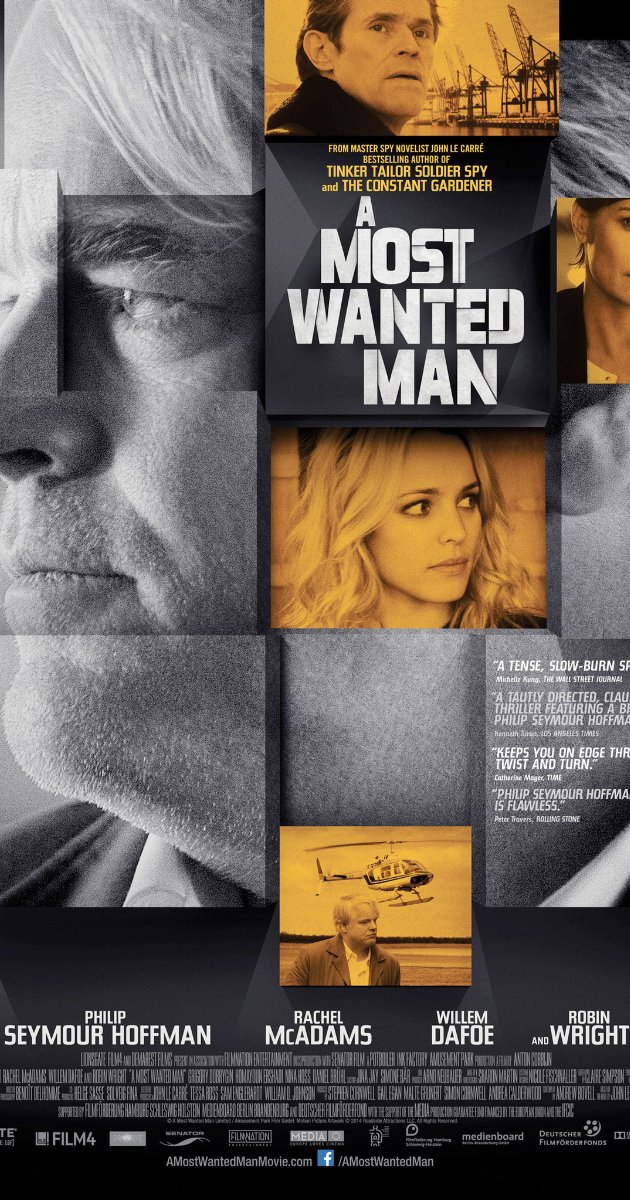
A Most Wanted Man

Post-911 Germany is scrambling to make sure nobody uses their country for terrorist organization again. Gunther Bachmann (Philip Seymour Hoffman) is one of the few “good” ones left in an intelligence unit largely corrupted by CIA, but his burnout is evident. When a young Russian-Chechen enters the country illegally, ostensibly looking for asylum, Bachmann decides to use the refugee to move up the ladder, hopefully toward a Muslim philanthropist who Bachmann believes is using charities as a front to fund extremist operations.wanted

Hoffman looks terrible in this film, which kind of fits with the character, who’s a bloated wreck, but it’s still painful to watch. He’s good though, if you overlook his German accent occasionally sounding Irish. Rachel McAdams plays a lawyer trying to help the refugee Issa Karpov (Grigoriy Dobrygin) claim political asylum. Dobrygin plays tortured and traumatized very well but McAdams seems miscast and out of her depth.

This movie is interesting but seems to have tried to pack too much into one single movie, so it’s a bit hard to follow. It’s also the least thrilling espionage thriller I’ve seen in a long time.  It’s not gripping because it gets bogged down in the details. And there’s no real heart. Who are we supposed to care about? The titular character, supposedly this Issa, is supposed to be mysterious. People are arguing over whether to arrest him now, or use him as bait to uncover his hidden motives, not just because he could lead them up the chain, but because they believe he himself may actually be a jihadist. The audience is meant to see him as a threat lying in wait, only he’s such a pathetic character that there is no real urgency, no real menace. In fact, the movie’s strongest sense of sinister undertone comes from conversations between Hoffman and Robin Wright, playing a CIA agent. The actors and director Anton Corbijn hint masterfully at malevolence.

It’s a mostly subtle film that makes you wonder how far is too far. How much should we infringe on someone’s rights in the name of “fighting terrorism”?  This movie will leave you unsettled, with a bitter taste in your mouth, both for the frustrating geopolitical policy, and for Hoffman’s swan song, his last completed movie.

Magic in the Moonlight

Colin Firth plays magician Wei Ling Soo (aka Stanley) brought in to a wealthy family’s home to debunk Emma Stone’s Sophie, a beautiful young medium who Stanley is sure is a swindler.Magic-in-the-Moonlight-onesheet

I want to say that Woody Allen films have been pretty hit or miss with me lately, only I can’t think of any hits. Last year’s Blue Jasmine cast an admittedly stellar Cate Blanchett but other than a great performance, I’m not sure the movie really did anything for me. I was similarly unmoved by Midnight in Paris. His movies for the past  couple of decades have been lighter and less ambitious (not to mention white-washed). This one, as a rom-com, is standard formula, but it does start off with some really great questions of belief. Stanley is a rational man who believes only in what his (5) senses can tell him. The convincing and bewitching young psychic have him doubting his entire existence, and for the first time, he’s feeling happy about life.

Magic in the Moonlight has some great dialogue, which Allen is known for, but also some heavy-handed expository stuff, which I find unforgivable. Allen’s motto of late seems to be quantity over innovation. He’s a very productive writer\director, but what is he presenting that is new? What he shoots is beautiful, but also predictable and safe.

Colin Firth is the Cate Blanchett of this movie, he makes it worth watching. The romantic nature barely concealed under disdain and haughtiness and a dash of intellectualism. Swoon. Emma Stone I was less sure of. I asked Sean, is she very bad in this, or is she always this bad, or is she pretending to be this bad? We weren’t sure. But I was pretty sure that I felt a little creeped out to see Colin Firth kiss her. Now why is that?

Emma Stone, the actress, is 26. But Emma Stone looks quite young and is playing quite young in this film. Hollywood makes no bones about pairing ingenues with daddy types, and either way, I am definitely on team Colin. He could tongue me any day he pleased even though at age 54, he is older than my mother.

So here it is. At what point does what we know about a morally corrupt artist taint the art that he produces? My repulsion to the kiss was not a conscious reaction to Woody Allen: film maker and child molester. But clearly these are serious allegations and so how do we feel when he continues to work out his neuroticism and sexual dysfunction on-screen? I’m not saying that art is confession (although it sometimes is), but I’m wondering at the correspondence between the characters he writes and the crimes we hear about in the newspapers. It’s troubling. Criticism must be within context. A movie written and directed by Woody Allen cannot be considered as wholly detached from Woody Allen the man.  His female characters are never well-developed, and the men in his movies, including ones he’s played himself, are very often emotionally stunted, and almost always chasing after some uncomfortably young tail.

So how do we watch Woody Allen movies going forward? Or should we not?

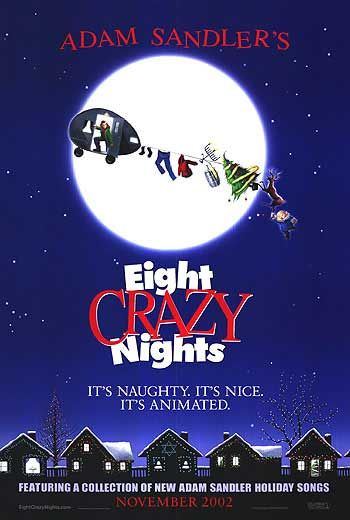
Eight Crazy Nights

Confession: I am an Adam Sandler fan. Or maybe he’s become more of a guilty pleasure over the years, emphasis on the guilty. I grew up watching him on SNL, fell a little in love with him watching Billy Madison, and have been the only grown woman in a long line of 12-year-old boys to many of his movies. And no matter how many Jack & Jills he throws at me, I keep coming back. eight_crazy_nights

Eight Crazy Nights is not your standard holiday fare. Two and a half minutes in and this movie has already distinguished itself from other holiday movies: it’s lewd, it’s rude, and grandma’s not going to like it. I’m not even sure that I do, half the time. Potty humour’s not my thing. Like really not my thing.

This movie, when you can look beyond the crudeness, is actually kind of touching. It has messages of gratitude and appreciation, and an interfaith holiday celebration that’s more inclusive than any other holiday film on our list. But Adam Sandler is an eternal pre-pubescent boy. He is so squeamish about real emotion that any time he attempts it in his movies, he just as quickly negates it with bodily functions or silly voices. His discomfort is sadly obvious to the grown-up viewer, and yet, this movie doesn’t exactly seem directed at or appropriate for children. It is however, juvenile humour all the way. This movie can only appeal to pre-existing fans with a high tolerance for toilet jokes. It’s not charming or clever but it does have some guffaws, and even a song (“Technical Foul”) that you may find yourself singing around the house. Fans of Saturday Night Live will recognize voices from Sandler’s usual repertoire: Kevin Nealon, Rob Schneider, and Jon Lovitz.

This movie doesn’t belong on any list of the “Classics” and I’m the last person to suggest that it be included, but I do find myself watching it every year around the holidays. I guess I’m a sucker for the Hanukkah Song.


Jay’s favourite Christmas movie: A Christmas Story

Matt’s favourite Christmas movie: It’s a Wonderful Life

Vote for YOURS!

Jodorowsky’s Dune

This documentary tells the story of arty film director Alejandro Jodorowsky’s inspired but ultimately doomed film adaptation of Frank Herbert’s sci-fi novel, Dune.Jodorowsky's_Dune_poster

To help realize the ambitious plans he had for this film, Jodorowsky recruited the very best talent available. He tapped Mick Jagger, Orson Welles, and Salvador Dali to star, Pink Floyd to do the music. A quarter of the budget was spent in pre-production, but the art and storyboards produced were stunningly surreal and top-notch. Maybe even a little too aspirational, because Hollywood studios balked at the high concept (and at the projected 14-hour runtime) and it never got made, despite having influenced countless sci-fi movies over the past four decades.

Jodorowsky is a great man to capture on film. Talking about his movie, it’s obvious that this was his passion project, his life’s work. Flipping through costume designs, camera angles and script changes, it’s astonishing and heartbreaking to see so much work and so much talent go to waste. Deflated over his Hollywood rejection, Jodorowsky stopped making movies. And it was with a heavy heart that he trudged to theatres in 1984 to see David Lynch’s Dune. He admits that if anyone could have done justice to his movie, it was Lynch, but he also gleefully tells us that his spirits soared when he realized the film was awful, a flop.

Jodorowsky speaks knowledgeably about the messiah complex that’s a running theme in the material without seeming to realize that he is the epitome of the expression. He admits that he “raped” the novel, albeit “with love” – it was rumoured that author Herbert was none too pleased. He took the story to places never imagined by the book itself, and perhaps it was this conceit, this unbowing grandiosity that was his undoing. Studio execs did not believe that this epic film, straying so far from the beloved source material, would ever find an audience. And maybe they were right. But between the conceptual art and the passionate storytelling of Jodorowsky, I wish that the choice had mine, had been ours, to see or not to see his masterpiece: Dune.

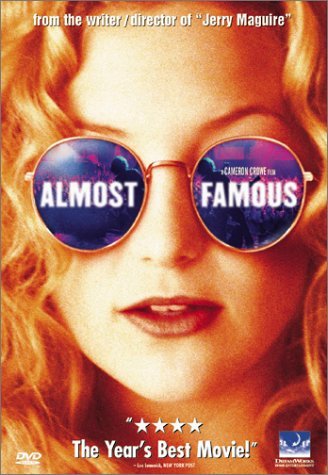
Almost Famous

I’m watching Almost Famous and I know you don’t need to be sold on it. It’s terrific. But sometimes, between viewings, you forget how terrific. I’m just eleven minutes in, at the part when the sister, played by Zooey Deschanel, leaves and she bequeaths her record collection to almosther little brother. He flips through those albums (actual saved albums of director Cameron Crowe) and dreams are born. Just watching him discover music that will open up his world wakes something up inside me, like the infinite possibility of childhood. Like you could fall in love with anything, any time.

Philip Seymour Hoffman gives a great performance; this is the first time I’ve watched a movie of his since his passing and really felt his loss. Frances McDormand can’t help but be excellent. Patrick Fugit and Kate Hudson give star-making performances (even all this time later, seeing him on screen in Gone Girl still prompted the whisper, isn’t that the kid from Almost Famous?). Rainn Wilson, Jay Baruchel, Nick Swarsdon, Eric Stonestreet and Mitch Hedberg all make “before they were stars” appearances, solidifying Crowe’s casting genius.

Almost Famous had triple the music budget of the average movie, and it was worth every penny. Peter Frampton was onboard to write music for the movie’s fictional band, Stillwater. But ultimately this movie hits home for a lot of us because it’s about discovery. Do you remember the first album you ever bought? Listening to a track obsessively? Memorizing lyrics? Calling in to your favourite radio station? Pouring over the liner notes? Music is the gateway to our growing up, and to witness William naive and wide-eyed bumping up against the most cynical of industries is a little like watching ourselves encounter the big bad world for the first time.


This is Where I Leave You

When Judd (Jason Bateman) comes home to find his wife fucking his boss, he moves out and is blind-sided by another piece of good news: his dad’s dead. So he and his 3 grown siblings return to their childhood home and are manipulated by their mother, the fabulous Jane Fonda, to stay for a week under the same roof to sit Shiva.  306995id1b_TIWILY_INTL_27x40_1Sheet.indd

It’s been a long time since these people were all gathered together with nothing better to do than nit-pick each other’s lives and observe each other’s failures, and what with other mourners randomly dropping in with secrets and casseroles, there’s a whole mess of drama that unfolds.

I wanted to like this movie more than I did. There’s nothing really wrong with it, and it definitely has its moments, but you just expect more from such an all-star cast. Why assemble so much talent only to waste it? The source material is pretty strong, and if this movie (now on DVD!) catches you at the right moment, you may find yourself identifying with it. Not that your family is this crazy, because it’s not. But maybe because when you go home to grieve your father, you also find yourself grieving the dreams you’ve given up on, the person you never became, the opportunities you left behind. Unfortunately, director Shawn Levy doesn’t show a lot of maturity with what he chooses to present on film. If he’s this afraid to scratch beneath the surface, then maybe he should stick to soulless movies like Night at the Museum and let someone else helm movies about grownups.

You won’t hate this movie, but you’ll probably forget quicker than Jane Fonda can shake her big, plastic boobs.


A Christmas Story

I will probably watch many Christmas movies over the holiday season, but my favourite, my absolute all-time favourite Christmas classic is A Christmas Story. The Christmas Story. Our Christmas Story.story
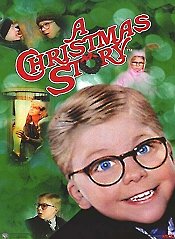
Because the best thing about this movie is how well it evokes the wonder and the misery of a childhood family holiday. It captures the agony of anticipation to this highlight of “the entire kid year.” Filmed in 1983 but set in the 1940s, I’m far too young (and way too beautiful, may as well throw that in) to remember things quite as old-timey as little Ralphie experiences, but by and large, a lot of the big themes were quite nostalgic for me as well, and probably continue to be today: running around outside, wearing those god-awful snowsuits (to this day I don’t own a parka, or snow boots, because I developed a severe claustrophobic reaction to winter apparel). The kid in every family who won’t eat? My baby sister. Their faulty furnace was our busted sump pump. The demoralizing lineup to sit on Santa’s lap. And we were never treated to the spectacular department store windows unfortunately, but for us it was the Sears Christmas catalogue. Not quite as good as “mechanized, electronic joy” but still pretty drool-worthy.

IMG_0168
You will surely remember that Ralphie wants, more than anything in the world, more than anything a boy of 9 had ever wanted before, was a Red Ryder BB gun. Me? I wanted a Barbie horse trailer. I asked for it every year for probably a solid decade, for longer than I even wanted it because it was tradition, and because I had to be getting close! I never got it, but my little sister did. At the time, I probably wished she’d somehow manage to shoot her eye out with it. She’s still got two beautiful blue eyes to this day, the little bitch.

This movie was only a sleeper hit at first but gained huge momentum as it aired on TV over countless Christmas seasons. The writing is just legendary. It’s perfect, and it should be, being based on Jean Shepherd’s successful series first published in Playboy magazine. It reminds me a whole lot of David Sedaris, though I guess I should say Sedaris reminds me of Shepherd.

The fantasy sequences are genius. I was a day-dreamer myself and was probably guilty of the same hyperbolic mental narration thatRalphie indulges in. He’s definitely the hero of his own story. But his father, brilliantly played by DarrenMcGavin, sure gives him a run for his money. Rumour has it that Jack Nicholson wanted the part, but his big salary demands meant the role went to the man who was born to play it.

A Christmas Story major prize - leg lamp

“The soft glow of electric sex”

And for all this magical Christmas spirit, for the pure joy of the soft glow of electric sex gleaming in the window, we have Porky’s to thank. It was Porky’s who put director Bob Clark on the map and allowed him to make the movie he really wanted to make. He shot the house itself in Cleveland Ohio but most other scenes were shot here in Canada – the tree lot right in Toronto, the schoolyard in St. Catherine’s. Peter Billingsley, the young star, knew a career-high when he saw it. Now he teams up with friends Jon Favreau (as a producer for Iron Man) and Vince Vaughn (as director of Couples Resort).

Aren’t you watching it yet? Relive the lusty unwrapping! The crappy Mom gifts (a fly swatter? really?). The present coma. The tinsel vomited all over the tree. The pink bunny suit, for chrissakes.

pink bunny suit from A Christmas Story

“He looks like a deranged Easter bunny”

This movie is a classic and respect must be paid. I’m not sure you need to watch the 24 hour marathon, but if you aren’t watching this movie, you aren’t really celebrating Christmas. This movie is filled with all the pitfalls of spending any amount of time with your crazy family, but the closing shot reminds us that this is what Christmas is all about.

What was your all-time favourite Christmas gift? Tell us in the comments! And don’t forget to cast your vote for best Christmas movie in our poll.

White Christmas

This movie is almost exactly like a great number of other musicals from the same era: a successful song-and-dance duo meet and fall in love with a sister act. But this wasn’t just another musical, this was Bing Crosby in White Christmas, and it became the highest grossing film of 1954, even though it’s “just” a Christmas movie.

The film also puts Rosemary Clooney and Bing Crosby on the screen together, which is a delight. Too bad you can’t hear them together anywhere but in the movie: Clooney’s record company wouldn’t let her on the soundtrack for a competing company, so Peggy Lee replaces her there. She released her own version of the songs, some with her actual sister playing the sister part. Danny Kaye and Vera Ellen round out the cast, though Vera Ellen mysteriously does very little of her own singing. But who cares? You came for Bing Crosby anyway!white

As usual, no expense is spared with set and costume. Or, for the numbers anyway – you’ll never see a sorrier excuse for a brick wall during the war bit at the beginning. I loved the tiny little pointe shoes on the tiny little ballerinas. I also loved Crosby’s unsuppressed (and unscripted) laughter during his and Kaye’s “drag” scene.

What I really enjoy about this movie though is the war aspect. We see Crosby doing a Christmas Eve show as a captain in the army. His fan and supporter (Kaye) saves his life, and when the war is over, the two team up and become quite famous performing their act all over the country. But the war is never really far from our consciousness. The plot is propelled by “favours” for old army buddies (well, that, and Kaye deciding that his buddy Bing really needs to get laid married). And when they find their general down on his luck, they rally around him in a touching tribute. This speaks to me because it’s clear that the war theme was still resonating with audiences in 1954.

We’ve of course forgotten the true meaning of White Christmas, the song, but it was beloved and popularized by the boys in the Pacific over a decade earlier, in 1942. Irving Berlin, the composer, realized that the soldiers were truly the ones dreaming of a white Christmas, and so he built this show (and then the movie) around the song. And while the movie has great big production numbers, this song is given a very simple treatment, just Bing accompanied by a wind-up music box, in front of the soldiers who loved it most, on a lonely Christmas Eve.

It’s interesting that during the movie, the characters make reference (through song lyrics) to USO performers going overseas to entertain the troops on Christmas. They sing “Jolsen, Hope and Benny all for free” but the original lyric was “Crosby, Hope and Benny” – obviously a change was necessary to maintain the integrity of the fourth wall – but it’s important to remember that this cause had long been dear to Crosby’s heart.

It’s incredibly touching to me at the end to see all those men in their uniforms saluting their general and all that he stands for. It’s a great representation of the camaraderie and the unconditional support that was birthed in those trenches (while ignoring the horrors of war, true, but this is a Christmas movie after all).


Vote for your favourite all-time Christmas movie in our poll!

Snow Piercer

An experiment to save the world actually destroys it, sending the world into a deep freeze. The few survivors board a train that constantly whizzes around the globe, smashing through ice and snow, in perpetual motion. The train is strictly divided according to class, with the very rich poshly appointed in the front and the poor kept in dismal conditions in the back until cryptic messages filter through to them, inciting them to rebellion.snow

Curtis (bushy bearded Chris Evans) is the reluctant leader of the great unwashed in a brutal, gruesome battle toward the front, and the train’s inventor\conductor, Wilford. Wilford sends his minions to do his dirty work, including a nightmarish Tilda Swinton.

I heard about this movie from several sources in late spring of 2014 and looked forward to finding it in theatres, though I never did. Why did such a fascinating movie disappear? It’s because of a little dick named Harvey Weinstein. The Weinstein Company owned the rights but didn’t believe that North American audiences were smart enough to “get” the movie, insisting on a 20-minute slaughter of the film, as well as the addition of opening and closing monologues. To punish director Bong Joon-ho for sticking up for his movie, Weinstein buried the movie. But guess what? We found it, lots of us did, and you can too.

This movie works on many levels – as an allegory, as social commentary, as an action flick, as an intense, thrilling drama.  I love how the progress of the underclass from the back of the train to the front is literally transformative, from the darkest quarters, to bright, lush, and sumptuous toward the front, with devastating frosty beauty outside the windows. This film is visionary, but it declares a certain urgency in setting year 0 at 2014. The editing is tight, it keeps the motion pressing forward, keeps the pace brisk  and exhilarating (and sometimes terrifying). This is a real trick of cinematography, to use the train’s inherent claustrophobia as an asset, and to use the momentum as a character and not byproduct of the plot. The scenes are literally compartmentalized but they fit together to make a really  nice, fluid picture that you’ll enjoy watching, enjoy rewatching, and really enjoy discussing.