Author Archives: Jay

The Island

Lincoln Six Echo (Ewan McGregor) lives in a futuristic community where life is prescribed for him: meals, wardrobe, job, friend, all are decided for him and none are negotiable. It’s to keep them safe. There’s been an extinction-level event “outside” in the world, and the survivors survive only because of the safety provided by the colony, and by following the rules. There are two bright spots in Lincoln’s life. The first is Jordan Two Delta (Scarlett Johansson), a woman who seems to breeze through life unscathed and unoppressed by the sterility and rigidity of her surroundings. Unfortunately, proximity rules keep them apart both literally and figuratively. The second bright spot is the lottery, wherein random colonists are selected to go to The Island, a tropical oasis of peace and tranquility, a sun-drenched retirement highly anticipated by all in the last uncontaminated paradise on earth.

Except lately Lincoln is plagued by nightmares. He has memories of life before the colony. He’s starting to question things.

Unfortunately, what might have been an interesting piece of science fiction turns to shit in the hands of director Michael Bay, who prioritizes explody things over plot and character at literally every turn. Every time there’s a plot hole, he fills it with flames or a car crash or both, like hanging a poster over all the cracks in the wall. Unfortunately, the posters do very little when the whole house comes crashing down, and Michael Bay hasn’t laid a foundation in years. If all you’re after is mindless action (and it’s okay if you are, there’s a time and a place for everything), this is a pretty flashy poster, probably the equivalent of a chick in a bikini straddling a motorcycle. It’s just too bad that he ruined a pretty good concept when he could have left this in someone else’s more capable hands and just filmed another Big Dumb Man Drives Recklessly While Shouting Slogans And Grabbing His Crotch And Saluting The American Flag script instead.
#Cats_The_Mewvie

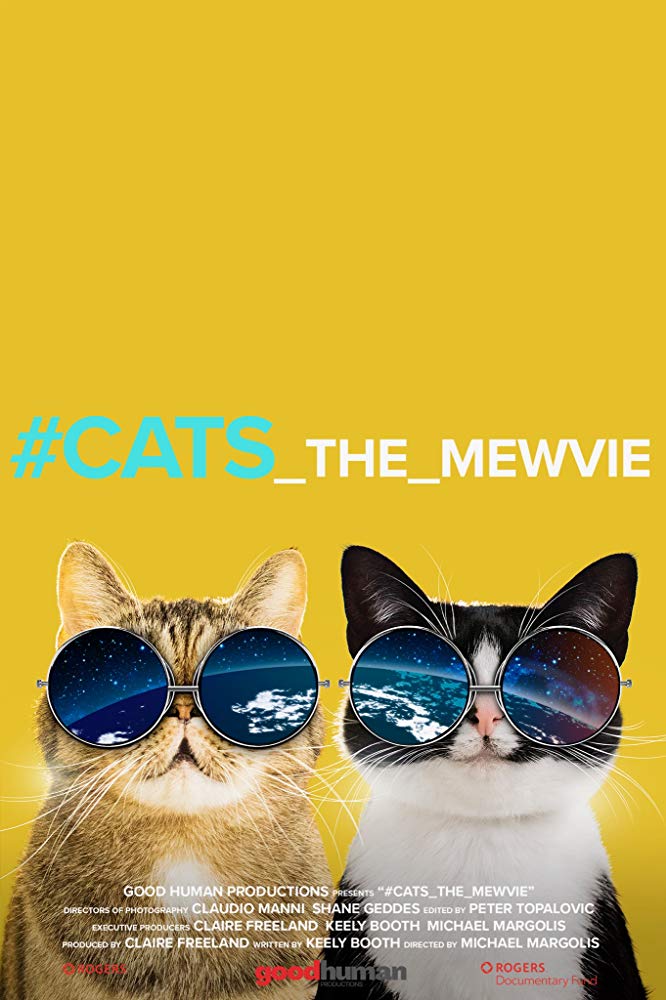
The Internet is: a) is a cat archive b) a world-wide phenomenon for cat enthusiasts c) a cat content generating machine, for cats, by cats d) now with 35% more cats. Even if you’re a dog person, sure there are cute puppy videos, but let’s face it: the internet is all about cats. Well, 96% about cats. Also 1% random ranting, 1% recipes and 2% butt stuff. At one point, when we were fools, we thought the Internet would be a treasure trove of accessible information and a geography-busting connection between humans. We were wrong. It’s all cats.

Not to be confused with Don’t Fuck With Cats, a true crime documentary on Netflix about hunting our own homegrown Internet killer, or Cats, a cinematic travesty that limped quickly out of theatres, tail between its legs, #Cats_The_Mewvie is a documentary that explores the whys and the hows of the feline domination of the world wide web.

Because I am on Twitter, I constantly hear people talk about how negative and soul-sucking and bleak the Internet is. And I often wonder: are we using the same Internet? Because I do not ever feel that way. Of course, I also don’t seek out disagreements, or start flame wars, or engage people who do. When I’m feeling sleepy, I pull up my favourite song. When I need cheering up, I watch puppies doing puppyish things. The worst thing that’s happened to me on the Internet this month is a comment I received on Youtube where Sean and I were referred to as “Handsome man and beautiful hairy lady.” I’m choosing to believe it was a problem of translation…maybe they meant beautiful haired? I’d buy that. In fact, I already have! Why thank you. Thumbs up. 👍🏿👍🏿👍🏿👍🏿👍🏿.

The Internet is filled with cats and people like to look at them so much that some cats are famous. Some cats have agents. Some cat owners have made millions of dollars. Of course, like any show biz parent, you have to be willing to harass your ‘asset’ and turn them into a product to continually be exploited. The rest of us are just taking occasional, amateur, jittery videos of our pets doing stupid or silly things. Those are the ones we post. Most of the time our pets stubbornly refuse to do anything insta-worthy the minute you have your camera out and ready.

Truly, the world is a beautiful place, the Internet is bursting at the seams with quality cats, and Netflix is a black hole filled with documentaries such as this.

The End.

The Last Thing He Wanted

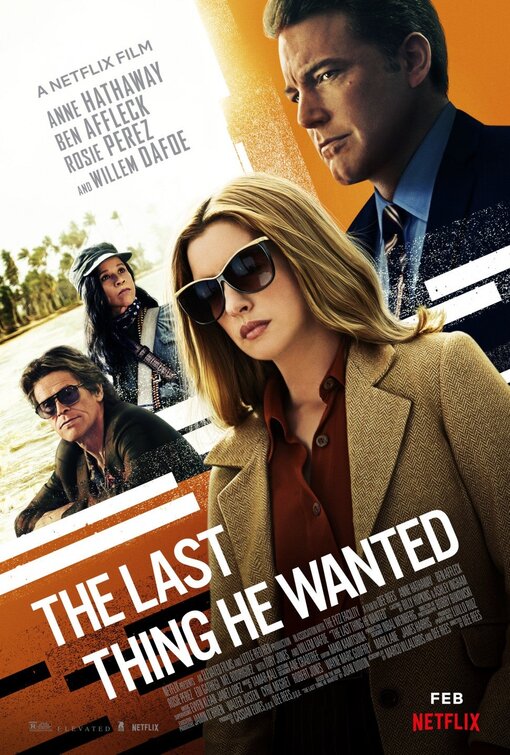
Do you like drama and intrigue and secret ops and exposing deeply classified cover-ups? Oh that’s too bad. This movie has none of that. The Last Thing He Wanted is the last thing anyone wants when they sit down to a movie. It’s sort of counting on you to turn it on and either take a two hour nap take a nap or walk out of the room for a snack and never come back.

Elena (Anne Hathaway) is a journalist who…covers foreign correspondence. She has a kid in boarding school since she’s never home and I have no idea what happened to the kid’s father other than he is indeed alive. Rosie Perez plays her friend/photographer. I think they get reassigned to cover the election at home, which pisses off Elena. She has a kooky father (Willem Dafoe) who is definitely into some shady business and possibly has dementia. He implores Elena to take care of a deal he’s sunk half a mil into but now cannot himself follow through. She does. Or she tries. And things get really shitty. Ben Affleck is around…pretty sure he’s CIA, possibly also into politics? Hard to say.


So this is a brand new Netflix Original that did two things very well: it confused me and it bored me. Granted, those aren’t generally things movies are trying to do, and maybe this one isn’t either, but that’s hard to believe given what a big fat mess it is.

IMDB seems to think it’s about a veteran D.C. journalist (that would be Hathaway) who loses the thread of her own narrative when a guilt-propelled errand for her father (Willem Dafoe) thrusts her from byline to unwitting subject in the very story she’s trying to break. So it turns out I did have the gist. I just didn’t give a fuck. I’m horrified to see this has been adapted from a Joan Didion novel. I hope she doesn’t have a Netflix subscription.

This isn’t a swing and a miss because it was never going to be more than a bunt. I lost track of motivations first, then plot. Anne Hathaway is…dogged. Either survived breast cancer or had a horrific boob injury. Her signature look is a chest covering scarf. She’s mad at everybody. She’s suspicious of nearly everyone but not suspicious enough. It’s so hard to get a handle on this and yet it was so underwhelming I can’t even be bothered to look it up.

Despite the brand name cast and director Dee Rees’ other successes, The Last Thing He Wanted is a real dud. It’s too late for me, but save yourself.


Rich Kid$

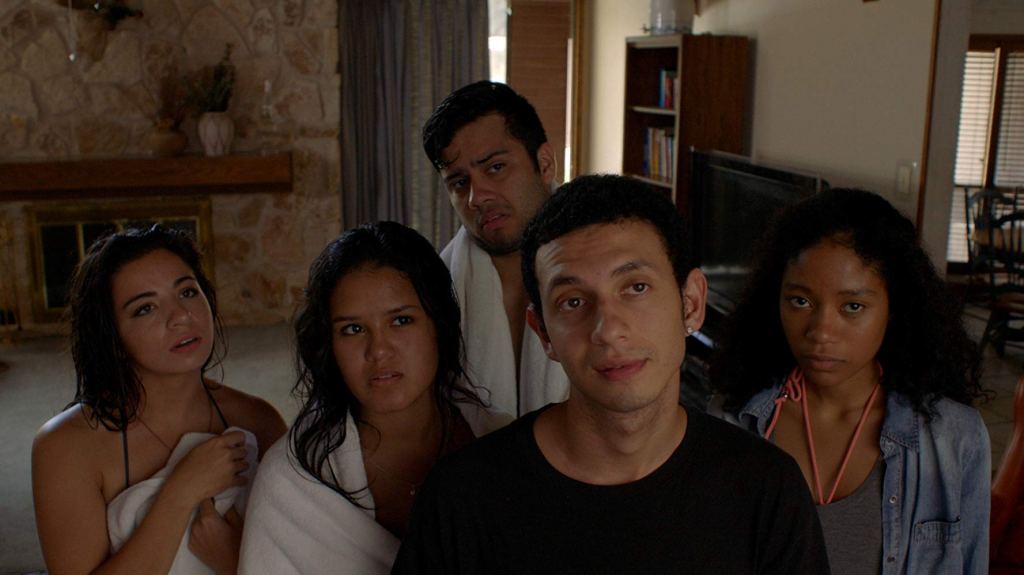
Matias (Gerardo Velasquez) has had a rough start to his day. The sheriff showed up with the landlord to evict his family. Mad at his father for being too proud to ask for help, he wants escape, but his neither his low-income neighbourhood or his similarly economically deprived friends offers much reprieve. So you almost can’t blame him when he and buddy Carlos (Ulysses Montoya) hop a fence to swim in the luxurious backyard pool of a wealthy neighbour who’s out of town.

They have such a nice time it seems almost criminal to keep their good fortune to themselves, so they’re soon joined by Carlos’ car-thieving, trunk-full-of-stolen-goods cousin Steve (Justin Rodriguez), and the girls: Vanessa (Michelle Magalon), Jasmin (Alessandra Mañon), and Isabel (Naome Antoinette). Of course, with the pool such a refreshing success, it’s only a matter of time before the group infiltrates the house as well, trying on clothes, microwaving food, inhabiting a life that, let’s face it, feels awfully good.

You can already sense that the stakes are getting incrementally higher; trespassing is one thing, breaking and entering another. But the kids aren’t doing a smash and grab, they’re cooling their heels on fine furnishings, drying off with plush towels, drinking top shelf booze. They’re pretending to be rich. They’re trying on wealth like a coat in a department store and it looks and feels so good they’re reluctant to part with it. But it’s not theirs, and thanks to subtle directing by Laura Somers, the audience never quite forgets it. Tension mounts the longer they stay; there’s a certain inevitability in the air, like the world they live in will want to put them back in their place.

Somers builds a line (or a wrought-iron gate) between the haves and have-nots. There’s no malice and there doesn’t have to be: the line simply exists. Wealth and privilege and the colour of one’s skin. It’s all tied together and it’s clear these kids have already felt how difficult these knots will be to untie.

A strong ensemble cast and some directorial restraint make Rich Kids a must-see.

After The Wedding

Isabel (Michelle Williams) helps manage an orphanage in India that is very strapped for cash. There’s a possibility of funding, but the investor stipulates that Isabel must come to New York in person, and Isabel isn’t keen to leave her little oasis or the children she loves dearly. But with serious money on the line and so many more children in need, she also can’t resist.

Her posh NYC accommodations are a stark contrast to the life she’s lived in India. Uncomfortable, she’s eager to get back, but the investor, Theresa (Julianne Moore), is adamant that she extend her stay. She even invites Isabel to her daughter’s wedding. Having promised not to return without “a suitcase full of money,” Isabel doesn’t want to disappoint her host, but it’s starting to feel as though Theresa has ulterior motives.

She does.

This is an American remake of a very good 2006 Danish film by Susanne Bier starring Mads Mikkelsen. This one isn’t bad, but it naturally suffers by comparison. This film, directed by Moore’s husband Bart Freundlich, swaps the genders of the leads and breaths a little bit of new life into the script because of it, but the only true reason to see this one at all is for restrained performances by its two formidable leading ladies (Billy Crudup, rounding out the cast, is at a disadvantage).

After the wedding is a very slight meditation on loss and regret but doesn’t quite pack the emotional punch of its predecessor. It’s definitely a quiet film about inner conflict, Williams suffering in near silence, Moore indulging in quite a fantastic display. If you watch it, watch it for them. But this film didn’t need to be remade. The first was so achingly perfect and less neatly resolved, its frayed edges lending it an authenticity that this highly-polished one lacks.


Kuessipan

In northeastern Québec lies an impossibly small village, an Innu community where many band members still live off the land and almost no English is spoken. Two young girls grow up inseperable; Mikuan (Sharon Ishpatao Fontaine) has a close and loving family, while Shaniss (Yamie Grégoire), like too many First Nation peoples, is picking up the pieces of a fractured family and broken childhood. And while their girlhood games of midnight fishing may not feel familiar, their little girl giggles are universal. Best friends forever, they vow to always stick together.

But just a few years later, when the girls are nearly 17, life is driving them apart. Shaniss has an abusive partner and a baby to care for while Mikuan is learning to express herself and pay tribute to her community through poetry. She falls in love with a white boy (Étienne Galloy) and dreams of leaving the small reserve to go to school. Shaniss, already grieving the loss of her friend, starts to feel abandoned.

Kuessipan, which means “your turn” in Innu, is adapted from a novel by the same name written by a young woman from this same reserve, Naomi Fontaine, who helped directed Myriam Verreault write it for the screen. Shot in and around the Innu Takuaikan Uashat Mak Mani-Utena reserve, the film uses band members rather than professional actors, which lends an authentic but not amateur feel.

The film, wise beyond the 21 years of its young author, is about finding one’s voice and one’s path, and having the courage to do so even when it means leaving people, and the comfort of familiarity, behind. With beautiful Indigenous imagery and stark cinematography, it’s also a look at contemporary life on a First Nations reserve, an infrequent subject in film or in literature. With a history of oppression and colonization, many First Nations people in Canada are still living impoverished, wounded lives. And yet their culture survives and thrives in many small communities across the land, their stories told through art that moves and inspires not just their own people, but Canadians across the country and people beyond its borders as well. Kuessipan tells the story of not one but two young women succeeding in their own way, leading lives that will pave the way for generations to come.

Downhill

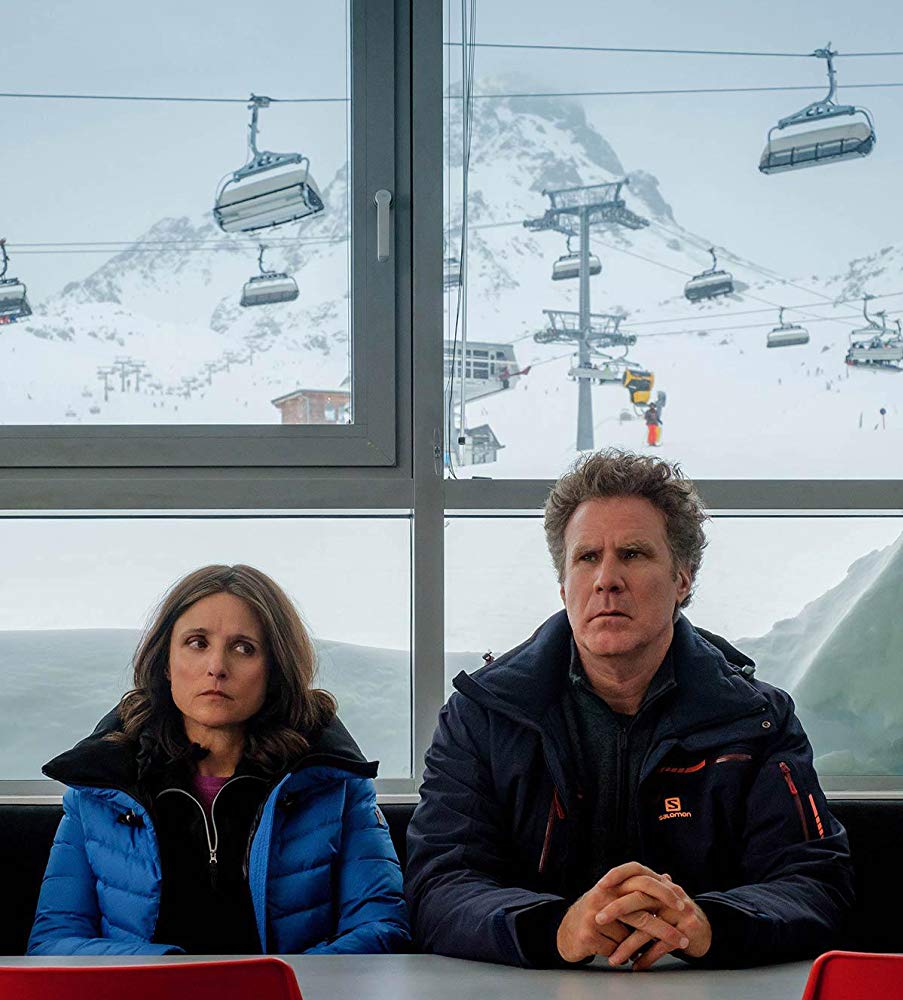
Billie (Julia Louis-Dreyfus) and Pete (Will Ferrell) are vacationing with their two teenage sons at a ski resort in the Alps. One day, during an outdoor lunch, a controlled avalanche sends a wall of snow down toward them, its powder cloud so substantial that all the restaurant patrons fear for their lives. In the panic, Pete flees, saving himself, leaving Billie trapped at the table, protecting their sons. When the snow cloud clears, no one is hurt, but tensions are high as his wife and sons believe he abandoned them in their time of need.

You won’t be surprised to learn that the rest of their vacation does not go well. Pete won’t admit what he did and Billie simmers in (mostly) silence, their interactions steeped in a strong brew of passive aggression. Things really reach a head when Pete’s coworker Zach (Zach Woods) shows up with his bubbly girlfriend Rosie (Zoe Chao) and their carefree hashtag lifestyle is no match for the simmering stress of their unhappily married friends. Billie tearfully, shakily recounts her brush with death and her husband’s cowardice, while the guests sit in horrified silence. She even gets the boys out of bed to confirm the story when Pete once again denies it. Oooof. The movie is supposed to be uncomfortable but it shouldn’t be so wildly miscast. Louis-Dreyfus is convincingly traumatized while Ferrell is just a buffoon. They’re feel like they’re making two different movies.

Downhill is the unnecessary American remake of the excellent Swedish movie Turist (known in English-speaking countries as Force Majeure). Force Majeure was one of the first films we reviewed here, and one that we talked about for weeks, admiring its cinematography and script, but most of all debating the ethics and themes. We went to a pub afterward, and talked about masculinity, filial duty, gender stereotypes, human instincts, and whether it’s fair to measure your relationship based on a split-second decision. Privately, we all wondered how we might have reacted ourselves.

Coming out of Downhill, all we debated was why Americans feel the need to remake movies and make them worse. Yes, laziness of course. Americans hate subtitles. And reading. But Parasite! Parasite just won Best Picture, and that’s subtitled. Progress? Or wishful thinking? At any rate, Downhill feels unfortunately titled considering how it compares to the heights achieved by its predecessor. If you’re going to bother, skip this one entirely and see Force Majeure. Provoking and invasive, it doesn’t just break the marriage open, it goes inside and pokes around.

A Shaun The Sheep Movie: Farmageddon

Shaun is a sheepdog’s worst nightmare. He’s kicking up plenty of mischief on his farm, prompting the poor, overtaxed sheepdog to post signs like: no sheep hot air ballooning, no sheep archery, and definitely no sheep tractor hijacking. But this farm has more alarming things going on than harmless sheep pizza pranks. Shaun has made a new friend, an alien who has special powers. And one of those special powers is for making Shaun’s mischief even more mischievous.

While the rest of the sheep rather obligingly cover for his absence, Shaun goes on an epic journey to get his alien friend back home, all the while evading capture by a certain government agency. Meanwhile, back at the farm, the farmer has had the bright and hopefully lucrative idea to capitalize on the town’s UFO fervor and turn his farm into a Farmageddon theme park – with the poor dog in charge of construction. The film clearly positions the dog as Shaun’s nemesis but you can’t help but feel the dog is given the worst jobs and takes all of the blame. I, for one, feel sorry for him.

Shaun The Sheep is very simple story telling, very charmingly told. There isn’t a shred of dialogue and yet the story is easily communicated. All the gags are visual, and most are aimed at children, but some references to the genre (to XFiles, for example, and Close Encounters of the Third Kind), are clearly meant for the adults in the audience.

Shaun and friends provide everything you’d hope for in a sequel, plus a far wider world to explore and enjoy. And as we expect from Aardman productions, the stop motion animation is not only sweet but filled with beautiful detail, a film clearly made with love. The character work is great and the film is gratifyingly simple. What else can you ask for?

Heartburn

Two people who refuse to ever marry again meet at a wedding, as you do. Rachel’s (Meryl Streep) a writer, Mark’s (Jack Nicholson) a writer, and they both know better when it comes to love. So of course they end up marrying, though not before Rachel keeps everyone at the wedding waiting for hours and hours as she tries to warm up her cold feet in the room next door. I mean honestly, what’s the max time you would spend at a wedding if the bride was refusing to walk down the aisle?

As if that was an inauspicious enough start to their marriage, the two embark immediately on a home renovation. Which, as we all know, is responsible for like 78% of all divorces and about 94% of matricides (when a wife kills her husband). But they get through it, even with the added pressure of a baby on the way who can’t possibly be born if the lace curtains aren’t hung. And Rachel, newly domesticated, is surprised to find how happy she is. And is totally devastated to find, during the waddliest waddle of her second pregnancy, that Mark is cheating on her.

What now? The Streep takes us up and down a whole xylophone of emotions, hitting every octave with masterful precision. Nicholson is the oboe to Streep’s xylophone, a little jauntier, but hitting complementary notes, pairing nicely. Plus his back hair catches pleasingly in the moonlight. But make no mistake: the xylophone is dominant.

Directed by Mike Nichols based on an autobiographical novel by Nora Ephron, the intimacy is authentic enough to make you feel like a voyeur but you need to decide in advance that you’re here for the performance, not the story. Because there isn’t much of one: love goes off the rails. It’s sad but it happens all the time. The minute Rachel shoves a key lime pie in Mark’s face, she’s every cliche we’ve seen before and none we haven’t.

Crazy Stupid Love

Poor Cal. He thinks he’s moments away from a creme brulee when his wife Emily hits him with a wallop: she wants a divorce. And that’s not all. On the tense car ride home, Emily (Julianne Moore) confesses that she slept with someone. Cal (Steve Carell) pulls a LadyBird out the car but it’s not going to save his marriage.

At a local bar, a very despondent Cal is attracting the wrong kind of attention. Crying in public will tend to do that. Resident lady’s man Jacob (Ryan Gosling) takes pity on him, and takes him under his wing to dress him up and teach him how to flirt. Best wing man ever? Suddenly Cal, who’s only ever been with his wife, is putting serious notches into his new, single guy Ikea bedpost. Which doesn’t sit well with Emily, but who is she to complain. Right?

Meanwhile, Jacob’s love life is going in the opposite direction. He’s met a woman he actually wants to not just sleep with, but wake up with. Hannah (Emma Stone) is the right mix of neurotic-quirky-cute and for the first time, Jacob’s falling in love.

Sure it’s a little too sweet sometimes, but Crazy Stupid Love is a legitimately funny rom-com with effervescent dialogue delivered by an A-list cast. Carell is likable as ever, making a convincing transformation both inside and out. For his part, Gosling is game for poking a little fun at his own image, punctuating some of the absurd if not ever quite crazy idiosyncrasies of dating, whether it’s the first or second time around. There’s a maturity (perhaps a pre-Tinder maturity) to it that gives it universal appeal.