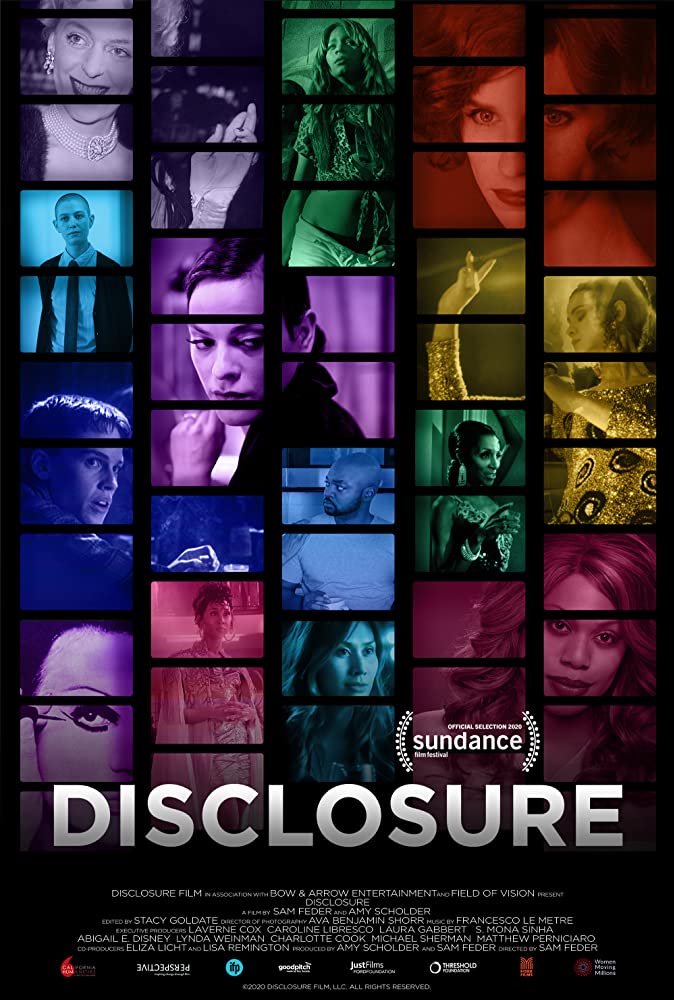
Disclosure gives us an in-depth look at Hollywood’s depiction of transgender people and the impact those stories have had not just on a transgender lives but on American culture as a whole.
Director Sam Feder puts together a documentary of enormous value, not just because of the breadth and depth of its interview subjects (actors certainly, but also historians, researchers, activists and more) but because this film acts as a valuable resource for cis-gendered people to learn and reflect more on the topic without burdening the trans community. Often we lean on minority communities to teach us how to value and respect them when we should be doing the work ourselves. Feder has generously accounted for our laziness and apathy and has made this easily-digested anthology on trans representation widely available through Netflix. No excuses: just watch it.
Let trans people tell you how it’s felt to grow up watching what few transgendered roles there are be of trans people being trafficked, raped, beaten, and murdered. And yet still they were grateful just to know that somewhere out there, someone else felt like them. Or what it’s like to see cis-gendered people playing trans-gendered characters, perpetuating the notion that some sort of trick is being played, or that gender is a kind of performance. And how important it is just to have any kind of representation at all, since the vast majority of us either don’t know someone who is transgendered, or don’t know that we do – and this includes most young people growing up who are trans themselves. Movie and television characters, however, come into our homes and our consciousness, so we need to get them right.
This documentary could easily shame me for not asking the right questions, not saying the right things, not knowing the right people. Instead, it just allows us to be a part of the conversation, to start thinking in the right direction, to start noticing the gaps, and to meet some people outside of our normal circles. They have every right to be angry and yet Feder and company flood us with hope and optimism. They show us the path forward with respect and dignity, and the very least we can do is take that first step.
7500 is the emergency code for a plane hijacking. Fasten your seatbelts, passengers. This is going to be one hell of a bumpy ride.
Tobias (Joseph Gordon-Levitt) is the American copilot on a flight from Berlin to Paris. He and Michael, the captain (Carlo Kitzlinger) are going through the usual piloty pre-flight rituals: ordering their sandwiches, deciding whether they’ll wait for tardy passengers, saying the word “check” a lot, or, to changed things up, occasionally “checked.” Extremely banal shit is what I’m getting at. The fun in being a pilot is apparently in the strut through the airport. Inside the cockpit it’s mostly just paperwork and hitting the right button for autopilot.
But unluckily for Tobias and Michael, no one titles their movie 7500 and then fails to follow through with hijackers. We know it’s coming, but the waiting is agony. Right up until the improvised glass shiv comes out, Tobias and Michael are having an uneventful day at the office which just happens to be 35000 feet above ground, zipping through the clouds at approximately 900 km/hr. I’m having a worse flight than they are, but that’s because I know the title and they think it’s something like “gawd I can’t wait for the weekend.” I feel a tightness in my chest, anxiety in my breathing. And soon enough, so do they.
Emergencies are why we even bother to have pilots at all. Sort of. The autopilot can fly and land and even handle things like engine blow-outs. And arguably it would do better in situations like this. The cockpit must never be breached. The pilot knows that. He or she knows that her #1 priority in a hijacking/hostage situation is to keep the bad guys out. But there’s a difference between knowing that, training for that, and actually doing it when the hijacker has a knife to a passenger’s throat. Or, let’s say, to the flight attendant’s throat who is secretly your girlfriend/baby mama. The autopilot would have no problem obeying this rule, but human pilots are vulnerable – to fear, to compassion, basically to emotion. Which is both a feature and a bug.
So Tobias is in a pickle. A big fat pickle.
This is not Die Hard. We’re not here to have fun. This entire movie takes place in a cockpit, and very nearly in real time. You can’t actually smell the fear pooling in Tobias’s armpits, but you might think you can, and I wouldn’t blame you one bit. This film is intense. So intense I hit pause about 45 minutes in just so I could catch my breath. We are marinating in Tobias’ stress sweat and it is brutally unpleasant. But this is how Patrick Vollrath’s 7500 distinguishes itself from virtually all others in the genre. This is not about action, or heroics. We spend 90 minutes living in a terrified copilot’s shoes. It is neither glamourous nor dignified.
Such is Joseph Gordon-Levitt’s talent that he’s able to convey concern for his unseen passengers and crew – the way he blinks, the way he breathes, the way he hesitates or doesn’t. We can’t see past the cockpit door, but we think of them, and even of the people in the city down below, asleep in their beds, unaware that a terrorist plans for them to die before they wake. Beyond the opposing forces of the highjacker and the pilot, there is little else. We are meant to feel this event viscerally, painfully. It is unlikely to gain traction as a mindfulness exercise but boy oh boy does it force you to live in the moment.
I like 7500 about as much as I like flying, which is to say, not at all. This is not a movie to be “enjoyed.” But airplanes take you to a new and perhaps exotic location. They take you to places that are exciting and interesting to explore. A vacation allows you to try on a different sort of life for a while. Maybe you enjoy it, maybe you don’t, but either way, travel makes you learn things, about the world and about yourself. And sometimes you don’t have to travel any further than your couch to get there.
Just on the off-chance that your internet browser history is squeaky clean and filled with wholesome pinterest pies and youtube videos of puppy piles, I offer you this:
Mope (in addition to other definitions, of course) (noun)
a bottom-tier porn performer willing to do the dirtiest, most depraved work in the business
We first meet Steve Driver (Nathan Stewart-Jarrett) and Tom Dong (Kelly Sry) as they sit among a bunch of men in their underwear. As soon as a light turns green the men cheer, and then start chanting “Bukaki, bukaki!” like a rallying cry, which I suppose it is, to their junk. Another definition:
Bukaki (both a verb and a noun, I think) (it’s filthy, so feel free to look away)
to gather around a woman and cum on her face as a group
The men keep up the chant as they circle around a naked woman named Treasure who is kneeling on a tarp, which should, in theory, be unnecessary, as all the men have only one target in mind. They all, more or less, hit their mark, with only Steve left in the end, still trying to get the job done. Tom offers his (moral) support, which helps push Steve over the edge, and poor Treasure’s face is indeed glazed like a donut. Tom and Steve become instant friends.
For some reason, Steve and Tom are desperate to break into the porn industry, which is why:
a) They agree to a ball-busting audition. I’ll spare you the textbook definition because it pretty much is what it seems – only remember, porn stars don’t wear Toms or ballet flats, they wear 9 inch platform heels.
b) They also agree to share a dorm and split a single salary between them.
But these boys are ambitious. They don’t want to be mopes forever, they want to be porn stars. They pitch themselves to director Rocket (David Arquette), the “auteur of porn,” as the Jackie Chan and Chris Tucker of adult entertainment. It…doesn’t work out for them. Nothing works out for them. The universe is telling them that porn fame is not in the cards for them. Tom accepts his fate, happy to fix up the studio’s subpar website, and contribute to a gang bang once in a while, but Steve is fixated, and maybe a little unstable.
The movie feels almost as amateurish as the porn scene it describes. It also fails to really justify itself as a film even though it’s an (apparently) true story. The script doesn’t generate much sympathy for these characters, who remain unlikable at best, nor does it ever quite find their humanity. This is a piece of shock cinema unlike any other, but that’s not a redeeming quality. The movie goes off the rails in the finale minutes of the film (you wouldn’t believe it if it wasn’t true), making for some memorable cinema, but memorable in the way that trauma is memorable. If only you could forget it. It’s not good for the soul, and I wholly regret having undertaken it.
Like many of you, when I heard the title, I naturally assumed the movie was about this guy:
His name is Herbie but he literally answers to Handsome Devil, a name he lives and breathes every single day.
It’s quite effortless, and quite evident in his swagger. But anyway,contractually I have to eventually boomerang this runaway movie review and get back to the topic at hand: handsome devils who are not my verygoodboy Herbie.
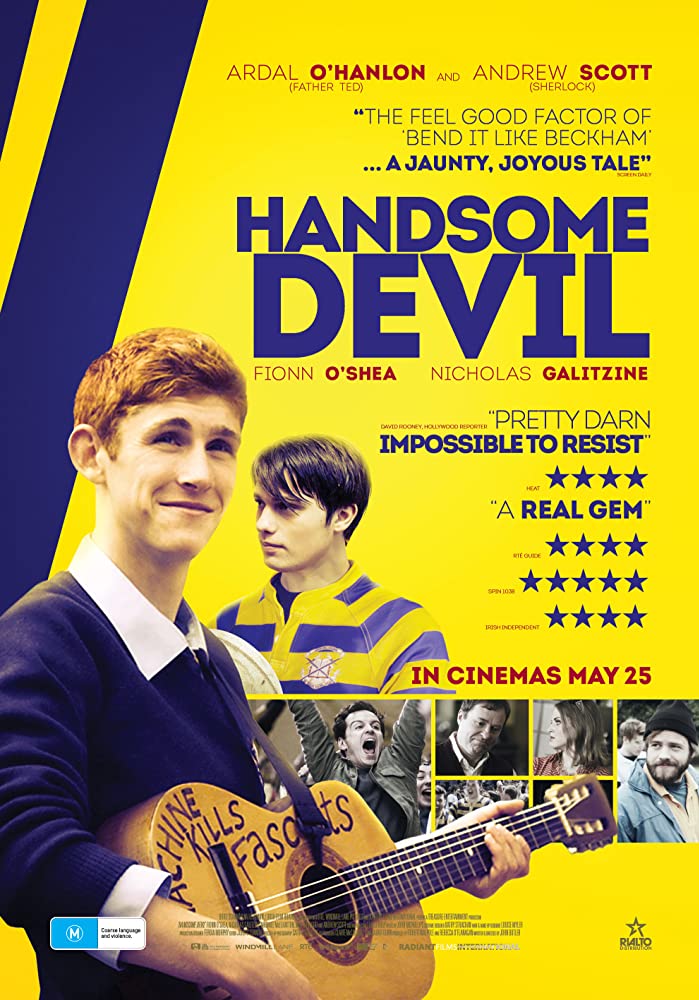
Enter: Ned (Fionn O’Shea). He’s a teenager at boarding school, a constant target of bullies because he’s gay. And then the worst thing happens: the new kid Conor (Nicholas Galitzine), star rugby player, rooms with him. Which means all the jocks (aka bullies) now have an open invitation to hang out in his bedroom, and Ned no longer has a single safe sanctuary on the entire campus. Nor does he own enough boxy furniture to build an adequate barricade around his bed, but that doesn’t stop him from trying.
As you might guess, the proximity does eventually break down their defenses (literal and figurative), and Ned and Conor start to bond. They’re not so different after all! With the encouragement of the new English teacher (Andrew Scott), who challenges students to find their own voices, the two boys find common ground in music.
A simple message, but one we apparently still need to hear. People fear what they don’t know, but all it takes is one friendship outside your normal social circle to expand your horizons and overcome some of the invisible barriers between us. The differences between skin colour. sexual orientation, gender, etc, are superficial at best. Friendships, relationships, even just basic respect – these are based on our shared values and interests.
School is not always a safe space for queer kids (or different kids, or kids), and we’ve been telling them ‘it gets better’ for a long, long time. Which is true: it does get better. But it’s nice every once in a while to hear a story where better starts happening NOW. Queer cinema can often be a bit of a tragedy fest, and while it’s important to remember those experiences as well, it’s really nice to celebrate the victories. O’Shea and Galitzine have a wonderful, subtle chemistry, and give their characters an authenticity I know a lot of us will relate to.
The Vietnam War. Yeah, we all flinch at the words. As a Canadian, I actually didn’t learn about this in school as we were “non-belligerent” (what a term!) (also, we were busy learning about our contributions in WW2, a war America remembers fondly by screaming at random Europeans “we saved your asses!” but Canadians remember as the war we joined immediately because we “thought Nazis were bad” and America ignored for two whole years because “Nazis were maybe okay” and finally joined when “something bad happened to us, on our soil.” Ahem) and I was born long enough after it that there was already a hit Broadway musical about it. But we can’t help having absorbed quite a bit about it, through pop culture of course, and by sheer proximity to our war-mongering neighbours to the south. I knew that it was a tough war because many Americans came to oppose it, which was probably the right attitude, but it meant that a lot of returning vets didn’t get the respect they deserved or the help they needed – which is an American hallmark, actually, by no means exclusive to the Vietnam war. And I knew that bad shit had happened there: we called it the My Lai Massacre; the Vietnamese call it the Son My Massacre, but either way you slice, it meant that 500 unarmedcivilians – men, women, children, babies – were slaughtered by U.S. soldiers. Women were gang-raped and their bodies mutilated, as were children as young as 12. When their cover-up was eventually busted, 26 soldiers were charged with criminal offenses but only Lieutenant William Calley Jr. was convicted. Found guilty of killing 22 villagers, he was given a life sentence but served only three and a half years under house arrest. And for me, the Vietnam war was oddly muddled up with hippies and their peaceful sit-in protests and with civil rights and their peaceful marches. And historically, that’s correct. Some were putting daisies into guns for peace and others were being sent to war, and those things were happening concurrently but not equally. Young black men were being sent to Vietnam in disproportionate numbers while young white men could easily avoid it simply by attending college: Bill Clinton deferred once for college, Joe Biden and Dick Cheney each deferred 5 times. And if staying in school indefinitely wasn’t your bag, your wealth and privilege could work for you in other ways; Donald Trump avoided the draft 4 times with educational deferments but the 5th time Uncle Sam came calling he out and out dodged it – his father called in a favour from a Queens podiatrist who wrote up a false diagnosis of “bone spurs” even though he’d been found physically fit to fight just two years prior and has since said it just “healed up on its own” with no treatment necessary!
Anyway, black civil rights leaders, including Martin Luther King Jr., were opposed to the war for exactly this reason. Once again, black men were being asked (well, told) to serve their country, and there weren’t any colleges or doctors writing bogus deferrals for them. They were asked to protect the freedoms of people in other countries when they still didn’t have that at home for themselves. They were called up in greater numbers of course, and were a higher proportion of combat casualties in Vietnam, and African American soldiers encountered bigots in their ranks, discrimination in the field, disadvantage when it came to promotions and decorations, and fewer services if and when they returned home. That’s a whole lot to untangle, but have no fear: Spike Lee is reaching back into the baggage of his righteous anger, and he’s not afraid to tackle these iniquities.
In Spike Lee’s Da 5 Bloods, Norman (Chadwick Boseman), a soldier in 1970s Vietnam, tells us “War is about money. Money is about war. Every time I walk out my front door, I see cops patrolling my neighborhood like it’s some kind of police state. I can feel just how much I ain’t worth.” Spike Lee always ends up sounding prescient in his films, but his trick is simply having the temerity to acknowledge that the patterns in our shameful history march on today.
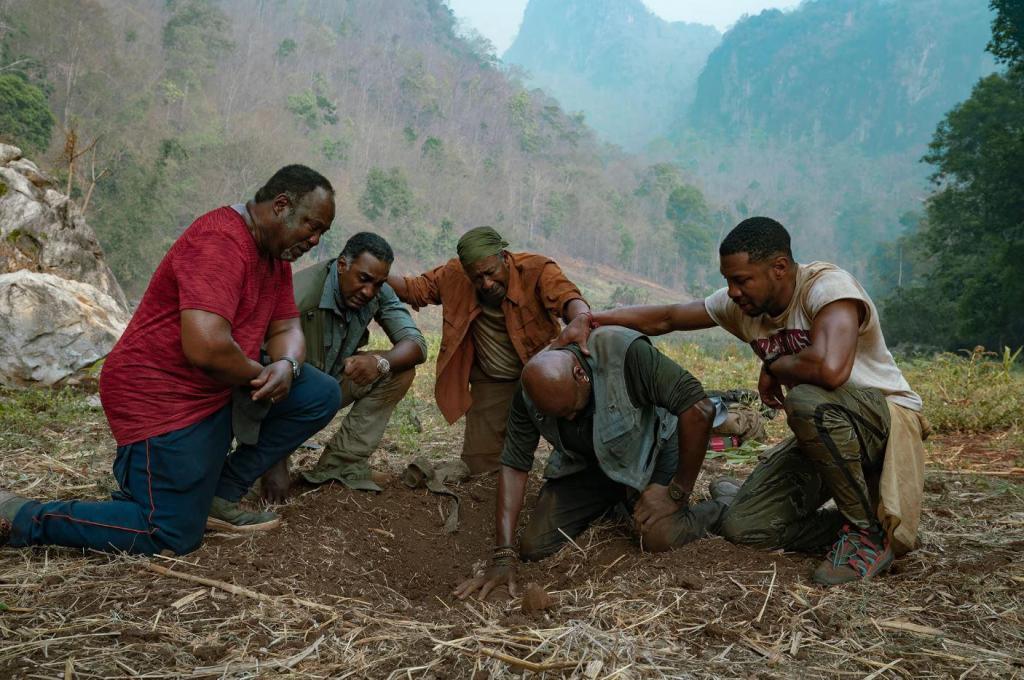
Many years later, four Vietnam vets, Paul (Delroy Lindo), Otis (Clarke Peters), Eddie (Norm Lewis), and Melvin (Isiah Whitlock Jr.) return to Vietnam to repatriate the body of their fallen comrade and 5th Blood, Norman…and also the pile of gold they stashed along with him. Now surely worth millions of dollars, you might guess that this buried treasure is not going to bring out the best in even the most devoted of brothers in arms. Greed, guilt, nostalgia, regret – these we understand, but Paul’s motivation is particularly murky. Unabashedly sporting a MAGA hat, prone to racist outbursts, he’s convinced himself that he’s doing this for Norman’s honour. But propelled by fury, by a barely-restrained rage for the many ways he and his African American servicemen were vilified for their role in Vietnam, that pile of gold bricks starts to feel like reparations. And this recovery mission starts to feel more like one of revenge – against an enemy that Paul can no longer distinguish.
Delroy Lindo’s performance is the sun around which all the other planets orbit, and like all bright balls of fury, Paul is flirting with supernova. And for his part, Spike Lee has of course never been known for his reticence. As a director, he’s prone to flourishes, allowing Paul’s stream-of-consciousness mutterings to morph into a rousing monologue, staring down the barrel of the camera, staring us down, charging us with his passion and urgency. Lee splices the story of his 5 Bloods with real life footage – Muhammad Ali’s conscientious objections, the Kent State massacre, the Black Lives Matter movement (yes, his film is once AGAIN that prescient, he’s taking the pulse of America right from the jugular, right from its crushed windpipe, his alarm and his agitation a perfect reflection of today simply by being unafraid to hold an honest mirror up to the ugliness of yesterday). His script stresses the cyclical nature of the violence without letting anyone off the hook. Spike Lee’s strength as a filmmaker has always been his point of view, his authorial voice resonating backwards and forwards through time, the immediacy of his plea undiminished.
Da 5 Bloods is as potent as anything Spike Lee has ever done, and possibly the boldest feather in Netflix’s cap. The film is visually arresting, the aspect ratio in constant flux as we travel through time (and our four main actors embody their characters in both timelines, a choice I can only assume is deliberate since Netflix has proven willing to splash out for de-aging, perhaps a nod to these men wanting and needing to believe they are still heroic, still capable, still virile, or a symptom of having glorified the time in their heads, and wanting to recapture that now, before it’s too late). But most of all I admire Da 5 Bloods as an allegory for reparations. Not even an allegory, really, but a template what financial amends might look like and how we can begin to take the next steps forward.
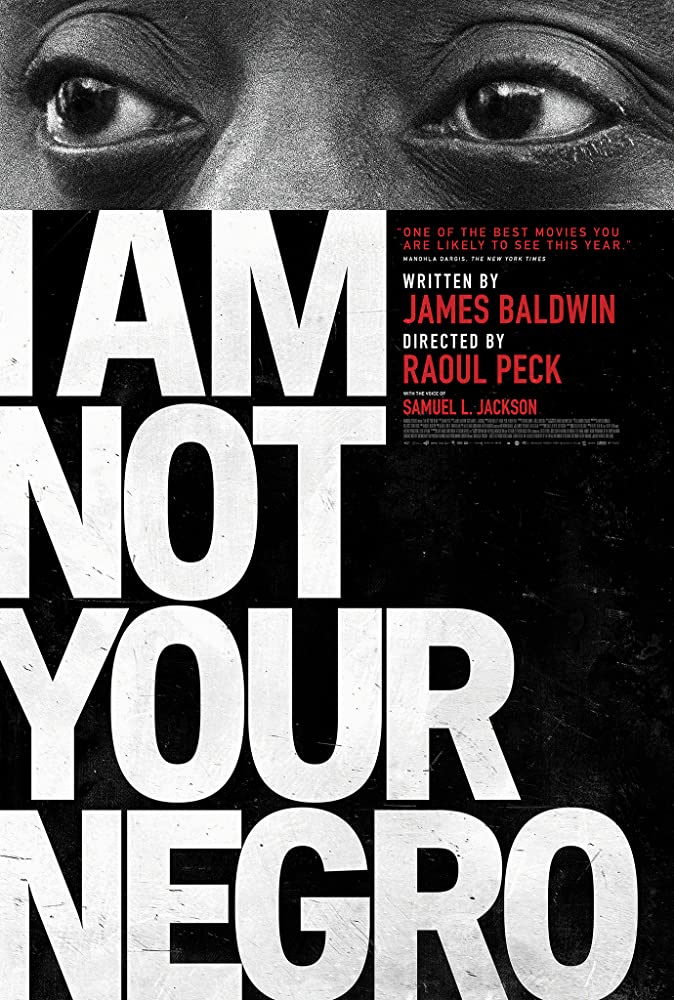
In 1979, James Baldwin wrote a letter to his agent describing his next book, “Remember This House.” It was to be a revolutionary, personal account of the lives and assassinations of three of his close friends: Medgar Evers, Malcolm X and Martin Luther King, Jr. But when Baldwin died, he’d only managed about 30 completed pages of this manuscript. Filmmaker Raoul Peck delivers a stirring documentary as an ode to the book James Baldwin never finished, a work that enmeshes the civil rights work not only of these 3 great men, but that of Baldwin himself.
Samuel L. Jackson narrates some of the strongest and most poetic words – which will not surprise you if you’ve read Baldwin before. He had his finger on the pulse of America, his America, the oft-forgotten America, and he reported on his people with undeniable lyricism, beauty, and confidence.
The documentary expands on his thoughts with archival footage, which is used most effectively when bridging words he wrote 40 or 50 years ago to images of modern conditions and protest, which still apply. I Am Not Your Negro is about civil rights, but it’s also an expression of identity, of unrest, of passion, of hope. He wrote about his people because he saw beauty there, even in the struggle. He was buoyed by it, as much as they were by him. They shored each other up, and as these same issues continue to be fought for even today, it is no wonder we still turn to his words of wisdom and of utter poetry.
Cineplex is offering Canadians a whole bunch of movies that speak to the black experience for free this month – check here for a complete list – and this is one of them, as it should be. I hadn’t seen it since it was released in theatres and Sean hadn’t seen it at all.
It’s been 7 years since this movie came out, but I still remember how deeply it had moved me, saddened me, enraged me, which is why a part of me wasn’t super keen to revisit it. And another part of me was disgusted by that part’s response: the suffering and inherent iniquity of my fellow human beings makes me uncomfortable because IT SHOULD. My ancestors helped create this mess, my privilege benefits from it, and my inaction maintains it.
Oscar Grant III was just 22 years old when he was shot by a white cop while lying face down on the ground. It’s been nearly 12 years since his death signaled a significant problem in policing, and nearly 12 years since we’ve continued to allow our darker skinned friends to die for their melanin. The problem has of course existed as long as policing has; American law enforcement was built in the wake of slavery as a new way to round up black bodies and extort free labour from them, but only in this century has the presence of cellphones allowed these shootings to be captured on film. Grant’s name joins a long list of black men and women murdered by police.
Fruitvale Station is the first feature length film by director Ryan Coogler and his first collaboration with Michael B. Jordan – but not his last. His next film, Creed, gives Rocky fans (and Rocky himself) a strong black protagonist to root for, an extension of Apollo Creed’s (Carl Weathers) legacy, but also a modern American hero for a new audience to look up to. Coogler’s next film takes that premise to an even greater height with Marvel’s first black super hero movie, Black Panther. Through Wakanda, Coogler explores themes of responsibility and identity. He casts Jordan as Killmonger, the fearsome but ultimately sympathetic villain. He helps T’Challa realize that Wakanda’s relative strength and power means they owe something to their neighbours in need, a message that seems not to permeate stubborn white audiences.
Cineplex and other streaming services are also offering another Michael B. Jordan super hero movie for fee this month: Just Mercy. Bryan Stevenson is a real-life African American lawyer who helps wrongfully convicted death row prisoners. Just Mercy is further proof that Michael B. Jordan is himself a black idol, and a major, bankable Hollywood star, living up to his name’s GOAT status.
God’s Own Country is the poor man’s Brokeback Mountain. Well, that’s not fair. It’s not just the men who are poor, even the mountain is more of a hill, or just, you know, fairly flat land, maybe?
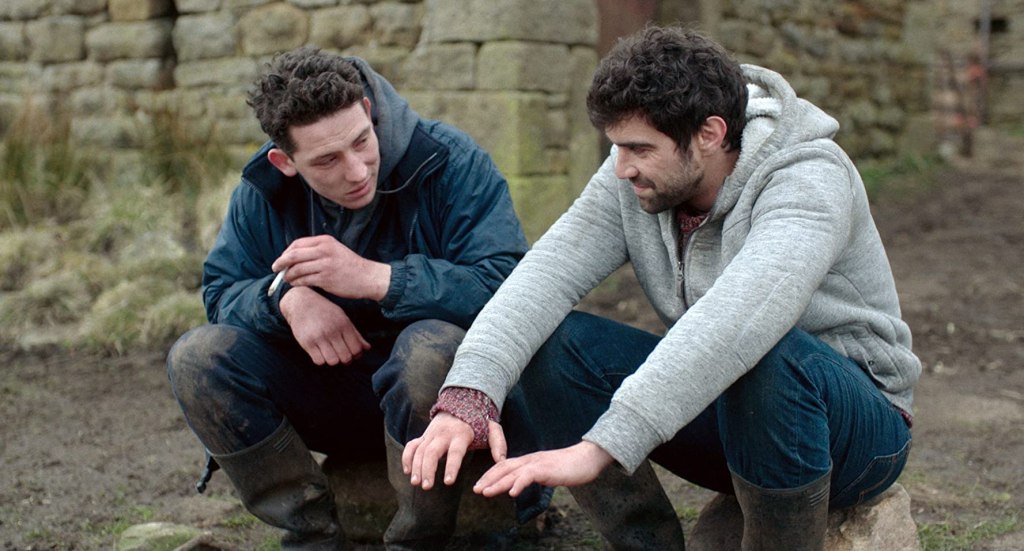
It is spring on the Yorkshire farm where Johnny (Josh O’Connor) works from dawn until dusk. It is perhaps not anyone’s first choice to waste one’s youth doing backbreaking work on an isolated farm, but for Johnny, there’s not much choice at all. The family farm is in disrepair and he’s the only labour, the only other inhabitants being his disabled father Martin (Ian Hart) and his elderly grandmother (Gemma Jones), who shower him with love and gratitude. Just kidding. What would be the movie in that? Johnny toils ceaselessly only to be met with criticism and an ever-growing list of tasks. It’s no wonder he escapes into town at night, to numb his frustration with shots and casual sex. He’ll be wrecked in the morning, and take abuse for it, but there is literally no other joy in his life.
And then lambing season comes. Johnny will spend it camping in whichever remote location the ewes have chosen. They hire Gheorghe (Alec Secareanu), a Romanian migrant worker, to help out, and as we know from Enis Del Mar and Jack Twist, those cold and forbidding nights inevitably end in some hot hot heat. They fall upon each other roughly, their early lovemaking looking a lot like rodeo calf roping, as only sex between cowboys and farmers can. Their initial passion is hungry and desperate but eventually makes way to an intense but intimate relationship.
Writer-director Francis Lee is speaking to us from experience. His story is not about forbidden love or being different, or searching for acceptance. His theme is much more universal: it’s about loneliness. It’s about how love can give meaning to your life if you let it. It’s about the bravery necessary for letting love in even when you feel like a garbage person. I’m paraphrasing of course, but Johnny doesn’t feel ashamed to me, or all that concerned about hiding. Mainly he seems broken and helpless and angry.
The setting is of course thrillingly authentic, painted in graphic, gritty detail. Cinematographer Joshua James Richards does amazing work, allowing Johnny to literally come into the light.
O’Connor and Secareanu give performances filled with achy longing; even as they repair holes in the farm’s fencing, they are dismantling their own barriers. Francis Lee delivers his romance with a dose of reality; we don’t smell roses, we smell manure. But there is beauty in honesty, and underneath the grime and filth is transformative vulnerability.
Despite my initial impression, God’s Own Country is not some poor relation of Brokeback Mountain. It is its son, born of a generation more hopeful and more tender. Jack and Enis would be proud.
If your memory needs refreshing, Punch and Judy are traditional puppets who have been entertaining crowds in the UK and beyond for over 400 years. They started out as marionettes in Italy; Punch was derived from the Neapolitan stock character of Pulcinella, which was anglicized to Punchinello and eventually just Punch when the show made the jump over to Great Britain, and the marionettes became hand puppets out of convenience or laziness or both.The show costarred Mr. Punch’s wife, Judy, and a cast of rotating characters. Much like a soap opera, the story wasn’t fixed, but it always featured some key elements: their baby, mishandled by Punch, a hungry crocodile, an officious policeman, a prop string of sausages, a generic hangman named Jack Ketch. The show was a series of scenes in which various foes come for Punch, but each is eventually victim to his slapstick (note: though Mr. Punch does an awful lot of clowning around, his slapstick is indeed a large stick used for slapping people, often to death). Mr. Punch will then utter his famous catchphrase “That’s the way to do it!” which is how the expression “pleased as punch” was derived – from his sense of gleeful self-satisfaction. Despite the numerous murders, a Punch and Judy show is a comedy, often provoking shocked laughter.
Cut to 2020 when writer-director Mirrah Foulkes re-imagines the show’s origin story in her own sordid tale, called Judy & Punch. In the tiny 17th century English village of Seaside (actually nowhere near the sea), Punch and Judy entertain the villagers with their weekly puppet show. The violent show is right at home among these people, who satisfy their bloodlust with public “stoning days” where their anarchic mob rule interprets random coincidences as witchcraft, condemning their neighbours to die – unless of course the crime is though to be particularly heinous, wherein they might just be hanged immediately.
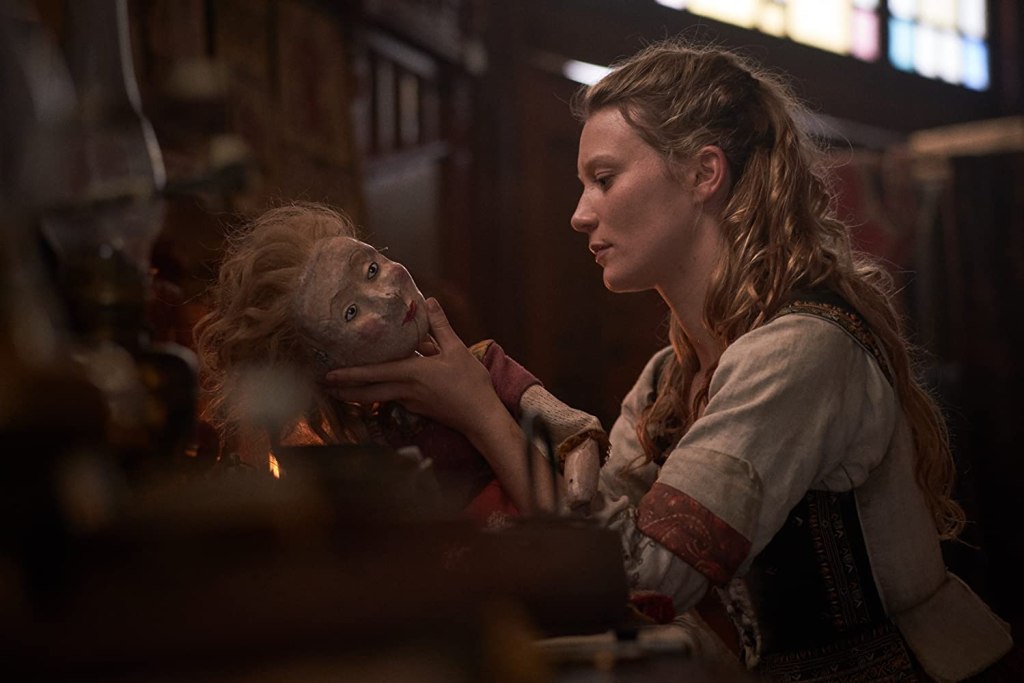
At home, Punch (Damon Herriman) is a drunk and Judy (Mia Wasikowska) his hard-working and long-suffering wife. One day while she makes a quick trip to market, Punch accidentally kill their baby during a drinking binge. Judy has been gone but an hour and is understandably heart broken to find her baby murdered but her sobs only enrage Punch, who then makes her a victim of his slapstick. He disposes of both bodies.
Allow me to interrupt myself here to say this: when the baby dies, it is under circumstances so perfectly orchestrated, so perfectly designed and directed that I uttered a single “Ha!,” followed by a horrified silence as I processed that the baby is in fact dead. If you were not familiar with the particular and very specific brand of dark humour found in a traditional Punch and Judy show, you might think that this movie has a serious problem with tone. But understanding the history means you cannot fail to admire Foulkes’ ability to find what has to be the very slimmest of veins wherein a baby’s death can be both funny and cruel, and executing it to perfection.
In the film, Judy narrowly survives the beating, unbeknownst to Punch, and hides among a band of outcast heretics while she heals. Together they plot revenge not just on Punch but indeed on the whole town who have so successfully driven out or eliminated anyone with a difference. In this way, Foulkes is able to explore the kind of atmosphere where such a show could have proliferated. Punch is undoubtedly a bad man. Each show usually includes a scene wherein Punch lays out the bodies of each and every one of his victims for the audience to count, yet they still cheer when he bests the hangman, or indeed even the devil himself. These were cruel times fueled by fear: if not them, then us.
Mia Wasikowska delivers a strong performance as a woman with talent, brains, and resources, yet so few options that she must hide in the forest for fear that her survival may be interpreted as witchcraft. Herriman pulls off an even harder feat as damned Mr. Punch: a fool, a predator, a charmer, a pretender. The thing about puppets is that whether dancing with their wives or bludgeoning them, their expressions never change. Perhaps a painted-on grin helped the audience swallow his violent attacks. But our Mr. Punch is a man, a puppeteer. Herriman has to be believable as both the bumbling buffoon chasing after a dog who’s stolen his sausages, and mere moments later, a father who has not only charbroiled his own baby, but pinned her murder on elderly innocents. And he is!
I am reminded of a time back in 2016 when I reviewed a “black comedy” that I felt was SO black it merited a whole new category, so I invented the Vantablack comedy, Vantablack being in fact a colour that is blacker than black, absorbing all but 0.035% of light; a black so black our human minds can’t actually perceive it. I would like to unroll this categorization once again, in honour of Judy & Punch, Mirrah Foulkes’ audacious directorial debut.
Judy & Punch is available digitally on Apple/iTunes as well as VOD services.
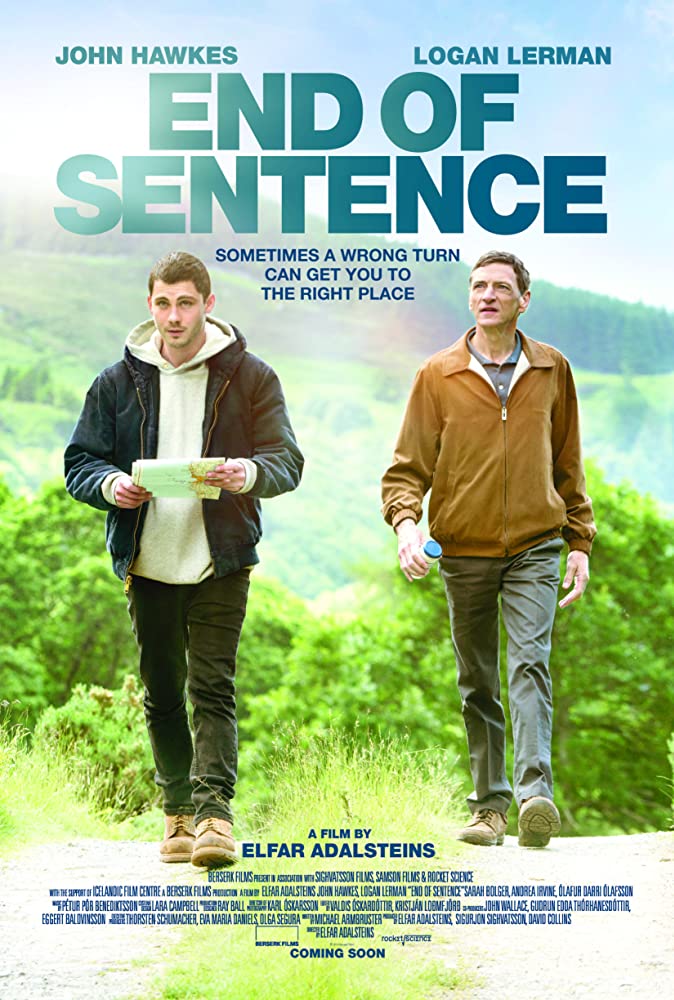
Frank (John Hawkes) is recently widowed when he picks up his estranged son Sean (Logan Lerman) from prison. Neither is exactly keen to spend time with the other, but Frank’s late wife’s last wish was for her son and her husband to travel to Ireland together to scatter her ashes in a special lake. Frank is determined to honour her wish, and Sean is determined to be in California in five days time. A deal is struck – Frank promises to deliver Sean to California by way of Ireland – and two reluctant travel companions, plus the ashes of their only common bond, are on their way east – very east.
In Ireland, Frank will come to understand his dearly departed wife a little better, while Sean will come to understand his distant father. None of these will be easy lessons. In fact, long before the mission is either accomplished or abandoned, you and I will start to suspect that the dead wife orchestrated the trip not so much out of preference for her final resting place but perhaps as one last attempt to reunite the two men in her life from beyond the grave. Of course, as in life, so in death: Frank and Sean share a complicated and painful history, and the Irish countryside, beautiful as it may be, is not a magical cure.
Michael Armbruster writes a story that is sensitive but not sentimental about two men who share the same grief but process it side by side rather than together. The story is about men, and how they will relate to each other now that their moderator/interpreter/buffer is gone. It is quite possible that Frank and Sean have never been in a room just the two of them before, and quite clear that this is their preference. And yet – mother knows best? Certainly in her last days she must have worried about them, about her son already careening down the wrong path, unlikely to succeed upon release without the one person who always believed in him, and about her husband, so unable to connect, so solitary and cold in his default demeanor. The script here is brilliant because it allows us to read and explore these things through action and inaction rather than constantly looking back, and director Elfar Adalsteins reinforces this idea by showing rather than telling. This leaves room for the audience to see a bit of themselves in this dynamic: bits of their own grief, their own fraught relationships, their own pain, desire, comfort, and hope for the future, and the story becomes that much more relatable, that much more resonant.
I knew nothing of this movie when we came upon it for rent on VOD, but it turned out to be one of those unexpected cinematic gems just waiting to be mined.




 ASSHOLES WATCHING MOVIES