
Kane’s been missing for a year when he suddenly turns up at the home he shares with his wife, Lena, hemorrhaging blood. He’s been deployed on a top-secret mission that Lena can’t fully understand even as she’s recruited to join the next one. Of the dozens of men deployed, Kane is the only one to return, and he’s just waiting to die of organ failure.
Three years ago, something mysterious happened to a nearby lighthouse, which has been enveloped in a “shimmer”, a danger zone inside which terrible things are happening and from which no one returns. The zone is growing daily, and their own city will be overtaken if they don’t figure it out soon. So Lena (Natalie Portman) joins the next mission, the first one to be all-female, an expert biologist but also just a wife wondering why her husband would sign up for a suicide mission. She joins a group of women (Jennifer Jason Leigh, Gina Rodriguez, Tessa Thompson, Tuva Novotny) highly trained but with nothing to lose as they enter what is likely to be their last mission.
 Inside, every living thing has been transformed. Mutations have made some things astonishingly beautiful, and other things the stuff of nightmares (imagine an alligator-shark hybrid). And now those things are also taking on human DNA.
Director Alex Garland took on human uniqueness in Ex Machina and further explores the subject here. When they are reflected back on us in other living things, which of our traits make us truly special, truly human? It’s a scary question. Garland continues to excel in the creepy, quiet moments between the splashier, gorier stuff. His style throws us off-kilter even as the visuals delight. The audience is continuously confronted with questions to chew on while scary monsters breathe down our goose-pimpled necks. Alex Garland is clearly a talented sci-fi film maker, and even if you leave the theatre confused, you won’t be able to let it go.
For fans of the novel, by Jeff VanderMeer, don’t go in too attached. Garland chose not to re-read the book before embarking upon the script, so the movie turns out more a distant cousin of the book rather than a faithful adaptation. In fact, the details I remembered most from the book were absent; clearly Garland and I latched on to different themes. But the essence remains, the terror remains, the curiosity remains. Annihilation doesn’t exist just to scare you, it wants to challenge you. This is a bold film that doesn’t fit inside any comfortable Hollywood mold. The studio is crapping its pants because it think the movie’s too “cerebral” for us folk. But you know what? Embracing the unknown can be freeing. And exploring these concepts with women as our protagonists, free from macho bullshit, allow us to also experience these things for their beauty and their terror at the same time. Portman’s character is remote, unreachable. Rather, Thompson and Rodriguez provide the most emotional heft as their characters contemplate the most gorgeous and familiar of mysteries.
I left this movie shaken.
 Poor Janet. She’s just achieved a major career coup and every single guest at her party will make a thunder-stealing announcement. It’s really not her night. It’s REALLY not her night.
 awry. Basically he’s chosen too good a gift, and someone beats him to it – a thief! But it’s poor Paddy who gets the blame, and somehow he gets thrown into gen pop prison, even though a) he’s a bear and b) he’s really just a cub. It says terrible things about Britain’s criminal justice system, when you think about it. Anyway, while in prison he falls in with rather a rough crowd, as tends to happen, and soon he’s Knuckles’ bitch. I mean, it’s decidedly less vulgar than I’m implying. He and Brendan Gleeson basically make sandwiches together until until either they escape or the Brown family gets their shit together.
 Turturro) may be stepping out on their mom, but he’s also the geeky guy who still takes them to Benihana for special occasions even though they’re far too old. Their mother (Edie Falco) has never struck them as a sexual being before, but it turns out that she too has wants and needs, and that maybe not all her tears and concerns are for them. This is a really great script that unfolds over just a couple of days, but pivotal days that will completely reconstruct the family.
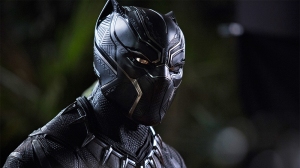 The Marvel Cinematic Universe is so bloated at this point that Marvel usually crams as many superheroes as possible into the “solo” movies in between Avengers instalments. For example, Iron Man pops up in
  ess the same movie. Clearly, that’s Marvel’s goal with a shared universe as that way, we movie-loving rubes have to see them all, and throw even more cash into Disney’s money bin (which by now must be bigger than Scrooge McDuck’s).
 ty disputes in Black Panther are resolved through lots of punching and kicking (which, for all its flaws, is clearly a more efficient political system than the one the USA is currently using).
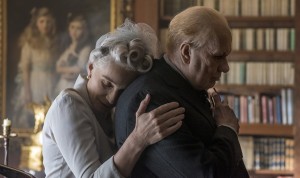 Brendan Gleeson, Timothy Spall, Robert Hardy, and most recently by John Lithgow in The Crown. He is not a saintly figure. He was a great orator but had some problematic positions that hindsight can’t afford to be kind about. Portrayals of him often emphasize his omnipresent cigar, and his particular style of speech (his custom dentures helped cover up a lisp). Gary Oldman is the gentleman tasked with bring old Winnie to life in Darkest Hour, and though he’s seen chomping on the necessary cigars, he turns the performance into something truly remarkable.
 former father-in-law’s fortune. Getty (Christopher Plummer) is pretty set in his ways, and to avoid dealing with his mouthy daughter-in-law, he sends his “security guy” Chase (Mark Wahlberg) to do the dealing for him. But will this weird and uneasy alliance be enough to save Junior (Charlie Plummer, no relation)? If you were alive at the time you likely already know the answer.
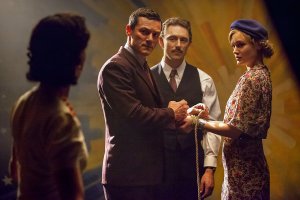 relationship, taboo and reviled in the 1930s and 40s, was that it inspired the creation of the Wonder Woman comic. Marston’s original stories (written under a pseudonym) incorporated the feminist ideals embodied by his wives. Wonder Woman was a strong woman who needed no man. His early comics also involved a fair amount of bondage and submission, which he pursued in his own bedroom and thought more young men should be turned onto. You can imagine the sort of censorship and uproar he faced.
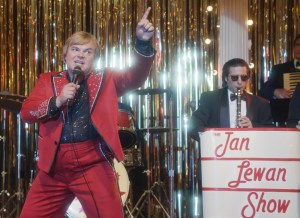 The FBI gets one whiff of this and feel it must be some sort of Ponzi scheme. They shut Jan down, but since he promises it was an honest mistake, and to pay back his investors, problem solved. Except, in order to pay back his investors, he ends up creating a second, bigger scheme.
 ASSHOLES WATCHING MOVIES