Category Archives: Kick-ass!

The highest honour we can bestow on a film. Anyrhing in this category is a must-see.

Free and Easy

To be honest, it took me a while to adapt to the pace of this movie. It is slow, deliberate, and very measured. There’s no getting ahead of yourself. But the unusual story and glimmers of humour hooked me and I was glad I stuck it out. Free and Easy is genuinely something that feels new and unique.

It’s about a “soap salesman” who never sells a single bar but does encourage people to sniff his product (“a different scent on all 4 sides!”) because doing so induces loss of consciousness. Once his would-be customers are asleep on the ground, he frisks them for money and valuables. So he’s really a thief, posing as a salesman.

1_22_free-and-easy1-676x450Director Geng Jun shows us a side of China rarely seen: crumbling, bleak, all but abandoned. This cold, deserted, post-industrial town in northeastern China is dotted with rural characters, and they’re all as shady as the salesman.

It almost watches like loosely connected vignettes, a series of petty crimes where corruption and lawlessness is the new normal. But whenever these criminals encounter each other, you can’t help but laugh. The humour is deadpan but it landed surprisingly well for a movie that runs the risk of being lost in translation. There’s some slap stick, which I suppose is universal, but really it’s just the contrast between this totally depressing setting and the buffoons that populate it that just works.

The film is minimalist but that doesn’t mean there isn’t a lot of attention to detail poured into each shot. Out-of-focus details often sharpen into the butt of the joke. You have to stay alert to small gifts planted by the director along the way. Sure the subtext of the film is a little depressing, but it’s delivered in such an obliquely funny way, the message presented by sliding it in sideways, that you’ll laugh appreciatively at things that aren’t even overtly funny. In a film full of grifters, it’s the cops who are the dirtiest  of them all. That’s the lens through which contemporary, provincial China is explored in (ironically titled) Free and Easy, and the film stays remarkably on-brand.
Dunkirk

We shall fight on the beaches, we shall fight on the landing grounds, we shall fight in the fields and in the streets, we shall fight in the hills; we shall never surrender, and even if, which I do not for a moment believe, this island or a large part of it were subjugated and starving, then our Empire beyond the seas, armed and guarded by the British fleet, would carry on the struggle, until, in God’s good time, the New World, with all its power and might, steps forth to the rescue and the liberation of the old.

-Winston Churchill, June 1940

Has anyone ever been better than Winston Churchill at giving motivational speeches?  He had a way of rising to the occasion and here, the stakes had never been higher.   This speech was given immediately after the British and their Allies had been run out of France by the invading Germans.  Victory over the Nazis was not on the horizokinopoisk.run and must have seemed impossible at the time.  That’s more or less what Churchill said, after all: he is not describing a plan to win.  He is describing a last-ditch effort to survive when the Nazis try to conquer Britain after they finish in France, and a cry for help to the New World to save the day in that bleak scenario (Canada was, of course, already part of the Allied forces at the time, but the U.S. would not be until Pearl Harbor).

The devastating outcome of the Battle of Dunkirk gave good reason for Churchill’s pessimism.  It is a fascinating historical event because it was a loss that could well have broken the Allies, but instead, it galvanized them, particularly in the way that the British survived: hundreds of civilian vessels sailed from Britain to France to help rescue over 300,000 Allied soldiers from the Nazis.

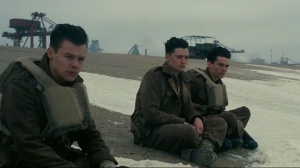
Time and time again, Christopher Nolan has proven himself to be as adept a director as Churchill was a speaker.  Tonally, Nolan’s Dunkirk captures what must have been the prevailing mood on the ground, at sea, and in the air as the Battle of Dunkirk was fought.  Nolan makes an inspired structural choice by intertwining three different stories over three different time periods, and as only Nolan can do, effectively explains a complex structure using only three small titlecards at the very beginning.  Dunkirk is reminiscent of The Prestige in that way – in both, Nolan always provides enough cues so the viewer knows exactly where a particular scene fits into the overall timeline and story, even as he tells the story in a complex, non-linear fashion.

With Dunkirk, Nolan has outdone himself.   Given how consistently great he has been throughout his career, it is incredible to think that he has gotten better, but that is clearly the case.  Dunkirk is absolutely masterful filmmaking from start to finish.  Above all else, Nolan’s film captures the essence of Dunkirk and gives us a true sense of the anguish of war, the desire to survive, and the fear of the unknown that soldiers must deal with constantly.  In particular, I am reminded of the scenes featuring Tom Hardy’s RAF pilot, all of which inserted me into the battle and truly made me feel how claustrophobic a Spitfire’s cramped cockpit would be, and how difficult it would be to spot, identify, and track an enemy fighter, let alone shoot it down.

For the viewer, this is a vital, visceral, and draining experience.  Dunkirk is a 106 minute movie that feels like it’s four hours long (which Nolan would take as a high praise, I think, if he ever read this review).  From start to finish, it is tense, it is devastating, it is awful and it is brilliant.  Dunkirk is filmmaking at its finest and a fitting tribute to one of the defining events of the 20th century.


The Honor Farm

I hadn’t seen my friend Josh in months and was eager to tell him all about the exciting new movie I saw at the Fantasia Film Festival. “I just saw The Honor Farm and I’m still trying to figure it out,” I told him while seated at a nearby Mexican restaurant.

I hadn’t seen the baby boomer somehow Honor farmstanding right over me until he chose this moment to cut me off. “I just saw that,” he complained. “It was terrible“.


I didn’t really want to get into it with this guy nor was I even confident that I had understood the film well enough to defend it so I just smiled politely as he told me that it wasn’t even scary. I bashfully admitted that I was the guy who jumped and cried out during the final act.

honor farm 2

The Honor Farm is exactly that kind of movie. It’s the kind of movie that you need to let sink in while you ignore those who will immediately and loudly dismiss it. Lucy (Olivia Grace Applegate) seems to feels like she’s just going through the motions as she prepares for her prom. After her drunk date embarasses her and tries to force himself on her, she reluctantly agrees to accompany her best friend Anne (Katie Folger) and a classmate she barely knows into the woods to take shrooms in an abandoned prison farm.

Other than that, the less you know about The Honor Farm the better. Although you should probably be warned that horror fans like the one described above may be disappointed. Because the set up seems bloody perfect. Eight teenagers, most of them seeming to fit a typical scary movie stereotype, entering a creepy prison on prom night might make you start placing bets on who will be first to die but this isn’t your typical scary movie. What follows is truly surreal and genre-bending and few of these character arcs play out like you’d expect.

I may have been a little lost during the closing credits but The Honor Farm keeps getting better the more I think about it. And I’ve been thinking about it a lot.

Chasing Coral

The ocean only has to warm about two degrees for coral to die, and guess what? The ocean is warming and the coral is dying. Much of it is dead already. It’s not just sad because we’re losing a beautiful animal; coral is vital to our ocean’s ecosystems, and when coral dies, so do many other species in the ocean, and it’s only a matter of time before we ourselves feel dire repercussions. Coral are the trees of the ocean, and their extinction en masse cannot and will not go unnoticed. The question is: will we notice before it’s too late?

One diver, Richard Vevers, realizes the ocean has a bit of an advertising issue: it’s out of sight, and largely out of mind. But if he could find a way to show us at home what’s going on beneath the waves, might we pay attention? Inspired by the film Chasing Ice, which captured the receding glaciers through years of time-lapse, Richard thought the same MV5BODA5ODAyNjk5M15BMl5BanBnXkFtZTgwNzQ3NTE5MDI@._V1_SX1777_CR0,0,1777,785_AL_technique could be applied to the reefs, so he called up director Jeff Orlowski, and an idea was born.

Underwater time lapse meant nothing short of a new invention was necessary. A whole team built special cameras that could exist in salt water for months a time, in the cold, under great depth and pressure, subject to storms, and needing not only to be wiped clean regularly, but to host a router that would send the images back. This is how they meet Zackery Rago, who’s part of the camera building team but also has a secret passion for coral. They position their cameras in the reefs of Hawaii, the Bahamas, and Bermuda, but nature and technology conspire against them. In the end, it’s necessary for them to go down and record this massive bleaching event themselves.

Another lesson learned: watching a beautiful animal die is hard. Watching them practically go extinct is wrenching. 2016 was a bad year for coral. 29% of the Great Barrier Reef died in 2016 alone. In 30 years, we could lose it all. White coral is a shock, of course. The white is the coral’s exposed skeleton. Death is imminent. Dead coral is even sadder, devoid of any life or colour.  While the time lapse originally meant that they could observe this happening from a distance, the modified plan of divers capturing the footage themselves means they are confronted with this death and dying in person, and they find that quite devastating. I think you will too and I think you should watch anyway.

Kristen Bell recorded a song specifically for use in the film. She feels strongly about the film’s message, but I think the hope is that we all will, and feel galvanized into action. You can start with Vever’s The Ocean Agency and suggestions found at Chasing Coral. But I think just not turning away from this is the important thing.


A Ghost Story

ghost-storyFilm as a medium is almost infinitely flexible, universal and personal at the same time. Film is capable of so much emotion and yet it’s also capable of conveying the complete absence of it. Beauty or lack of it.  Terror or peace. And, as A Ghost Story proves beyond any doubt, film can make you feel so fucking uncomfortable and voyeuristic that you would give anything for the director to just yell “cut” already!
Put another way: how long do you think you could bear watching someone eat pie? Think carefully before you answer. For the full A Ghost Story experience, write your response down on a little scrap of paper and hide it in your house (or underneath a rock if your house is just a couple of pegs in the ground).

Whatever you think you can bear now, the inescapable truth is that no amount of tolerance for pie voyeurism will be enough to survive A Ghost Story unscathed. In one strange, haunting scene, A Ghost Story makes its mark, and there are lifetimes of other achingly lonely scenes for you to digest (but only if you can stomach it).

A Ghost Story plods, skips, stops, philosophizes, winks, and does whatever it wants, conventions be damned. It is a wonderfully strange, unique and brilliant experience that I cannot recommend enough.

By the way, see A Ghost Story in a theatre if you can, because there is a magical dichotomy in the mixture of loneliness and comradery that should result from experiencing this film with others. That contrast is yet another example of film’s versatility, and doubles as a valuable touchstone if you ever happen to become a ghost. It will all make sense in the end, and that is a comforting thought, isn’t it?


Vegas Baby

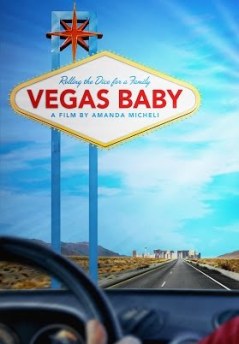
Perhaps as many as 1 out of 6 couples faces some sort of fertility issue when trying to conceive a baby. To answer this need, science offers a smidgen of hope: the ability to harvest eggs, inseminate them, and plant the fertilized embryos in utero, giving conception a greater chance. Is it a perfect system? No it is not. The odds are likely still against you. But the numbers aren’t the only barrier to babies – so, too, is the cost. One fertility clinic therefore offers the chance to “win a baby” – really, just one course of in vitro fertilization. But this contest attracts many desperate people who make emotional appeals.

This is a really interesting documentary, and a heartbreaking one too. It addresses issues ranging from:

movieposter.jpga) Is it even ethical to “give away”  a baby as promotional material?

b) Is it exploitative to force fertility-challenged people to compete against one another?

c) What happens to all the “losers”?

d) Why are people willing to spend hundreds of thousands of dollars trying to conceive, but unwilling to adopt?

e) Why do some countries consider infertility to be a legitimate medical condition deserving of coverage and treatment while the U.S. leaves infertile men and women high and dry?

e) After bankrupting themselves financially and emotionally, what happens to a couple who still doesn’t have a baby?

f) What happens when your heart tells you to pursue baby-making by any means possible, but your religion expressly forbids it?

Director Amanda Micheli has fertility problems of her own, and used the baby contest as a provocative conversation starter in this documentary, a film that takes a look behind the curtain at the subject that is so rarely talked about. It’s a well-made film that is interesting and worth of your time. Kudos to all the people who shared their journey and their private pain; fertility and infertility are little understood, so shining a light on this issue is an important step in humanizing a subject that really hits us at the core of our personhood. We take our fertility for granted and losing control over something our bodies are supposed to do naturally seems to be a demoralizing process. The film is full of heartbreak. But there are little rays of hope too, and Micheli does a good job of balancing the rain and the sunshine.

Spider-Man: Homecoming

spidey11Spider-Man: Homecoming may not be the best movie in the franchise (since my favourite Spidey villain is Doc Ock, I have a soft spot for Spider-Man 2) and may not even be the best superhero movie of the summer (Wonder Woman is undeniably great).  But the fact that those were the conversations the assholes were having after we saw Spider-Man: Homecoming last night shows that Homecoming is a great movie in its own right.
Most importantly, Homecoming GETS Spider-Man.  This is a movie that is fan service from start to finish.  The Marvel Cinematic Universe features prominently in the story as the events in the Avengers and Civil War are built on (and Iron Man plays a pretty big role).  There are also a ton of familiar names for fans to find, from Ned Leeds to Flash Thompson to Mac Gargan, and one or two more that I’ll let you discover for yourself.

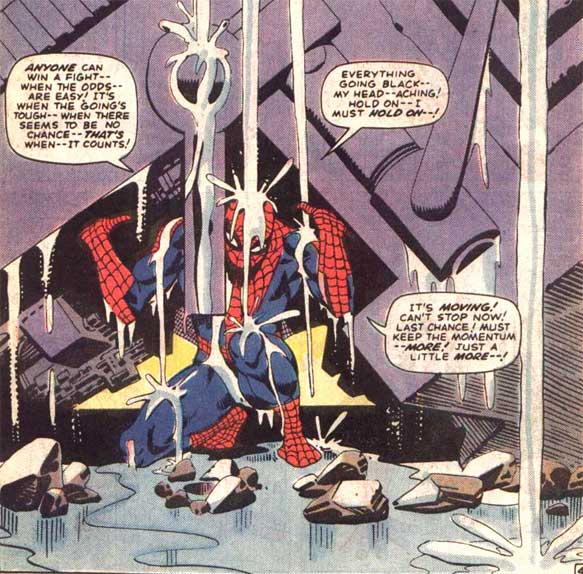
Even better, the story calls back to several classic comic moments, including this one from Amazing Spider-Man #33 (1966), which is a defining moment for Spidey:

ditko3.jpg

I don’t think it’s a spoiler to say that Spider-Man finds a way to succeed even when it seems there’s no chance, and the final battle in Homecoming is a great display of what I love about Spidey, from start to finish.  The conclusion of that battle especially reminded me of the first Spidey comic I ever read, and really, every Spidey comic since.  Spider-Man’s desire to do the right thing is what makes him my favourite and I was extremely happy to see that made a focus of the film (“with great power comes great responsibility” is never actually said, but it’s the movie’s underlying theme and that’s a far better approach than giving us another depiction of Uncle Ben’s death).

Fittingly for Spider-Man, the hero who can’t stop saying corny one-liners as he fights the bad guys, this may also be the funniest superhero movie ever made.  It captures the light-hearted, good-natured awkwardness of Peter Parker and the awkwardness of high school in general.  There are a lot of laughs from start to finish, and like Ant-Man and Guardians of the Galaxy before it, Homecoming always finds a way to entertain the audience in between the action (often at our hero’s expense, as it should be with Spidey).

(SPOILER: sometimes the humour even comes at the audience’s expense, as you will find out if you stick around to the very end.)

Spider-Man: Homecoming met my high expectations, and then some.  This is how you make a great superhero movie, by staying true to the character, and when that character is your friendly neighbourhood Spider-Man, you’re in for a treat.

The Big Sick

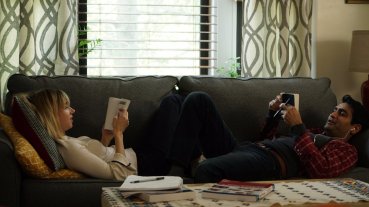
It’s hard to put a movie like The Big Sick into a box. If you heard romcom, you heard wrong. Not dead wrong, and not totally untrue, but you’ll have to shift your expectations. What you SHOULD and can expect from it: a very authentic and relatable experience, with lots of family drama, a little rom, and some definitely com.

It’s about how star Kumail Nanjiani met his (spoiler alert!) wife Emily, with whom he co-wrote the movie. So yes, they end up together. But you’d hardly guess it. In this only-slightly-fictionalized-account, they meet and fall in love rather quickly, but basically agree that there’s little chance of this being a long-term thing; she’s in grad school and The-Big-Sick-moviedoesn’t want a commitment, his fate involves an arranged marriage, sooner rather than later if his mother gets her way. They go their separate ways, and that might have been that had Emily (Zoe Kazan) not fallen ill with a life-threatening illness that left her in a coma. Her friends all busy with finals, they call him in to sit at her bedside while her parents fly across the country to be with her.

Kumail was a struggling stand-up comedian\Uber driver at the time, and he kept his relationship secret from his family, who expected him to marry within the culture, to a woman of his mother’s choosing. Emily’s parents, meanwhile, are not huge fans of Kumail’s, since he’s the guy who recently dumped their daughter after admitting that he’s gone a series of blind dates at his mother’s dining room table. Her parents, played by Holly Hunter and Ray Romano, actually add a very interesting dynamic to the whole thing. But though the script doesn’t gloss over any of life’s bumps (at times, it’s nakedly, shockingly honest), it also doesn’t cast anyone as the villain. It’s just people coming at things from different angles. Love is hard, and if you’re lucky, long. It takes work and compromise. It’s even harder and compromisier when a couple comes from different backgrounds, and may have different expectations of love and dating and marriage.

Bottom line: I cannot recommend this enough. While not a laugh riot, it’s cheeky and authentic and well-written, like show-offily well-written. Real people populate this film, and all the players are its equal. Nanjiani is great, of course, but unexpectedly great performances from Hunter and Romano, in roles much meatier than you might anticipate, really make this thing come together. You care about these characters, together and separately, which is 107% more than I care about the soulless, sequel-heavy pieces of utter balogna that dominate movie theatres this day. The Big Sick isn’t just a great movie, it’s a shining beacon of hope in a bleak landscape of unimaginative belly button lint. Producers, take note: more like this, please. On the double.

Okja

The new CEO of Mirando, Lucy (Tilda Swinton), announces that her company has made a discovery that will rid the world of hunger: a super piglet that looks like a cross between a rhino and an elephant that we’re assured tastes really fucking good. 26 super piglets are distributed to farmers around the world to be cared for over the next decade. In 10 years, popular TV veterinarian Dr Johnny Wilcox (Jake Gyllenhaal) will judge them and declare one ‘the best.’

Cut to: 10 years later, Wilcox hikes up a remote Korean hillside to visit Okja, a prized super piglet raised by Mija (Seo-Hyun Ahn) and her father. Raised on love and freedom, Okja is objectively the best of the bunch, but that means this beloved pet must go to NYC okja-creature-littlegirl-woodsto be paraded around by its parent corporation (to disguise the secret testing) – unless of course she’s kidnapped by the Animal Liberation Front headed by Jay (Paul Dano), “not a terrorist,” along the way. And the ALF is only the first group of people Mija will come across that want to control the fate of her large friend, Okja.

Co-written and directed by Snowpiercer’s Bong Joon Ho, you can bet he’s got some interesting thing to say about these events: GMOs, image-obsessed corporations, eco-terrorism. But he cleverly brings it back to one of the most basic relationships to remind us of what’s important: the one between a girl and her best friend, the family pet. Here in North America, not only can we not imagine eating dogs, we object to it morally. Here, we name our dogs, we sleep curled up beside them, we feed them table scraps from our fingers, we look into their sweet faces and tell them they’re good boys, very good boys. If we accorded all animals the respect we give our pets, it would change the food industry okjaas we know it. This is the way Bong Joon Ho choose to frame Okja’s predicament.

Tonally, Okja is very different from Snowpiercer. If the score doesn’t alert you to its farcical nature, and Jake Gyllenhaal’s voice doesn’t do it, then the unconvincing CGI will likely push you in that very direction. But Bong Joon Ho’s skill as a director means that he juggles these switchbacks in tone very carefully, and Okja’s whimsy never fails. Yes, it’s a completely weird movie, one that can feel like a cartoon and a horror at the same time, that can make you laugh amid the darkest of scenes. I realize this movie won’t be for everyone, but I found it profoundly interesting. Tilda Swinton is excellent, and Gyllenhaal does something we’ve never seen from him before. But it’s Seo-Hyun Ahn who steals the show, her bond with Okja and her purity of heart that elevate this movie from fantasy to fable.


Little Boxes

There are a million movies about country bumpkins going to the big city: fish out of water hilarity ensues. In this case, a family does the opposite migration; they move from Brooklyn to small town Washington and culture shock ensues. In fact, the Burns family has a flat-out identity crisis. Mom Gina (Melanie Lynskey) has accepted a new tenure-track position at the local college but her new colleagues find her photography to be a little “New York centrist”. Dad Mack (Nelsan Ellis) struggles to keep up with is cooking show critiques without working appliances – the moving truck hasn’t arrived yet, so he’s chasing them instead of devoting time to his second novel. And son Clark (Armani Jackson) is finding out how it feels to be the only black kid in town as he attempts to befriend some girls who are looking for a token minority third.

You might almost want to call Little Boxes a companion piece to Jordan Peele’s Get Out for its quiet inspection of white liberal racism, but the truth is, this one lacks bite. It’s a little too tame in its condemnation. But what makes the film worthwhile is the excellent MV5BZWJmMWJmNzYtNzZhZi00MjFmLTliMmEtODdkYmQ0OWI1YzU5XkEyXkFqcGdeQXVyNTU2NDMyOTM@._V1_SY1000_SX1500_AL_family dynamic between Lynskey, Ellis, and Jackson. I always feel chuffed to see Lynskey in anything; she’s the Queen of indie movies and I bow down before her. Ellis was strong right out of the gate, but I struggled to place him. It was the voice that tipped me off: I knew him from somewhere. It took until the last scenes of the movie before I had my light bulb moment – True Blood (he played the cook, Lafayette). Even the kid is good, and I’m of the opinion that child actors can make or break your project. Too many directors don’t spend near enough time finding a kid who’s more than just cute. I’m happy to report that Jackson earns his spot in the Burns trifecta. They make a family you’ll fall in love with immediately, which is what makes it so effective when they hit a rough patch. Their disharmony transfers to us.

The messiness of life is addressed honestly if not always subtly. There are many ways in which to not fit in, and Little Boxes finds at least three. But it also finds a comforting way to put things back together, and maybe that’s the point, not the oddly-shaped puzzle pieces that life gives us, but the glue that holds them together.