Category Archives: Kick-ass!

The highest honour we can bestow on a film. Anyrhing in this category is a must-see.

Mommy Dead and Dearest

Dee Dee Blancharde had had a rough go: displaced by Hurricane Katrina, she was the sole care-giver for her severely disabled daughter, Gypsy Rose. Gypsy’s diagnoses were many: epilepsy, muscular dystrophy, asthma, sleep apnea, cancer, chromosomal and developmental defects. She was confined to a wheel chair, fed by a tube, often breathing with the help of an oxygen tank. She endured frequent surgery and chronic pain. She was brain damaged and stuck at the intellectual age of 7. Dee Dee, devoted to her daughter, didn’t work. They accepted charity in the form of a house from Habitat for Humanity, met Miranda Lambert through the Make-a-Wish Foundation, got free trips to Disney World, Gypsy’s favourite. Kindly neighbours pitched in what they could; the Blanchardes were community fixtures, and well-liked. Then one day Dee Dee’s Facebook status read “That bitch is dead” and when police investigated, they found her stabbed to death in bed. Gypsy was nowhere to be found.

This case caught my eye at the time and I read about it extensively. It turns out that MV5BZGI5Nzg5YzktOGQ5NS00MGJhLWI4MWUtODQxZGE1MGQxYWMzXkEyXkFqcGdeQXVyNjA0OTQxMDQ@._V1_Gypsy was never sick, wasn’t even paralyzed. She had endured years of abuse, via ‘Munchausen by proxy,’ a condition wherein a caregiver fakes and actually induces health problems in their child in order to gain sympathy and attention for themselves. Gypsy, armed with a secret internet boyfriend, had had enough, and plotted her mother’s murder.

Mommy Dead and Dearest is a shocking documentary that explores this case in depth. People who knew them were shocked to see Gypsy Rose walking unassisted, and wondered how much she herself had been in on the deception. But even Gypsy Rose didn’t know her true age, or the extent of her health problems. Many of the medications given her to treat fake illnesses gave her real, troubling side effects. The documentary follows her trip through the justice system and asks us whether we must consider her to be a cold-hearted perpetrator, or a victim who finally fought back. Director Erin Lee Carr lets the story tell itself, giving the narrative time and space to unfold itself, deftly answering questions before we even ask them. This case is so astonishing that Carr’s guidance is particularly necessary, yet her presence is minimally felt. I was completely fascinated and absorbed by the story, and I bet you will be too.

A Man Called Ove

There is indeed a man called Ove. He is a crotchety old man who rules his condo tenement with fierce rigidity. He’s aged out of his job and his wife has left him (well, died, but he’s such a grump I can only assume it was purposely, to escape him). I shouldn’t joke; his wife’s grave is the only time and place where he’s a little tender. Does he list her a litany of complaints? Of course he does. But only because the world’s gone to MV5BNTgzNDcxYzEtZDljOC00NDZmLTk2ZTAtOTVhM2Y1MWI1YzUyXkEyXkFqcGdeQXVyMDc2NTEzMw@@._V1_SY1000_CR0,0,1581,1000_AL_shit without her. The only reason he hasn’t committed suicide yet is the damn neighbours, who need constant monitoring and discipline, and who else would take it upon themselves to mete it out?

It turns out that Ove has had a pretty interesting life. It’s just that no one knows it because he isolates himself, sequestered in a condo that’s still a shrine to his dead wife. It’s only because some boisterous, needy new neighbors draw him out against his will that we learn the ups and downs that have contributed to his current thorny state. If you’re feeling like this sounds a little sentimental, well, it is. But it stays just shy of saccharine thanks to a nuanced performance by Rolf Lassgård in the title role. He never lets Ove go full-martyr, he keeps the role alive and flawed and beautiful. Ove’s may not exactly be a unique character arc, but it’s charmingly irresistible in Lassgård’s hands.

The film is a little predictable but so sweetly executed that I’m finding it hard to fault it. It’s surprisingly funny at times, mixing genres fairly deftly, making for a lovely, bittersweet, and humane character study that’s a pleasure to watch.

My Life As A Zucchini

Zucchini goes to live in an orphanage after his alcoholic mother dies. The orphanage is not a bad place. This is not a bad-orphanage movie. It’s about the broken children who live inside. The kids are there for many reasons (deportation, mental health, abuse, poverty, etc); some can dream of one day returning home, while others know they never will. For the most part the children band together and support one another as they cope with loss.

MV5BMGU1ZDI5Y2ItOTY2OS00ZjBiLThkYzEtZDIxOTA4NmVmMjE3XkEyXkFqcGdeQXVyMjUyOTI5MQ@@._V1_SX1777_CR0,0,1777,999_AL_My Life As A Zucchini is stop-motion animated in a very compelling way. It’s a simple story with colourful characters and a strange title but make no mistake, there’s little silliness awaiting you. It’s a pretty bleak story.

I watched the version dubbed in English, which features voice work by Nick Offerman, Will Forte, Ellen Page, and Amy Sedaris. But even with all this wonderful adult interference, director Claude Barras keeps the story firmly within Zucchini’s corner. The story is told through the eyes of children, almost without taint from the adult world. It is heartbreaking but also tender and compassionate. By focusing on the resilience of children and the difference even one caring person can make, hope shines its rays even on this dark little tale.

I enjoyed this very much. It’s not as heavy on the heart as it sounds, and Barras manages to wrap things up in under 70 minutes. I’m always a fan of the loving work that goes into stop-motion and this one is no exception – perhaps it is exceptional. The expressive characters and honest story give My Life As A Zucchini a sensitivity, like a spoonful of sugar to help the medicine go down. I’m very taken by this and am heartened to see animation tackling such complex characters so deftly. Definitely worth a watch, tissues at the ready.

Train to Busan

Seok-Woo (Yoo Gong) is a busy hedge fund manager who thinks mainly of himself, and his success. He’s pushed away his wife, who has left him, and he’s letting his mother raise his young daughter, Soo-an (Soo-an Kim). When a Wii fails to impress Soo-an for her birthday, Seok-Woo reluctantly agrees to take her on a trip to visit her mother. They board a trail from Seoul to Busan, and their timing is impeccable (although, to be honest, I’m still not 100% if it was impeccably good or impeccably bad. You decide). Just as their train is pulling away, a very fast-spreading zombie infection overtakes the station. Has the train gotten away cleanly? Well, no, not entirely.

Like Snowpiercer and Murder on the Orient Express, the train setting gives a unique twist on the genre in question, in this case, the good old zombie movie. A train, as you MV5BMGUyZDQ2NzEtZDIwMi00ZTA4LWEyM2EtNTIyZDdlZjBmNmY3XkEyXkFqcGdeQXVyNjEwNTM2Mzc@._V1_SY1000_CR0,0,1494,1000_AL_know, is basically a big metal tube and while it’s travelling, you’re all but locked inside. There’s no where to go. All the players, good and bad, and all the answers, good and bad, must be found within the train.


Seok-Woo is intent on protecting his daughter. It’s sad that it takes an apocalypse for this father to finally dedicate time for his daughter, but there it is. For better or worse, their fates become intertwined with those of the people in their compartment: a pregnant woman and her aggressive husband, a couple of elderly women, a vagrant, a high school baseball team, an arrogant businessman.

Director Sang-ho Yeon makes brilliant use of the cramped quarters. The action sequences are taut. He’s less confident about the wobbly social commentary he sometimes wants to make, and the zombies’ abilities do waver a little bit depending on what will service the plot, but it’s never very long before another burst of action is upon us. The characters have actual personalities; some you’ll root for, some you’ll cheer for when they get eaten.  Sure dad’s character arc is a little predictable, but when’s the last horror movie that even bothered with one? Train to Busan is a little overlong but very watchable, even for a chickenshit like me. Zombie outbreaks tend to bring out the worst in us but Yeon reminds us that we’re still capable of compassion and sacrifice as well. He elevates the film from its generic genre; though its roots are still evident, this film is as fresh and unique as it filled with spilled brains.

Oh, Hello on Broadway

oh hello

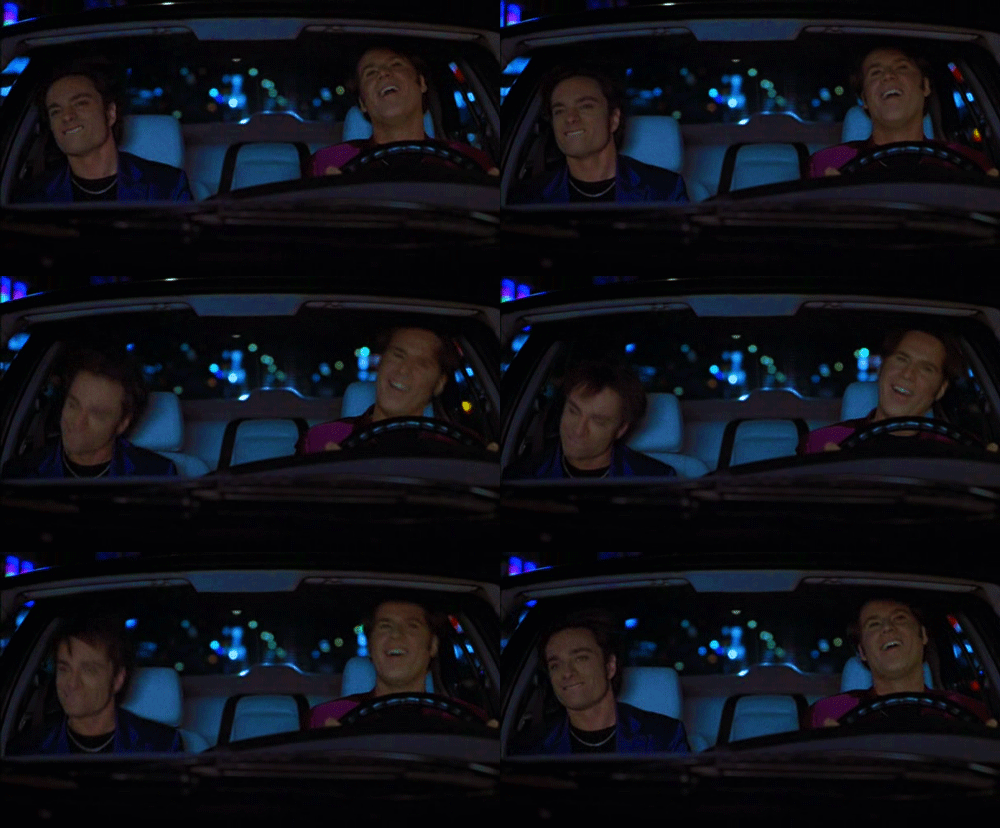
Remember when they used to make movies based on Saturday Night Live sketches?  Isn’t it weird how that used to be a thing?  And that one of the best of the bunch was the movie about these two guys:

night at the roxbury.gif

Even though I grew up during the peak of the SNL movie craze, I was still blown away to see Oh, Hello on Broadway pop up on Netflix, in a “How is this even possible?” kind of way.  But I’m so glad it did and it’s better than I could have hoped.

For the uninitiated, Oh, Hello is one of a boatload of great skits from the Kroll Show, featuring two old men who, in a way, are not that different than the Butabi Brothers.  As the unimaginative name of the Netflix special implies, Oh, Hello then became a Broadway play, because why not?  And now, Oh, Hello on Broadway is a Netflix special that is basically a full-length movie about these two guys.  A flat-out hilarious hour and 42 minutes in the company of these wacky geezers.

tuna.jpgLike Night at the Roxbury, Oh, Hello on Broadway takes a one-note premise and uses it as a gateway to a fully-fledged story that looks behind the premise to the characters themselves.  Absurd as they are, Gil Faison (Nick Kroll) and George St. Geegland (John Mulaney) are surprisingly relatable and human, as we are shown through an insane play-within-a-play structure that works far better than it should.  The background story also is far better than it needed to be, because I would have been satisfied with a few, ‘Oh, Hello’s, and ‘Too Much Tuna’s.   Which of course I got.  Kroll and Mulaney knew why I was watching, but they also showed me how much they love these characters by giving them a proper home.

Because the special is so different from the skit, I don’t think any knowledge of the skits is needed.  Feel free to jump right in, but still, you should watch the skits at some point because they’re funny as hell.

I’m so glad to see stuff like this on Netflix and I hope we get more.  Jay and I had hoped to see this on Broadway but the scheduling didn’t work out, and while seeing it on Netflix is not the same as seeing it live, it’s better than not seeing it at all.  You should definitely add this one to your list.


Mindhorn

mindhorn_finalCanadians are consistently the funniest people in the world as far as I’m concerned, which is hard to reconcile with the stereotype that we’re boring and forgettable.  So I don’t try, I just think of us as funny and the stereotype as another example of how Americans are just not as good as we are.  Above all else, Canadians specialize in satire.  I have to think that is inherited from our former colonizers, as the British may love satire more than we do.

But just as Canada is not Britain (because in 1867 we asked politely if we could be our own country from then on, and the Brits were like, didn’t you already leave when the Americans did?), British satire is a whole other thing from ours.  I have always been fascinated by how there really is no middle ground in North America – either you devour British satire or you think it’s unbearable.  Personally, I find Steve Coogan a good test for one’s tolerance for British satire.   If he cracks you up then you are going to enjoy Mindhorn, whereas if you’re thinking, “Who the hell is Steve Coogan?” then you should probably give Mindhorn a pass.

I think Coogan is hilarious so of course Mindhorn made me laugh.  As a bonus, Coogan is not just a random reference I decided to use.  He’s also a bit player in Mindhorn along with a ton of familiar Brits (including a great cameo by a guy nicknamed “Kenny B.”).   But Mindhorn is co-writer Julian Barratt’s vehicle, and he is terrific as Richard Thorncroft/Mindhorn, a washed-up actor/TV detective.  Mindhorn’s gimmick is his bionic eye that is a lie detector, allowing him to literally see the truth.  Mindhorn made Thorncroft a huge star in the 70s and early 80s but he hasn’t exactly been tearing it up since then.  In fact, he’s just lost his last endorsement contract (for orthopedic socks).  So when a call comes in from the police department requesting Thorncroft’s help (as Mindhorn) in solving a murder case, he jumps right in, seeing it as a great way to kickstart his career.

In the finest British tradition, we quickly learn that Thorncroft is a grade-A idiot (maybe even grade-AAA if you use the meat grading system).  Still, as tends to happen, Thorncroft manages to bumble his way to (moderate) success despite not having a clue at any time.  And while Mindhorn’s way forward isn’t particularly innovative or clever, Barratt is clearly having great fun bringing Mindhorn to life and that fun is infectious.  The satire is spot on, as Mindhorn takes every opportunity to poke fun at the real TV shows from Mindhorn’s day, like Knight Rider and the Six Million Dollar Man, and there are some good shots at the cheesiness of those shows as well as the spin off products from them (such as Mindhorn’s best-selling rock album).

You’ve seen this all before but it’s good fun and I don’t think satirizing David Hasselhoff will ever get old.  So if you have 90 minutes to spare and think Coogan is a funny guy then you should check out Mindhorn on Netflix.

Scott Pilgrim vs. The World

Edgar Wright, I think I love you.

And Edgar Wright loves movies. It’s clear from Scott Pilgrim vs. The World that Wright pours love into his film by loading it with details that’ll take you several watches to truly absorb.

Scott Pilgrim (Michael Cera) is a young dude in a band. He’s dating a high school student 9d0uzolbut is ready to drop her the moment he meets his dream girl, Ramona (Mary Elizabeth Winstead). The catch? Catches? Well, his ex-girlfriend is in town, giving him a serious drought of self-confidence, and Ramona actually has 7 exes, er, 7 evil exes, whom Scott must fight in order to “win” her favour. The movie kind of asks: what would happen if a random guy suddenly had the ability to fight as if he were in a video game? And you know what? The results are pretty fantastic.
Edgar Wright soaks this movie in video game references. He got permission to use the 500fulltheme song from The Legend of Zelda by writing a flowery letter to Nintendo, calling it “the nursery rhyme of this generation.” The more you know video games, the more you’ll appreciate this, but even I can concede its greatness.
Moreover, Wright has a knack for casting that you can’t help but admire. He picked a whole bunch of young kids who would launch into stardom. Brie Larson went on to win an Oscar just a few years later, and Anna Kendrick a nomination.

Of course, my favourite part of the movie is how carefully Wright, an Englishman, preserves the Toronto locale. Toronto is a cheap place to make movies so it often stands in for other places, notably New York City. For once, Toronto gets to be Toronto, giphyunapologetically Toronto, with the TTC, Honest Ed’s, Casa Loma, and even dirty, dirty Pizza Pizza. This movie feels like home. In a meta moment, a fake New York City backdrop is literally ripped open to reveal the glorious Toronto skyline. When Scott Pilgrim earns points, the coins that rain down upon him are loonies and twonies, Canadian style.

And Wright, who is an excellent curator of music, finds some excellent Canadian bands to do the heavy lifting for him. Broken Social Scene wrote two of the 4-second songs played by Crash and the Boys (“We hate you, please die” and “Im so sad, so very, very sad”). Metric wrote the song performed by The Clash at Demonhead. And Chris Murphy vocalist and bassist for Sloan, served as the music performance supervisor, which I think means he made sure the actors held their guitars the right way and stuff. (Non-Canadian Beck wrote the music for Pilgrim’s band, Sex Bob-Omb).

Scott Pilgrim vs The World is ultra-stylized and brilliant to watch. It’s incredibly fast-paced and feels hyper real. It’s almost unbearably quotable, fresh, and inventive. The script can’t always keep up with the film’s flash and charm but darn if it doesn’t try. I’ve been in love with this movie for 7 years or so, and a recent re-watch confirmed that I’m still crushing hard.


What movies do you love to re-watch?


Crossing The Line

Danny Lee Harris, 1984: a American track and field athlete who ran the 400-meter hurdles and won silver medals at the Summer Olympics in Los Angeles. He was the guy who always finished behind Edwin Moses, a track and field phenom, known as the guy who never loses – and he never did; he had a decade-long winning streak of over 100 races, and never lost until 1987 in Madrid, where he was unseated by Harris.

Danny Lee Harris, 2004: arrested in Santa Monica, he’s charged with the kidnap and robbery of a 75 year old woman. He faced life in prison.

Crossing The Line covers the ground between these two formative events, and what led from one to the other. Hint: cocaine.

David Tryhorn’s documentary explores the highs of sports achievements, and the lows, especially comparatively, that come after it. There’s not much that competes with winning a medal for your country, but I suppose cocaine is close. An athlete almost has to have an addictive personality in order to keep that single-minded discipline required for elite training. But what happens when that career is over and the sport just doesn’t consume you the way it used to? There’s a void. Tryhorn uses interviews with Harris’s track and field colleagues and with addictions counselors to give a fuller picture of that post-race deflation effect.

For Harris, the more cocaine he did, the more raced he need to run and to win in order to fund his habit. But running meant exposing himself to drug tests. Eventually he was caught and banned for 4 years, effectively ending his career (at the time, steroid use, an actual performance enhancer, would have only gotten him 2 years). Harris’ downward spiral feels almost inevitable, but Tryhorn is careful to paint a wider picture in which he is only one of many athletes to trace that trajectory. Crossing The Line is a well-made film that shows the flip side to sporting fame and glory.


Megan Leavey

megan leaveyWar is hell, but returning from war is really rough too.  As we’ve realized the devastating effects of PTSD and how severely it has affected an entire generation of American soldiers, war movies have more frequently shown us the human effects of conflict.  In my view, that is a welcome and long overdue change.  I was somewhat apprehensive going into Megan Leavey, because I feared that it would try to glorify or justify the invasion of Iraq.  That’s a non-starter for me because there was no legal basis for the invasion or occupation, and no glory to be had over there.  You will never convince me that it was a good idea for the U.S.A. (and not just them) to send hundreds of thousands of troops to a no-win situation in the Middle East.  Many of those troops didn’t come back and those that did were never the same.

Megan Leavey (the movie) is the story of one of those troops.  Megan Leavey (the person) is a former marine who was deployed to Iraq in 2005 and 2006.  Leavey’s experience in Iraq must have been the most stressful tour of duty imaginable, because Leavey toured Iraq with a partner: a bomb-sniffing dog named Rex.  Leavey and Rex went “in front of the front lines” to sweep for bombs and weapons intended to kill the troops supporting the new Iraqi government.

real megan leavey

The real Megan Leavey and Rex.

The Iraq we see in Megan Leavey feels authentic.  Much of Iraq was (and still is) a war zone, an awful place for a soldier to be, and a worse place for civilians to be.  Whatever their reason for joining the armed forces (and for Leavey her reason is to escape upstate New York), the American soldiers deployed there were largely good people with good intentions.  We can judge their leaders for numerous bad decisions and questionable motivations, but the fact remains that the soldiers on the ground were doing their best while in harm’s way and on edge because the threats they faced were not obvious.  It was not just buried bombs, though that was the prime threat to Leavey and Rex.  Most of Iraq’s residents did not (and do not) support terrorism, insurgency, or Saddam Hussein.  But a few of them did, and they weren’t wearing name tags, so for an American soldier, every single person not wearing the same uniform as you might be planning to kill you.

Whatever your political views on the war, it should be obvious how bad a situation it was to be an American soldier in Iraq, and in fact politics often get in the way by dehumanizing the situation.  With the knowledge we have today, you can (and should) be against the invasion and occupation of Iraq while also sympathizing with the troops who suffered through that insanity.   Megan Leavey chooses to remain neutral on the political side and focus not just on the war but also on the aftermath, in service of Leavey’s (and Rex’s) story.  The result is a compelling tale that is broader than Iraq, and Kate Mara’s performance really conveys the anguish that returning soldiers suffer through, whether they’re humans or dogs.  It’s a very focused movie and more of a tribute to the bond that forms between us and our dogs than a true war movie.  I really enjoyed it.


Tunnel

On his way to his young daughter’s birthday party, a man becomes trapped in his car as a tunnel collapses around him. There’s no telling when or if help with arrive, and all he’s got are 2 bottles of water and a birthday cake to see him through. His wife finds out in the worst way imaginable and the Korean news is pretty ruthless in reporting the failure of a newly-built piece of infrastructure. The damage is so encompassing that the rescue will be a long-term affair and there’s no guarantee that a little water and cake will be enough to keep him alive until help arrives. Of course, that’s not even considering whether the panic and isolation might get him first – or if the poorly and hastily constructed tunnel might further deteriorate.

Jung-soo (Jung-woo Ha) is the man in the tunnel so of course this movie is his. As blunders delay the rescue and the national media loses interest, this poor guy is as alone fullsizephoto731941on this earth as anyone will ever be. He isn’t just going through a physical hardship, but a psychological one as well. Occasional glimpses of the rescue effort reminds us just how bleak his situation really is. Dae-kyoung (Dal-su Oh) is the only member of the rescue team truly dedicated to Jung-soo’s survival. Politicans are turning their backs and resources are drying up – are being redirected, in fact, to the construction of yet another tunnel. Meanwhile, Jung-soo’s wife, Se-hyun (Doona Bae) treads the fine line between hope and realism. This trio of actors give very fine performances. Tunnel ends up being more character-driven than action movie, and that’s a good thing. When the script demands it, the visual effects are there, but it’s Jung-woo Ha and co-stars who drive the story forward. It’s a story we’ve seen and heard before but writer-director Kim Seong-hun injects this with satirical elements that bring renewed interest to the genre.

Tunnel is perhaps overlong and could have benefited from some fat-trimming but I still really enjoyed it. It’s got some juicily angry scenes (Kim Seong-hun obviously has something to say about bureaucracy in general and his nation’s government in particular) and some surprisingly dark humour. You might not expect to chuckle through a disaster flick, but this one’s got a little bit of everything.