Category Archives: Jay

I Lost My Body (J’ai perdu mon corps)

I forget sometimes that I speak French. Well, maybe not forget so much as don’t think about it. Much like I don’t specifically think about speaking English. I just do. If I hear or see French, my brain understands without me having to engage anything in particular. It’s just effortless. Growing up we spoke both at home, both at the same time, every sentence seasoned with both languages, choosing whichever words or expressions suited us most. So when I started watching this French film on Netflix, I listened without thinking, and since I was also doing work on my laptop, I didn’t even realize there were subtitles, and may not have consciously realized it was French until I glanced up and my brain shuddered: the subtitle had a mother calling her son “sweet pea” when in fact what she called him was a “soft caramel.” Soft caramel isn’t really a thing in English. I mean, it’s a thing you can eat, but it’s not a term of endearment. So the subtitles substituted for something that made more sense but wasn’t a direct translation. This happens all the time of course, sometimes with hilarious results, but when you’re understanding both at the same time, it can be a little jarring. I’m positive Netflix must have an option for turning off the captions but I’m also positive that about 4 minutes of bumbling through buttons netted no results.

So here I am, watching an animated movie with two tracks, basically: spoken French and written English, and the two are in basic agreement. It’s about a little boy named Naoufel who dreams of becoming a concert pianist and an astronaut. And about the same young man, grown up, who is a pizza delivery guy. Which I feel is supposed to be some sort of humbling come down, but what has an astronaut ever done for me? And yet the pizza guy routine brings joy, hot and cheesy, to my front door. My life would be worse without him. Anyway, Naoufel isn’t exactly the most exemplary of deliverymen, and one night when he’s struggling even more than usual, he just gives up, gives in, sits down in an apartment lobby talking to a woman on the intercom while he eats her undeliverable pizza. He falls in love and devises an elaborate scheme for stalking/wooing her.

Meanwhile, across town, a disembodied hand escapes from a laboratory fridge. The hand goes on an epic Parisian journey through the city’s gutters, fending off pigeons and rats. The hand is sad, I think.

Yeah, it’s weird. That might be the weirdest sentence I’ve ever written here. It’s damn weird to have a stalker love story be intercut by a dirty roaming hand. And all the dirty, greedy flies who follow it. And yet it is strangely beautiful, poetic, almost hypnotizing. The animation is soft, subtle. The story is intimate and sad, truly something unique and unforgettable.

Tell Me Who I Am

Do yourself a favour and go into this movie blind. Normally I’m a complete whore for your time and attention, and I do implore you to come back once you’ve finished, but truly, you don’t need to read this review. The movie is good, worthy of your time. Go watch it.

***

When Alex is 18 he wakes up in a hospital bed and the only person he recognizes, in fact the only thing in the world he knows to be true, is that the 18 year old man sitting beside him is his twin brother Marcus. A woman claiming to be his mother brings him to a house she assures him has been his childhood home; he shakes hands with a cold man he’s told is his father. Alex has no memory of his life up until this point, knows nothing; he has to be told what a bicycle is and how to ride it – and then he doesn’t know where he’s going. The world seems scary and blank but Alex has one thing on which he can rely: brother Marcus. So after he starts to get the basics down, Alex asks Marcus about more personal questions like: who am I, really?

Is there any one person in your life who knows the entire answer to that question? The truth is, every single person who knows you knows a slightly different version of you. They see you through their own filters. You present yourself to them with your own hopes and biases about how they’ll perceive you. You may augment yourself in certain areas, you might tell little fibs about your past, or construct whole chapters of it out of thin air. Who, then, has the authority and insider knowledge to fully tell you who you are.

***Spoilers ahead

The truth is, Alex and Marcus had a terrible childhood. Terrible is too easy a word, actually. So when Alex’s memory was erased, Marcus kept it from him. He painted a lovely picture and Alex never questioned it. But Marcus found that lying to his best friend and twin would take its toll. Still, telling him the truth felt way worse than to carry on lying.

Gosh. What a choice. What a life. Not only did Marcus take on the the guilt of lying, but also the aloneness. Because that childhood, the knowledge of that childhood, was still his. And now he was alone with it. The lies were a gift to his brother Alex, but what did they do to Marcus? Now he has to pretend to not be fucked up. He has to look the other way when Alex acts lovingly toward his parents. He’s swallowing his own pain and anguish to protect his brother. But if you keep up these lies for years and years and years – how long before you start believing them? And how long before that buried dirt comes back to infect you? And when the truth surfaces, as it always does, will Alex see the lie as a gift or as a betrayal? Oof.

This documentary is presented very simply yet with great emotional impact.

The Report

The Torture Report is based on real events as I’m sure you’ve not failed to notice. In the aftermath of 9/11, the CIA went rogue. Or went roguer. It was panicky because as the country’s central intelligence agency, it sort of had a responsibility to avert disasters such as these. And technically speaking, it knew about the specific 9/11 threat and had failed to do anything to stop it. It was embarrassed and tried to cover its embarrassment and perhaps culpability the only way it knew how: with an aggressive show of force. So it started acting both above and below the law, doing whatever it deemed necessary to get things done, but not running anything by anyone else, and not actually getting things done either.

Cut to: Senator Dianne Feinstein (Annette Bening) puts together a task force led by staffer Daniel Jones (Adam Driver) to investigate the CIA’s so-called Detention and Interrogation Program. And the thing is: the work is easy. Their guilt is dripping off each and every report he reads, and poor Jones reads literally millions of pages of documents. Jones of course finds evidence of torture, but also that the CIA then attempted to destroy evidence, subvert the law, and keep things secret from even the highest offices in the country. And if that wasn’t bad enough, the truth was that their torture techniques didn’t even work. Although they were so brutal that more than once the prisoner died while being tortured, not once (worth repeating: NOT ONCE) did their EITs result in information they didn’t already have. So either the torture was ineffective or the prisoners truly didn’t have any dirt to spill, and the CIA couldn’t tell the difference anyhow. In fact, afterward even the CIA admitted that at least a quarter of its prisoners should never have been detained in the first place – and keep in mind that people died in their custody. And that’s just what they admit to.

By ‘things’ I mean torture. They basically invented a whole new kind of torture to get information out of terror suspects and they called it ‘enhanced interrogation techniques’ (EITs) in order to not have to call it torture. But that’s what it was. Meanwhile, the president of the United States is strutting around telling the world that the USA does not torture prisoners, confidently saying as much because the CIA was saying that to his face while crossing their fingers behind their backs.

Adam Driver is playing a desk-sitting paper-shuffler in this, and it can be hard to make that very cinematic but the truth of his performance lays in how passionate he is about the work. After spending more than 5 years in a secure, windowless office, working nights and weekends to put this thing together, and being constantly confronted by the shady, unlawful, and shameful actions of his country, it wears on Jones. He can’t help but be emotionally invested.

The film, directed by Scott Burns, earns its tension in that despite this being his life’s work, and obviously vital knowledge, there are tonnes of people who want to bury the report. Even Senator Feinstein wavers. The CIA is not just torturing people abroad, they’e keeping secrets from their president (and openly lying wherever necessary), and spying on their own people, including on the Congress of the United States of America.

It’s kind of amazing that the film ends up feeling gripping and vital. There’s a momentum to it that really brings the subject alive and Driver injects the thing with urgency and humanity.


Knives Out

We went to see our little nephew play hockey on professional ice today. It was a fundraising effort for his team – we bought tickets to see the pro home team play, and then the kids took to the ice afterward. They got to walk onto the ice through fog, with swirling lights, have their names announced, and stood for the anthem. Then played a game with music breaks and the announcer throwing out goal credits, and our nephew rose to the occasion with a hat trick. It was a perfect way to spend our Saturday noon, except getting in and out of the parking garage was perfect hell. The arena was in the same area as a big open-air Christmas market and the whole thing meant we spent 30 minutes driving to the venue and 50 minutes waiting to park, and the exit process was looking to be just as harrowing only with more honking, so we got into our car, considered our options, and got back out to spend our time more wisely: paying for a movie that at least one of us had already seen.

[It’s awards season, so besides Frozen 2 and Last Christmas, which we’ve already seen, the theatres are packed with things one or both of us have seen previously at film festivals.]

Of our options, we went with Knives Out, even though we grabbed two of the last 5 seats in the theatre, which means we were watching from the front row and Daniel Craig’s head was horrible distorted.

The script, however, was just as delightful. So even though I’ve already given you a full review of the film here, I wanted to urge you, if you’re at all interested in this film, to check it out at the cinema. Our packed theatre was having so much fun, laughing out loud consistently, it’s such a great communal experience to laugh alongside your fellow hooman.

Dream/Killer

On October 31, 2001, a journalist was killed in the parking lot of his newspaper. Two years later, a 19 year old man named Chuck turns himself in, confessing to the murder, and naming another man, Ryan, in the process. The police confession tapes reveal that Ryan maintains his innocence, and in fact his confusion, throughout the entire interview. Worse, they also reveal that Chuck doesn’t seem to know much about the murder either, though investigators are keen to spoon-feed him details.

The American “justice system” is an oxymoron. The system is broken and I’m not sure it’s serving anyone on either side of the bench. Perpetrator, victim, guilty, innocent, everyone’s getting fucked.

Ryan is charged with second degree murder despite there being no physical evidence. Chuck testifies in court against him, suddenly a very polished and credible witness, totally confident in details that he had no prior knowledge of. Ryan’s lawyer seems lost and incompetent. The other lawyer bullies him on the stand. The jury finds him guilty, sentences him to 40 years in prison. His family, in the stands, sobs.

There’s a certain amount of shock and numbness that I imagine comes with hearing your kid be sentenced to a lengthy prison term, knowing you’ll be dead before he gets out. Ryan’s dad, Bill, marinates in his grief for just 24 hours before realizing that if anyone’s going to save his son, it’s him. Because Bill has never wavered in his conviction that Ryan is innocent.

The justice system has washed its hands of Ryan. He’s rotting in prison, watching his youth waste away. The courts won’t have anything more to do with him. So let’s all take a minute to stop and wonder: if your life depended on your father hustling for you – would you be free, or would you be locked up? Because lots and lots of people accused of crimes don’t have loving families taking care of them. I’d be behind bars for sure. But even if you have a father in your life, does he have the time, the experience, the resources to do this? To learn the law, re-examine the evidence, walk the crime scene, track down the witnesses? Does your father have enough flex time in his job to do this, enough money in the bank account to pursue this, enough energy and persistence to do this year after year (after year after year)?

No “justice system” should rely on lay people to chase that justice. That is not a fair system. Ryan is languishing behind bars for a crime he didn’t commit and yet in many ways he is lucky: he has people who visit him, people who believe in him, people who prop hi up when he’s low. When you’re in prison, stripped of every possession, every freedom, the only way you can be rich is rich in people, rich in loved ones who will pick up that collect call from a federal institution and lend their support.

Ultimately, a documentary like this is a shock to the system. We like to exist in our little bubbles, believing that the world is relatively good, and safe. But if this can happen to Ryan, it can happen to me, or to you. The system needs fixing and we all should be motivated to see that it is. Cops who force false testimony should be fired, made examples of. Prosecutors who do shady things, including fabricating evidence and violating the Constitution, should be fired, made examples of, not promoted to judge as he was in this case. And we, as people, need to value justice above easy arrests or empty charges or wins in court. Yes, we like to believe the bad guy is off the streets, but that only works if it’s the actual bad guy, and that means doing a lot more police work – hiring the right kind of police officers, and then making sure they have the necessary resources, the necessary training, and redefining their jobs as finding the truth instead of finding someone to blame.

And here’s the worst part, guys. This documentary is dedicated to seeing Ryan set free. It is a testament to the hard work and persistence of his family. But if Ryan didn’t commit the murder, who did? There is still an innocent man who was beaten to death as he left work. His murderer is still out there. This victim has not seen justice. His case is unsolved – that’s what happens when concentrate on convictions instead of guilt. The wrong guy got sent away, his life was ruined, and terrifying, a killer has been allowed to walk among us, and possibly to kill again. So even if you’re never wrongfully arrested, we are all a little less safe when these things happen and the nightmare reality is: they happen all the time.

Bikram: Yogi, Guru, Predator

I don’t mind stretches and poses but I’ve never bought into yoga culture. I don’t like the body shaming or the forced spirituality or the merchandising juggernaut it has become. Some yogic schools of thought actually believe that yoga should be a gift to the people; teaching yoga is a seva, a blessed service, so teachers shouldn’t charge. And yet yoga studios pop up in every gentrified corner of the world ready to take hundreds of dollars from their affluent customers, with a LuluLemon around the corner ready to charge exorbitant rates for a see-through pair of pants.

Bikram Choudhury arrived in Beverly Hills (where else?) and immediately set the yoga world on fire – and some would say, created the yoga world, at least in America. He claims clients in Elvis, Nixon, Frank Sinatra, Barbra Streisand and more. He built an empire, franchising some 600 studios and embracing the nickname McYoga as some kind of distinction of honour.

Bikram was a celebrity and loved his Hollywood lifestyle. Sure his acolytes saw “red flags” and signs of “megalomania” and acknowledge that humiliation was part of the training. People were fat-shamed routinely. “The best food is no food” was a popular mantra. All part of the fun. Yoga was a cult and his followers were clearly brain-washed – some of them still today, scrambling over all kinds of logical fallacies to excuse away his transgressions, one lady basically saying they won’t say anything negative about him because thanks to him, her back bends were deeper. The man referred to himself as a blood sucker and literally told women “put a cork in your pussy, you’re not allowed to pee” and still people cover for him, “he has his own truth.” Yes, he certainly does.

This documentary covers all manner of sin in the Bikram Yoga Studio. “Separate the man from the teacher,” they said, but you’ll notice nobody says “separate Jim Jones from Peoples Temples”; I’m pretty sure we’ve agreed that everything that comes from an evil cult leader is also evil.

Were you surprised to learn that Bikram Choudhury is a sexual predator? That his yoga studios were basically an excuse to have a constant rotation of sweaty women in bikinis parade their flexibility in front of him so he could pick who to rape next. Bikram yoga was a conveyor belt feeding a hungry rapist.

And let e tell you: if anyone refers to themselves as your family who is not actually your family? Run. RUN. Normally this happens at work, and it’s almost always done to cover up some kind of abuse. They’re about to make you work weekends. Or not pay you for overtime. Do it because “we’re family” though it never EVER works both ways.

And another little hint from your friendly neighbourhood Jay: a man who shows up dressed only in a Speedo and a Rolex? Not a good guy.

It breaks my heart to see so many of his followers turn a blind eye to some really awful stuff. Bikram the man is a monster, but how many of his followers are complicit? Hundreds. Thousands. More? He has fled the country but he’s still doing teacher training and studios are still sending girls to him in Spain and Mexico. Shame on them. The only effective inoculation is information, and this documentary is a powerful dose.

The Irishman

Martin Scorsese has finally married the two sides of his personality: the one who delights in showing us the excess of sin (think: Wolf of Wall Street) and the one who is concerned about the state of our souls (think: Silence). It has taken him some 25 films and 77 years to get here, which is possibly why this film lacks the verve of his other gangster movies. The Irishman is mournful – perhaps even an elegy.

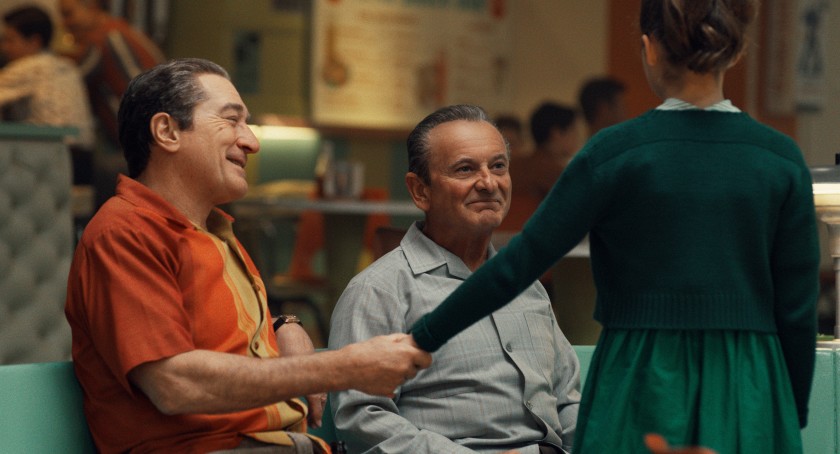
The films revolves around Frank Sheeran (Robert De Niro) in his position as hitman for the Bufalino crime family. There are three distinct timelines in the film: 1. old man Sheeran recounting his crimes at the end of his life; 2. middle aged Sheeran on a road trip with mob boss Russell Bufalino (Joe Pesci) and their wives; 3. “young”ish Sheeran as he meets Russell, befriends Jimmy Hoffa (Al Pacino), starts a family and makes a living putting bullets through people’s heads. Scorsese navigates between these timelines with relative ease (shout-out to editor extraordinaire Thelma Schoonmaker!), though it does take some time and attention to get used to. He keeps the camerawork clean and businesslike, almost as if the camera were just a fly on the wall, observing unobtrusively.

De Niro et al are given the “de-aging” CGI treatment so they can play the parts in all 3 timelines, which is not my preference. I’ve seen de-aging used well (meaning sparingly, like Carrie Fisher in Star Wars) but De Niro always looks a little off, and the trouble doubles when he’s got his shirt off. Plus it’s startling when De Niro is meant to be doing something more physical. When Frank is meant to be stomping on someone lying in the street, De Niro may have a young face but his kicks are that of an old man (the actor is 76). But his performance is quite good, and complex, and possibly the least showy of his career. Which is polar opposite to what Al Pacino does in the film, and I’m still not certain what to think of that. On the one hand, I do believe Hoffa was a bit of a ham himself. On the other hand, Pacino’s acting seems to have devolved into an over-the-top impression of himself. I’m not even sure it’s conscious. I’m not even sure he could stop. Although I confess I could watch him scrape the bottom of an ice cream sundae while screaming “cocksucker!” all day long, and at 3.5 hours, I pretty much feel like I did. His volume’s turned up to 11, and when it crashes into De Niro’s coiled repression, gosh, what a sight. What a symphony.

Scorsese seasons the story with all kinds of various wiseguys and goombas (Bobby Cannavale, Jesse Plemmons, Stephen Graham, Ray Romano, and not least of all, Harvey Keitel) and it makes a fair point about how Frank views the world: there are friends, and there are acquaintances. He can make peace with having to whack a mere acquaintance. But tighter ties would be a problem. He keeps people at a distance, or at least that’s the justification. The truth is, Frank is a sociopath and throughout the film we watched as his humanity is leeched from him. The money might be good, folks, but the job does take its toll. But Sheeran is such a stoic, melt into the background guy that we never see it. He is scary because we don’t ever know what makes him tick, what motivates him. If he has any inner life at all, we can only guess.

Meanwhile, mortality emerges as Scorsese’s other major theme, and it’s one we imagine hits quite close to home for him. Frank is looking back on his life, confessing his sins – but does he feel remorse? Can he feel anything at all? Frank has four daughters but at the end of his life, he’s fixated on Peggy (Anna Paquin), the one who won’t speak to him. Peggy is one of the few female characters in the film (sure there are “wives” but they’re about as important and present as background actors) and she says almost nothing. Her silence is judgment, revulsion. She has seen her father for who he is and she wants nothing to do with him. Even as a small child she has always felt the same about Russell Bufalino no matter how hard he bribe her with gifts; Peggy is in many ways the moral centre of the film, alarming since she’s on screen for about a total of 4 minutes out of the film’s 209. Speaking of Bufalino, Pesci does a startlingly good job of portraying a man who has completely blurred the boundaries between work and evil that he is absolutely, coldly, rotten to the core and doesn’t even seem to know it. This may be the stand-out performance of the film for me.

This all sounds like some pretty epic, pretty heavy stuff, and it is, but at times it’s also funny, surprisingly so. Most of the characters are introduced to us with one important statistic: the date and manner of their death. On their own it’s often quite comedic, but time after time, bullet after bullet, death clearly stalks them all. And when the bullets run out, time starts cutting them down, and old age is often more brutal than violence. It’s slower, and crueler. In the end it’s coming for Frank too, and he’s left to face it alone, everyone else either dead or just done with him. Does he regret his choices? Does he even believe they were choices? The story is based on a memoir that’s fairly contested in terms of facts, but Scorsese isn’t interested in the history, he’s interested in the allegory, and, at this stage of his career it must be said, the legacy. Whereas his earlier gangster movies left a more glamourous impression, The Irishman leaves no room for doubt: mob life is no life at all.

Holiday Rush

The day after Thanksgiving, Rush Williams (Romany Malco) is up early like always to host his popular morning NYC radio show. At 5am he’s already fielding texts from his daughters for their Christmas lists which looks like “pony!” and “Prada bag!”. Are his kids spoiled? Well, they actually seem pretty sweet, but the four of them are used to a certain lifestyle and their expectations correspond to it. Plus, son Jamal just got into Harvard.

So it’s a really, really bad time for Rush to have lost his job, but that’s exactly what happens. Bad news waits for no one. And those kids are NOT pleased about their come down in life. As they move out of their lavish home and into the small house they grew up in, now occupied by Aunt Jo (Darlene Love), and plan for a scaled-down Christmas, dad Rush hears a lot of grumblings.

Meanwhile, Rush and his producer Roxy with the cool hair (Sonequa Martin-Green) scrape together just enough money to buy their old radio station, the one where they got their start. It’s small, but it’s theirs, an opportunity to build the show and the station they’ve always wanted. But the new owners at the old station aren’t making it easy, threatening the advertisers, hoping to turn off their lights before they play a single song.

At the risk of losing all credibility, the truth is I believe this Netflix holiday movie is a cut above. The script is almost always my biggest side of beef with these things but in the case of Holiday Rush, it’s no beef, it’s beef wellington, it’s roast beef, it’s prime rib. Settle down, Jay. Prime rib may be reaching. But it IS charming and smart, despite being written by two white dudes. And the acting is uniformly good, an impressive ensemble propped up by excellent, never obnoxious kid actors, convincing chemistry between Malco and Martin-Green, and Darlene Love is the icing on this gingerbread house, a real treat that we all deserve.

Meanwhile, Holiday Rush earns a little bit of extra integrity by addressing grief over the holidays, something so many of us deal with but often try to suppress. There’s a lot of pressure to be jolly over the holidays, but it’s a time of family, friends, and traditions which often make loved ones’ absences be felt more keenly. The truth is, grief can and must exist alongside joy. You can miss someone even as you welcome in someone new. Living, and enjoying life, is no disrespect to someone’s memory. The movie’s acknowledgement that grief can be part of a holiday normalizes it for us, gives us permission to feel two things at once and not beat ourselves up about it.

And of course there’s some heart-warming bullshit about making Christmas less consumer-y. How many Christmas movies will it take to convince us? “It’s not what you have, it’s what you have around you.” Absolutely true. But I’d also take the pony.


Last Christmas

Emma Thompson writes a holiday rom-com inspired by the music of George Michael? Can. Not. Compute.

Kate (Emilia Clarke), having recently recovered from a major illness, is sort of spinning her wheels in life. A weekend job she took in a year-round Christmas store has turned into a permanent position. Singing at auditions isn’t bringing her joy. She avoids going home because her overbearing mother Petra (Emma Thompson) is a piece of work and maybe wishes Kate was still sick. She’s just going through the motions, sowing some oats, not being a very good friend or daughter or sister or employee. Not being very good to herself. Still, she’s a little embarrassed that her negligence resulted into a break-in at the store. Her boss, Santa (Michelle Yeoh), has a brusque exterior but is decent and kind at heart. This is your wake up call, Kate, even if she doesn’t yet know how to answer it.

Around this time, two mysterious men show up in or around the store: one for Santa, and one for Kate. Kate is curious about Tom (Henry Golding) but not overly attracted to him. Still, they start spending a lot of time together, and he grows on her, not least of all because he’s someone she can confide in. He listens to her, wants the best for her, helps her restart her life. He’s the perfect guy, basically, with a whimsy to him and an irresistible smile.

You might say the trailers are a bit misleading but we should have known that Emma Thompson (who came up with the story along with husband Greg Wise and co-wrote the script with Bryony Kimmings) wouldn’t be responsible for a run-of-the-mill rom-com. If you divorce yourself from the concept, I think you’ll find the film is actually pretty worthwhile. And can we just have a moment of appreciation for cinematographer John Schwartzman who seems to have lit a movie entirely with Christmas lights? Magnifique!

I straddled a line with this movie – I hate to do Christmassy things too early in the ‘season’ – for me, Christmas doesn’t really start until December 7th, and I don’t like to do anything much before December 1st. Of course, having this site forces me to watch holiday movies far in advance of that, so I’ve only just seen Last Christmas despite its November 8th release (of course, wait too long and it may no longer be in theatres). It didn’t fill me with the Christmas spirit, though that’s not offered as a criticism – it did satisfy me as a movie-goer. Talented actors play flawed characters who don’t normally populate romantic films, yet they still deserve their happy endings. Small bits of politics are kneaded artfully into the dough. But even if the batter tastes familiar, this ain’t no cookie-cutter Christmas movie.