Category Archives: Jay

Inception

Inception, to me, is a near-perfect movie. It’s immersive and cerebral but also stunningly visual. It has some complex concepts but the script is so fine-tuned that it reveals only exactly as much as we can digest at a time so that the world opens up to us like a flower.

It’s about a man, Cobb (Leonardo DiCaprio) who goes inside people’s dreams to steal or plant ideas. It’s a dangerous world because when you fuck with the mind, screws come loose and there’s just no telling when the whole thing might come apart at the seams. But the money’s good, and Cobb’s got some troubling personal circumstances that make the game worthwhile. Arthur (Joseph Gordon-Levitt) is his right-hand man, and often the voice of reason. Eames (Tom Hardy) can impersonate anyone. And Ariadne (Elliot Page) is the architect – she’s the world-builder, the one who buries mazes inside of dreams. They’re hired by Saito (Ken Watanabe) to plant an idea in a business competitor’s mind so that he will sell off the company he’s just inherited from his dead father. Robert (Cillian Murphy) is the mark: he’s the grieving son who’s about to undergo inception – planting an idea so subtly that he’ll never suspect it’s not his own. And Mal (Marion Cotillard) is the one who can bring it all crashing down around them at any moment. Look out for her.

Neu8

To pull off this memory heist, they’ll have to build a dream within a dream within a dream – levels that director Christopher Nolan is clearly all too gleeful to construct. In one, rain pours down in sheets; the dreamer has to pee. But just like the dreams themselves, Nolan’s movie is always working on multiple levels. The first is this new world of corporate espionage. But the second is Cobb’s sacrifice. It’s the things he has lost in pursuit of the ultimate theft, and his last shot at redemption.

When Inception becomes about Robert’s dream, there are multiple worlds on the go, so we flip deftly between them. But there’s a catch: each world is experiencing time differently – the further down you go, the slower time moves. There are some very worrying consequences to this. But then there’s also “reality” – though their bodies are sleeping, they have to be somewhere, and someone has to be taking care of them. In fact, someone has to care for sleeping bodies in each dream within a dream for them to be able to access the next level. It’s complicated stuff that Nolan somehow makes feel perfectly reasonable, a true testament to his talent as a writer as well as his precision as a director. He is the audience’s true friend, unwilling to lose us.

My favourite set piece is Arthur (Gordon-Levitt) in the hotel. At this point in time, they have lost gravity, so everything is floating around him. Not only is Arthur caring for the bodies of his comatose friends, he’s also coordinating an important and infinitely precise detonation, and he’s fighting off bad guys. I didn’t know it until I saw it, but a zero-gravity fight scene was exactly what I was missing in my life. Nolan prefers practical effects, so you can imagine the lengths he went to in order to breathe awe into the spectacle. JGL performed all but one stunt himself.

inception-gif

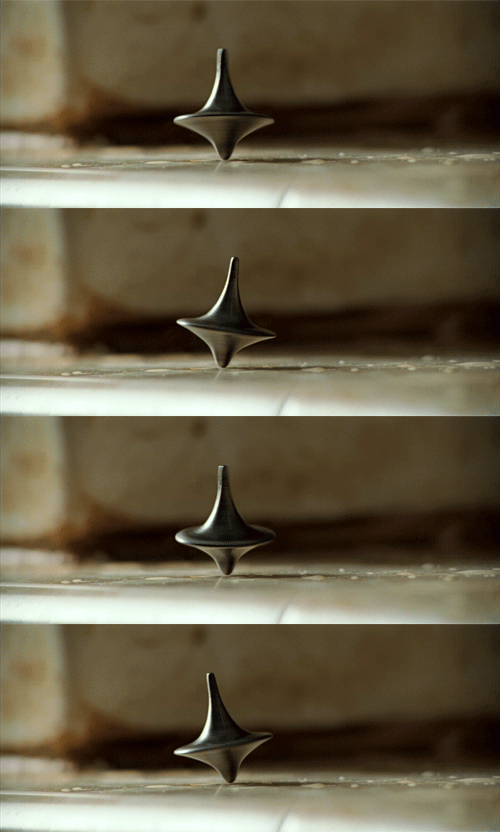
The film has a tantalizingly ambiguous ending. Cobb has a totem, a fool-proof method of testing whether he’s still dreaming, or back in reality. But in the movie, his character walks away – either distracted, or uninterested, or certain of the result. But not the camera. The camera stays with his totem, and it’s the most epic rim shot of all time. Will it or won’t it? Nolan focuses on the totem rather than on any human character. Nothing else matters. But it just keeps going and going, never giving us its judgment until – the screen goes black before a conclusion can be reached. I know it drives some people nuts, but I love an ambiguous ending. To me, it’s the ultimate mark of respect for one’s audience, that Nolan has trusted us to participate in his film’s end, to choose our own ending, in effect. And for someone who produced such a tight and specific script, it’s a ballsy move to put the ending in our hands. But that’s what he does. I believe there IS an answer, a right answer, and the movie is littered with clues that should point you in the right direction. But it’s okay not to know. It’s okay to debate it. It makes us collaborators.
giphy

Of course, the whole film is a show of respect for his audience. Inception is possibly the most complicated blockbuster of our time. Nolan is careful and exacting but he doesn’t dumb things down. He introduces concepts about the subconscious mind: the genesis of ideas, the source of pain, the malleability of memory, the vulnerability of reality itself. It’s a lot. And the more we chew on this, the more meaningful the movie becomes. It’s a thriller with higher stakes than anything before it, because Nolan has tapped into something worse than death. But he also makes the movie a game; it can be won, or it can simply be enjoyed. If there are bits of the plot that go over your head that first viewing, it’s okay. Inception is one of Nolan’s airiest and most forgiving pieces. There’s a gracefulness to the way this movie moves through its layers. Even if there’s something you don’t quite grasp, you don’t get stuck on it. It’s fluid, almost suspiciously fluid, as if plot holes don’t matter. Now why would that be?

Inception is also a capital M Metaphor. As in: to film is to dream. If you inspect Cobb’s team, you’ll see what I mean. Cobb is the director. Arthur is the producer. Ariadne is the production designer. Eames is the actor. Even more than that: Saito is the studio, and Robert is the audience.

We watched Inception recently because I had a dream wherein I was engaged to Prince Harry. We were working on the guest list for our wedding, and I was being all bubbly thinking about how Grandma would be so excited to meet the Queen. Grandma is 96 and a big fan of Elizabeth II, who is nearly her own age. Grandma is sharp as ever, sweet and bright and entertaining, but her mobility has taken a sharp hit recently, and even in my dream I knew that an overseas trip would be a stretch for her – but that the Queen would be quite the motivation. But then I realized: Grandma is not actually MY grandmother, she’s Sean’s. If I’m marrying Prince Harry, I’m not married to Sean and I don’t know Grandma. And the minute I had that thought, my dream started to crumble. Literally, the walls fell over as if they had been the set of a play that was being struck down. I had contradicted myself and shown the dream for what it was: a fiction. I routinely inflict my dreams on Sean while we shower the next morning, and being the disgusting cinephiles that we are, talk naturally turned to Inception (and, in fact, to Inside Out, wherein characters are seen “filming” dreams for the sleeping Riley). Movies and dreams have always mixed, and have always shared blurry boundaries. Inception exploits that. Nolan invites us to dream alongside him.

Thor’s Endgame

Super hero fatigue is real. Keeping up with the MCU can be hard if you’re not a superfan, and some of the plots can seem a little juvenile if you’re not ten. But Marvel, having reached true juggernaut status, is now in a position to take risks. They’re reaching beyond the fandom, courting new viewers, and straying every so slightly from the tried and true formula that has consistently put butts in seats and dollars in pockets. One surprising but welcome MCU twist was that Kevin Feige allowed one of his Avengers to be completely rebranded. Previous Thor films had underwhelmed and underperformed (in a ‘it’s all relative’, millions of dollars kind of way), but it was still a huge risk to hand over the reins to a relatively unknown guy with a funny accent and a filmography comprised solely of quirky indies.

Taika Waititi has been my favourite director for as long as he’s been directing movies. When I met Sean about a decade ago, I made him watch Eagle vs. Shark as a litmus test: was he cool enough and funny enough and subversive enough to be with me? He was. Barely. But he has a big penis so I let it slide.

63Zy

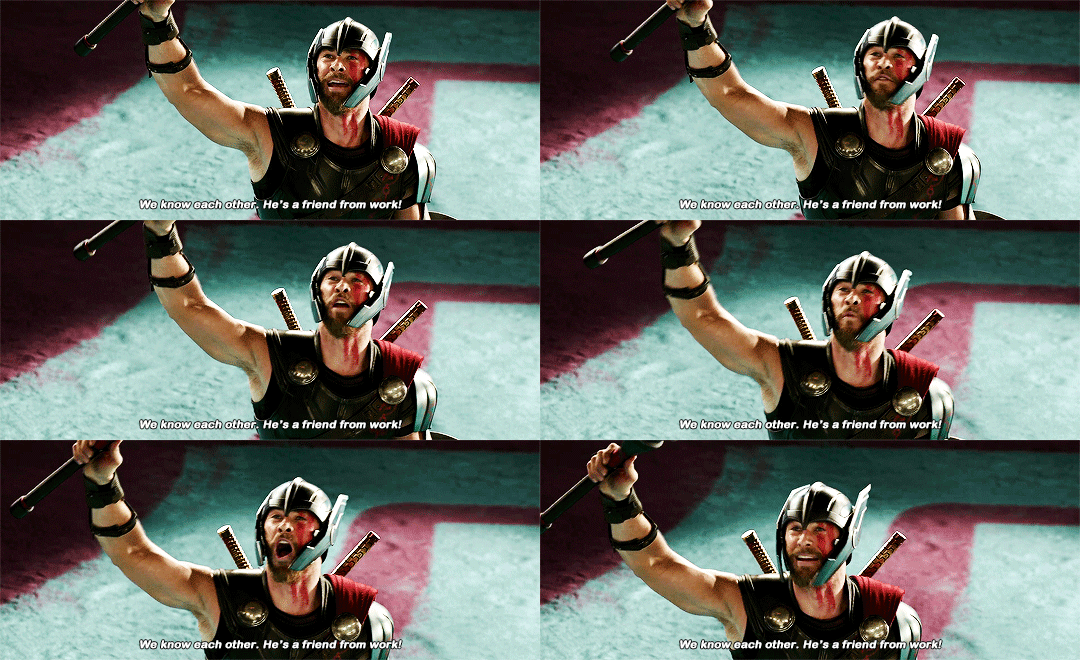
As you may know, Taika Waititi came on board to direct Thor: Ragnarok and is largely responsible for turning an arrogant god into a thoughtful and affable leader. Thor was transformed. Thor is fun! Plus Waititi gave Thor a haircut and suddenly I was thinking: Thor is hot?

ypfdzx4qney01

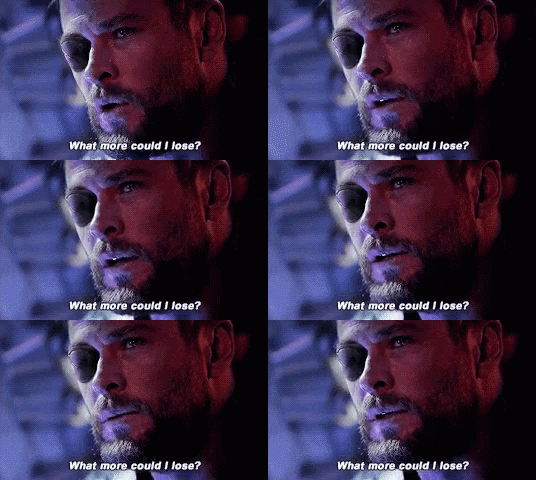
So Thor has since been my favourite Avenger, which is why I was so sad to see his trajectory in Endgame. Thor is suffering from (is it too much to say?) PTSD. He’s been at constant war for years and years, maybe even lifetimes, and has only recently slowed down enough to be crushed by the weight of it all. He blames himself for failing to “aim for the head,” taking responsibility for Thanos’ humanity-shearing snap. Five years later, the movie finds Thor hidden away with his Ragnarok friends Korg and Miek, playing video games and inciting trolls, drinking too much and letting himself go. His physical self reflects his internal turmoil; he isn’t caring for himself anymore. Which is really sad, and surprisingly realistic for Marvel. Thor is a solider returned home from war, and he’s finding that his old life doesn’t fit him anymore. It’s such an honest reflection for how many war vets feel when they attempt to reacclimate to civilian life. But then they ruin the whole thing by playing it for a laugh. As Thor walks into the room, the camera goes straight to his beer-bloated belly. Prompted, the audience laughs. He is shirtless so we can see the extent of his mortification. This man is hurting and Marvel wants us to laugh.

tumblr_osdb03aJGC1tx5jamo3_250

This dilutes the very worthy and valid message about mental health and how we all struggle with it. If we took away the fat suit punch line, we’re left with a deeply conflicted man who is really suffering. He’s lost his family twice now – The Avengers were his family, and not only are half of them turned to dust, but he has exiled himself from the rest. And when he finally does rejoin them, Tony Stark doesn’t ask him how he’s doing, he makes a joke about his appearance. True enough: often even our close friends and family miss the signs of depression. And who would think it of such a strong man? And yet we are all fallible. Pain and trauma are the great equalizers of men.

Let’s remember for a moment that Thor’s other family, his real family, are also dead, but every single one of them – mother, father, brother Loki, that pesky half-sister Hela, even his best pal Heimdall – died before the Snap. So they’re not coming back no matter what happens in Endgame. And he’s lost his home, Asgard, literally blown to smithereens, along with much of the population, which is then halved again during the Snap, which also took Valkyrie, his one remaining link to home and past.

tenor

So it’s nice that Thor gets a moment with his mother, who immediately knows that she is being blessed with a visit from a future-version of her son. She doesn’t waste time asking about his appearance or about her own safety, she wants to know about his pain. They talk about the true nature of a hero. She gives him strength. He begins to heal.

Chris Hemsworth brings a lot to a role that he’s had to stretch and adapt over the 8 years that he’s played him. You wouldn’t expect a comic book hero to be the role that shows an actor’s versatility, and yet here we are. Hemsworth has compassion for Thor. Even while the audience is invited to laugh at him, Hemsworth doesn’t want to make him the joke. Thor puts on a show for his friends, unwilling to let the mask slip and show his true vulnerability. But we see it. Sometimes just in the pain that flashes across his eyes, or the defeated slump of his shoulders, formerly so square and erect.

Avengers-Endgame-2019-dir-Anthony-Russo-Joe-Russo-the-avengers-41776663-540-320.gif

This is a movie, so Thor’s arc movies quickly, as it must. But it’s not shown to be a quick fix, nor complete. These wounds take time to heal but they can heal, even if Thor will never be the cocky god we knew before. Not that we’d want him to be. This new Thor may be fat, but he’s also learned so much. He knows now that other people’s worthiness doesn’t take away from his own. He can share in the heroics comfortably, and even pass the torch. And that’s why I liked the scene as he’s preparing to fight Thanos: he calls on the  gods to ready him for battle. They do, but not by restoring him to his former glory. They outfit his new body. They braid his unkempt beard. It is THIS Thor who defeats Thanos when the old one could not, so let’s not laugh at his body, let’s celebrate his accomplishments, let’s shore up his mental health, let’s rejoice in his triumphs and share in his loss. He is finding his way through trauma. Thor is a god, but he’s having a very human response, and I wish ours in turn could be just a little more humane.

Paper Year

Franny (Eve Hewson) and Dan (Avan Jogia) are young and broke but they’re terribly in love so they get married at city hall, keeping mum until after the fact.

The first year of marriage is supposed to be the easiest. You’re literally still in the honeymoon period. You’re still writing thank you cards for all the wonderful gifts you received at the wedding. You’re blind with bliss and you’re killing it so hard at this marriage thing that you practically think you invented it. But it’s also a time of transition and adjustment. Now that you’re officially bound to another human being, you have to make real compromise.

Franny and Dan are in for a bumpy ride. He, an out-of-work actor, takes a job house sitting/ dog walking while some other, luckier actor is out of town. She, a writer, finally lands a job writing for a terrible reality TV show. It’s not a glamourous job but she does respect her boss, head writer Noah (Hamish Linklater)….maybe a little too much? Because it certainly causes friction at home, her landing a dream-adjacent job, and him taking a job that forces him to admit that acting is not a thing he gets paid to do. Their paths diverging, they grow apart.

Paper is the traditional anniversary gift for a first anniversary. But I think in this case, it’s also referring to the fragility of that first year. Paper is so easily creased. So easily ripped, in fact. By the third year you’re into leather, which, whoa, is a lot more durable. Also durable: fifth year’s wood, 10th year’s aluminum, and motherfucking 60th anniversary’s diamond. Jeez Louise. Marriage, as an institution, makes less and less sense. And yet most of us are still making the attempt. Lots of us fail in that attempt. Some of us fail multiple times. I mean, can you even imagine being with someone for 60 years? When marriage was invented, it was a social bond, a partnership wherein financial stability and child rearing were emphasized. Today we expect everlasting romance. For 60 years? Yikes.

Franny and Dan are having a heck of a time just making it to year one. I remember my own year one: we bought a house, we got a third dog, and a new car. My nephew was born. My sister got married. Sean changed jobs. We traveled to New York City, and to Vegas where we renewed our vows for the first time. It was a good year. But Sean and I were not young newlyweds – Sean was an old maid in his 30s, in fact. We already had homes and careers and lives. We didn’t need to complete each other. Franny and Dan have a lot more working against them, and let’s be honest: they’re not half as charming as Sean and I. So while it’s understandable that you’d keep coming back here because we’re so damn irresistible, I’m not sure even 89 minutes is worth spending with Franny and Dan. Dan and Franny (do couples always agree on who’s name goes first?). Paper Year is an okay movie, strictly speaking, but it didn’t move me, it didn’t inform me, it didn’t delight me or captivate me. And those are all things I continue to get from my own marriage, on a surprisingly daily basis. And it’s just plain old Sean going about his ordinary life, being a (mostly) wonderful person and (largely) thoughtful husband.

1ST YEAR: Paper
2ND YEAR: Cotton
3RD YEAR: Leather
4TH YEAR: Fruit & Flowers, or Linen & Silk
5TH YEAR: Wood
6TH YEAR: Iron / Candy
7TH YEAR: Wool/ Copper
9TH YEAR: Pottery
10TH YEAR: Tin/ Aluminum
11TH YEAR: Steel
12TH YEAR: Silk
13TH YEAR: Lace
14TH YEAR: Ivory
15TH YEAR: Crystal
20TH YEAR: China
25TH YEAR: Silver
30TH YEAR: Pearl
35TH YEAR: Coral
40TH YEAR: Ruby
45TH YEAR: Sapphire
50TH YEAR: Gold
55TH YEAR: Emerald
60TH YEAR: Diamond

Howard The Duck

Last month I struggled to rein myself in after watching a forgotten Tom Hanks movie from 1986 called Nothing In Common. I consoled myself by reciting other, better movies that were released that year. Reasons why the year didn’t suck completely. Some of you contributed: Labyrinth, from Widdershins, was a particularly good one; it’s a darkly wonderful movie that I loved before I even knew who David Bowie was. Imagine growing up knowing Bowie as that guy from the weird Muppets movie. And realizing years later that that’s a young Jennifer Connelly starring alongside him. I still know all the words by heart. Not just the songs: ALL the words. But one of you has a delightful cruel streak that I can’t help but admire. One of you, not naming any names, suggested that Sean and I watch Howard The Duck. Howard The Duck! Also from the garbage year 1986, it’s a movie I’d never seen and never wanted to – not when he made a brief appearance at the end of a Guardians movie, and not even when Sean’s buddy contributed to his comic book revival.

Anyway, somewhere in this or another galaxy (not too sure about the geography – another dimension, maybe?), Duckworld is a planet where intelligent life evolved from waterfowl. Duckword is a lot like Earth; the ducks are humanoid, they walk on two feet and speak English and they’ve made movies like Splashdance and Breeders of the Lost Stork.

Anyway, one day Howard gets home and sits back in his lazy-boy with a beer and a cigar when a hole rips through the galaxy and swallows him up, depositing him on Earth where he meets a surprisingly amenable punk rocker named Beverly (Lea MV5BZjM2NzA2NTYtNTkwYy00MzY0LWIwOTQtZTgzMjQ1NDZjNGI1XkEyXkFqcGdeQXVyNzc5NjM0NA@@._V1_Thompson). I mean, her look is early Madonna but her name is Beverly, which implies Mom jeans and shapeless sweaters, and her sound is more 80s power ballad, and she’s played by Lea Thompson, and it’s hard to sit here in 2019 and see how exactly she was ever considered an It Girl. Beautiful? Hot? She’s mousy and thin-lipped and mostly whiny. But anyway, let’s pretend she’s a hot as shit punk rock girl who somehow befriends a duck – and finds him sexually attractive.

Howard’s main concern is getting back home but the few scientists who could help him generally don’t. In fact, when they come close to opening that hole in the universe back up, Dr. Jenning (played by the creepy principal from Ferris Bueller, Jeffrey Jones, who turns out to be an actual sex offender and child pornographer in real life) accidentally infects himself with Evil Overlord. Which, you know, is not good. And quite sweaty. Not quite as repugnant as his real-life situation, but close.

In short, the movie’s a real shit show. If Howard The Ducks is fun at all in the comics, he’s a chore in the movies – it’s easier to imagine Lea Thompson being a sexpot than Howard T. Duck being at all interesting or fun to read about. Howard is a little person in a 2 million dollar duck suit walking around in an otherwise very CGI-heavy movie and none of it looks good, not now in 2019 and I bet not in 1986 either. At some point, near the end of the movie, I turned to Sean and said “Doesn’t this guy remind you a bit of Tim Robbins?” Apparently it was Tim Robbins, and had been the whole time. Apparently I am not familiar with 1986 Tim Robbins. He’s doughier and pastier than I would have guessed. I’m surprised he was able to defibrillate his career after this.

George Lucas has just finished building Skywalker Ranch to the tune of 50 MILLION DOLLARS and counted on this film to get him solvent again. Needless to say: it didn’t. Poor guy had to start selling off assets in order to not go belly up. Apple CEO Steve Jobs bought LucasFilm’s CGI animation division for a hefty sum, and so I guess two good things came out of Howard The Duck: what would eventually become Pixar, and also that every other Marvel movie from 1987 until time immemorial would positively glow in comparison.

…You’re welcome?

Take This Waltz

Margot and Daniel meet over the whipping of an adulterer in old Montreal (one of this old-timey reenactment thingies). It’s brief, and it’s awkward, but they’re not exactly displeased to find each other sitting side by side on the plane ride home to Toronto. They’re pithy and flirty with each other, and it seems fairly cracking until the split cab ride home reveals two alarming truths: Daniel (Luke Kirby) is Margot’s neighbour, which prompts Margot (Michelle Williams to hurriedly confess that she is married. Happily. To Lou the cookbook writer (Seth Rogen).

Gem Sarah Polley writes and directs, and through her scenes of mundane domesticity, we see a content and comfortable marriage. The detail in their MV5BMTQwMTc2MTY2MF5BMl5BanBnXkFtZTcwNDQ5NjU3Nw@@._V1_SY1000_CR0,0,1503,1000_AL_coupledom, the weird little quirks that pepper their relationship, these things are so specific they feel true. This couple feels solid. But while Margot knows inner contours of Lou’s every thought, Daniel is tantalizingly unknown. It’s hot: both the steaming Toronto summer and the relationship growing between neighbours. Maybe it’s even hotter because they’re trying to be good. Margot’s trying to be married to Lou, who gives her no reason to stray, and yet. And yet Daniel is mysterious and alluring. He’s new. Falling in love is not just about this other person, it’s about seeing your best self through their eyes. Of course Lou still thinks she’s beautiful, but beautiful in the way of a couple who’s been together a long time and hardly notices each other anymore. Beautiful even though he’s seen her bloated, he’s seen her blemished, he’s seen her hangry and petty and wearing sweat pants for 3 days straight. Beautiful in a way that when she’s naked in the shower, he’s more concerned about pranking her than ogling her body. Meanwhile, Daniel is deeply fetishizing her. She’s still a manic pixie girl to him, full of dark corners and intoxicating unavailability.

And here’s the true truth that Sarah Polley eventually gets around to: the grass isn’t greener. Or rather, the grass is greenest where you water it. Don’t take love for granted and don’t mistake novelty for connection. Take This Waltz is bittersweet and filled with melancholy despite having a saturated look about it, with reds that pop and yellows that burn like sunshine. It’s a great little movie that’s depressingly honest – a romance that defies its genre.

Pure Country Pure Heart

I’m as surprised as you are that this is a real thing. And nearly as surprised that Sean chose it.

Here’s a thing: it takes Sean longer to find a movie on Netflix than to watch a movie on Netflix. He flips through titles so quickly it literally gives me motion sickness to look at the screen, so he’s largely on his own, his bad taste off-leash, running amok through genres he knows damn well he has no business perusing.

Another thing: we are not above watching something in irony. Or even hate-watching something, if we’re in a mood (yes we have collective moods). The thing is, I didn’t know we were in a mood when Sean hit play on this, so yeah, I was taken aback. Was he drawn to the horsies? Or still dazzled by the best movie we’d seen all week: an Instagram video of my 3 year old niece singing Alcohol You Later?

Anyway. Two young sisters who love to sing their own country songs decide to go on a quest to Nashville (less than an afternoon’s drive in a rickety pickup truck, so not exactly an epic adventure, but still) to find out who their father was. I mean, who he was in terms of likes and dislikes and was he more of an autumn or a winter. Their mother doesn’t like to talk about him since he died…in a war? Iraq, maybe? Anyway, he’s a heroic war veteran who threw himself on a grenade to save some other guys in his unit (although not overly effectively, since it left at least one other guy paralyzed) (what, we’re not allowed to joke about stuff like that? Okay, fine. I guess someone’s in a mood after all).

Long, uninteresting story short: their dad liked to sing country too! In fact, he used to record and tour with this semi-famous country singer who they befriend. Behind their mother’s back of course, because mom likes the semi-famous country singer even less than she likes talking about her dead hero husband.

It weren’t no good. There’s lots of singing and lots of pie and surprisingly little talk about god. Willie Nelson’s in it, though he’s disavowed it. I know this because I could not for the life of me guess what this movie was called. The only clue was Willie’s presence, but his IMDB denies any knowledge of this film. So does google, for that matter. I asked Sean and he came back with the answer straight away, and I thought: Geez, this guy continues to surprise me. In fact, the only thing that should surprise me is that he’s able to sign in to Netflix from work, which is what he had to do when “country movie Netflix two sisters pies” failed as a search term. God I love this man.

I Saw The Light

This movie meant to be Hank Williams’ Walk The Line, but it fails in every way imaginable.

Tom Hiddleston, as the country-western crooner, is no Joaquin Phoenix, and I do mean that in the nastiest way possible. I’m never a fan of Hiddleston, but in this he’s charmless and unforgivably bland, though it’s at least as much the fault as writer-director Marc Abraham who apparently thinks Hank Williams is the most boring man on earth but decided to make a movie about him anyway.

It doesn’t help that Hank Williams just isn’t that interesting a subject. Oh, he drinks, you say? Cheats on his wife? Squabbles with his bandmates? As if we have seen MV5BMTg3MDcxNzc3Ml5BMl5BanBnXkFtZTgwNTMxNDA1MDI@._V1_SY1000_CR0,0,666,1000_AL_exactly those issues in better movies than this a hundred times before. And Williams just doesn’t have the allure of Johnny Cash or the talent of Ray Charles or the magnetism of James Brown. He’s just an entitled white dude who made life rough for himself. He made some music and then he died. Hank Williams may be a legend, but you’d never know it from this movie. It makes him seem banal and tiresome. And that’s gotta be hard to do to a man known as the King of Country Music, influencer of Elvis Presley and Bob Dylan, prolific song writer, winner of a posthumous Pulitzer for craftsmanship.

Of course, the film itself is unstructured and just sort of plods along, dragging its feet through the obligatory musician-biopic tropes like womanizing and shenanigans on tour. Abraham seems to be a pretty dull fellow and he’s fully committed to bathing everyone else in that same flat light. The only thing consistent about I Saw The Light is how relentlessly lifeless it is. Neither Hiddleston nor Elizabeth Olsen can do a single thing about it, and you’d kind of expect more from a Loki-Scarlett Witch combo. There should be sparks at the very least. Instead, Olsen’s Audrey Williams (Hank’s first wife) has a heart full of self-interest and their turbulent marriage seems always to be two paths rapidly diverging. Only Hank’s semi-weird relationship with his mother (Cherry Jones) provides the slightest kindling, but that’s neglected and the smoke dissipates before there’s fire. Pity.

Teen Spirit

Teen Spirit, a singing competition not unlike The Voice or American Idol, comes to the Isle of Wight for the first time. Violet (Elle Fanning) is the first in line to audition, though she’s shy, and her strict Polish mother forbids it. Popstardom seems a far cry from the austere life she leads on a small farm with her single mother, who believes singing for god in the church choir should be more than enough. But for Violet, it’s not.

She auditions, and she recruits a strange old man named Vlad (Zlatko Buric) to pose as her guardian as she is not yet 18. In fact, Vlad has a mysterious past as an opera singer, so he might have some valuable insight into this whole singing thing, if only his fondness for the bottle doesn’t get too much in the way.

MV5BMWVjZTYxZTgtMWUwMS00YTAyLWFjYjktOGE0YjE3MDJhYzE2XkEyXkFqcGdeQXVyNTc5OTMwOTQ@._V1_SY1000_CR0,0,1499,1000_AL_Teen Spirit is a singing competition, but for Violet, it’ll test much more than her voice. It’ll test the bonds of friendship and family. It will test her integrity and her ambition. Her mettle and her tenacity. And honestly, what teenager could stand up to such a battery of glittering tests? It’s a box full of sin and temptation, just as her mother feared, but Violet can’t wait to rip it wide open.

Max Minghella writes and directs Teen Spirit, though to be honest, he could have both written and directed more. It’s short on story, and what story is there is very familiar. The underdog’s story has been told a million ways and it doesn’t feel like Minghella is particularly interested in adding to it. But he does have a knack for the music breaks. Invariably set to a monster pop song, those scenes are slick and spiffy, candy for the eyes and ears. They contrast well with Violet’s otherwise shabby life back home. Elle Fanning sells it. She is the candy, and she’s very sweet; Minghella is smart to have stocked up on her. The movie is worth watching just to see her break out of that shell and if it inspires your singing-and-dancing-in-the-shower routine, you’ll know who to thank.

Someone Great

Jenny has just suffered a soul-crushing breakup with forever boyfriend, Nate. After 9 years together, things end right before she’s about to move cross-country for a new job. Thank goodness for best friends Erin and Blair who are prepared to drop everything to grieve with her while celebrating one last night together, out in NYC.

A series of glowy flash backs convince us that yes, Jenny (Gina Rodriguez) and Nate (Lakeith Stanfield) were indeed great but the truth is, in mourning a boyfriend, this movie really celebrates girlfriends. Jenny, Erin (DeWanda Wise) and Blair (Brittany Snow) have a bond that’s outlasted all the other relationships in their lives.

Rodriguez, Wise, and Snow have terrific chemistry. Writer/director Jennifer Kaytin Robinson keeps things loose; it feels like the women spent time getting to actually know and like each other, rather than rehearsing. It feels real. It feels familiar, like they’re MV5BOWUyZTQ0MjEtNDRmMy00NDJiLWE4YjktNDk3MDBiYzQ2ZGEyXkEyXkFqcGdeQXVyMjM4NTM5NDY@._V1_SY1000_CR0,0,1499,1000_AL_tapping into the weird naturalness and closeness of our friendships from early adulthood. Things will change for them, I bet, and soon. I want to tell them to treasure the fuck out of these moments. In fact, these women are on the cusp. They’re nearing 30: careers are taking off, relationships are getting serious. Kids, suburbs, and neglecting our female friendships tend to come next. That sounds sadder than I mean it to because this movie is surprisingly upbeat and fun. So maybe time won’t get away on them, and maybe phone calls won’t go unreturned for months at a time, and maybe they won’t find themselves saying ‘We should get together soon’ and never quite making it happen. Maybe.

But that hasn’t happened to them yet! They’re still the most important people in each other’s lives, and on this night in particular, they are super duper there for each other and it’s marvelous.

Also: it has a pretty great soundtrack.

Killing Patient Zero

Patient Zero: the man who brought AIDS to North America, sparking the gay plague epidemic, killing several hundred thousand gay men. His name was Gaetan Dugas – a French Canadian flight attendant for Air Canada. His name was published, his lifestyle vilified, his family shamed.

Except it turns out Patient Zero didn’t really exist, and even if he did, he wasn’t Gaetan Dugas.

When the CDC was frantically trying to crack this strange and terrifying disease, they interviewed a bright young flight attendant who was quite forthcoming. They greedily drank up every piece of information he offered. Ultimately, Gaetan’s extensive recollections helped them piece together a cluster chart that helped them identify the sexually transmitted nature of the disease. He was labelled patient O – O as in Out of California (which is where the first 56 men they interviewed had lived; Gaetan was the 57th, and he did not). But that O would later be mistaken for a 0 and that erroneous 0 would be interpreted as meaning the beginning, the originator, the first case of AIDS in North America. Obviously that was 100% factually incorrect, but a reporter who seethed at the government’s lack of response decided to galvanize the world with a book. In it, he constructed the Patient Zero narrative, which guaranteed that the book would be published, read, talked about, regardless of whether it was completely or even remotely true.

Killing Patient Zero is about correcting this notion and rescuing Gaetan’s name, a man who history has wrongfully accused. Director Laurie Lynd interviews many: friends and coworkers, leaders at the forefront of gay civil rights and AIDS advocacy, doctors and researchers and sociologists. Together they weave a portrait of a man joyfully enjoying his life. One man among many who are enjoying newfound freedoms, exploring possibilities, exploiting opportunities, embracing life. AIDS happened just as the world was opening up to gay men. Some called it the ultimate punishment for a sinful life. Gay men lived in terror, but terror of the unknown, because AIDS proved elusive, hard to define, impossible to treat, easy to contract, but by what means? No one could say.

Gaetan too would have lived with that fear. And when the telltale purple splotched appeared, he knew he would soon die. Still, he took the time to talk to the authorities and tell them what he knew. He did more than most.

Killing Patient Zero is as enlightening as it is profound. It’s an important historical record, one that honours not just Gaetan’s memory, but all of those who witnessed a vital community’s near-extinction and did something about it.