Category Archives: Movie Reviews

Our reviews and thoughts on the latest releases, classics, and nostalgic favourites. Things we loved, things we hated, and worst of all, things we were ambivalent about.

TIFF18: Wildlife

Joe Brinson’s family has just recently moved to Montana but his dad’s already out of work. You can tell it’s 1960 because father and son play football in belted khakis with their perfectly-pressed polo shirts neatly tucked in. Jerry Brinson (Jake Gyllenhaal) has a lot of pride and believes he’s “just too well-liked.” Jeanette Brinson (Carey Mulligan) swallows whatever disappointment she feels with her husband out of work again after yet another move to a place she doesn’t want to be, and still manages to ask politely for his permission to find work herself. Joe goes to work too, part-time, as his father slides into depression. But when Jerry finally gets off the couch and goes to work, Jeanette finally lets her anger erupt. He’s going to fight the massive forest fires for a buck an hour, and she doesn’t think that’s worth risking his life for. When he goes anyway, the crack in their marriage fractures perhaps irreparably, and Jeanette goes off the rails.

Wildlife is a movie about people on the brink. The Brinson family are on the brink of financial ruin. Jerry and Jeanette are on the brink of divorce. With fires ever raging, theMV5BZjhiNzJkZjctZjY2Ny00YTdjLWIxMjYtNjQwZjVmNjFiNGRjXkEyXkFqcGdeQXVyNjUxMjc1OTM@._V1_SX1777_CR0,0,1777,922_AL_ whole town’s on the brink of disaster. In 1960, the whole country’s on the brink of a sexual revolution, and women’s lib. But they’re not there yet. It’s shameful that Jeanette has to work instead of staying home with her son (who is 14 and never home). And they clearly don’t know how to do divorce; they forget the part about telling each other, and not committing adultery in front of the children. It’s a crazy time to be alive!

Paul Dano directed and co-wrote (with partner Zoe Kazan) Wildlife and the love and care show up on film, but he somehow holds back from showing us all the fancy tricks he can do, flexing his muscle with restraint instead. It’s impressive.

And given his pedigree I suppose it’s unsurprising how great he is with his cast. Carey Mulligan, to my  mind, turns out one great performance after another, but this still might be my favourite. It’s almost certainly the most complex. Jeanette is a woman ahead of her time. Her agency is startling, her behaviour a direct challenge to the values of 1960. The fact that her son (Ed Oxenbould) is a direct witness to her wantonness is often challenging, but Mulligan makes sure that Jeanette is given a humane treatment, while the script kindly paints the couple without heroes or villains – just two people forced to flaunt and rewrite the rules. It’s a sympathetic family portrait, if not quite an intimate one (we’re often at an emotional remove). And sometimes the story loses steam, but damn if Mulligan doesn’t just keep pulling me back in. All eyes on her.

TIFF18: The Kindergarten Teacher

Lisa is having a mid-life crisis. No, Lisa (Maggie Gyllenhaal) is having an existential mother fucking emergency. She’s been a kindergarten teacher for 20 years and she’s tired of teaching a curriculum she doesn’t believe in. She feels invisible at home, a mother to grown kids who don’t need her anymore, a wife to a man she doesn’t feel connected to. A continuing education class in poetry only highlights her unrealized potential and stifled creativity.

So Lisa is ripe for a prodigy, and what do you know, she “discovers” one right in her own classroom. Five (and a half) year old and full-time cutie-patootie Jimmy (Parker Sevak) MV5BMTYxODY2NDU5MV5BMl5BanBnXkFtZTgwNDE3MTgyNDM@._V1_composes poetry that is beautiful and eloquent beyond his years. Lisa feels an addictive high when she recites it as her own in poetry class, receiving praise by peers and teacher (Gael  Garcia Bernal) alike. But mostly she just becomes obsessed with this kid, believing she’s the only one who can nurture his talent. Her behaviour becomes increasingly troublesome, though even on the mild end of the spectrum (depriving him of naps, luring him into bathrooms, alone, with candy bribes), I was uncomfortable.

Lisa is a complex character. You’re picking up on that, right? She legitimately believes she’s got a Mozart-level genius on her hands, and also that our current culture crushes creativity. And she’s not wrong, definitely not about one of those things, and maybe not about both. But she believes that gives her the right to overstep her bounds in some pretty major, pretty outrageous ways.

Maggie Gylleenhaal deserves every good word you have to say about her performance. It’s melancholy, human, and desperate. There’s something universal about a woman’s unsatisfied needs. But you don’t quite know where or how far Lisa will take this – it’s just slightly unhinged, which keeps you riveted despite the fact that the film sometimes feels like it’s not quite sure what it should be.

Director Sara Colangelo explores the many facets of her protagonist even when motivations are muddled and compromised. There’s almost a dark comedy running through the veins of this movie, throbbing and daring in a way that’s surprising given it takes place in a kindergarten class. You’ll laugh, you’ll wince, you’ll sympathize, you’ll condemn, but you won’t look away, even when it stumbles, even if it can’t commit. The Kindergarten Teacher offers a confident performance and a fascinating character study.


Catch The Kindergarten Teacher on Netflix October 12.

Peppermint

In two heartbeats, Riley North loses everything. Her husband and young daughter are gunned down in a drive-by shooting. The only thing that licks at her grief is justice. She stumbles out of the hospital to identify her assailants in a line-up, and then confronts them in court. But the justice system fails Riley (Jennifer Garner), and the killers walk free.

Contorted with rage and sadness, Riley disappears, and spends the next several years obsessing about revenge. When she resurfaces in Los Angeles on the 5th anniversary of Peppermint-1her family’s murder, she’s got a plan, and she’s got the skills and weapons to see it through. First, a trio of dead gang members are found hanging, execution-style, from the carnival ride where Riley spent her last moments with her daughter. It’s a message to the city, to the cops, and to the criminals she holds responsible. She’s coming for them.

And for the next 24 hours her time (102 minutes our time), it’s a goddamned bloodbath. The cops don’t know how to stop her and the city rallies behind her, their angel, their vigilante.

Jennifer Garner steps very nimbly back into badassery, and it feels like the genre has missed her. Although her character benefits from movie magic as the bad guys politely wait their turn to attack, single file, never overwhelming or completely outnumbering her, she still feels somewhat real. Maybe it’s the mom in her that never dies – she’s a kamikaze filled with revenge lust, but she still remembers to buckle her seat belt. Maybe it’s because Garner is a fierce mama bear in real life, admirably so. Riley is tough, but she hasn’t forgotten her humanity. She is haunted by the ghost of her little girl but has a soft spot for all children, sometimes to her own detriment. Otherwise, she’s not playing around. She wears boots, not heels, because she means business. Does she maintain unrealistically cute beachy waves? She does. But her hair is dirty, and her body is coated in blood and grime and she basically goes through hell – twice.

Director Pierre Morel knows a little something about putting families in jeopardy – he’s the guy behind Taken. Peppermint has a certain visual style that’s fun to watch. Morel takes us to the gritty streets of Los Angeles, plants us firmly in skid row, and the wrong side of the boulevard, but he also has Garner shooting up a pinata shop in gleeful contrast. The action sequences are tight, the action is hot, and Garner has fun uttering the perfect one-liner as the body count multiplies.

The Vow

Oh The Vow. I see that you want to crawl up inside my vagina, manipulate my lady hormones, and convince me to buy movie tickets and packets of kleenex and ample ice cream, and quite possibly those handbags that the camera keeps inexplicably dwelling on. You’re a cheap ploy in romance clothing, but I’ve got your number.

The Vow thinks having two attractive leads is enough for you to believe in their love. He looks good, she looks good, what more could they want? The movie sets the bar low for itself but still  manages to tumble far, far beneath it.

Item #1: When she is sick, he leaves her a box of ‘get well’ goodies, containing, and I can hardly believe I’m about to write this: lingerie. Which is a subtle way of saying: I think you’re gross right now, but I look forward to fucking you again in the future when you’re useful to me again. He does not hand her this box, merely leaves her to discover it while he waits a plate-glass away. Not only is that unromantic, it’s completely misguided and for me, would be an automatic break-up. You know what’s romantic? Risking her germs to actually be present when she’s sick. Letting her know that you love her whether you currently find her fuckable or not. Loving her whether she’s currently well enough to blow you or not. Loving her enough to be in the same room as her in sickness and in health. THAT’S romantic. Or, you know, basic human decency.

Item #2: When he farts in the car, she rolls up the window. Okay, I’m gagging right MV5BMjI4NTQ4MDIxMV5BMl5BanBnXkFtZTcwMTAzNDUzNw@@._V1_SX1500_CR0,0,1500,999_AL_now because yes, that’s played as romantic in this twisted little shit of a movie, when in fact that’s the most disgusting thing I’ve ever seen on film, and I’ve seen Matthew McConaughey receive some poultry-related fellatio, so keep that in mind. Hot boxing farts is romantic? No. Holding it in until you’re in a bathroom is romantic. Sticking to turkey at Thanksgiving to avoid ham farts on the car ride home later (sorry for outing you, Sean) is romantic. Or, you know, basic human decency.
The Vow, because if you don’t already know it, it’s probably not apparent, is about a couple, Paige (Rachel McAdams) and Leo (Channing Tatum), who fall in love because every thing they do is just so damned romantic. Except for the car crash that nearly kills them, and leaves her without a memory. Or, at least, without a memory of him, their entire relationship just wiped out. The doctors seem to agree that this is a thing that can happen even though I suspect she’s just tired of his constant need to come up with new ways to plausibly be shirtless. But anyway. He’s still deeply in love with his wife, but his wife thinks he’s no better than a stranger. So she elects to go home with her parents instead since she doesn’t remember they’re estranged, and they’re pretty eager to pretend they’re not (Jessica Lange and Sam Neill are the sole touch of class to this movie and are completely, egregiously wasted – the movie would be vastly improved by writing out Tatum and McAdams completely and focusing on the talented, veteran actors instead. Alas.).

So: does he try to win her back, or does he do the kind thing and let her go? His friends are of two minds: a) she doesn’t remember all the stupid shit he’s done, like the car farts b) can he really get her to fall in love with him again? Paige has reverted to some juvenile or naive former version of herself and doesn’t seem willing to give him the time of day (in fact, has her eye on an old boyfriend, the smug Bradley Cooper type who is apparently played by Scott Speedman when production runs out of money). And stupid Leo’s ONE movie consists of an expensive box of chocolates that I don’t know how they afford because she’s an artist and he owns a recording studio which means they’re basically unemployed and broke AF, and a guessing game that even Forrest Gump would have found immature.

What happens in the movie doesn’t matter because it’s boring and predictable and full of shit. Even the real life people upon whom the story is based don’t like it because the film erases their Christianity, and Rachel McAdams says fuck. And I don’t like it because it preys upon the lonely, romantic saps who just want to believe in true love, and then feed them a barrel full of horse manure and label it truffles. Baloney.

However, I have enjoyed taunting Sean about whether or not he could win me over in the case of amnesia. I mean, what if I woke up with standards? Hopefully we’ll never know. And hopefully it doesn’t take head trauma for you to realize that flatulence should never be part of courtship. Hopefully we’re all living better lives than the doomed couple in this movie – this is the kind of “romantic” movie that causes single people to gloat and everyone else hang their heads real low.


Children of Men

It’s 2027 and the world’s youngest citizen has just died at the age of 18. People take it hard. With fertility down the tubes, humanity is staring in the face of its own extinction and it’s a pretty bleak picture.

Theo, a former activist, is kidnapped by some scary dudes (Charlie Hunnam, Chiwetel Ejiofor) who turn out to be working for his ex Julian (Julianne Moore). The two haven’t seen each other in 20 years, since their son Dylan died in a flu epidemic, but as the world’s countries have collapsed around them, Julian has led an underground rebellion, and she needs Theo’s help. They need to illegally transport a refugee, Kee (Clare-Hope Ashitey), and while Theo’s cousin can secure the necessary papers, they obligate Theo into accompanying her. Which ends up being just as well because shit goes down and Kee needs Theo. But the world needs Kee: turns out, she’s pregnant with the world’s first baby in 18 years. Now it’s up to Theo to get her safely to a refuge at sea, but no one, not the government, not the angry mobs, not Julian’s own people, are going to make it easy for him.

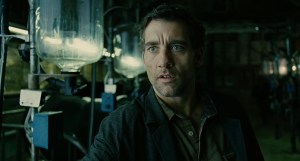
MV5BODQ4ZjMwMjEtMjc0Ni00MzA4LWE3N2ItODA3NmEwNDU3ZTE3L2ltYWdlL2ltYWdlXkEyXkFqcGdeQXVyNDAxOTExNTM@._V1_First, this doesn’t need to be said but I will say it anyway: fucking Alfonso Cuaron. What a brilliant director. This is just such an astonishing work in film. The sense of urgency is brilliantly sustained throughout. There are so many scenes in this one movie that are best of career, highlight reel stuff that you can never quite catch your breath. There’s a long scene, kind of a car chase in reverse, where the car in question is specially outfitted so that a custom-rigged camera can rotate not just inside the vehicle, but outside the windshield as well. It’s fantastic, heart in throat stuff.
Cuaron stays away from exposition but the film never lacks. We aren’t told much about Theo but we’re shown quite a lot – nearly every scene contains an animal, and that animal is always drawn to him; he never touches a gun; his private cry for Julian; his aborted cigarettes; his seemingly unflappable response to crisis; his need to save others, even strangers. A character emerges without wasting a lot of time on formalities – that’s how you establish a frenetic pace.

And Cuaron’s setting of the film is second to none. It was filmed in 2005, just a few short weeks after London had its own terrorist bombing. Cuaron uses imagery from Pink Floyd (who often sang about oppression, war, and being) and Banksy, a guerilla street artist and political activist. At one point, the camera pans by cages with prisoners inside and one of them gives us a brief glimpse of the “hooded man” from the Abu Ghraib prison torture pictures, seen in the exact pose as the real pictures. There are specific calls to past wars, and political movements (Michael Caine has based his character on the fervent pacifist, John Lennon, Theo’s workplace is a nod to George Orwell’s 1984) but I was surprised how well it holds up, feeling every bit as relevant to today’s issues as those of a decade ago. Which is obviously not a good thing for the world but shows what a specific and visionary film maker Cuaron is. And meticulous. There are so many details, musical cues, religious references, nods to thematically-relevant literature that you lose count. You can’t even notice most upon first-watch, but you absorb them and get immersed in this gritty world and all of its noise and flaws and trauma.

With stunning lensing by Emmanuel Lubezki and astonishing, seamless editing by Cuaron and Alex Rodriguez, Children of Men is must-see moviedom in every sense. Cuaron is an immense talent; his is a filmography that must be discovered and rediscovered at every available opportunity.

Overboard (2018)

When it’s over, Sean turns to me and says ‘I know you recently crowned SPF-18 the worst movie ever, but what do you think, could this usurp it?’ And the thing is yeah – he’s not wrong, though I must uncomfortably remind him that while we watched SPF-18 for “free” (Netflix), we paid to watch this shit. Which makes its awfulness that much harder to swallow.

Sure the 1987 version was horribly sexist, but it was also soaked in charm. Goldie Hawn and Kurt Russell had major chemistry, and Garry Marshall knew how to wring a scene for laughs. In the 2018 remake, it’s hard not to compare Anna Faris to Goldie Hawn, and it’s impossible for her not to lose, and by quite a large margin. Hawn has big presence and effortless likeability. Faris has her wide mouth and not much else.

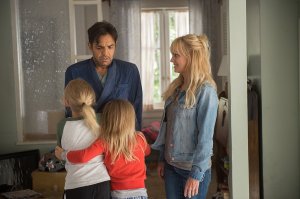
In 2018, the roles are reversed. Kate (Faris) is the hard-working widow, and Leo (Eugenio Derbez) the pompous, spoiled brat. She meets him one day vacuuming up a glitter bomb on his beautiful yacht, and failing to meet his impossible standards, is MV5BZjNkOTNjMjktZGI5Yi00ODJjLWFhMzQtZWQ2YTU3NDBiNzRmXkEyXkFqcGdeQXVyNDg2MjUxNjM@._V1_SY1000_CR0,0,1502,1000_AL_thrown overboard, unpaid. He later suffers an accident and ends up unidentified in a hospital with amnesia (his evil sister refusing to claim him so she can inherit the family business) so Kate, egged on by her best friend Theresa (Eva Longoria),decides to claim him as her husband and force him into a life of servitude in order to extort retribution. Nothing about this new life feels familiar to Leo, and he’s not immediately great at working a back-breaking job, doing all the housework, caring for 3 kids, and getting nothing in return.

Eugenio Derbez is a curious choice to play the leading man here. He’s a big star in Mexico but virtually unknown to the rest of North America. He’s also too old for Anna Faris, and not handsome enough, and doesn’t seem at home in either end of his role’s spectrum – the rich playboy, or the blue-collar dad. Either Overboard got some major Mexican money and had to meet certain conditions, or they were courting the Mexican box office (indeed, that’s where it made half its money) hard. Either way, Derbez just doesn’t fit. And Anna Faris, while never my favourite, has something to offer, though that something was left on the table. She’s more adept at physical comedy, screwball stuff, and the script did not play to her strengths at all. The chemistry between them is non-existent. How did this thing even get off the ground?

Never mind the fact that the premise just hasn’t aged very well. I mean, she’s basically kidnapping a mentally disabled person and forcing him into slavery. And when she delivers a laundry list of chores for him to complete on top of his two jobs and caregiving responsibilities, it just comes off as mean. Which isn’t nearly as bad as how she comes off as a mother. First, the gall to complain that her mother (Swoozie Kurtz, whom I have never not loved) is not prepared to derail her whole life in order to care for Kate’s kids full-time. Um, they’re your kids Kate. I get that it’s tough to be a single parent, but it’s nobody’s responsibility but yours. Second, she constant reminds us how icky it is to leave her three young daughters alone with a strange man (the only thing she knows about him is that he’s a horndog douchebag, ie, not great babysitting material) and yet it happens over and over. Kate is a widow, apparently, though that’s mentioned once and forgotten. There is no mourning being done in her household – no mentions, no memories, no pictures even. So I get why she might “fall” for a provider type, someone to lessen her burden. But why would Leo fall for her? She’s so much worse than just your standard liar: she’s amoral and selfish and exploitative. This is not a love story you can root for and not a comedy you can laugh at. So what the heck’s the point?

On Chesil Beach

Two young people are trying to have sex, apparently on their wedding night, which is important to note because they’re old-timey virgins who are nervous and awkward and don’t really know where things go or for how long or how hard.

Somewhere between toes and tits, Florence (Saoirse Ronan) and Edward (Billy Howle) reminisce about their entire relationship, through flashbacks. Spoiler alert: MV5BMmFlOTkyYjQtYWQyYS00ZDY3LWE3ZjktZDE4Y2Y5M2EyMzQwXkEyXkFqcGdeQXVyNTc5OTMwOTQ@._V1_SY1000_CR0,0,666,1000_AL_they have a history! Their courtship was often influenced (often negatively) by their pasts, by their families, by what they know and what they don’t. Sound familiar? That’s probably because it’s true of absolutely every human who has ever lived. So how did this movie get made?

Well, Ian McEwan wrote a wonderfully descriptive book, as he does. The kind of book that languishes and meanders around in a poetic bath of language. On film, oh gosh, it’s beautiful, and Saoirse Ronan is luminous and wonderful, but there’s not a whole lot of action. Haha, even saying the word action in this context feels bizarre. I mean, on their hottest date, Edward chastises Flo for her lukewarm bird watching.

Anyway, if you find it hard to imagine what sex was even like in 1962, before the sexual revolution had really…revolved…well, consider yourself lucky. On Chesil Beach gives you an eyeful in all its pasty glory, which doesn’t actually involve any nudity because this is the generation that has never seen their partners naked. Anyway, the fumbling is real. Activities are prematurely aborted, or, well, not quite. Things are said. Things like: that’s revolting, which is hard to recover from. It begs the question: does sex just sometimes…not happen? ‘Frigid’ is another word you don’t recover from.

Anyway, the whole thing feels rather minor, and that’s not a comment on poor Eddie’s manhood. It’s just very introspective, and perhaps a visual medium is not quite the best path for this story. And the movie just stretches on and on, beyond what feels right or makes sense. Certainly beyond my patience, and beyond the tether of my empathy for these people. The film fails its characters and fails the audience by not having much of a bigger picture. At least with a book you can hurl it across the room – hell, I’m sure I’ve even broken a window or two launching a stupid book right through it, but a movie? Those faces loom so large and yet I cannot reach out and slap them, and that is the greatest travesty of all.

SPF-18

The first half of SPF-18 is about virginity, or the loss thereof. Penny (Carson Meyer) needs a prom do-over, and when her boyfriend Johnny (Noah Centineo) house sits for Keanu, she brings her cousin Camilla (Bianca Santos) and a pack of condoms and and the deflowering is on.

The second half of SPF-18 is about surfing, and using it to somehow honour one’s dead father.

MV5BZjVhMmFmYTQtYTMwNC00Y2JiLTg1MDAtOGM3ZGM3Y2I0YWMyXkEyXkFqcGdeQXVyNTQ3MjE4NTU@._V1_SX1777_CR0,0,1777,999_AL_There’s a very thin line between these two halves where SPF-18 could have crossed over with The Meg, and had these vapid teenagers been devoured by a megalodon, I might have hated this a little less. As it was, just thinking of them as shark poop helped get me through.
In reality, a Christian country artist wannabe named Ash (Jackson White) baptizes himself in the nude in front of the girls, thus cementing himself in their hearts. And even though her virginity is still freshly smeared all over Keanu’s sheets, Penny’s heart goes the way of her hymen – torn.

And then Johnny’s dead dad’s surfing protegee resurfaces, guilt-ridden about his drug usage which may or may not have contributed to his mentor’s untimely death. This story really doesn’t need to be here, but the film is already a scant 75 minutes, so I guess it added some flesh to the bare bones. The rest is just redistributing the lovers. Ash has a soulful voice but Johnny has abs worth praying about.

You should be able to deduce that the script is bad but that really doesn’t do it justice. IT’S HORRENDOUS. The dialogue is embarrassing and cringe-worthy, but it’s not the worst part. The worst part are the disparate ideas strung together to make a movie. They’re so random I don’t even know how they decided which order to put them in (Evil studio executives! The benefits of pilates! Illegal doping scandals! Greek mythology! Animated meditation! High school superlatives! Unnecessary narrators! Intellectual property law! Unexplained lip lesions!). Can you hodge podge these together to make a film? No you can’t, you definitely can’t, but that’s not stopping anyone.

I don’t know anything about director Alex Israel, but I can guess that he’s an 80s kid. He certainly reveres the decade. Why else would you give a millennial rom-com a power ballad-filled soundtrack? And how else to explain small roles for Pamela Anderson, Goldie Hawn, and Molly Ringwald? This movie was painful for me, and not just because SPF-18 may as well be bacon grease (I like a nice hard 50 myself) for all the good it does. It feels like this may have been made and edited in the drunk tank by people with double vision and shaky hands and very, very poor judgment. I literally cannot believe this is a movie and I definitely cannot warn you away vehemently enough.

Extract

Chances are, every pantry has a little bottle of pricey vanilla extract on its shelves. It’s practically ubiquitous in baking. Just try to make a cookie without it. But have you ever wondered where it comes from? No. And neither have I. But that’s not going to stop Jason Bateman from trying to tell us.

Joel (Bateman) is one of those classically sad, back-boneless middle aged men who aren’t particularly effective at home or at work. He owns the extract company, but it’s barely profitable and the employees bully him. At home, his wife Suzie (Kristen Wiig) dons her sweatpants in a nightly ritual to thwart his bedtime advances. They’re going through a dry spell. So when Cindy (Mila Kunis), an alluring young woman, comes looking for a job at the factory, can we blame Joel for wanting to give her something else? I mean, yes. We absolutely can. And even Joel is a bit wishy-washy on the whole thing, so it takes the bad influence of his best friend (Ben extract-02.jpgAffleck) to come up with this convoluted plan: they’ll hire a teenage gigolo to seduce Suzie, leaving Joel free to have an affair guilt-free. That’s a legit loophole in the vows, right?

Anyway, turns out Cindy’s a conwoman who’s trying to influence a former employee (Clifton Collins Jr.) to sue Joel for the loss of his testicle. So who, exactly is going to get a happily ever after?

From the mind of writer-director Mike Judge, I expected a lot better from Extract, and I probably shouldn’t have. I mean, it’s funny. And there are a lot of great cast members really selling their parts (David Koechner is a scene-stealer in a part that will infuriate you). None of these things add up to anything significant, but if you can live with some ridiculous, and often ridiculously funny, bits and pieces, you might be able to make this work for you. It’s no Office Space; like the extract itself, a little goes a long way, but if you’ve got a hankering for some ethical flavouring, Extract has the essence.

Love After Love

Warning: do not ask your spouse (or your friend or your kid or your brother) if they’re happy unless you’re really, truly prepared to hear the answer. Unless you’re certain the relationship, and your heart, can survive honesty. Happiness is a tricky thing, perhaps overvalued, perhaps not, but certainly contentious, perhaps elusive, always sought-after.

Brothers Nicholas (Chris O’Dowd) and Chris (James Adomian) are dealing with the death of their father, which was a rough one (or are they all?). Grief never exists in a vacuum. Death doesn’t wait for marriage, divorce, career, or even nervous breakdowns. It doesn’t wait to be convenient. Grief gets woven into the pastiche of life and it’s hard to watch these two mostly lovable guys flail about. But in some ways it’s even harder to watch their mother (Andie MacDowell. Andie MacDowell!) try to cope. She’s too young to be a widow and too vibrant to just curl in on herself. And too concerned about her children to not say what’s on her mind. Grief doesn’t make you a better person.

hero_Love-After-Love-2018-2

Love After Love is a bold movie that refuses to put on a brave face. There are no easy answers and no Hollywood endings. Grief changes a person, distorts a family dynamic. It can be ugly and it can be cruel, and director Russell Harbaugh savours those moments like they’re precious, and I suppose in some essential way, they are. The film feels loose and untethered; a series of family gatherings reveal their struggle to return to stasis. It’s as messy as they are, and seeing these emotions portrayed so honestly and unflinchingly is bleak of course but refreshing – I almost felt a sense of relief to not have to buy into the normal Hollywood tropes.

The cast is wonderful because they’re fearless. I have loved Chris O’Dowd since I first laid eyes on him and in the past few years he’s shown incredible range (though I tend to believe that if you can do comedy, you can do anything – not true in reverse). But I’m also super glad to see Andie MacDowell because we never get enough and she’s as underrated as they come. Together, the three of them reflect an authentic experience that can be hard to watch because it feels personal. This kind of unraveling is meant to be private, or at least that’s what the death rites in North American tell us, and it makes us uncomfortable to witness it. This film delivers some very raw performances and if you can maneuver around the emotional minefield, I think you’ll be quite pleased that you did.