Ida

Poland’s submission for best foreign film does feel foreign, and not just because of the subtitles.

Ida (Agata Trzebuchowska) is a young girl who’s lived in an orphanage since the war.  Just as she is about to take vows to become a Catholic nun, she discovers she is Jewish, and sets out with her only known living relative, aunt Wanda (Agata Kulesza), to find out what happened to her parents.ida

This film is starkly shot in black and white, with the weirdest framing I’ve ever seen. Shots are obscured by door frames. Long, static shots feature two talking heads at the very bottom of the screen while a vast emptiness dominates the rest, reminding me of a certain austerity that I guess is fitting for the 1960s Polish setting, but is jarring nonetheless.A burden on their shoulders?

There is stillness to this movie, and quite a bit of quiet. It’s stark. It’s bleak. And it may also be read as the world’s weirdest road trip movie. I didn’t really pick up on this until a minor character in the film calls them an “odd couple” and I suppose they are. It’s just that their mourning and anger sap any of the fun usually found on the open road.

The Agata who played Wanda was very good. The role itself is very good, meaty, interesting, frustrating. She is Poland, with all the guilt, the betrayal, the hurt, and the redemption that comes with it. She says more with a well-timed puff of her cigarette than with the sparse dialogue. The other Agata is less revealing. Her face is blank, often staring, often empty. It’s hard to know where this character is going, and it’s hard to attach to her. I’m trying not to fault the movie for having made me work so hard just to watch it, but it is a difficult one and I did struggle.

I suppose director Pawel Pawlikowski is asking us what to do with this history, once (re)discovered. I’m just not sure I came away with the answer.
Golden Globes – Best Director, Motion Picture

The Nominees

Ava DuVernay, Selma

Richard Linklater, Boyhood

Wes Anderson, The Grand Budapest Hotel

David Fincher, Gone Girl

Alejandro Gonzalez Inarritu, Birdman

David Fincher is the easiest one to strike off the list. I’m not even sure how he got on it in the first place, except that he’s the kind of director people feel confident in nominating. He’s David Fincher! He does arty, interesting things! Just not this time.

It paints me to say this, but I think Wes Anderson’s my next victim. Love the movie, but it’s not terribly important and it’s always been easy for voters to ignore him no matter how good his stuff is.

The last three are the problem. I feel like I keep saying that. I mean, if it was up to me, I’d let Linklater go. I feel guilty saying that because he made this “achievement” in cinema, but I felt like it was more of an achievement and less something I actually would choose to rewatch.

Inarritu’s Birdman was undoubtedly one of my favourite movies this year and I think he really shook things up and reminded us all of what is possible. I don’t think his chances of winning are overly good, deserving as he may be.

Ava DuVernay has made a masterpiece that will still be watched and loved and appreciated 20 years from now. She made it lovingly, truthfully, and skillfully. And I think they’re going to give it Linklater anyway.

Golden Globes – Best Actor in a Motion Picture, Drama

The Nominees are:

Eddie Redmayne, The Theory of Everything

Steve Carrell, Foxcatcher

Benedict Cumberbatch, The Imitation Game

David Oyelowo, Selma

Jake Gyllenhaal, Nightcrawler

What a year! So many strong performances. Nightcrawler is the best performance of Gyllenhaal’s career so far, but he’s not going to get an award for it. Neither is Carrell likely to, although I think he really pushed himself and we saw him at a whole new level. Sorry Steve, it’s not your year.

The next 3 are super, super tough to call and I wish we could just shake everyone’s hands, call a 3-way-tie, maybe watch Eddie Redmayne blush through his freckles and call it a day. But awards hardly ever work like that (although we did see a tie at the Oscars two years ago). There isn’t always going to be a clear winner, because there aren’t clear qualifications. Art is subjective. These 3 are all portraying real men (and so was Steve Carrell) so maybe in this case we do have a bit of a yardstick against which to measure. But other than that, all you can do is follow your gut reaction, and vote for what spoke to you the most.

For that reason, I’m eliminating Benedict Cumberbatch. I know he’s fairly heavily favoured  but  as I said before, I think he’s a really great and nuanced actor who did as good a job as I believe was possible with that role. I also believe that the writer did not provide as fleshed-out a character as possible, and that’s where Cumberbatch loses out to Redmayne. Redmayne became Hawking, and the writers allowed us to see both the good and the bad in the man. The audience got to see him grow and change as a man whereas the Turing character seemed much more static.

Eddie Redmayne was the first of these performances I saw, and I immediately declared it the one to beat. But last night I finally saw Selma and wasn’t prepared for just how much I would enjoy it, and enjoy Oyelowo’s portrayal of Dr. King. He’s able to show us this historical figure so revered, so hallowed that we forget he was a real man, and at the same time show us a flawed man who was barely holding it together. It’s got to be daunting to play Dr. King, especially in this kind of movie, but he never faltered. So I’m giving it Oyelowo.

Do I think the Globes will agree? I think they would if they all had the chance to see it, but this one’s been in very limited release until this weekend and apparently Paramount’s been having a hard time getting out screeners. I’d hate to see such a stupid reason lose Oyelowo the race, but I wouldn’t be surprised.

Score two Selma

Selma

I know who Martin Luther King was. But this movie made me realize how little I know about what he went through as a leader in the civil rights movement, and it was just a tiny sample of what must have gone on throughout the 1960s (and beyond). It made me want to learn more and I think that is an important accomplishment. It has now been 50 years since the events in the movie actually took place, and I think the horrors that went on need to be remembered so we can try to learn from them (because we do still have a lot to learn). All of this is in the background. This movie would be notable for that alone, and it is hard to separate out the fact that what we are seeing actually happened, which I have been trying to do so I can then judge Selma as a movie and not just as something that needs to be seen as a record of important events.

The events in this movie are horrific. It is difficult to imagine that any of them could ever have happened, but then you remember that things like this still DO happen, that for some reason the USA still can’t or won’t indict cops who kill black people (and it is not just a US problem, the recent incidents just happened to take place there). And still that is only a small part of the big picture, because it is not just “white, black and other”. There are lots of concurrent struggles for equality going on, still, with no resolution in sight. We have made some progress but not nearly enough (and as a straight white male what I would consider enough may not even actually be enough, which makes it even clearer that 50 years later we still aren’t close to achieving real equality).

I would not likely have thought about any of this today if I hadn’t watched Selma, and it goes to show again that regardless of how well this movie was made, I am glad I saw it.  But here’s the thing: this movie is incredibly good. David Oyelowo IS Martin Luther King. He is phenomenal. He would have carried this by himself but he does not need to. Everyone involved is intent on making this movie the best picture of the year. Their love and respect for the subject matter drew me in from the very start. I do not think this movie could be any better. Because of the subject matter I cannot promise that you will be entertained but I can promise that you will be moved.

Ten out of ten. See it.

Selma

Ooof. I confess, I don’t really know how to review this movie. Why does it feel different from any other movie? Because it’s a piece of art? A piece of history? No, it’s because this is a piece of heart, of our collective hearts. This story is an act of remembrance, an act of grace.

Matt, Sean and I attended the screening of this film at Silver City last night and I’ve been sitting with it ever since, wondering how I can add my voice to what’s being said about this movie. This is not just a history lesson. The images of protest, of indignation, of police brutality, of black people being gunned down for no reason, these could just as easily be ripped from today’s headlines as from 50 years ago. That’s the part that will scrape raw at your conscience, as it did mine.

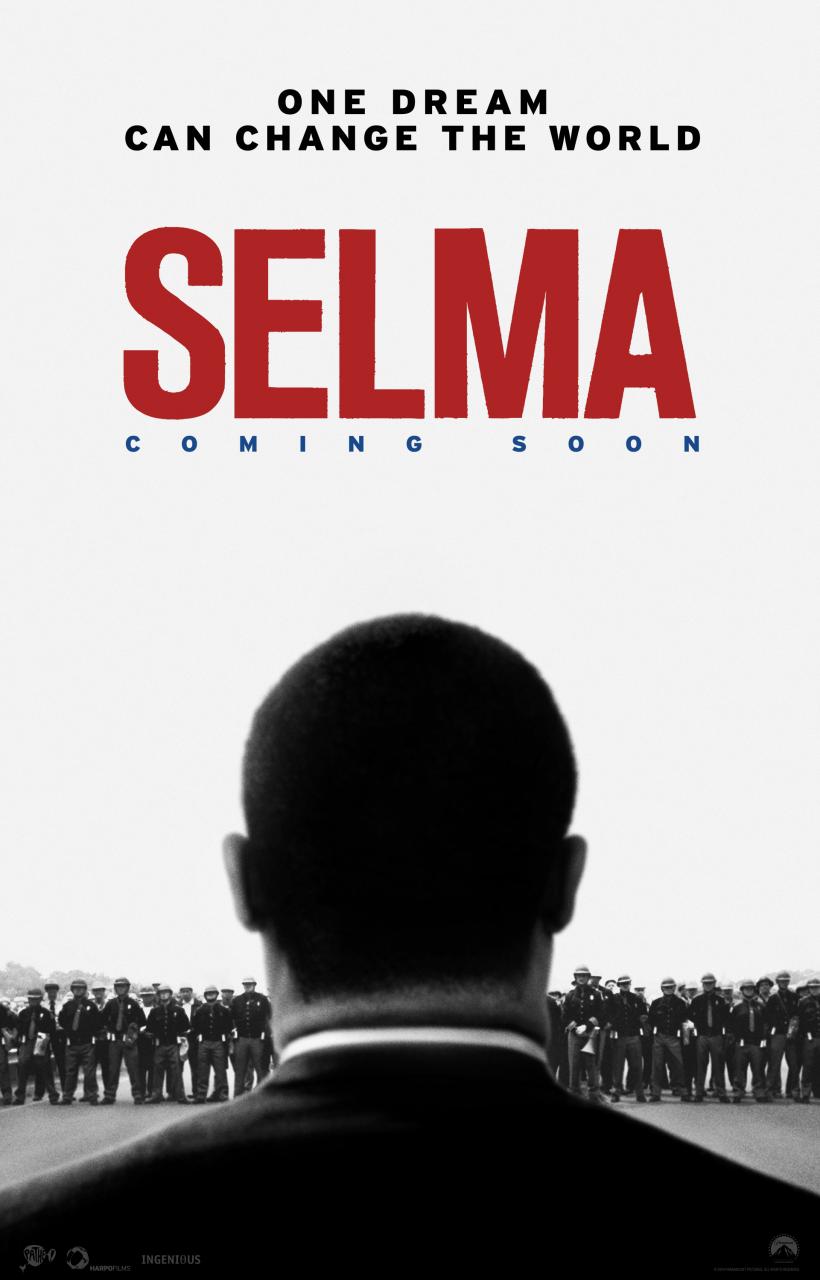
selma-movie-posterAnnie Lee Cooper is an older black woman registering to vote, as is her right as a supposed American citizen living in Selma, Alabama. The registrar is white, and resorts to dirty tricks in order to deny her once again. She leaves, slump-shouldered and dejected. Annie Cooper is played by Oprah Winfrey in the movie. I’m not normally a fan of stunt-casting, but in this case, using America’s sweetheart, a respected, powerful and highly successful personality who is also a black woman, to remind us just how far we’ve come in just 50 years, is pretty much the most perfect casting in the history of the world. Winfrey plays it winningly, with all the dignity the role deserves.

Insert Dr. Martin Luther King, Jr (David Oyelowo). He and his crew arrive in Selma to unite the people, to stir up activism, to attract the attention of the president (LBJ, played ably by Tom Wilkinson) and force him to do something about this supposed right to vote. Of course the president is reluctant, has his own agenda, and so King and company use their non-violent protest to force action in a genius and tragically necessary way.

The cinematography is a subtle tip of the hat toward realism. The costuming, particularly the suits worn by LBJ (those shoulders!), is pitch-perfect. The casting is strong. On paper it seems a bit weird to employ so much British talent to portray American icons, but it works. Oyelowo does a great job of shouldering the man and the spirit, the hero and the human being, without impersonating him.

It is hard to sit and watch this film. Director Ava DuVernay knows this and even uses it, with a stirring montage of Americans of all kinds watching horrified as the events unfold across their evening news, mirroring our own choking dismay.

DuVernay succeeds in stringing together a lot of different plot points in the course of the Selma events – the internal struggles of the organization, King’s problems at home, his grief and self-doubt, and government apathy or outright hostility on all levels. The film works so brilliantly because, while it stays humble in its scope, it becomes a representation for the movement as a whole, and for all the smaller victories along the way that led to real change. This flexibility in her story-telling is skillful and impressive and I can’t wait to hear her name announced as an Oscar nominee  (I won’t even say if), the first black female director ever to make the list.

Please see this movie. I can’t say that enough.


Big Eyes

This movie failed me on many levels. I want to tell you that it’s still a movie worth watching, it’s not horrendous, and it’s a fascinating story. I want to tell you that, and I suppose I have, but I also can’t help but tell you the rest.big_eyes_movie_poster_2

First: Christoph Waltz. So miscast. He runs through the movie like a bull in a china shop. It’s like he decided to approach this role as a Jim-Carrey-in-The-Mask impersonation, with a peekaboo German accent, and maybe whiffs of Jack Nicholson in The Shining, just for kicks. When he was on screen, and he almost always was, I could barely suppress my urge to yell “Cut!” Where was director Tim Burton in all of this? Has Burton spent too long in kooky, make believe worlds that he can’t even tell what’s real anymore? It certainly felt to me like he was out of his depth. Waltz’s portrayal of Walter Keane was artless and unrestrained. Yes, he plays a schmoozy con man who takes credit for his wife’s art for years, but this was also a real man and Waltz does not convey for one second that he has a single genuine, authentic bone in his entire body.

Amy Adams as the quashed artist Margaret Keane didn’t quite satisfy either. I kept hearing in the script Margaret fighting back a little with bitterness and sarcasm, but Adams couldn’t carry them off. She’s too mousey and breathy.

My biggest problem, though, is this. The movie is about a woman who is passively (and then maybe not so passively) abused for years. Her husband steals from her, takes away the thing of which she is most proud, and intimidates her into silence, forcing her to live in secret, isolation, and near-sweatshop conditions. And the era in which she lives doesn’t provide a whole lot of viable alternatives. But the movie itself is another act of subjugation. She’s not really the star of her own story. It’s Christoph Waltz who dominates the screen. He’s allowed to steal the scenes. Amy Adams can never inject her character with enough backbone to compete. He walks all over her. This turns out to not be the story of her stolen art, but about his swindle.  You  need only look at the movie poster for proof.

So that’s how you ruin a mediocre movie. You take a powerful story and you tell it from the entirely wrong perspective. It’s as if the movie itself hasn’t learned its own lesson, and in 2015, that’s a heartbreak.

The Hundred Foot Journey

I only watched this movie because Helen Mirren was nominated as Best Actress in a motion picture, musical or comedy by the Golden Globes for this very role. She’s a twelve-time nominee with four wins under her fabulous belt. I think she’s great, and not just in a girl-crush kinda way (though definitely in that way as well), but in that I find her elegant to watch on screen. She usually make good choices, and as the film is backed by the likes of Oprah Winfrey and Steven Speilberg, I was a little let down to find this one was more hamburger than filet mignon.The-Hundred-Foot-Journey-2014-movie-poster

It’s about Madame Mallory (Mirren), a restaurateur of a fine French establishment who is horrified when foreigners open up a curry shop not 100 feet from her front door. She tries to harass them out of business but eventually must admit that their young cook (Manish Dayal) is superior to her own.

The food porn is fabulous, and of course I watched it on an empty stomach (confidential to Matt: butter chicken tonight?) but it’s not enough to hurdle over the holes in the plot, which is dashed sparingly throughout the movie like so much spice, along with pounds of clichés and a good measure of cultural stereotype to boot. Not to mention the slow burn (but maybe you’re looking for a movie to nap to?) and the schmaltziness that Mirren and co-star Om Puri should be above.

It’s predictable and pompously-titled, and at one point I found myself really bothered by the score, which was overdramatic (sounds like Schindler’s List, is actually over melting ice in a bucket of fish). The cast is solid (Dayal is a serious cutie) but in Lasse Hallstrom’s cinematic food fight, baguette vs naan, all you end up with is a bit of sliced Wonderbread with the crusts cut off.

Golden Globes – Best Screenplay

The Nominees:

Gone Girl (Gillian Flynn)

The Grand Budapest Hotel (Wes Anderson & Hugo Guinness)

The Imitation Game (Graham Moore)

Birdman (Alejandro Gonzalez Inarritu,  Nicolas Giacobone, Alexander Dinelaris & Armando Bo

Boyhood (Richard Linklater)

How to predict such a broad category? Well, I can start by striking Gone Girl from the list. I’m not sure if it’s an author’s dream or worst nightmare to be given a second chance, via screenplay, to correct your novel’s mistakes, but Flynn just isn’t that strong a writer and the screenplay probably would have done better in someone else’s hands, someone with a fresher eye and a little more distance.

After that, I’m kind of done. Graham Moore does a wonderful job of portraying a story that is mostly about thinking and shows us how the thinking is done. Alan Turing had a rich interior life and Moore gives us the tools to explore it. It’s not always a graceful trick, as Matt will tell you, but it is a magic trick, and it results in a very watchable film.

Wes Anderson is brilliant. His stories are intricate and engrossing, injected with energy and idiosyncracies. In The Grand Budapest Hotel, he finds just the perfect line of dialogue for his enormous cast of regulars. You never feel they’re extraneous. There’s a gloss and sheen to this script that tells us only getting better.

Inarritu et. al for Birdman are of course going to be favourites of mine. They’re innovators. The script manages to be philosophical, existential, metaphysical, and yet relatable. Major respect.

Linklater is last but not least. Script-wise, I’m not sure how it holds up to this pack, or even to itself, over time. This is the movie it took 12 years to make. A script must naturally evolve over the course of such a long period, and yet it feels like a cohesive and believable and very natural work of art.

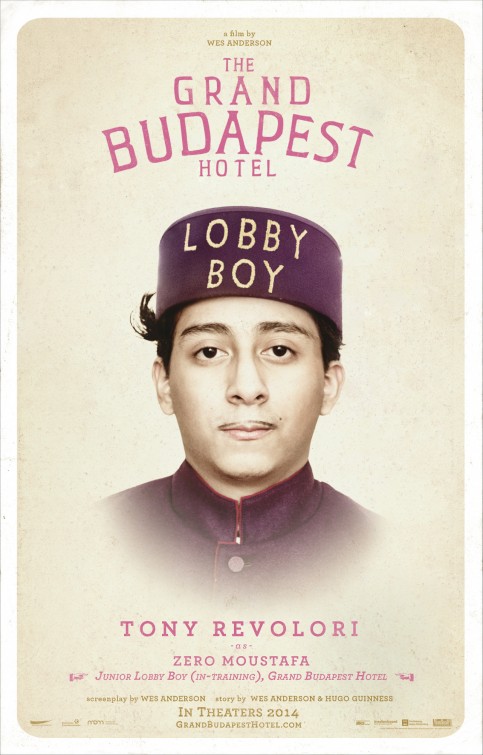
grand_budapest_hotel_ver12So who will the Globes pick? I’m sort of feeling they might throw Wes Anderson a bone on this one. As long as Flynn doesn’t go home with the trophy, though, I think it’s a win any (other) way you slice it.

Golden Globes – Best Original Score

The Nominees:

The Imitation Game’s Alexandre Desplat

The Theory of Everything’s Johann Johannson

Gone Girl’s Trent Reznor and Atticus Ross

Birdman‘s Antonio Sanchez

Interstellar’s Hans Zimmer

This category will probably bubble down to a battle of the British biopics. Johannson has never even been nominated but stands a good chance. You can’t count Zimmer out because it’s Zimmer, but if you read our Interstellar reviews, you know that we found the music to be ‘loud’ and ‘too loud’ and ‘kind of manipulative’ rather than particularly good. Desplat is an awards darling and could just as easily been nominated for his stellar work in The Grand Budapest Hotel as well. He’s not undeserving and his score for The Imitation Game is beautiful.

I hope, though, that the Globes will surprise us all and declare Antonio Sanchez the winner. When I reviewed Birdman, I felt the score was almost another character. His drum beats become a part of the movie, sometimes subtle and other times propulsive and assertive. Drums are not normal fare for a movie composer, but this is part of what Birdman such an exhilarating movie. It takes risks. Sanchez’s work weaves itself into the story and gives it life, a pulse.

The Oscars refused to even consider Birdman’s score, citing various flimsy excuses, amounting Birdman-movie-posterto the director having occasionally used some pieces of classical music as themes for certain characters, thus rendering the score somehow ineligible (although this adds up to about 16 minutes out of the film’s 119). Certainly if pre-recorded songs are dominant, then the score is thought not to be, but that’s just not the case in Birdman. I do believe, however, that voting Academy members are not used to a single drum comprising a score. They themselves conduct orchestras and employ many (unionized) musicians, whereas Sanchez does not. So his innovative work will be frustratingly snubbed by the Oscars. Will the Globes have the balls to make up for it? I doubt it, but I hope so.

Score 2 for Birdman.


Find more Golden Globes predictions: Best Original Song, Best Motion Picture, Musical or Comedy, Best Animated Feature

NightCrawler

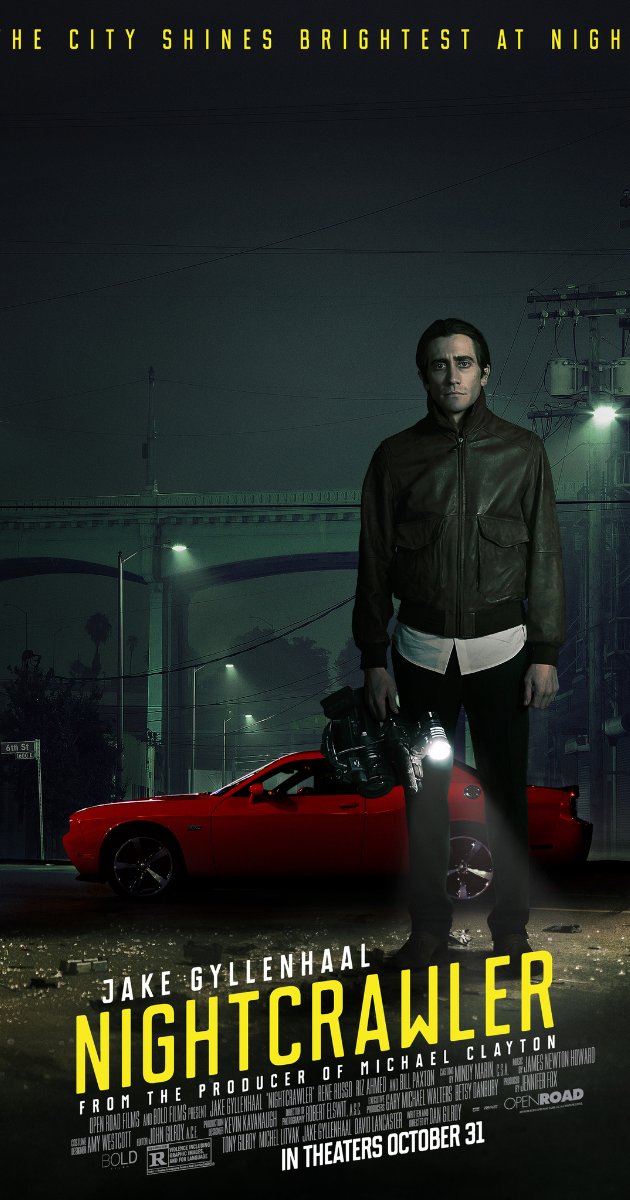
Jake Gyllenhaal’s Lou Bloom shows that you don’t have to be a journalist or a photographer to make it in the news business, you just have to have a nose for blood and a really strong stomach. In fact, tracking down the goriest, most gruesome deaths and crimes (especially those committed in rich neighbourhoods and against white people) seems a perfect fit for an enterprising but morally vacant soul such as Bloom, and thanks to a partnership with ratings-whore Nina (Rene Russo), he’s encouraged not only to continue, but to blur the line between finding and creating mayhem to “report.”nightcrawler

Gyllenhaal is gaunt, like a hungry animal prowling the night, his unblinking stare reminding me of Donnie Darko’s. He gives an increasingly chilling performance, cold but needy. You can never quite get a handle on just how intelligent this guy is. He studies the internet voraciously and comes off sounding like a wikipedia page, but the one thing you can’t learn online is feelings, and those are in short supply. Watching footage of a brutally murdered family, Lou has a self-satisfied smirk on his face, and Nina is practically salivating. These are not good people. There isn’t even a question of privacy, or of going too far. There is no too far.

Lou is pretty much irredeemable, as far as I can tell, unlike any other character I’ve seen on screen this year. It will give you the willies. First-time director Dan Gilroy will have you watching this movie with dread; with no ethics or scruples, anything can and may happen. Lou’s a dirty scavenger at best, and an unapologetic predator at what he would consider his best. Morality doesn’t factor in, which makes for a fascinating if disturbing character study of a man, who as near as I can tell, is void of any character to study.