Jurassic World: a preview


Everyone’s buzzing about two movie trailers that were supposed to drop into theatres this Friday – Star Wars, and Jurassic World. But Jurrassic world managed to win the day with a “leak” (that was probably more scoop than oops).

So who’s excited to see this one? I think the franchise lost a lot of viewers with their last installment but they’re hoping for a major reboot (and a major payday). They’re peddling their little asses off; as if a trailer premiere isn’t enough, they teased the teaser in the days leading up to its realease.

You’ll still have to wait 6 more months of this movie – Jurassic World is released June 12 – but it looks like the park is finally open. Yes, 22 years (22! Who feels ancient?) have passed since the park was first dreamed into reality by John Hammond. We all know that didn’t exactly go well for the park or for the people (and director Colin Trevorrow promises that neither Sam Neill, Laura Dern, nor Jeff Goldblum will be forced back onto the island under any pretenses. Pinky promise?). This film features Chris Pratt (note: too cute to be eaten) as an on-site scientist doing behavioural research on velociraptors (um, why?). Dinosaur-hell breaks loose when the company inadvertently (worst track record ever!) unleashes a genetically modified (because they can be patented – cha-ching!) hybrid dinosaur on the park.

I think Sean just got wood. Not only is this going to be a MAJOR drive in movie this summer, it’s also going to get its own Lego sets (making this Chris Pratt’s third time as a little yellow plastic man – there’s gotta be some kind of club for that). Merchandising aside, this movie is guaranteed to be good – after all, the last time co-stars Judy Greer and Bryce Dallas Howard got together, a little piece of movie magic called The Village resulted. No bombs in sight.


p.s. Let’s hope the Jurassic animatronics are of slightly better quality than the Zombeavers ones. Can I get a hell yeah?
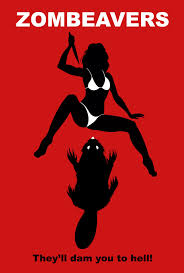
Zombeavers: a totally real movie. Apparently.

So it’s come to this: Zombeavers. If this isn’t a sign of the apocalypse, I don’t know what is. I don’t want to know what is. Sean’s cousin pointed me toward this gem and I can’t thank her enough.

The worst thing about this movie is that it doesn’t really know it’s a joke. It tries to be a real movie. There’s no parody here (I mean, can you even parody a parody?), no wink toward the audience. It’s genuinely, earnestly a movie about zombie beavers.zomb

Okay, that’s not the worst thing. But it’s a very bad, terrible thing.

Is it outrageous? No. It’s tired. The beaver jokes start almost immediately (to call it innuendo is aiming a bit too high, considering the script…innuendo implies something clever is happening, and there is NOTHING clever happening) unless you count the title, in which case the first and only joke is made before you even start the movie. If you’ve seen the poster, you’ve seen enough.

Bill Burr and John Mayer in a handlebar (believe it) open this thing up with a discussion about shitting in your friend’s house. It turns out that this would be the high point of the film (plus or minus the gratuitous dick pics), and it shouldn’t come of much of a surprise that it’s these two chuckleheads responsible for the whole zombified beaver mess.

Cue the pretty people partying and sexing it up in a secluded cabin in the woods. The script refers to them variously as college kids and sorority sisters but leaves the audience wondering which college exactly lets in kids who don’t know what a beaver dam is, or a landline for that matter. There is near-immediate toplessness (admittedly some pretty great tits) but then the douchebag boyfriends show up and a round of pointless fuking ensues.

A fun drinking game to play while watching this movie (and believe me, you’ll want to be on the vodka train for this doozie) would be to guess which douche is the first to bite the dust. Or better yet: which douche goes for a swim in the lake and comes back holding his own severed foot?

But wait! These zombeavers aren’t just hungry for human meat, they’re also quite devious. They don’t just sever feet, they also sever phone lines.

By the way. This movie goes the way of some 80s classics of the genre, eschewing effects for animatronics which are inevitably terrible. You’ve seen better animatronics on the 25 cent carousel in front of your grocery store. They’re not funny, they’re not scary, they’re just beaver puppets and totally, totally regrettable. A real dog is thrown in as beaver-bait and when he dies, so does the best actor in the bunch.

The worst actor of the bunch, “Hutch Dano”, does in fact “play” a very convincing dickwad. What he fails to convey with any aplomb is “guy hammering a nail.” Seriously. Watch this guy hammer a nail. And then watch him play whack-a-mole when the beavers start popping up through holes gnawed in the floor.

And if you thought the zombeavers were bad (and they’re godawful, truly), you should see what happens when a human gets bit and morphs into a zombie-beaver-human hybrid. It’s almost poetic and the costume lady seems to have saved herself some time by reusing the Miley Cyrus’s redneck teeth she bought for Halloween. Two birds, meet one stone. Love it.

There are a lot bad choices in this movie, but there is one redeeming factor: this movie clocks in at just 71 merciful minutes. So there’s that.

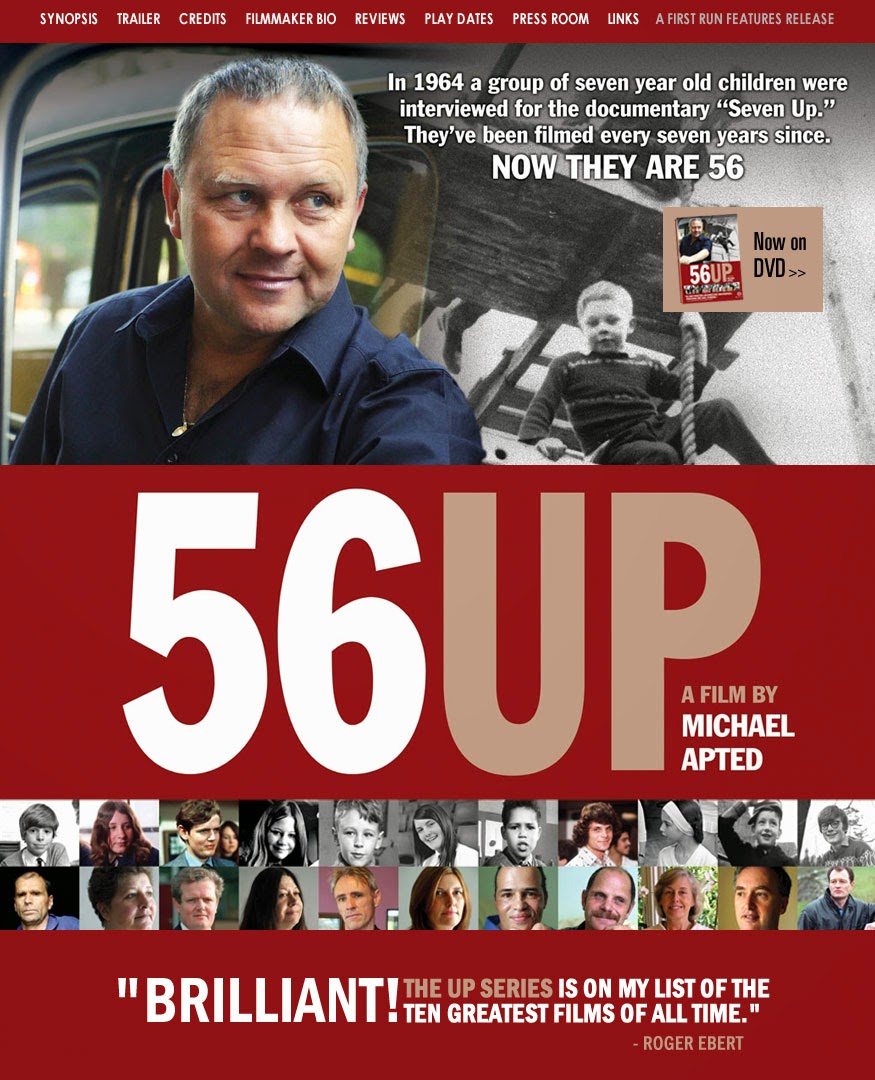
56 Up

I learned about this documentary through watching Life Itself , the ode to Robert Ebert.He was apparently quite a champion of this series and I was curious to find out why.

In 1964, the movie’s producers assembled 14 “diverse” (meaning 1 biracial kid, 4 girls, and 2 kids from the country) seven year olds and asked them a whole bunch of questions about what it was like being them, and what they saw for themselves in the future. The premise was taken from a Jesuit motto “Give me a child until he is seven and I will give you the man.” It was thought that at the time that these 7 year-olds would be heralding civilization into the next millennium (ie, they’d be grown up and leading us into the year 2000). The film has checked back in with the group every 7 years since, with this last installment, the group at age 56, filming in 2012 and airing in 2013.

What we get to watch is a decades-long social science experiment. These are very much ordinary people updating us on the minutiae of their lives. What have they become? Are they fullfilling their own prophecies? Living up to their potential? The director makes no bones about his original thesis – he assumed that each child’s social class would predetermine their future.The kids were apparently selected from different backgrounds (though like I said, they all seemed to come from the same end of the colour wheel). And the director himself admits that he didn’t anticipate “feminism” – he deliberately only followed 4 girls because it was sort of thought – who cares? They were never supposed to “become” anything anyway.The children were not held under contract so every 7 years since, they can volunteer (or not) to do the update. Though many express apprehension and sometimes even animosity toward the series, all but one have continued to make appearances.

Watching this, I wish I had started at the beginning. We see glimpses of previous interviews, we see the child, and the middle-aged adult, but I would have liked to have seen more. Each person presents us just a slice of their true picture, but we do pick up on divorce, unemployment, miscarriage, aging and ailing parents, the struggles of parenthood, and everyone’s changing (or static) politics.

The original hypothesis being that their life paths should have been set at birth has proven surprisingly (depressingly) true – most who started in the working class have remained there. But the interesting bit is not judging their success by the class which they inhabit, but rather by watching them judge it for themselves, over time. Are they happy? Satisfied? Do they feel they’ve wasted their lives? Contentment spreads over all the classes, as does doubt and regret.

I won’t summarize each of the subjects because that’s the point of the movie. One who really caught my eye though, I believe his name was Neil, was a sweet and charismatic little boy, not the one you might have guessed would grow up with mental health issues, only to battle thoughts of suicide, and spend time both jobless and homeless, but that’s what this film uncovers. These are not always pretty truths, but that’s exactly what we need to see. A little bit of reality before “reality TV” was ever a thing.

The exciting thing about watching this rather banal update is that it makes you question yourself. You wonder what you would have been telling the producer when you were 7. What job did you believe your future self would hold? I think when I was seven I wanted to be a teacher, which rather disgusts me now. My nephew (still a few years shy of 7) wants to be a green dragon when he grows up. Did your seven year old self think you’d ever get married? Or travel? See outerspace? Work a dead end job? Be a single parent? Are we failing our inner child’s dreams for us? Have we settled? Should we be happy with the compromises we’ve inevitably made? Are we learning from our mistakes? How do we really measure happiness, and what exactly is “success”?

Whatever experiment this started out as, it’s now become a question of existential proportions. And while I enjoyed watching this, I wished I was watching it with someone, maybe even some of you assholes, because I wanted to ask you these questions. Who did you think you would be when you were seven? Who do you think you’ll become in the next seven years? And at what point in your life can we really take stock, and declare it a success or a failure?

This movie is available to watch on Netflix.

Gone Girl, Starring Ben Affleck’s Penis

The bad news is that you have sit through pretty much the whole entire movie just to see it. And don’t be distracted by his ass. That was a fine tactic by the filmmakers and I respect it but we should rise above. You can see ass in almost any movie. You came here to see dick.

See that thigh? Keeeeeep going…almost there. Penis! Side peen, but peen just the same.

Jennifer Garner, proud wife of Ben and owner of said penis, shocked Ellen by saying Fincher needed a “wide lens” to shoot that glorious thing.nph

I believe this movie is 2-for-1 in that we also get a glimpse of Neil Patrick Harris’ cock as well, but that one comes at the exact moment that the whole theatre is recoiling in horror and looking away.

So. Big Ben. Thumbs up or thumbs down?

Life Itself

Our first meta-review, guys! Because how do you review a documentary made about the man who made movie reviews famous? Roger Ebert wasn’t the first film critic, and probably not the best, but he’s the one I grew up with, him and his thumb, and whichever way he was wielding it, it had power.

This film, made in the months immediately preceding his death, is an ode to love of film, and love of life. Indeed, we are privileged to meet the love of Ebert’s life, and she is brave enough to share their story with us. For that reason alone, this film is worth the watch.

It also gave a fascinating glimpse of the relationship between Siskel and Ebert. With some behind the scenes outtakes from their early days of television, we see the two not just butting heads but activiely disliking and dismissing one another. The animosity is awkward and seething and you can only imagine what it must have been like to work on the set of that show. At one point we hear Siskel refer to Ebert as an asshole, and though that’s not the origin of this blog’s title, we are the Assholes Watching Movies, and that little bit of trivia caught my breath. By the end of their tenure they seemed to have grown into genuinely respecting and even caring for each other – Siskel later said that Ebert was an asshole, but “he’s my asshole.” The film pays no mention at all to Siskel’s replacement, the comparatively bland Roeper, and most people felt the zing went out of the show when Ebert lost his favourite sparring partner.

Life Itself (although the title of Ebert’s memoir) explores the nature of Ebert’s criticism. He was a populist who wanted to like every movie he saw, and he saw an enormous amount (although probably not as many as we watch – we don’t technically get paid to watch movies, but we mostly get paid while watching them, which is almost as good). He took his job seriously and defended his position vehemently. He sometimes introduced new voices to the world. He championed Scorsese, who probably didn’t need it but seemed to really value it nonetheless, is his early, unknown days as a budding film director. Werner Herzog says of him “He reinforced my courage.” He measured movies against his own moral code and if they violated it needlessly, he could be ruthless. But he also believed in reviewing movies within a context, which is something I hope we’ll replicate here. We’re part of the fan culture that he helped create with his accessible reviews. We aren’t trained critics, but neither was he (he started out as a sports writer, apparently). He wanted his reviews to be only the starting point, and that’s what we’re hoping for here too – to have a conversation with whomever wanders in and reads the blog. Write us comments. Let’s discuss.
Roger Ebert’s disease was eating away at him. Without a jaw, he still managed to not only be witty, but infectiously so. He could still be expressive even without his voice. It was when words started failing altogether, when he could no longer type nor communicate that he seemd to lose his will to live. It hurts to watch this decline but it helps a bit to see this film as a celebration of a man who lived for movies, and lived as if he was in one.

Rest in peace.

Quartet

We find three friends living in a nursing home for retired musicians. They have performed together, years ago, and remember those days fondly, but their days of entertaining are not quite over. The home puts on an annual show and everyone’s busy preparing for it, as well as preparing for a new resident – rumoured to be quite a star. And as she pulls up in a chauffeured car with her many furs and jewels, Maggie Smith is every inch a star.

The trio of friends is in upheaval – Cecily is ecstatic to reconnect with an old friend, but Reginald is angry to find his ex-wife now living in the same home. Reginald’s best friend and one-time best man Wilf (played by Billy Connolly) tries to keep the peace but soon they must all work together because age and failing health has jeopardized the show, and the quartet must replace the last act, currently hospitalized, to ensure enough money is raised to keep the home solvent for another year, although Jean (Smith) has vowed never to perform in public again.

Okay, so the plot is predictable. Will they sing together once again? Of course they will. We’d be watching four more amenable geezers otherwise. The meat of the movie is more in the subplot, the pain between Reginald and Jean and their heartbreak still palpable after all these years. The joy of this movie is seeing all of these musicians, in the “encore” of their lives, still burning with passion for their craft. Even with dementia creeping in, music is the last thing to be forgotten. Director Dustin Hoffman does a lovely job juxtaposing the ailing bodies with spirited music, arthritic fingers still finding all the right notes, voices cracking with age but still filled with dignity and resonance.

Of course Billy Connolly injects a lot of energy and charisma into the film, providing lots of light counterpoints. It’s an enjoyable film that gives you lots to admire. I particularly enjoyed that the supporting cast is made up of actual retired stage performers (check the credits for their past work). Oftentimes when watching a British film, it’s like watching a reunion of old friends. When Maggie Smith appeared, I was watching over her shoulder for Penelope Wilton, who never appeared, but the ghost of The Best Exotic Marigold Hotel was a bit of a specter in this movie, and anyone who enjoyed that one will find satisfaction in Quartet.

p.s. If you enjoy this movie, and maybe even if you don’t, you should check out Young at Heart (2007), a documentary about an elderly chorus group who enjoys singing rock, punk, and all kinds of unexpected tunes. Really good stuff.

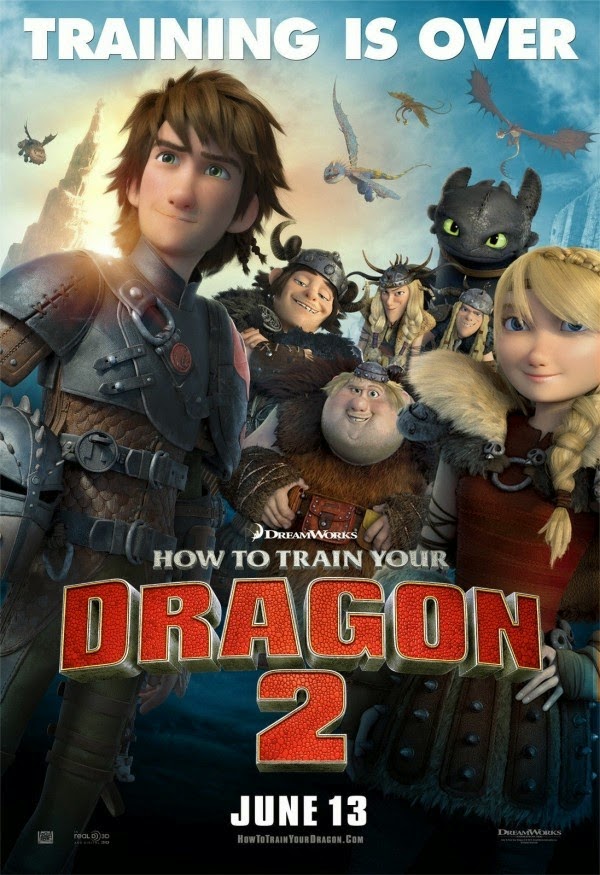
How To Train Your Dragon 2


Has it really been four years since the first one? No wonder I barely remember it.

I do remember being surprised how much I liked it though. The heroic score and spectacular animation of dragons in flight was impressive even when seen through my tiny portable dvd player. And the story-as best as I could remember about a Viking boy named Hiccup who is the only one who believes that dragons can be our friends- was touching stuff and completely changed the way I felt about dragons.

In How to Train Your Dragon 2, Hiccup has changed his village for the better. Now everyone has a dragon of their own and even have dragon races. Even though he is solely responsible for all these changes, Hiccup still can’t quite fit in and skips the dragon racing to go exploring with his own pet dragon, unsure of who he is because he never knew his mother.

Last time, Hiccup discovered that sometimes, we are afraid of things because we misunderstand them. This time, he will learn an even more grown up lesson- that sometimes we are afraid of things because they are scary. When Hiccup’s dad, the chief, learns the evil Drago is building a dragon army, Hiccup urges everyone to keep calm and let him find Drago and reason with him. “This is what I’m good at”, he says. He will soon learn that “Men who kill without reason cannot be reasoned with” and that Drago really does in fact plan on enslaving all the people and dragons he can get his hands on. What a maniac. Once he has accepted that some men are just bad and need to be fought, Hiccup will finally be able to become his father’s successor as chief, a job that only Hiccup doubts that he was born for.

My memory of How to Train Your Dragon is vague but I remember enjoying it more than I did the sequel. The animation is even more impressive this time around with two battle scenes that I absolutely loved but the story doesn’t add anything to the message of the first one. And Kristen Wiig, as talented as she is, should not be doing voice work.

Gandhi

I spend a lot of my movie-watching time with old movies- “classics” as most DVD rental stores call them, so I thought I would post some online reviews of films that have been around longer than online reviews to see how well they hold up. This week I rented Richard Attenborough’s 1983 Academy Award for Best Picture Winner Gandhi, a movie I’ve always meant to see because I thought I “should” but never got around to. Maybe it was it’s 190 minute running time. But I sat through Interstellar twice over the last two weeks so I decided I was ready.

This is, of course, the story of Mohandas K Gandhi, who I’ll assume needs no introduction, beginning in South Africa in 1893 until his death in 1948. So, 55 years of history over 3 hours. Get comfortable.

What it’s lost with age. Or maybe this was always a problem. I was a year old when Gandhi was originally released and my parents wouldn’t take me to see it at the time as much as I begged. Watching it today though, I thought Attenborough’s perfectly understandable reverence for his subject might have gotten in the way. Gandhi is potrayed more as saint than complex human being and we never really understand why he did the things he did. I’m not usually one to complain about length but it is tough to hold an audience’s attention for three hours when the main character does nothing but humble and self-sacrificing things.

What still holds up. Gandhi is played by Ben Kingsley (Sir Ben now but back then I think it was just Ben). Ben won a well-deserved Oscar for the part, beating out Tootsie’s Dustin Hoffman who ironically turned down the chance to play Gandhi, making me shudder to think how bad this movie could have been. As both the young hopeful Gandhi and the exhausted and starving older one, Ben’s eyes, voice, and posture are almost perfect. His performance is by far the best reason to see this movie.

Nice surprise for modern audiences. Early in the film, Gandhi is stopped on the street and mocked by three young punks (although they probably wouldn’t have been called that in the 1800s). My first thought was “These guys are so over the top. They have to be the worst actors in the entire movie”. My second thought was “Is that Daniel Day-Lewis?” It was. I guess everybody has to start somewhere.

Bottom line. When I’m watching a movie about a real guy, I tend not to like movies that try to cover too much. 55 years is a lot and I would have liked a movie that focused on a smaller, more manageable window in greater detail. Still, the old school production (real human extras instead of CGI ones, for example) give you that “they don’t make ’em like this anymore” feeling. And then there’s those performances. Ben Kingsley at his best, Daniel Day-Lewis at his worst. Who could ask for more?

Rain Man

Sean and I watched Rain Man, me for the nine hundredth time, Sean for the first. The first!Can you believe that?rain

I’m not going to review it because I believe and I certainly hope that he’s the only idiot to have not appreciated this film until now. And he did appreciate it. This film holds up beautifully, except maybe for the synth over the opening credits. This movie could have gone wrong in a lot of ways, so I have to give credit to the brilliant director (Barry Levinson) who treated the subject so tenderly. He doesn’t go directly for the heart strings, he doesn’t’ cloud the relationship with a lot of outside help. He creates a bond and lets his two actors shine. And they do. The movie may be a little off-kilter in some places but Dustin Hoffman never is. His performance I think is the best of his career (the Academy agreed). Tom Cruise could easily have faded into the background of such a performance but instead he also delivers one of his best, a raw and unsentimental portrayal of a man deeply layered in pain, confusion, and selfishness. Despite the inherent heaviness, this movie manages to pull us in not with easy tears, but with well-earned laughs.

And so Sean’s education continues.

Exciting New Development at Kanata Landmark Cinemas

Sean and I were recently out at Landmark Cinemas in Kanata to see Big Hero 6. It was a super sweet movie, surprisingly action-packed, with some awesome animation and a bunch of slick characters, including inventors\scientists (always a refreshing change from the ubiquitous princesses) who have endearingly quirky superhero alter-egos, and a snuggly inflatable robot named Baymax who steals the show and your heart.

We had a lot of fun at this movie and if you want to find out why, you can read Sean’s review here. Me? I’m not here to talk about the movie. I’m here to talk about the soda fountain.

There’s been a change at the Kanata theater since we were there last month to see Gone Girl, a big one. Now for the low, low price of twelve-freakin-bucks-and-change you can pour your own drinks! But not just any drinks! You can choose to vanilla Coke, or maybe you’re more in the mood for grape Sprite, or even (Jesus!) cherry Mr. Pibb!

Coca-Cola Freestyle is a touch-screen drink fountain that means you can have the option to over one hundred drinks and none of them are my beloved Diet Pepsi. It also means that there are long, long lines of thirsty people because though they’re fairly easy to operate, they’ll never be easy enough for old people, and there’s also an annoying browsing opportunity that newbies will take advantage of, people behind them late for their movies be damned.

Embracing the spirit of the big scary Coke robot, I opted for a cherry Sprite . Sean? Sean just had a coke.