Some reviews need to be delivered in person!
All Dogs Go To Heaven
6 Replies

Some reviews need to be delivered in person!
Some directors just have their muses: Scorsese has DeNiro, David O. Russell has Jennifer Lawrence, Tim Burton has Johnny Depp, Wes Anderson has Bill Murray, and Peter Berg has…Mark Wahlberg. Spencer Confidential is another Peter Berg – Mark Wahlberg collaboration, the fifth in a lineup of increasingly forgettable films: Lone Survivor, Patriot’s Day, Deepwater Horizon and Mile 22 and it feels like it was cobbled together by an AI that’s been programmed to write screenplays based solely on other Berg-Wahlberg collabs. It has thrown together all the B(b)erg cliches: Wahlberg inexplicably shirtless, Wahlberg sporting a sexy black eye, Wahlberg sticking up for the working man, Wahlberg just wailing on a guy, driving cars, crashing cars, and just generally acting macho.
He plays Spenser, a Boston cop who’s so dumb he spells his name wrong. He suspects his superior officer is a dirty Boston cop so he shows up at his house and beats him silly. You know, not exactly a rule follower. So he goes to prison to cool his heels, as you do when you assault a police officer. And when he gets out he lies low, drives transport trucks for a living, takes vacations in the desert.

Haha, just kidding. Spenser is out of prison for less than 24 hours when the cop he assaulted winds up murdered, and guess who’s the prime suspect. And even though he’s very much not a cop anymore, he still works the case. Out of the goodness of his heart?
Anyway, he’s got two buddies backing him up: an old man named Henry (Alan Arkin) and a complete stranger who’s also his new roommate, Hawk (Winston Duke). Conveniently, Hawk is a tank of a man who’s an amateur MMA fighter and knows a little computer, so he actually comes in handy when he’s paying attention. But believe me, you don’t want to be Mark Wahlberg’s friend. I mean Spenser’s friend. Okay, I mean both. Spenser has a knack for finding trouble. He’s never even heard of minding his own damn business.
Anyway, Spenser Confidential is a new kind of forgettable that’s actually forgettable even whilst viewing. Luckily there’s no real plot to keep track of and there’s no character development because no characters were drawn in the first place. Which is super convenient if you mostly watch Netflix for the white noise.
Every geek dreams of being able to apply their obscure knowledge to a real world situation. It hasn’t happened for me yet, but Barley Lightfoot (Chris Pratt) is about to get his chance. See, Barley and his brother Ian (Tom Holland) live in a fantastic world where magic is real, or at least was real before technology took its place.
As a result, Barley’s favourite fantasy role playing game is not just fiction. Instead, it’s based on historical events, and Barley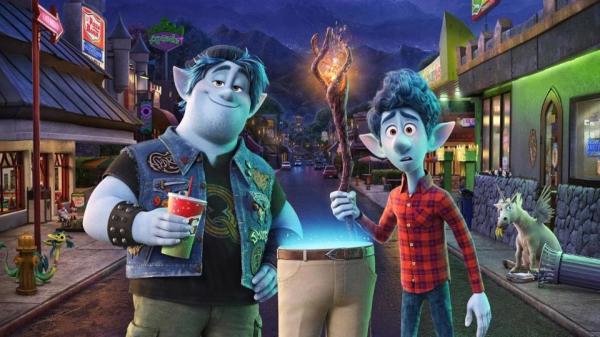 ‘s knowledge of those obscure facts really comes in handy as Ian and Barley embark on a quest to find a Phoenix Stone to power their father’s magic wand which will allow them to bring their dead dad back to life for 24 hours. If those stakes weren’t high enough, Ian and Barley have accidentally brought back their dad’s legs so the clock’s ticking!
What might have been a paint-by-numbers fetch quest in lesser hands is an epic adventure imbued with magic and wonder from Disney-Pixar. The extraordinary attention to detail makes Onward’s world feel authentic and exciting as we follow Barley, Ian and their half-a-dad on their epic adventure. Along the way, their efforts revitalize the world around them and bring back some of the magic that’s been forgotten. By the time we arrive at the final battle, everything has come together just as the prophecy foretold (truth be told, there is no explicit prophecy mentioned but this adventure is clearly the stuff of destiny). It’s a lot of fun to see it take shape.
Onward is more pure cinematic magic from Disney-Pixar. Even though Onward may not quite hit the heights of the studio’s very best, it’s a worthy addition to the catalogue and it will be especially enjoyable for anyone who has slayed dragons as an elf, troll or wizard in their basement (whether in modern digital form, the classic tabletop and 20-sided-die variety, or both).
This is the kind of movie that throws you into a world and a situation we know nothing about, and writer-directors Zach Lipovsky and Adam B. Stein aren’t in a hurry to tell us.
Dad (Emile Hirsch) has sequestered himself and his 7 year old daughter Chloe (Lexy Kolker) in their home. The drapes are duct-taped closed, the door is quadruple-locked, and no one is allowed in or out. They are preparing for or hiding from some ominous event, and the blood dripping from Dad’s eyes make me think it’s not just all in his head, no matter how paranoid and controlling this all seems.
Still, Chloe is a 7 year old girl. She wants to make a friend, to play in the park, to eat an ice cream cone. So when Mr. Snowcone (Bruce Dern) repeatedly parks directly in front of their home, Chloe can’t resist, and all she has to do is wait for Dad to fall into one of his sleeps to make her escape.
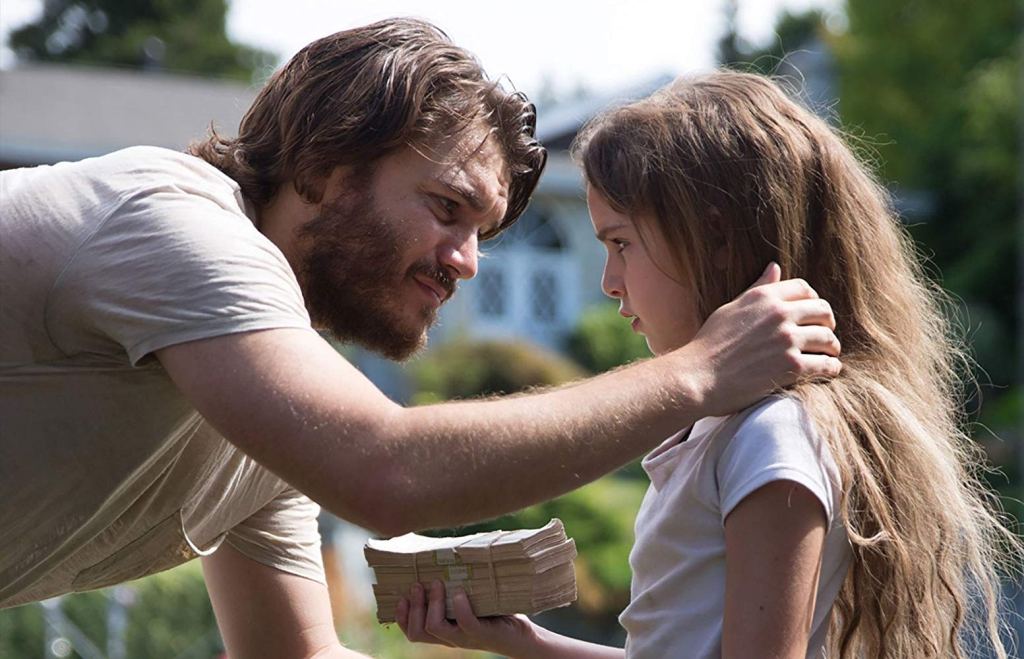
But on the outside, it turns out not everything Dad told her is a lie. There ARE bad people – it’s just harder than she thought to identify them. In fact, Freaks is almost the flip side to The Incredibles. I know, I know, that sounds like weird comparison, but you may recall that as we meet the Incredible family, we learn that super heroes have basically been outlawed and this family has been relocated and have to hide their powers to fit in. Chloe’s family also have powers of some kind, and public fear has meant that all the special people are either hiding or relocated or dead, and the government prefers the latter to the former.
The story keeps us firmly within Chloe’s understanding of her own powers and the circumstances in which she lives. She’s understandably frustrated with her confinement and she makes impetuous, chocolate-driven decisions. The directors have crafted a horror-sci-fi hybrid that keeps us guessing, unfolding at Chloe’s pace, not mine or yours or theirs.
Freaks is perhaps a little inconsistent, but it’s boldly directed and surprisingly well-acted. There’s more character development than a dozen other horror films combined and its message is as strong as it is relevant.
For a minute I wonder if I rented the wrong movie. These are real, human actors: Marla (Anya Taylor-Joy) just finished high school and instead of going off to college she confides in her brother Charlie (Gabriel Bateman) that she’s destined for a life of adventure. But that all ends when a knock on the door reveals a police officer come to tell them their parents are dead. Cut to: a couple of years later, Marla, having put her dreams on hold, is struggling to keep a household going while brother Charlie is disappointed in the distinct lack of adventure in their lives. He runs away one dark and stormy evening and just as Marla tracks him down at some sort of toy convention with a large Playmobil village, they get sucked into it and pop up an animated Lego form.
Marla reanimates as a girl in a sweater set but Charlie is more fortunate, taking the Viking shape he always carried on his bookbag. Landing in the middle of a viking battle, Charlie immediately makes friends but then gets accidentally trebucheted into another land. Marla scoops up some viking gold and chases after him, not realizing her loot makes her a target as well. She hooks up with Del (Jim Gaffigan), purveyor of magical hay, and he agrees to help if she’ll recompense him.

If you walk down the aisles of the Toys R Us Lego section, you’ll find dozens of Playmobil sets, Lego for the younger set. You will find pirates and police officers, dinosaurs and dragons, mermaids and magic yetis. In the film’s universe, all of these disparate sets are connected by a highway. Turns out, a lot of citizens have been going missing lately, so a debonair secret agent named Rex (Daniel Radcliffe) joins them on their quest.
Confused yet? That may be up to 20% my fault but definitely at least 80% the movie’s. Playmobil is appealing directly to small children, dispensing the shackles of story and logic and just hitting them with a spray of a thing and a thing and a thing and a thing. Are they connected? Vaguely, I think. But mostly they show off a wide variety of toy sets available in a toy store near you while keeping up a colourful and frenetic pace.
It’s very easy to forget that the monarchy is made up with real, living, breathing people. Extremely privileged people of course, who are often very out of touch with the real world and therefore the people they are meant to represent as well. But people nonetheless. Victoria (Emily Blunt) reminds us that even palaces can be prisons.
By the age of 11 she is made aware of her precarious and burdensome lot in love; the only living heir to King William IV’s throne. Victoria’s teenage years are dominated by her possessive mother, the Duchess of Kent (Miranda Richardson) and the Duchess’ consort, John Conroy (Mark Strong), who imposes all kinds of rules on Victoria. Despite the pressure, Victoria refuses to allow them the power to act as her regent, and she finally takes the crown at the age of 18.

In fact, this only means that even more people seek to control and influence her, including her cousin Albert (Rupert Friend), with whom it is hoped she will fall in love for political reasons. Having only just left the clutches of her mother, she isn’t quick to attach herself to someone else, but instead falls under the influnce of Prime Minister Melbourne (Paul Bettany), whom she trusts implicitly, even to the point of constitutional crisis.
Emily Blunt does a masterful job of portraying the young queen – her confidence, her missteps, her optimism, her suspicion, her inexperience and her willingness. Most 18 year olds aren’t ready for such weighty responsibilities but when your birth decrees it, there is nothing to do but step up. She is the sun around which so many orbit, on whom so many depend. A power struggle is inevitable.
The Young Victoria is romantic but lumbering, never quite hitting the right balance of tension and story. There’s a lot of wistfully reading letters aloud while sitting on various tufted couches. But if you’re looking for a Victorian drama, there are plenty of petticoats around, the scenery is terribly opulent. Blunt and Friend have a sizzling chemistry and you almost wish the movie had started rather than ended there.
Matthew (Ryan Reynolds) is a loving husband and father who struggles to pay the bills since his business failed. He’s the one to pick 9 year old daughter Cass up from figure skating practice while wife Tina (Mireille Enos) cleans hotel rooms in Niagara Falls. One evening, he pops into the pie store off the highway for just a moment, but in the time it takes to pay for a cherry rhubarb, his daughter has disappeared from the backseat of his truck.
You and I have the privilege and the horror of knowing that she’s been snatched by sexual predator Mika (Kevin Durand), whom you’ll immediately be able to identify by his pedo mustache. But the police, including Jeffrey Cornwall (Scott Speedman), a detective newly appointed to the Child Exploitation Unit, and his boss Nicole Dunlop (Rosario Dawson), suspect Matthew to be involved. Though they never have evidence to arrest him, over the next 8 years, the strain and taint of suspicion eventually crumbles Matthew and Tina’s marriage.
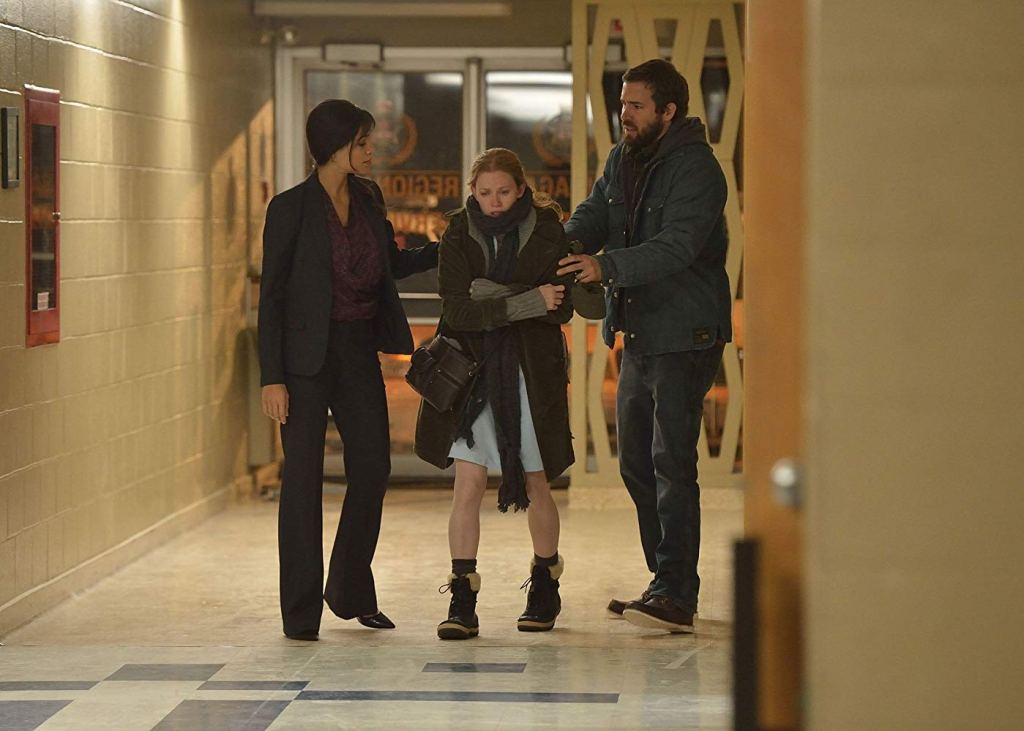
Matthew resolves to find Cass on his own, which mostly involves driving slowly by every single teenage girl he comes across, while Tina is still in touch with the Child Exploitation Unit, who’ve been coming the dark web obsessively, Jeffrey posing as a fellow pedophile and trying to ease his way into a sex trafficking ring. After 8 years, he’s found an image that he suspects might be Cass, and indeed we know that even as a 17 year old no longer of any interest to pedophiles, she’s still be held and used as a friendly face to lure other unsuspecting children into the vans of predators. But since no one knows where Cass is being held, including Cass herself, a rescue mission is impossible. And as the days tick by, both Matthew and Jeffrey are losing touch with reality.
Director Atom Egoyan crafts a film that is deeply unpleasant to watch, while Reynolds’ performance adds up to heartbreak. However, the film remains difficult for other reasons, Egoyan’s murky jumps in time seemingly purposely obfuscating reality. Egoyan often plays around with time and memory, but the result is usually haunting rather than confusing. The twists and turns feel cheap and tricky and even though the outcome to root for seems painfully obvious, it also feels undeserved. Each frame taken individually is ridiculously and meticulously perfect in its composition but their combined effort is unconvincing and unsatisfying. As Dunlop says herself: “there are no happy endings in my line of work.”
The Bronx, summertime, 1993: Brendan (Jimi Stanton) is working hard at the local deli to support his brother and his alcoholic mother. Their fridge is always empty. He meets college-bound Eva (Princess Nokia), and even though she has a boyfriend back home in Puerto Rico, she agrees to hang out with him. He’s not the kind of boy her mother would approve of. His family isn’t the right kind of family. But sparks are sparks.
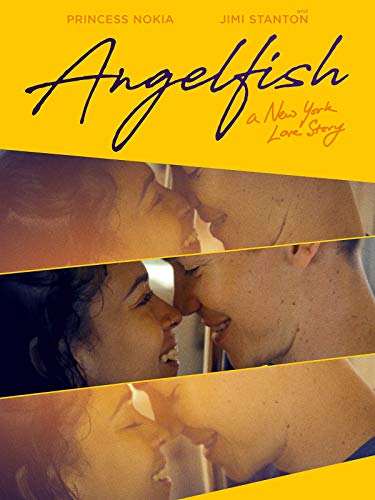
Director Peter Andrew Lee creates an excellent sense of time and place, the backdrop to a classic tale of a young couple from two completely different worlds, with a nuanced and specific point of view. The chemistry between Stanton and Nokia is undeniable but their story is anything but fresh. The film excels at making their respective neighbourhoods and cultures pop but the romance amid clashing backgrounds feels familiar and this retread contributes little to its genre other than unaffected performances by a young and talented cast.
Despite the shortcomings of the script, its emphasis on place rather than character, the film remains charismatic and compelling. Angelfish would have profited from a meatier plot and higher stakes, but it’s a tender and stirring feature debut from Lee. His film is as cautious as the courtship between our two star-crossed lovers, but the talent is there, and if Lee can strike out more audaciously next time, he’ll be a director to watch.
This film is part of the TIFF Next Wave film festival, Feb 14-16 2020.
There’s flooding in Mozambique, and when the rains finally come in Malawi, they come heavy. The farmers have been struggling for years, unable to cope after the big tobacco farms went elsewhere. The wealthy estates take advantage, offering a lump sum in exchange for the lumber on their lands. Cash-strapped, many are tempted, but the village chief warns that these trees are they only resource they have to protect from serious flooding.
William (Maxwell Simba) must drop out of school when his family’s money runs out. The harvest is poorer than anyone predicted; his father Trywell (Chiwetel Ejiofor) manages less than 70 ears of corn, and that’s all the family will have for the entire dry season. The government denies a food shortage but hunger makes people do bad things. Whole villages are starving.
William thinks he can generate power by building a windmill that would operate a water pump, extending the growing season, but to do so he’d need to sacrifice the family’s only possession, a bicycle. Trywell refuses. You might guess from the title that William will prevail. And if a movie is willing to spoil itself right in the title, then you know it’s about the journey, not the destination.

The Boy Who Harnessed The Wind is about hunger. Not just an empty belly, but a need for something, a strong desire. And that kind of hunger can be very motivating. But a child surpassing his parent is hard on both.
Chiwetel Ejiofor directs himself in the film; he bought the rights to the book after reading it and set to learning Chichewa, the Malawi dialect spoken in the film. He shot it on location in Malawi, helping to bring authenticity and context to a true story. Farming is getting harder for everyone, everywhere. Global warming makes weather unpredictable, too wet, too dry. In Africa, where so many have so little, there is little margin of error. A thirteen year old boy saved his village from famine by cobbling together a wind generator built out of garbage. He was self-taught from books he wasn’t technically allowed to read, not having paid his school fees. He makes it look easy, but for him, it was simply and urgently necessary. This impressing directorial debut from Ejiofor communicates both the hope and the despair, but above all, ingenuity.
Violet and Finch meet atop a bridge. He is running across it, she is teetering on its ledge. He offers her a hand, and she takes it.
It’s a powerful and awful way to start a relationship, saving someone’s life. Violet (Elle Fanning) goes to Finch’s school. She is struggling with her sister’s death, a car accident Violet was in the passenger seat for. Finch (Justice Smith) sort of takes her under his wing, coaxing her out of her comfort zone under the guise of a school assignment. They travel to the wondrous places of Indiana, which will kill any thoughts of tourism you may have been harbouring because the wonders are underwhelming at best but Finch presents them with whimsy and charm, and how can Violet resist? But for all his saviour posturing with Violet, Finch has some pretty deep emotional scars of his own.
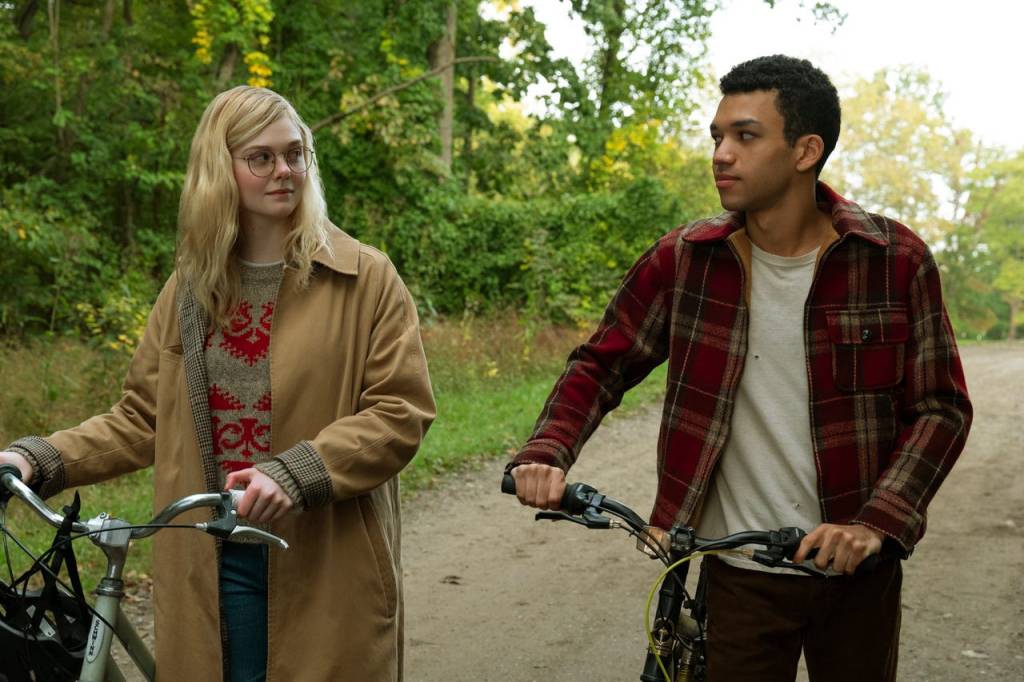
Despite its title, All The Bright Places can go to some very dark places. The leads are meant to be 17 but the story gives their characters some pretty heavy burdens and some serious sophistication. Fanning and Smith have great chemistry and give grounded performances, saving the film for what might have been maudlin or overwrought. Still, with Violet and Finch confronting grief, abandonment, and struggles with mental health, All The Bright Places is quite weighty for a teenage romance. I’m not sure the film quite handles itself correctly all the time; at times it feels a little superficial and easy. But on the whole I found it quite enjoyable. It’s based on a YA novel by Jennifer Niven and it feels like it. Which is not a criticism, actually, and it does deviate quite a bit from the book, it’s just that it wants to impart some wisdom, it wants to make some profound discoveries, and it doesn’t mind being rather obvious about it, like a parent or a guidance counselor might. Like, if you wanted to extrapolate that you should become your own bright place, the film will nod at you encouragingly while quietly nudging a box of tissues in your direction. Take the box.
 ASSHOLES WATCHING MOVIES