As a young fairy, Maleficent is like any other girl, wings and horns notwithstanding. She likes adventure and good stories, and a little mischievious boy named Stefan with whom she shares a first kiss. But as they grow older, Maleficent (Angelina Jolie) must protect her land from an evil king and Stefan (Sharto Copley) has taken off in pursuit of ambition and power. On his deathbed, the king calls on his trusted inner circle, including Stefan, to kill Maleficent to earn his crown. Stefan seeks her out to warn her,ostensibly, but it plays out a lot more like betrayal. Woe her broken heart.
King Stefan is crowned and soon there is a child: a girl. Maleficent is furious, and her fury is a glorious sight: green light, crumbling walls, the world bends to rage and damn I wish my anger could manifest itself like that. Meanwhile, the kingdom is celebrating the birth of little Aurora but Maleficent crashes the party, putting a curse on the little sleeping babe. Unfortunately, she learns too late that this child, this sleeping beauty if you will, is perhaps the one person who could have united the land that Maleficent holds so dear.
Disney has learned to pay heed to their villains lately, as well they should. They are often more interesting than the so-called heroes, and in Aurora’s case, this is 137000% true. Sleeping Beauty is as passive a princess as they come since she’s doomed to spend her own movie either in hiding, or deep in sleep. Maleficient, on the other hand, is dripping with vengeance, steeped in power. It’s magnificent.
The Disney World parks, however, still default to the princesses. On our upcoming visit to Disney World, we’ll visit Aurora at Queen Elsa’s castle. Last time we met her in Cinderella’s. Lucky for us, we caught her between naps.
Halloween, however, is the one time of the year Disney embraces its dark side. Only around Halloween can villains be spotted at meet and greets in the park. They even get their own merch and treats – check out this Maleficient look-alike ice cream cone, available at StoryBook Treats. Her dragon breathes fire at parade goers. Halloween seems like an exceptional time to visit Disney World for some value-added extra fun and fright, but alas, Disney rips down its Halloween decorations on the night of November 1st and by the 2nd, the park is transformed for Christmas, which means we’ll get an awfully early start on the holiday.
Anyway, the Maleficent film tells the villain’s unknown side of the story, and it shows that she is perhaps not as evil as we’ve been led to believe. Disney is an unreliable narrator, y’all.
Keep your eyes peeled: two of Jolie’s children, Pax and Zahara Jolie-Pitt, have cameos in the film. Daughter Vivienne played the baby Aurora, and was the only child on set who was frightened of her while in costume. Her Maleficent cackle was developed at home, with her children as barometers, voting on which was just right. Jolie confesses she kept a pair of horns for herself, though presumably not the ones so heavy she’d get neck pains even after very short scenes. She had a hand in developing Maleficent’s look – Disney wanted to capitalize on her beauty of course, but Jolie insisted on Maleficent’s more devious look, drawing inspiration from Lady Gaga. Even so, it was Lana Del Rey she hand-picked to sing Once Upon a Dream for the end credits. The movie has the biggest budget for a first-time director, but Robert Stromberg had an excellent pedigree, with two Oscars under his belt for production design on Alice in Wonderland, and Avatar, which understandable earned him substantial credit with the Disney team.
Angelina is wonderful in the film and this first one performed so well that a sequel is expected in theatres October 18th.
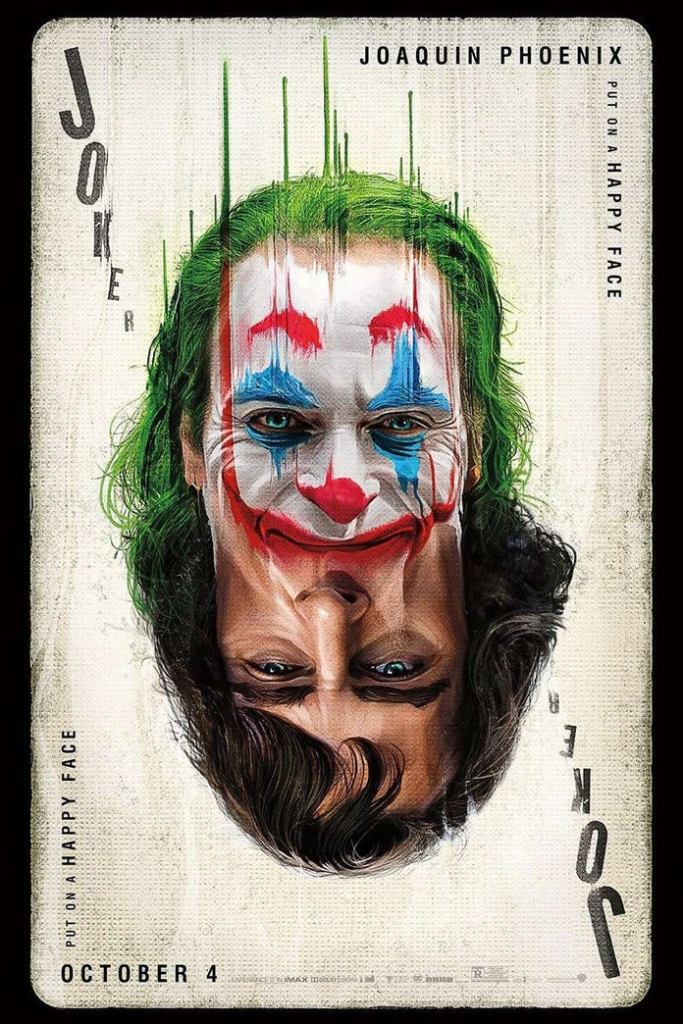
Sean and I both saw Joker at TIFF last month, at back to back screenings. We met up for lunch afterward (I believe we had a slight pause before seeing the Harriet Tubman movie) because boy did I have thoughts, comments, and questions, which I tried not to yell too loudly because: spoilers.
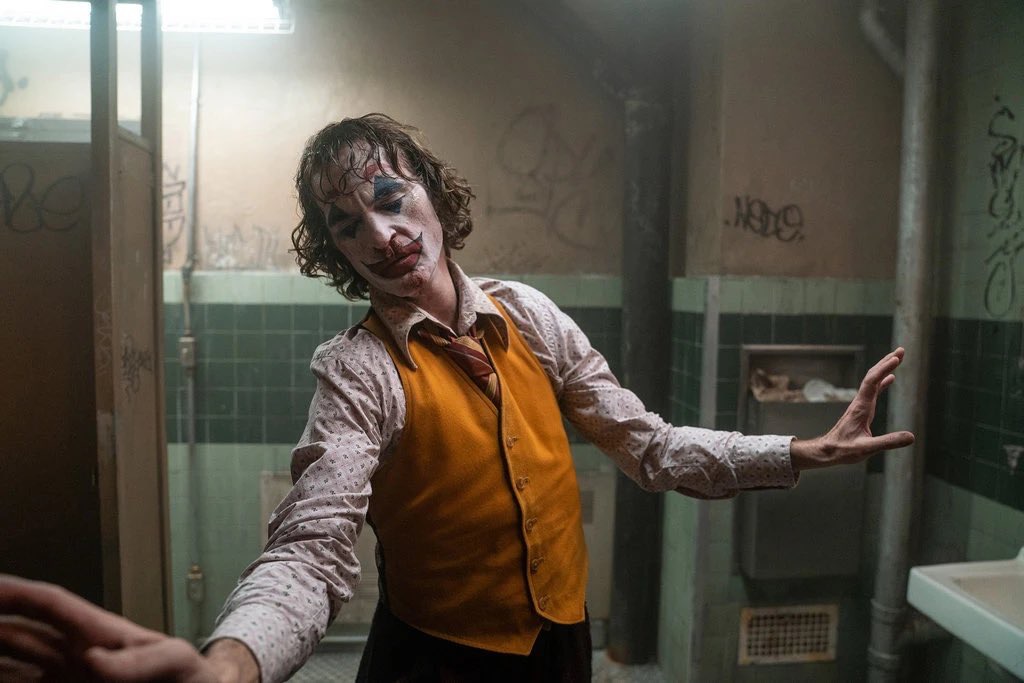
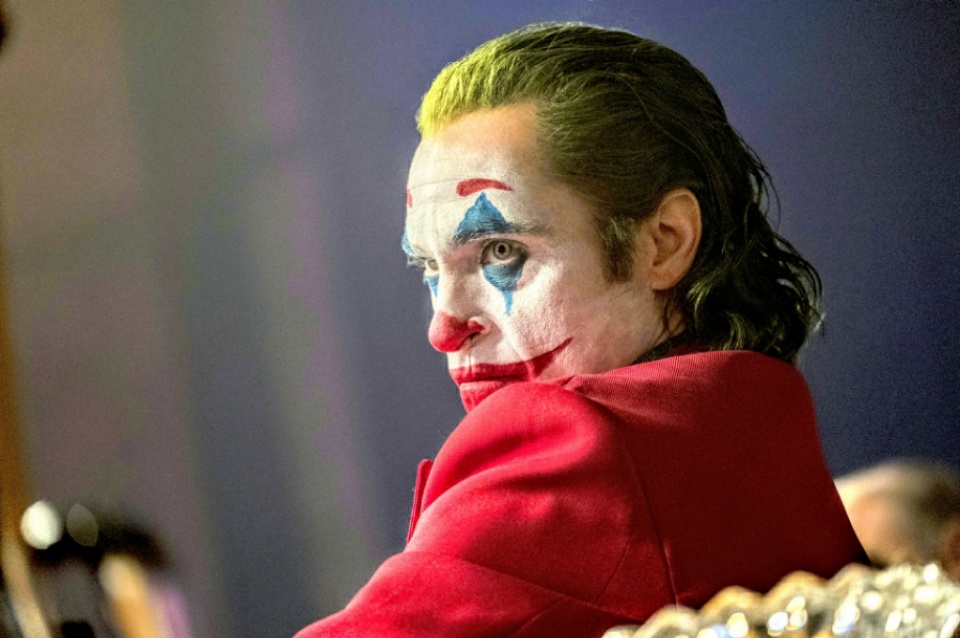
Joaquin Phoenix plays Arthur Fleck in a totally new but not entirely unfamiliar way. He works as a (semi) professional clown but dreams of becoming a stand-up comic. He’s not a great clown; he gets a lot of complaints. Maybe it’s because he breaks clown rules. Real clowns prefer to paint their faces in large circles because pointy-ended makeup gives kids a subliminal fright. As you can see, Arthur paints both eyes and mouth with sharp ends, normally prohibited in the clown community. But there was another rule-breaker, historically. His name was John Wayne Gacy, and Joker’s makeup is likely a subtle nod toward this man, a serial killer who entertained kids on the side as Pogo the clown. He also raped, tortured and murdered at least 33 teenage boys during the 1970s.
Arthur has a complicated relationship with his mother (Frances Conroy), with whom he lives. She’s not well, and depends on his support, meager as it is. She may be somewhat delusional because she writes long-winded letters about her poor living conditions to one-time employer Thomas Wayne, hoping his outrage will be enough to improve their circumstances. Until such a time, mother and son alleviate their suffering by cuddling up every night to watch their favourite late night talk show, Murray Franklin (Robert DeNiro).
Arthur is dangerously thin, but people aren’t just uncomfortable about his physicality. There’s also the laughing. He laughs often, and inappropriately. It’s a neurological condition, and he hands out cards to strangers to ease their discomfort when his laughing goes on just a little too long. Still, it gets him into trouble. Joker’s laugh is iconic, and Phoenix taps into something so deranged, so haunting, it’ll nail your feet to the floor. The laugh alone justifies casting him. It is distinctive, different, perfect. Unforgettable. Scary as hell. It sounds almost painful for Phoenix and it sent shivers down my spine.
Meanwhile, Gotham City is a total shit show. Garbage is piling up everywhere, home to super rats that terrorize the city. It’s never explicitly stated, but I’m guessing it’s 1981. The clothes are very late 70s/early 80s, you can still smoke indoors, and both Blow Out and Zorro The Gay Blade are playing at the movies. People are starting to agitate. The city’s becoming increasingly dangerous. There’s an undercurrent of discontent. It isn’t safe. Arthur gets robbed, jumped, beaten. There’s a certain electricity in the air. We all know Joker to be a villain, but the way things are going, these people may see him as more of a hero. Kill the rich – that’s their slogan. Not a great time to be the Wayne family. But is Joker the symbol this rebellion needs?
Arthur Fleck is nobody’s idea of a hero. He’s a mentally unstable man. He’s been in psych wards. He takes 7 different kinds of meds but still feels bad all the time. He keeps a joke diary filled with suicidal thoughts. “The worst part of having a mental illness,” he writes, “is people expect you to behave as if you don’t.” I’ve lost count of how many Jokers we’ve seen on screen now, but it truly feels like Phoenix doesn’t fuck with any of them. Truly, he and writers Todd Phillips and Scott Silver have created Arthur/Joker from the ground up. He is an amalgam of childhood trauma, torment, debasement. You really get the sense that if anything had gone even just a fraction differently, you’d end up with a different guy. Arthur’s natural reaction to the world isn’t insanity or violence or evil. He genuinely seems to want to bring joy to the world. He wants to make the people laugh. He is searching for a way in. He is searching, I suppose, for identity. For purpose. But for one reason or another, this guy just keeps slipping through the cracks. There’s nobody to help him. If one person had reached out when he needed it, this would be a very different story. And I suppose that’s why this movie is so good. It doesn’t feel like a comic book movie, it feels more like Taxi Driver. It’s a character study. This man feels unpredictable, and yet we know his ending. There is a surprising amount of tension for a movie that can really only end one way. But director Todd Phillips creates this constant sense of swirling stress and anxiety, this emotional tautness by repeatedly having Arthur reach out. He doesn’t want to be a weirdo, or a loner. He wants that same connection that we all do. But society is keeping its distance. He’s isolated. He’s forgotten and ignored. We have countless opportunities to save the world from the Joker but we never do – we fail Arthur Fleck. Does the film show empathy toward him? I suppose it does, in many ways. Or at least to people who fall through the cracks. Personally, I had a hard time feeling empathy toward his first victims. Arthur is a complex man living in some complex times. There is no single reason that tips him over into villainy. There are just an awful lot of cracks in the pavement. A chasm is bound to open up, which is maybe the scariest way to look at it. There is no vat of acid. Joker’s descent into madness, or crime, or evil, or whatever you want to call it – it’s grounded in reality.
Comic books and super hero movies tend to deal in quite general archetypes of good and evil. This makes the characters instantly recognizable as hero or villain, but it also serves to put a distance between audience and character because there is little to relate to. Todd Phillips’ Joker is much more layered, which means at times you’ll root for him, and other times you’ll be disgusted by him. It’s a push-pull that few actors could pull off, and it’s why Joaquin Phoenix, already one of this generation’s biggest and truest talents, deserves an Oscar nomination, and as of right now, I’d say even the win.
Joker, however, is not just a great performance. It’s a wonderful, thoughtful film, a send up to gritty character studies of another era. Todd Phillips has said “The goal was never to introduce Joaquin Phoenix into the comic book movie universe. The goal was to introduce comic book movies into the Joaquin Phoenix universe.” Goddamn I love that quote. I think it shows great appreciation for Phoenix’s body of work. This isn’t just another origin story, this is a deep dive into a man’s psyche. Phoenix tends to gravitate toward the broken and tormented, but they’re not one-dimensional. They are faceted individuals. Different actors have interpreted Joker in many ways: a fiend, a terrorist, a thug, a psychopath. But Joaquin Phoenix goes with something else: human.
Edit:
So I wrote all of that last month, after seeing Joker at TIFF. Since then, certain media outlets have tried to whip up a story about possible violence at Joker screenings and whether this movie sends a terrible message. I have wondered whether I should contribute to that noise at all but find that I do have something to say about it. Feel free to debate.
Does the movie treat the Joker too sympathetically? In a word: no. This is not the Joker from Batman comics. That Joker doesn’t exist yet. Arthur Fleck is a sad man with mental health problems. When he kills, he has a reason. None that justify the violence of course, but it’s not senseless or diabolical or insane.
Is Joker gratuitously violent? Actually, no. There is some violence, of course, but compared to other films, relatively little – in fact, probably relatively little even compared to other Batman movies. This is primarily a character study, so a lot of the interesting stuff is introspective, in his head, as his character transforms.
Is the film inviting violence from incels? Of course not. An incel, if you haven’t heard, is a man who believes himself to be INvoluntarily CELibate – ie, no one will sleep with him, and he blames it on some big female conspiracy. Incels have found each other in chat rooms and encourage each other to be nasty and wrong and gross, and angry toward women generally, and perhaps even violent toward them. They somehow think they are owed sex and even more confusingly, plot revenge for all the sex they aren’t getting. And somehow no one stops to think: this is why. This is why no one wants to date me. I am a creep. Women get a creep vibe from me, and they stay away because they sense I am an angry, dangerous dude. Maybe I should try…being nice? But the situation in the Joker movie doesn’t apply. There’s a woman he fixates on but even a criminally insane Arthur Fleck doesn’t blame her for his failures. He’s not an incel and I don’t think they even tread into that territory, so people trying to associate that with the movie are just being deliberately inflammatory.
Let’s remember that this movie is only the Joker’s birth. He’s a Joker fetus. He isn’t a criminal mastermind. There is no Batman yet; Bruce is still just a boy and Arthur is just a man finding his identity on the dark side. Where society has rejected him, the underbelly accepts him and raises him up. Of course it’s intoxicating. And of course it’s wrong. But if we’re talking body count, he’s responsible for only a fraction compared to Blade, or The Bride, or Rambo, or Walter White. And if we don’t protest every instance of violence, why are we targeting Joker? Especially when we could instead read it as a plea for early intervention, as a workbook for reaching out to the Arthur Flecks instead of merely condemning the Jokers.
If you love Julie Delpy, as I do, you probably love her talky scripts, her hyper-verbal, over-analytical characters who leave no thought unspoken. She has a knack for combining drama and comedy and elevating both with intelligent commentary. My Zoe is quite a departure. Which isn’t to say that it’s not smart or insightful. But it is very, very different.
Isabelle (Delpy), loving mother to Zoe (Sophia Ally) is going through a divorce from her husband, James (Richard Armitage). Their daughter’s custody is their battleground. They both love and want her desperately, but they might also have the need to hurt and wound each other however they can. It hasn’t been easy. Zoe is a sweet little girl who is too young to understand the animosity. When James notices a bruise on Zoe’s arm, he is not un-accusing of Isabelle. When Isabelle hears Zoe sneeze, she is not un-accusing of James. They are suspicious of each other’s parenting, determined to be the Best and Most Devoted One. I wish I could say that all dissolves when it turns out Zoe is gravely ill.
A mystery illness strikes quickly, and severely, and the waiting room where the two parents wait is a literal tiny glass box where their tension just bounces off the walls and back into their bodies, ratcheting up the hostility with each allegation lobbed. Is it love gone sour that has them at each other’s throats, or just fear and frustration? Truly, to be the parent of a sick child is the most helpless one can feel. It’s no wonder they seek their scapegoats. Up until this point, the movie is riveting: emotional and raw, full of anger and spite. But then it makes a u-turn.
The next half is so materially different that you might wonder if you’d fallen asleep and woken up during an entirely different movie. It’s still Julie Delpy, still playing a devoted mother, obsessed, even. But everything else has changed: the characters, her surroundings, and most of all: the tone. It’s disorienting trying to get your bearings in this new reality.
Delpy is of course quite good – sometimes astonishing, sometimes vehement, often dangerous and despairing. Her performance is a wail heard by mothers everywhere. But it also reaches beyond the normal, natural borders of motherhood and asks: what else? The answers are not necessarily comfortable.
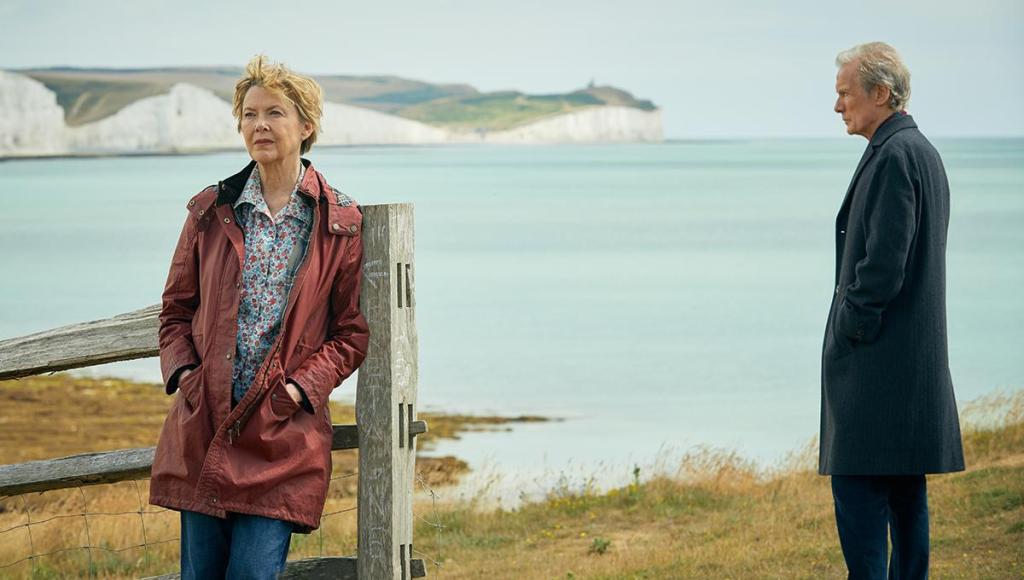
Grace (Annette Bening) and Edward (Bill Nighy) are a many-years married couple. She bickers and snipes at him, he slumps his shoulders and takes it. Over 30 years together, they’ve found lots of things to agree and disagree on, but they’re definitely united on one front: son Jamie (Josh O’Connor) doesn’t visit nearly enough.
When he does visit on this particular weekend, his mother does her usual thing, wasting half the visit dressing him down for not visiting her enough, thus making him less inclined to visit next time. But that’s her way. She speaks her mind. He’s used to it. He also fends off her religious overtures, and ultimately she goes off to church alone, which is when his father surprises him.
After some hemming and hawing he just says it: “I’m leaving your mother.”
Now hopefully we’re all groaning on the same page here: he’s told his son before he’s told his wife. And of course his wife feels blindsided, hurt, and not a little angry. Mostly that there was no warning. She never saw it coming. Now, Edward has some excuses for this: that she’s domineering, that she’d only try to stop him and his mind is fully made up. But to her, this is a 30 year relationship we’re talking about, and it’s worth a little effort, worth an attempt or two to save it. Not that this has stopped her from any of her heated squabbles.
Edward is not a complete idiot. He’s timed this so that he could abandon his wife quite quickly, leaving his son to pick up the pieces. Grace is understandably bitter and Jamie feels trapped. His mother isn’t just sad, she’s depressed, perhaps suicidal. It’s a lot to ask of a son.
This film is based on writer-director William Nicholson’s own experience of his parents’ divorce. It’s a little light on plot or direction, driven mainly by some great performances. Neither Grace nor Edward come off as particularly admirable people but Bening and Nighy give them a little more sympathy than is truly deserved. The collapse of a marriage is always an aching thing. The grown son being pulled between two grieving parents acts as a proxy for the audience, but because neither character comes off as entirely blameless or even likable, we actually feel pulled in neither direction. Instead, we remain unmoved somewhere in the middle, which doesn’t make for a very bracing or rewarding trip to the movies.
Motherless Brooklyn looks a lot cooler than it is. Gosh it pains me to say that. I really wanted Edward Norton’s Motherless Brooklyn to be great, and it isn’t bad, but it doesn’t do a lot to distinguish itself.
Norton plays Lionel Essrog, a private detective who works for friend and boss Frank Minna (Bruce Willis), who’s into something deeper than he should be. Lionel doesn’t know what, but when Frank winds up dead on his watch, you can be sure he’s going to find the fuck out.
Lionel, with his tics and Tourette’s, is not your typical P.I. – it’s hard for him to really stay under the radar when he’s yelling out rude things. But he does good work, and he’s very motivated to do right by his friend. Following the clues leads him to Laura Rose (Gugu Mbatha-Raw) and to exactly where these things always lead: dirty politicians. Is there any other kind?
Anyway, the movie is a send-up to ye olde film noir of yesteryear, when men wore trenchcoats with deep pockets stuffed with revolvers and fedoras worn specifically so they could be doffed each time a dame walked into the office, though you could barely see her through the yellowed fog of cigarette smoke. The detective was haunted by his past, of course, possibly by a dame he didn’t save in time, but he was stoic, never talked about it much. Just fingered his gun and smoked some more. Motherless Brooklyn puts a slight spin on things by introducing a detective who can’t shut up. And gives him a dame who is, and I’ll whisper this part: not white.
The film is so meticulously put together that sometimes it feels more like a history lesson than gumshoe caper; the diorama of NYC is gritty and seedy, so lovingly rendered that it doubtless earns its A+ but also serves as a distraction in an already bloated movie. And the maddening thing about Motherless Brooklyn is the performances are roundly very good, engaging and solid. But when you throw in the period setting and the metaphors and the big moods and Norton’s search for political relevance, something is bound to get lost. And clocking in at 2.5 hours, that’s a long time to devote your attention to each of the film’s moving parts, especially when things don’t quite add up to what they’ve promised. I also, if I may, think this was a missed opportunity to shoot in black and white. I mean, go all in if you’re gonna go all in. The actual result is a bit of a mixed bag. I think the good outweighs the bad, but at 144 minutes, I think there was opportunity to excise some of the bad completely, but no one has the courage to really wield the knife.
A series of victims, each with the same puncture wounds on the back of their necks. They bleed from their noses, their ears, their eyes. They bleed and they die. The only thing that connects them is a mysterious woman in a blue hoodie, who seems to have visited each before they died. When Locke (Boyd Holbrook) and his partner Maddox (Bokeem Woodbine) investigate, along with their Lieutenant Holt (Michael C. Hall), what they uncover makes little sense.
Turns out, thanks to a glitch in the moon, every 9 years this hoodie woman (Cleopatra Coleman) gets to visit from the future and assassinate a few select people who would eventually contribute to Earth’s destruction. It’s like going back in time to kill Hitler’s grandparents. It’s for the good of humanity, but try telling that to the beat cop on the case. Locke gets a sense of this but no one else believes him, which means that every 9 years he gets crazier, more obsessed, more fixated on a narrative that can’t possibly be true.
The plot’s a little bumbly so it’s better to focus on how isolating it would be to hold a tiny piece of history secret in your heart, to chase a serial killer who reincarnates every 9 years, even after you think you’ve killed her. There’s no scenario in which that makes you a better person. Which the voice-over narration tells you pretty bluntly. And the thing about voice-over narration is that it’s usually used to mask glaring holes in a story that the film isn’t up to showing in a less obtrusive, sermonizing way. It’s rarely a good thing. And as you might guess, as we gain understanding of these slayings, the movie’s tone shifts from detective whodunnit to preachy science fiction – not exactly my favourite.
Jim Mickle’s In The Shadow Of The Moon starts off with promise and then declines steadily from there, perhaps falling to its own ambition, which does not incline me toward forgiveness.
In her late 40s, Judy Garland is down on her luck, near destitute in every way but loaded with debt, desperate to make just enough money to keep her kids with her but never quite sober enough to make it work. In America, her reputation for being unreliable practically a national headline. The real money is in London, but that’s a whole ocean away from her kids. But needs must.
The thing is, Judy’s demons are portable. They travel with her. Her engagements do not run smoothly. We flash back to her early days in the studio system, circa The Wizard of Oz. Studio head Louis B. Mayer is a total dick. He steals her childhood and replaces them with pills. Pills for everything: to pep her up, knock her out, thin her down, keep her going for 18 hour days. Judy’s addictions are traced with a very straight line back to these early days, before she’s even old enough to question them. Her parents practically sell her to the studio and she’s completely at the mercy of people who just want to exploit her.
But that voice, that talent, those unforgettable movies: it wasn’t Judy who got rich on them.
These shows, the London shows, are some of Judy’s last. She will be dead in 6 months, and the fact that she is waning is clear to all. A good day means a fantastic show: the legend is still in there somewhere. But there are bad days, and very bad shows.
Judy is not a biopic, it’s a very small sliver taken mostly from the end of her life. It is 0% glamour. This movie is a performance piece. It is a 100% ‘for your consideration’ love letter to the Academy for Renee Zellweger to be considered for her Oscar, please (in fact, she’s already got a Best Supporting, but rumour is, it’s a little lonely up there on her mantelpiece).
I never quite forgot that I was watching Renee, but I did often see Judy (and Sean, being less familiar with Judy, saw Liza), so she was doing something right. She was doing a LOT right: she channels Judy’s voice, singing more so than speaking. And she nails the spastic mannerisms of a pill-popper, jerking painfully across the screen. The total effect is an awful lot of sympathy for an icon who really just wanted to be a regular woman. But if you’re not a fan of Judy, there may not be much there for you. There isn’t a plot. There’s mostly just going to and from the venue, with gin and tonics in between. Is it a great, meaty role, well performed, with much to be admired? Absolutely, taking up so much space it leaves room for little else.
Yi, a young woman with serious cankle problems, is grieving her father – not just his loss, but the music they shared and the adventures they’d planned but never went on. She spends less and less time at home, with her mother and grandma Nai Nai. Which is why her absence doesn’t raise any resounding alarm bells when she disappears suddenly.
Where has Yi (Chloe Bennet) gone?
Excellent question! The answer may surprise you! Unless of course you’ve seen the trailers, or the movie, in which case, the answer will be quite obvious.
A Yeti squats on the roof of her apartment building. He’s hiding out from the collector, Burnish (Eddie Izzard) who found him, and the scientist Dr. Zara (Sarah Paulson) who is determined to get him back. But poor Yeti (who Yi names Everest) just wants to go home – to, well, to Everest. So yeah, Yi sucks at naming pets, but the quest is clear: return Everest from whence he came, escaping bad guys in a series of escalating near-misses.
Along for the ride: next door neighbour and perennial cool guy Jin (Tenzing Norgay Trainor) and his rambunctious little cousin Peng (Albert Tsai).
[And just to satisfy your curiosity and save you a google search: yes, he is the grandson of THE Tenzing Norgay, first man to reach the summit of Mount Everest alongside Sir Edmund Hillary. Nice reference, Abominable.]
Anyway: cue some effusively pretty animation of Chinese landscapes and countrysides, beautiful rivers and fluttering flowers. In fact, even the city scenes are pretty astonishing what with the attention to detail regarding lights and architecture and even advertising (I see you, McDonalds). And great use of music. It all works together to create something magical, and this movie wasn’t exactly short on magic, what with a yeti who speaks to nature with specific requests, and nature responds in creative yet helpful ways. But the script doesn’t sit back and let the animation do all the talking. There’s a sweet story in here about valuing what’s most important. “Sweet” is often a synonym for simple and perhaps minor, and that may be a fair assessment here. It’s most a movie for kids, with a King Kong reference or two thrown in for the grown-ups. And while it’s not really showing us or telling us anything we haven’t already seen, it is inherently endearing.
Director Yung Chang sets his sights on Robert Fisk, a ground-breaking and game-changing longtime foreign correspondent. Reporting primarily from the Middle East, the documentary visits his old stomping grounds – Syria, Palestine, Lebanon, and revisits many of his old stories, some of which (many of which) are ongoing. Problems in the Middle East are a revolving door, and a journalist has to have fortitude and determination to keep reporting with the same urgency and integrity when the story seems unending.
Robert Fisk clearly has a lot of deeply held beliefs about a journalist’s integrity, and it is clear that his has been questioned many times over the years. He writes what he sees, whether or not it’s what readers back home want to hear. His angle isn’t always the popular one. He’s been called racist, he’s been called an anti-Semite. But to him, truth is truth, even if it’s uncomfortable.
He also talks about what it’s been like to be amidst armed conflict so many times – and certainly, he seems inured, wanting to stop and poke around even as local guides nervously caution him of the danger. Wars are notoriously “dodgy things to predict” he tells us, as he barrels straight in. But there are consequences to this bombardment. One’s sensitivity becomes anesthetized; emotions are suppressed in the name of objectivity.
He’s a bit of a dinosaur, no longer truly of this world, which has moved on a bit in his absence. He still clings to newsprint even if his own words are purely digital. He’s realistic about the story’s ceaselessness, but keeps a fresh eye because “I still want to see what’s next.” Even in the face of great human tragedy “I can’t draw myself away.”
In the age of social media and fake news, Fisk is perhaps the kind of dinosaur we need. A reminder of how important it is to seek and expose truth. His rule of thumb: be on the side of those who suffer. Challenge authority. Don’t look away.
Oh man. It’s already been more than a week and in many ways I’m still digesting this.
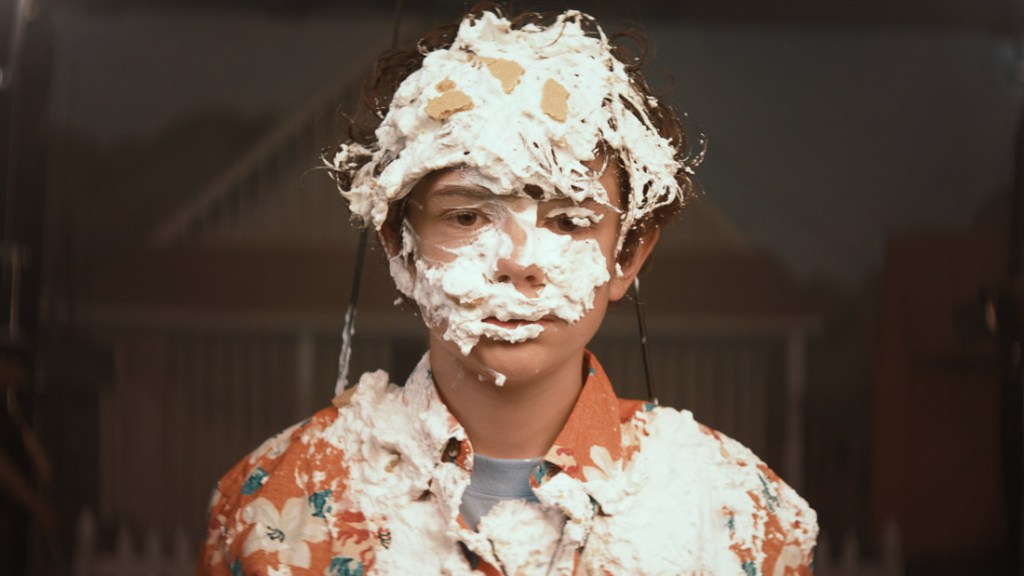
Honey Boy is an autobiographical movie that Shia LaBeouf wrote. Deep breaths.
Now we know a couple of things about Shia LaBeouf: he has suffered a pretty lengthy and public meltdown, and he has continued to put out some pretty worthy performances, albeit in smaller vehicles (American Honey and The Peanut Butter Falcon recently). In a review for Charlie Countryman, I attempted to parse the nature of his problems and his pain, but of course from the outside, you can only guess, and wish him well (or not). But Shia is at that point in his healing where he is letting us in. He is performing an exorcism here. The ghosts in his closet have been let loose – but will they haunt him less?
“Selfishly,” he told us, “I made this movie for 2 people: me, and my dad.” Let’s unpack that a bit.
First, you need to know that in this movie he wrote, Shia plays his father. His own father. Noah Jupe and Lucas Hedges play young Shia and older Shia, though the character goes by Otis in the film. What does it mean that he’s written this painfully intimate autobiographical film, but called his character by another name?
Shia’s father James was (is) an addict, an ex-con, abusive to both Shia and his mother. And yet when we meet young Otis, who is hard at work on the set of a show not unlike Even Stevens, he is living in a dingy motel with his dad. His dad is not just acting as a parental guardian, but as a paid one. James doesn’t work. He takes money from his kid. Which doesn’t stop him from neglecting the son he’s being paid handsomely to watch, or from hitting the child who is technically his boss.
This makes for a complicated relationship and a complicated childhood. And though Otis’s mother is seldom heard from , you do have to wonder – if it’s dad who has custody, just how bad is mom?
So you start to realize that this little kid has no parents. Or, actually, that he’d be better off without the ones he does have. But what he does have is a full-time job and more money than most adults. But he’s also got family obligations and staff who are also relatives but virtually no one telling him how to navigate these complex situations. So by the time Noah Jupe magically transforms into Lucas Hedges, Otis has PTSD and his own struggles with addiction and no idea how to take time out from his busy career and the pressures of Hollywood to deal with them. Until a court gives him very explicit directions to do so (and thank goodness).
But maybe his best therapy has been writing this screenplay. Clearly troubled after the TIFF premiere of Honey Boy, Shia is quick to reassure us that he’s happy to be here with us, but he’s quiet, introspective, quick to deflect to his costars and the director he so admires, Alma Har’el. As his struggles have become increasingly public and undeniable, he is coping with the tools he has available: creatively. But will his creation be his catharsis? And is any of this interesting or entertaining to those of us who have to personal stake in his recovery?
Resoundingly: yes. The absolute best bits are between young Otis (Jupe) and his father (LaBeouf). Mostly stuck in a crappy motel room, the anger between them is never at less than an aggressive simmer, and it’s ALWAYS on the verge of boiling over. Even the quiet is not to be trusted. The tension is awful and soon we too are responding like an abused kid, ready to flinch at the least provocation. If you come from a conflict-filled background yourself, you won’t fail to identify the triggers. Be gentle with yourself.
Honey Boy is a moving, emotional movie-going experience. I also hope it brought a certain amount of closure to a young man still wrestling with his demons.






 ASSHOLES WATCHING MOVIES