TIFF19: How To Build a Girl

I first came to know Caitlin Moran when her publisher sent me a copy of her book, How To Be A Woman, to review (Jay trivia: I did in fact review books before movies – scandalous!). That’s all it takes to be a Moran convert. She’s so…I mean, likable is both the right and wrong word. She does not asked to be liked. She does not write to be liked. But her don’t-give-a-fuck-edness is extremely likable. She is the role model we deserve: bold, brash, body-positive, full of piss and vinegar. She isn’t someone else’s shitty idea of a woman, she is a REAL woman, no apologies given and none necessary. She may have been new to me then but she was already a well-respected journalist and popular TV personality in England. But over here we’ve mostly had to make due with her books.

Lately she has embarked on a semi-autobiographical trilogy, the first of which is How To Build A Girl. It follows Johanna Morrigan, an educationally-uninspired, council-estate-abiding, overlooked teenage daughter in Wolverhampton who one day just decides that the best ticket out of there is one she writes herself. So she reinvents herself as the fast-talking, confident Dolly Wilde, music journalist extraordinaire. With a top hat and some swagger, Dolly trips through life, interviewing Britpop’s biggest bands at the beginning of their journey to fame, and swashbuckling through bedrooms as a Lady Sex Pirate (Moran’s words, but god I wish they were mine). Is it easy? Fuck no. The music industry is notoriously sexist, and Johanna/Dolly is, after all, still a teenage girl.

The movie has a lot going for it, but I’m going to start with its star, Beanie Feldstein, whom you might already love from Booksmart or Lady Bird, and with whom you will fall certainly and mightily and madly head over heels in this. Johanna Morrigan is the kind of character every actor wants and few will ever find; the personal grown charted on screen is nearly immeasurable. Johanna is every kind of dichotomy you could hope for in a character study of a young woman: brave and nervous, self-conscious and audacious. We see every attempt to ‘build’ her up by the men in her life – father, boss, boyfriend, brother. But then we get to see her break away from all that bullshit and start to build herself. And the ingredients for building a self-possessed girl are all here. It is glorious.

Caitlin Moran’s signature style is all over this film, which she helped adapt to screen. The humour is self-effacing, witty, rude, clever. It is amazing and liberating and just such a relief to see a young woman’s actual sexual awakening be told (though I think it may be slightly watered down from the book, if you can imagine). And that’s what will punch you right in the face: director Coky Giedroyc has given Johanna permission to be a real person, whose inner life and outer trappings are just as full and fully-realized as any man’s. Yes, she’s ambitious. Her peers find her intimidating and confusing. Her life isn’t perfect. She swears like a sailor. She likes her body. She likes sex. She wants more. Have we ever seen a better representation of a female character, ever? EVER??? Everything I like about this movie makes me dislike every other movie just a little bit. How To Build a Girls is vital and necessary – easy to fall in love with, because it’ll make you fall in love with yourself.


Evelyn

If you love documentaries, you may already know Orlando von Einsiedel’s work from conflict zones, where he throws himself into dangerous situations; he won an Oscar for The White Helmets.

He seems more nervous about this one though. It’s about the death of his brother, Evelyn. The suicide of his brother, in fact. It happened a number of years ago but his family rarely talks about it. They’ve hardly said his name in a decade.

The 3 remaining siblings, Orlando, Gwennie, and Robin go on a walk together through Scotland’s Cairngorn National Park with their mother, giving them the chance to reflect on their grief and share the feelings they’ve been bottling up for a long time. Evelyn’s absence has fractured his family in so many ways, and their grief has prevented them from reassembling themselves.

And then they do it again through the Lake District of Cumbria with their father. In fact, they are often joined by family members and close friends, who help them broach the memories that have been too painful for them to revisit. The youngest brother, Robin, confesses that he’s “struggling just to hold it all together” and you sort of want to reassure him that in fact, it’s okay to fall apart. It’s clear their brother’s suicide was a major trauma for them. He’d been depressed for a number of years and made previous attempts, which had the family walking on eggshells. His diagnosis as schizophrenic threw them into a tailspin and perhaps they’ve never really recovered.

Mental illness is a difficult thing to talk about. Suicide is a terribly difficult thing to talk about. There’s clearly still a stigma there that this family feels, perhaps for their own peace of mind, that it’s better to repress the memories.

The great thing about this movie is, belated or not, this family has created a safe space for itself to unleash their loss. It’s been a long time coming. But that doesn’t make it easy. Revealing yourself, your inner heart, your deepest wounds – that’s not meant to be easy. Nor is it a cure all. But it’s a start. Courage, folks.

***If you’ve been thinking about suicide, please reach out. In Canada you can call 1.833.456.4566, 24/7 In the USA you can call 1.800.273.8255 In the UK you can call 116 123 In Germany you can call 030-44 01 06 07

Feel free to add additional phone numbers in the comments.

If you’ve lost someone to suicide, big hugs. I’m sorry.

TIFF19: Bad Education

Superintendent Frank Tassone was a beloved teacher before becoming a dedicated administrator. He has done so much to improve his school district that the area realtors rain gift baskets down upon him because better schools mean heftier housing prices. Everyone is happy. Frank (Hugh Jackman) feels appreciated by his school board president Bob (Ray Romano), and understood by his second in command, Pam Gluckin (Allison Janney). She gets him: she gets his passion for the work, and his single-minded devotion, turning down dates from many parent committee moms while still mourning the death of his cherished wife.

But this is not the story of well-run school board. It’s based on a real event, the single largest public school embezzlement scandal in history. Pam Gluckin drives flashy cars and owns multiple homes, but the only thing she’s gossiped about is her growing collection of husbands. It’s actually surprising she got away with it for as long as she did because she wasn’t overly discreet. Still, it took an intrepid high school reporter (Geraldine Viswanathan) to uncover some inconsistencies. And that’s how Pam’s pretty house with wall-to-wall carpeting came crashing down. A kid reporter. Boy did they regret encouraging the kids to do their best then.

Of course, superintendent Tassone was a little more worried about his job, and more importantly, his reputation than about the school’s missing money. He gathered up his school board and convinced them not to go to the cops. Instead they’d quietly dismiss Ms. Gluckin, establish a pay-back scheme, but basically keep the whole thing under wraps so that nobody’s confidence would be lost, and the upcoming election wouldn’t be compromised.

Thus begins Tassone’s own downward spiral. His meticulous lifestyle unravels. Hugh Jackman does this well. Very well. It doesn’t hurt to be playing opposite Allison Janney who has only ever blessed any project she’s been on with her talent, with her very presence. Bad Education is no exception; it’s two top-tier actors at their best. But their best doesn’t quite save this film, by director Cory Finley based on Mike Mawkowsky’s script, who apparently attended the very high school in question. It’s not bad, but the performances really carry it. It has all these moving pieces involving greed, corruption, and privilege, but it never quite puts them all together.

TIFF19: The Two Popes

When Pope John Paul II died, a conclave of the world’s cardinals assembled in the Vatican in order to elect their new leader. A cardinal needs 77 votes to win; votes that fail to achieve that number are burned and black smoke signals to the throngs of believers outside that another round of voting will be necessary. After two such failures, the guy who wants it the most, Ratzinger (Anthony Hopkins) makes the rounds, glad-handing and kissing babies. Just kidding. The process IS crazy political and Ratzinger is the consummate candidate, but priests are still celibate last I checked and besides, babies would wreak havoc on those all those white robes. Ratzinger wins in the third round, becoming Pope Benedict XVI, sending up a puff of white smoke to cheers outside.

But Ratzinger’s papacy is mired by conflict from the start. You may have heard some of catholicism’s myriad scandals – the whole priests molesting altar boys and all that. Plus his own personal secretary is arrested, and his correspondence leaked. But most of all, he’s haunted by the runner-up for pope, an Argentinian named Bergoglio (Jonathan Pryce), who seems to be effortlessly popular. Bergoglio didn’t even want the job and didn’t campaign for it, yet he still almost won, which drives the ambitious but unlikable Ratzinger crazy.

The bulk of the film is about a secret meeting between the two when Ratzinger begins to realize that though Bergoglio is much too progressive for his taste, he is perhaps what the church needs right now. They’re not enemies, because brothers in god can’t be, but they are opposites. They discuss theology, dogma, belief, but they’re also just a couple of grumpy old men, struggling to fit in in a world that seems to want them less and less. Ratzinger is a Fanta-Formula 1-Fitbit kind of pope, touches that humanize a man who seems otherwise apart from, and perhaps above, humanity. Bergoglio is a football and tango kind of cardinal. If two of the highest-ranking catholic priests can’t find common ground, what hope have we for the rest of us?

The film opens closed doors in Vatican City and offers brilliant behind the scenes insight. It makes you wonder about things you’ve never stopped to think about before. But it’s put together in a fun and very watchable way. If you never thought about the natural pairing of a somber religious occasion and Abba, then please allow director Fernando Meirelles to expand your horizons.

Hopkins and Pryce play off each other with such dynamism even their silly pope clothes fall away, leaving just two men, more fallible and more human than we’re usually allowed to consider them, telling each other their sins, secrets and regrets. The audience is their confessor, without being asked to judge, or forgive.

The Two Popes is thought-provoking but more importantly, and somewhat surprisingly, delightfully funny and entertaining.

TIFF19: The Sleepwalkers

The Sleepwalkers is about 3 generations of a family spending a holiday at their summer home. The matriarch is contemplating the house, which angers at least one son and pits the siblings against each other. But it is a daughter-in-law, Luisa (Érica Rivas) who has it worst.

Luisa doesn’t want to be there. Unhappy in her marriage, she vents her frustrations to a brother-in-law rather than her husband. There is not enough space in the house for a relationship that’s falling apart. But most of all she’s worried about her daughter, Ana (Ornella D’elía), who is young enough to be getting her first blood, but looks considerably older. She’s already caught the attention of an estranged cousin, Alejo (Rafael Federman), recently resurfaced and apparently without boundaries. Even more concerning, Ana is a sleepwalker like her father. She has recently been discovered sleepwalking nude in her own home, and her mother is understandably concerned about what this may mean in a strange house full of people. But Ana doesn’t take kindly to restrictions, and her moody temperament causes her to lash out at her protective mother, and question just which one of them is truly sleepwalking through her life.

Director Paula Hernández has something to say about the pressure and position of women in the family, but for me it was obscured by camera work that literally made me sick. Almost always, only one main character would be in focus, while everyone else had constant blur. At first it was merely frustrating but after 107 minutes it made me physically uncomfortable – sick. And that’s unfortunate because there were some good bits, some very interesting stuff to be examined, but I felt unable to truly concentrate on it. Perhaps, by taking away my choice in what to look at or concentrate on, Hernández wants to put me in the shoes of a young, stymied woman. But that just makes me feel like she doesn’t trust enough in her script. It left me feeling angry and frustrated and ready to bolt. The two lead female characters keep looking for safe space to unleash, to vent, but I felt denied that myself. I never had the space to orient myself or digest what was happening. I felt like a horse with blinders on.

Luisa and Ana are going through some tense and important times. Their performances are good, restrained, even. Hernández makes their inner turmoil obvious without being obvious. I just wish she could do it without creating so much in me.

TIFF19: Dolemite Is My Name

Rudy Ray Moore is a real-life man who made something of himself. He started from the bottom, begging people just to notice him, but eventually finds his niche, creating a character named Dolemite and telling jokes on stage and on comedy albums to very appreciative (mostly black) audiences. He’s a success by any measure, but after a lifetime of being told no, he sets his sights even higher, wanting to take his character to the big screen even though the studio system refuses to make room for him.

This is the role Eddie Murphy was born to play; he is truly at his very best here, more alive and in his skin than I’ve seen him in a long time. His joy is infectious. A long time passion project for Murphy, it’s clear all the cast has caught the bug as well. It truly feels as though everyone is proud to help bring this story to the screen, and to a new generation’s attention. The exceptional ensemble cast, including Keegan-Michael Key, Wesley Snipes, Craig Robinson, Tituss Burgess, Mike Epps, and the lovely Da’Vine Joy Randolph, has a shared energy and passion making for a veritable party on the screen. It’s easy to join in and feel part of the fun.

Dolemite was a character just waiting to be born from years worth of cultural stories and jokes passed down generationally in the African-American community. Moore tapped into this consciousness, giving Dolemite back to his people, and director Craig Brewer ensures that he will not be forgotten. Watching Murphy as Moore find the groove of this Dolemite character is pure magic, a privilege to see. Moore achieved fame as a blaxploitation star in his own right and on is own terms, and he reached back, creating opportunities for others as well as himself, recognizing and picking up spare talent along the way. It’s a remarkable story and kind of an inspiration – in a weird way, a lot like Tommy Wiseau and The Disaster Artist.

But Dolemite is such a unique character and Murphy such a massive talent that this film is simply undeniable. Also rude, crude, and vulgar – not fit for a dog to see, as they say. The best kind of dirty. Dolemite is his name. Fucking up mother fuckers is his game. And for a time, it can be yours.

TIFF19: The Goldfinch

I mean, who’s NOT excited to see a film adapted from a 784 page, Pulitzer-prize winning novel about a missing piece of art? Sean Taylor, that’s who. He did, however, make use of the film’s 147 minute run time to have a hearty nap. Hands lightly clasped, mouth totally agape, he slept, and he slept hard, for 60 of the film’s first 65 minutes. So when he did wake up, I wondered what the point was in staying. Surely he was lost. Surely there would be no rejoining the movie at this point.

But the truth is, wide awake as I was and always had been, I wasn’t any more into it. And yes, I had read Donna Tartt’s novel, which has been bowing my bookcase ever since.

The Goldfinch is about a little boy who visits a museum with his mother, who then perishes when the museum is bombed in a terrorist attack. Having survived the bombing, young Theo (Oakes Fegley) wanders around the ruins, searching for his mother, until an old man stops him, and with his dying breath, implores him to take a painting, Fabritius’ The Goldfinch.

Basically orphaned, Theo is sent to live with classmate’s family (Nicole Kidman plays the mother). He befriends the old man’s business partner, Hobie (Jeffrey Wright) and another young survivor, a cute redhead named Pippa, who sustained brain damage in the attack. But just as he’s maybe settling into this new, motherless life, his deadbeat dad (Luke Wilson) shows up, with a surprise girlfriend (Sarah Paulson) in tow, and whisks him off to live in a deserted Vegas suburb of foreclosed homes. His only friend is a boy named Boris (Finn Wolfhard), who’s got some questionable habits, though not nearly as objectionable as his dad’s, as it turns out.

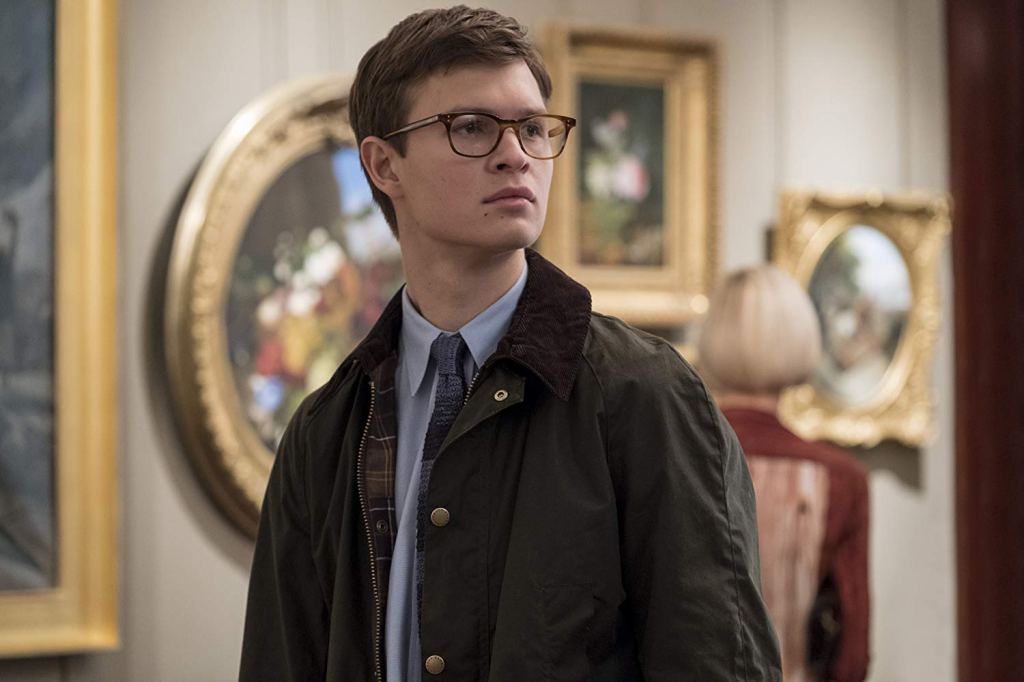
Cut to: adult Theo (Ansel Elgort) is an antiques dealer, working with Hobie in New York City, trying his best just to cope with the lingering effects of the attack, trying hard not to be held hostage by the trauma. He’s held onto this painting, a very historied and valuable painting, all these years, secretly of course, allowing the rest of the world to believe this priceless artifact was destroyed in the bombing along with so much else. But that is not the case.

Can you imagine what this painting might represent to a young orphaned boy, having saved it from the very same rubble in which his mother’s body lay? Director John Crowley cannot. In 2.5 hours, the painting is not a symbol of hope, or a replacement parent, or the receptacle of grief and loss. It’s just a dead thing underneath a kid’s bed, as if it means nothing. In fact, the movie itself means nothing, but it takes an agonizingly long time establishing this nothingness. On and on, with lots of things happening yet none of it finding meaning. And worse yet, it finds no emotional connection, nor does it appear to even look for it. And when you’re talking about childhood trauma and absentee parents and feelings of dread and loneliness – well, you’ve got to be pretty bad at your job not to even accidentally stumble upon some kind of feeling.

The painting The Goldfinch is about how we preserve meaningful bits of our lives and our culture, but the movie The Goldfinch is about how some things are destined to be forgotten.


TIFF19: Jojo Rabbit

I love director Taika Waititi more than makes sense, more than is reasonable by any standard. His absurd sense of humour speaks to me. His arch commentary on the perfectly banal is what I live for. So it was with a heavy heart that I stepped out of the packed theatre and admitted to Sean, who’d rushed the film unsuccessfully (festival vernacular: “rushing” means standing in line for hours when you don’t have a ticket, in case some ticket holder doesn’t show), that Jojo Rabbit was just okay. And I kept up that ambivalence for all of 30 seconds before confessing that I’d loved loved LOVED it, despite having solemnly promised not to rub it in if he didn’t make it in. Sorry, Sean. Jojo Rabbit was fucking awesome.

It’s about a little boy named Jojo (Roman Griffin Davis) living in 1940s Germany. He’s a good little Nazi boy, an unthinking fanatic; his bedroom walls plastered with propaganda posters that reflect his somewhat innocent claim “I’m massively into swastikas.” So he’s utterly broken-hearted when he flunks out of Nazi sleepaway camp. He’ll never know the honour of serving in Hitler’s Guard. His father went away to war and hasn’t been heard from since so it’s just him and his mother, Rosie (Scarlett Johansson). What’s a devastated little fellow to do with no father figure around? Invent an imaginary friend, of course, and why not aim high and adopt everyone’s favourite Fuhrer, Adolf Hitler (Taika Waititi) himself?

Jojo Rabbit is a satirical comedy about learned hate. It’s sympathetic to this child who blindly loves and trusts in Hitler, but doesn’t yet have a taste for blood or violence. Hitler is his Batman, his hero, but he’s about to learn that all heroes are flawed. And some turn out to be villains. But first, there’s a complication. Of course there’s a complication, as if growing up the outcast in Hitler’s Germany wasn’t hard enough. There’s a monster in the attic – or, in fact, a Jew (bless you), named Elsa (Thomasin Mckenzie). Jojo’s mom is hiding her so the secret must be kept. Hangings in the town square remind us of the stakes. But this pull between duty to his family and to his country creates an awful lot of pressure for one small boy, especially when his imaginary friend is quite critical of the situation, and Captain Klenzendorf (Sam Rockwell), a soldier who’s befriended him, is a little too close for comfort. It’s obviously a disorienting time for him, to find out inch by inch that the real monster is his imagined friend, and the girl in the attic is in fact a lot like him. Imagine the dissonance, the panic, the confusion, the revulsion.

Scarlett Johansson gets the chance to clown around as a mother trying her best to get her young son through a terrifying, grueling war. I can’t remember seeing her this loose and free on the screen before, which is ironic considering the character is rife with burden. In many ways, the mother is the most grounded character; you feel the weight of her responsibility, but also her vitality. She’s not merely trying to survive a war – she’s living. This is her now. Even when the world has gone to shit, there is no pause button. Sons must be raised. Homes must be kept. Jews must be hidden. But still, there is dancing.

Jojo is a complex character, embodying both hatred and innocence in one 10 year old body. It would have been critical to find the perfect and, I imagine, rare talent to fill the role, but believe me, this kid is up for it. He plays against McKenzie particularly well, who is in fact not a monster but a moody and sometimes bratty teenage girl. Neither is strictly the sinner nor the saint history imagines them to be. The two form the most tenuous, the most fraught of bonds, but it’s enough. Familiarity is often enough. It is a cultivator of hope, a vanquisher of fear.

My favourite scenes, however, are when Jojo’s imaginary pal Hitler drops by. Taika Waititi plays him without hindsight; his Hitler doesn’t yet understand how history will judge him. He still thinks he’s all that and a bag of chips. Waititi plays him fey, embracing the absurd conflict and duality of the character who is of course the architect of evil but also just a very small and not very brave man. He has fun with it but never forgets who this man is or why we hate him.

And it probably goes without saying that Sam Rockwell is having a ball. He’s done wild satirical stuff before so he approaches this with guts and gusto. Which is not to say that anyone in the cast fails to bring the necessary sensitivity to a movie like this. They do. But they also remember that no matter where they fall on the scale of good to evil, they were all just human beings.

It’s an interesting choice to go to Nazi Germany to deliver such a powerful message of anti-hate but where else would it have so much impact? And who else would endeavour to take it on except the fearless Taika Waititi, for whom rules seem not to apply. We worry about which subjects can be spoken of, and which can be made fun of, but the answer is pretty much anything if it’s funny enough. And Jojo Rabbit is funny enough – funny enough to counter hate with laughter, and isn’t that a beautiful thing? At another movie I saw at TIFF this year, Mr. Rogers reminded us that “anything human is mentionable, and anything mentionable is manageable.” Jojo Rabbit helps us talk about difficult things. It’s an important act of remembrance, and Waititi shows us that even if we’re burning out on all those war stories, there can (and must) still be new and inventive ways of remembering. It’s not just a comedy. It made me laugh and it made me cry, but most of all it moved me to think of these people as human, like me. And how things got away on them little by little until it was too late. History repeats itself, but it’s not too late for us. Not yet.

TIFF19: No Crying At The Dinner Table

Director Carol Nguyen interviews her own Vietnamese-Canadian family, mining them for secrets.

Mostly they share their losses, their grief. The short film explores the cultural and generational differences in how her father, mother, and sister have experienced loss, from physical expressions of sympathy to regret and shame and forgiveness. It’s incredibly personal and soberly realized. What Nguyen accomplished in just 16 minutes is a veritable portrait of grief, and a moving, and living, family history. Her precisely-composed shots reflect the range of emotions, from raw to repressed, and her unobtrusive camera allows us a spot at the dinner table, preferably close to the tissues.

I love how we get to experience the difference between old country new country for this immigrant family, but the truth is, all families are different. Nguyen’s mother shares that she only kissed her own mother once, when she was very ill. Just once. She’s fairly matter of fact in the recounting, but her eyes betray some anguish.

I come from a very physically affectionate family, though I wouldn’t have described us as such until I met Sean’s family. We don’t necessary feel the urge to hug and kiss all the time, but I think our casual touches are actually a testament to our closeness. We might stroke each other in jest, or pinch each other with affection. Rarely does a family gathering go by without someone’s hair getting brushed, or braided. Or perhaps feet rubbed or nails painted. And we might sit very close together, even touching, even lying on top of each other if someone needs the cuddle, or sitting atop each other, if someone’s being a pain. Sean is not naturally a physically affectionate person. I call him a robot all the time, and he assures me that he has feelings, and I pretend to believe him. We just didn’t grow up the same way. It’s fine. We’ve just had to get used to each other. But now he’s the one always reaching for my hand, and he gives me a backrub almost every night before bed (of course, he mislabels this as foreplay, but that’s another story for another short film whose review I’ve highjacked). With coaching, I’ve even gotten him to admit to his mother that he loves her right before hanging up the phone. That’s huge for him. And occasionally he and his father have exchanged a hug rather than a handshake.

And that’s kind of another great revelation hidden inside this film’s 16 minutes. People do change, even just one generation to the next. We learn. We do better. Trauma changes us, but life goes on, and maybe next time, we do it differently. That’s a beautiful thing.

TIFF19: Parasite

The Kim family squats in their dank basement apartment, assembling cardboard pizza boxes and trying not to breathe too deeply as fumes from the street extermination waft in from the open window.  The piece work doesn’t pay well, but since the whole family is out of work, they can’t afford to pass up an opportunity.

And then, a stroke of luck: the Kims’ son is offered a job tutoring a young girl from a rich family.  With some forged credentials, he’s in.  Recognizing an open door when he sees one, the son soon proposes his sister (posparasiteing as a mere acquaintance) as an art tutor.  A few more forgeries later, the Kims have secured two high-paying jobs from a family they increasingly see as gullible.  Do they quit while they are ahead?  They do not.  Mom and Dad are found jobs as well, though by “found”,  I mean they set up other employees to be fired, thus “creating” positions for each other.

Their pursuit is so ruthless, you start to question who, if anyone, you should be rooting for.  Bong Joon-ho, the visionary director of Snowpiercer, has once again presented us with a treatise on class systems; indeed, class warfare.

A parasite is an organism that needs to leech off something else in order to live.  Of course, our impoverished protagonists rely on jobs from their privileged employers, but Bong makes it clear that it works both ways: the rich, unable or unwilling to care for their homes or their children, rely on workers who must do much for little pay.  The degree to which the rich allow virtual strangers into their homes and lives is ripe for abuse, and this posh, architectural marvel of a house soon becomes an upstairs/downstairs rebellion with deadly consequences.

As we’ve come to expect, Bong is a master at ratcheting up the tension.  The film could stand to be a little shorter, but with so many parts working so well to stun and enthrall, it would be a shame to see any of it go. Once it hooks you, it is relentless. Filled with dread and hardly daring to breathe, we await the inevitable, the walls of the house closing in. No matter how many possibilities you anticipate with increasingly sharp fear, Joon-ho has thought of more. Parasite continues to surprise, never allowing the viewer any footing, the camera work placing us among the Kim family in a heady rush of hubris and anxiety. The film is never less than two things at once; your gut reacts to the horror elements but your head identifies the piercing social satire. The film has darkness in its soul but often makes us laugh as well. It defies classification, a cinematic roller coaster ride that feels brutal and dangerous and necessary and fun.