Graduation
From time to time, we all have to compromise our own values. It’s part of growing up. But do you remember the first time that you betrayed your own moral code?
According to Romanian filmmaker Cristian Mungiu, director of the brilliant and beautiful 4 Months, 3 Weeks, and 2 Days (which I have not seen), Graduation is about a lot of things. “It’s about family. It’s about aging. It’s about you. It’s about me”. But mostly, as the Cannes Best Director winner articulated at the North American premiere, it’s about that pivotal moment in one’s life where they make a conscious decision for the first time to do what they know in their heart to be wrong.
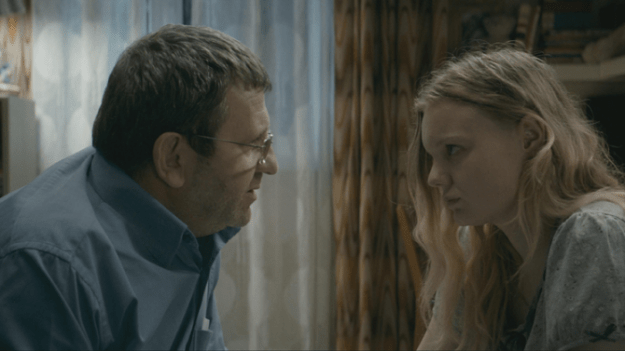
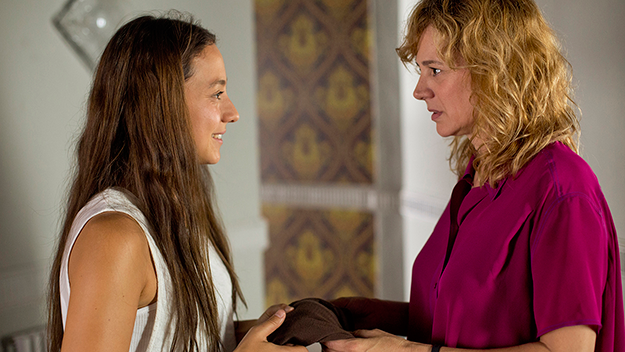
Romeo (Adrien Titieni) couldn’t be more proud of his daughter Eliza (Maria-Victoria Dragus) when she gets accepted into a fancy British school but he still can’t relax. Despite her stellar grades, she still needs to pass her finals to get out their Romanian town. When a vicious random assault threatens to shake Eliza’s confidence just days before her exams, Romeo can’t help feeling tempted to use his position as a well-respected surgeon to bargain with her educators in exchange for some leniency.
Graduation takes its time. It takes time to establish the relationships, set up the scenario, and let the story play out. Mungiu doesn’t resort to melodrama or even a musical score to beg for our attention. Almost every scene plays out in just one meticulously framed take. It’s an approach that gives his actors plenty of room to shine and his story the time to come alive. If you don’t mind the slow pace, Graduation asks big questions and will get you talking. It’s a very rewarding experience.
My Entire High School is Sinking Into the Sea
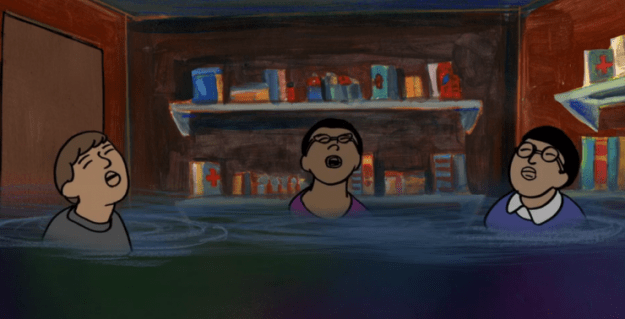
Dash Shaw was in high school when James Cameron’s Titanic was in theaters and couldn’t help imaging what it would be like if his school sank like the famous ship with all of his classmates inside. When you think about it, to avoid drowning to death in a sinking building, the smartest would head for the top floor and try to get to the roof. Once Shaw, director of My Entire High School is Sinking Into the Sea and apparently quite an accomplished comic book writer, started imaging each floor being occupied by a different grade level, he knew he had a story worth telling.
To see a film called My Entire High School is Sinking Into the Sea without feeling like you’re seeing something completely unique would be a letdown. So I’m pleased to announce that, whether you love it or hate it, Shaw’s debut feature will not let you down. The unusual animation style takes a little getting used to at first and, even once you get comfortable, there is so much to look at that many of the movie’s jokes- and the jokes are almost constant- can be easy to miss. My Entire High School may eventually be best remember for its carnage (those who are spared from drowning are mostly impaled, electrocuted, or eaten by sharks) but it’s made all the more special by the hilarious and sometimes touching dynamic between three adolescent friends whose bond is in crisis just as their lives are in imminent danger. And it’s all brought to life by some of the best voice acting you’ll hear this year from Jason Schwartzman, Lena Dunham, Maya Rudolph, Reggie Watts, and Susan Sarandon.
It’s Only the End of the World
I was one proud Asshole walking out of the Toronto premiere of Quebec director Xavier Dolan’s latest family drama. I was genuinely moved by a Xavier Dolan film. I admired Mommy, his last movie, I really did. It was just too self-indulgent for me to really relate to it in any real way.
So I was pleased to find myself loving this movie, more than almost anything else I saw at the Festival this year. I was finally starting to get it. I was quite disappointed to see that not everyone was as impressed as I was. It’s Only the End of the World currently has a score of 48 on Metacritic. If you’re not familiar with that site, let me put that in perspective. That’s only four points higher than Batman v. Superman’s score. Ouch.
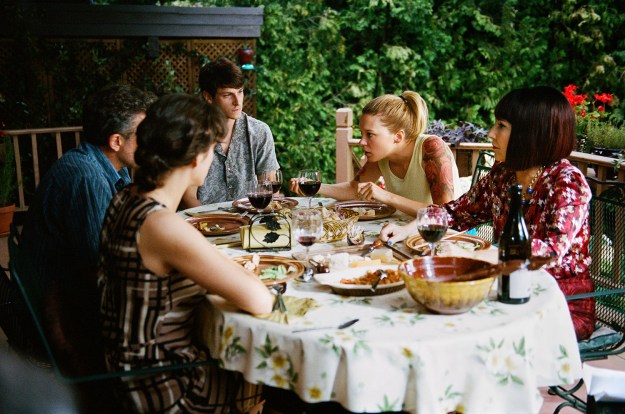
I stand by my recommendation though. Based on a play by Jean-Luc Lagarce, It’s Only the End of the World tells the story of a family who are easier to relate to than to understand. After a 12-year absence, Louis (Gaspard Ulliel) is finally coming home but he is bringing sad news with him. He is very sick and doesn’t have much time left. He’s not quite sure how to bring it up but it wouldn’t matter anyway because his mother, brother, and sister can’t stop alternating between picking fights with him and each other and awkwardly trying to force reconciliation. They try to bond over trivial things and fight over tiny details but can’t seem to bring themselves to talk about anything important.
The claustrophobic family reunion atmosphere seems to rein Dolan in a bit. He still manages to make Lagarce’s play his own though. For such a talky film, it’s surprisingly cinematic with its unnerving score and great performances from Ulliel, Nathalie Baye, Marion Cotilliard, Lea Seydoux, and Vincent Cassell. Using his signature tight close-ups, Dolan works with the actors to find subtext amid all the shouting. No easy task. Hard to act like you’re holding back when you’re screaming at each other.
I’m still not entirely sure what they were fighting about. But the story feels real and profoundly sad.

Nocturnal Animals
Careful with this one. The people around me at the TIFF encore screening of Nocturnal Animals were basket cases watching it.
It’s easy to imagine yourself in the same position as Tony (Jake Gyllenhaal), a husband and father whose family finds themselves terrorized while driving a lonely Texas highway in the middle of the night. The tension is nearly unbearable as this story unfolds. Those around me could barely sit still watching it and Susan (Amy Adams) is getting even more stressed reading about it. See, the scary part of Nocturnal Animals is but a story within a story. It’s the plot of a manuscript that Susan’s ex-husband (also Gyllenhaal) has sent her of his latest novel. As unnerving as the novel is to watch, it’s even worse for Susan. She’s quite sure the novel is about her.
The three narratives (there are also a lot of flashbacks of Susan’s marriage) are balanced beautifully in the second film from director Tom Ford (A Single Man). Susan is a successful art dealer and everything around her is beautiful and fake. In the story within the story, Tony’s world is harsh and all too real. Nocturnal Animals is sure to be divisive. Ford lays out his themes very clearly and I’m sure I feel comfortable with all of his implications. But there’s so much to look at and so much to feel, think,about, and talk about that you kind of just have to see it.

Oh, and if you’re not sold yet, Michael Shannon plays a crazy cop in it.

 Aml Ameen is enormously good as Seyi. Not all of the cast is as strong as this, but I also really enjoyed Michael Hyatt, who plays his mother. There is dysfunction, drama, and heartbreak between the two and I could have watched a whole movie just about their dynamic. In fact, this movie would be improved had it narrowed its focus just a little. Seyi’s burdens are great but they result in a lot of sub-plots that aren’t well-served in a 90 minute run time. That said, I can’t believe this is writer-director Anthony Onah’s first feature film. He’s already got a polished style that belies a lot of talent. Onah is also a Nigerian-born Harvard grad, so his script is informed if a little busy.

 of people who are grieving even as she still lives, dealing with a loss that is still happening before their very eyes.
 started turning things around. But Molly Shannon was a break-out, and some of her characters even got movie deals. I just didn’t like them. I thought she was brash, over the top, and obnoxious. I still do. But in this movie, as they dying mother, she’s none of those things. I still don’t like her, but she was easier to stomach when he’s mostly occupied evacuating hers. Is that a terrible thing to say? Yes it is. But it’s the truth.
 locations, but a movie doesn’t have such limitations. This one sticks closely to its confines, however, and as director, Denzel Washington uses a series of tight shots to further the exposition. The characters, and Washington’s in particular, are talky, prone to excessively lengthy essays that explore 1950s racial tensions in relation to their lives.
 has made a fantastic film about family, grief, and how easy it is to push people away when we’re hurting. It’s one of 2016’s best films not because it has any particularly new ideas or innovative style but simply because it’s refreshingly honest.
 And her daughter Chloe too, as it turns out (Kristin Scott Thomas). His father purchased the apartment some 40 years ago, but bought it en viager, which means he got a pretty good deal on the price, but he had to agree that not only could the current owner keep living in it until she died, he’d have to pay her for the privilege. So for 40 years the father has been paying this old lady to keep living in a home that he technically owns, and now Mathias has inherited a property he can’t sell, and which is actually a debt, with a monthly reverse-rent that must be paid or he forfeits ownership altogether.
 them and it’s mind-boggling to think that they’re not in fact little girls anymore, but women, and 2 of them mothers with babies of their own. Not dollies, babies. And not even babies: one nephew is already a dinosaur expert, another an enthusiastic soloist, and a third a stunt bike rider. They’re all 5 and under and as handsome as they are smart (which is inherited from the aunt, right?).
 disability for her family to handle. Now a young woman, she’s moved back home and is trying to assert her independence. Her mother, played by Diane Keaton, has never really known how to parent her. Her sisters (Poppy Montgomery, Sarah Paulson) didn’t grow up with her. It’s making friends with someone with his own challenges (Daniel, Giovanni Ribisi) that inspires Carla to aspire to a larger life.
 Lion tells the true story of a 5 year old Indian boy named Saroo. Separated from his brother one night, he falls asleep on a train and wakes up miles away from his home, his family, from people who speak his language. He survives on his own for weeks before being thrown into an orphanage and then shipped down to an Australian family who adopt him.
 task but Saroo is miraculously lucky. Off he goes to India, to see if he can locate any family near the place he once called home.
 the screen. It literally is just a guy staring a screen night after night for weeks, months, years. He’s moody and emotional in between, throwing his relationship (with Rooney Mara, in an underwritten role) onto the rocks. Nicole Kidman gives an admittedly strong and stirring performance as his mother and helps bridge the gap, but there’s a marked lag until Patel goes back to India.
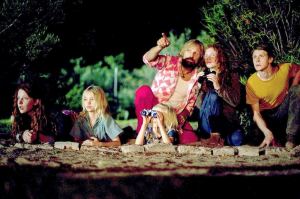 and grow food, read meaty novels by campfire light, and train their bodies strenuously, sometimes dangerously. Each kid has a unique, made-up name so they’ll be the “one and only” in the world. It sounds heavenly or lonely, depending on your perspective. Not all the kids are happy. Not all the parents are happy either, although so far I’ve only mentioned Captain Dad. Mom, as it turns out, is off in a mental health facility, and has been away from the family for several months before they learn she’s committed suicide.
 establishment values best addressed by dropping out of society? How much freedom is too much freedom for children? And what kind of risk is acceptable? And do children need to sometimes be shielded from difficult or painful concepts, or is complete honesty always the best policy?
 ASSHOLES WATCHING MOVIES