
When director Chang-hee Lee saw Oriol Paulo’s 2012 film, The Body, he enjoyed it, but he also saw how he would make it differently, and perhaps more importantly, how he could inject it with some Korean spice. Chang-hee Lee introduces the film to us at Fantasia Film Festival, and appears overwhelmed to have traveled all this way for his first feature film, awed at the reception, abashed at the applause. After greeting us in French (garnering immediate rock star status), he reassures us that this is not so much a horror film as a thriller, and so of course the opening scene causes me to pee just a teeny, tiny, barely perceptible bit. It was hella scary.
OF COURSE it’s scary: a night security guard goes down to the basement DURING A BLACKOUT on a rainy night BY HIMSELF armed with only a flashlight TO A MORGUE where he sees – what? a woman? a body? a ghost? We don’t know, because someone (or something) shadowy gives him a crack on the head, and when the police arrive it’s not really the security guard who grabs their attention, but the empty drawer in the morgue.
Yoon Seol Hee, newly dead, formerly a young, successful CEO, has gone missing. Well, her corpse has. Bad-boy detective Woo Joong Shik is on the case, and he’s cynical as hell and casts an accusatory eye at her “trophy husband”, Park Jin Han, although he’s more concerned with murder than mere body snatching. Of course, since Park and Yoon run  with an elite crowd, the higher ups are cautioning Detective Woo to back off – but he’s much too much a loose canon to respect authority, isn’t he? You know he is. Meanwhile, if Park is looking inadequately grief stricken, he’s overly concerned about his wife’s missing body. And pretty soon he’s frantically claiming that she’s responsible for her own disappearance, and is somehow still alive.
The cool thing about this movie is that it takes place over the course of just one night, which gives it a real sense of urgency. Movie detectives are often of this variety, the old “renegade cop” trope, the guy who plays by his own rules. He’s tough, a bit of a cowboy, a definite anti-hero, often with a side of alcoholism or anger (mis)management. But there’s something about seeing this Detective among his much more restrained, polite, effacing, perhaps more stereotypically Korean colleagues that’s intriguing and fresh. No one quite knows what to make of him, and he definitely shakes up the investigation.
Even if you’ve seen the original Spanish version, you’ll still get a kick out of The Vanished; the Korean setting of course makes for quite a change, but circumstances and even outcomes have been rearranged as well, for your viewing pleasure. And to be honest, it was quite a pleasure. I can’t believe this is a first feature for the director. It looks slick and cool and there are lots of visual details to admire, we get a sense of his style and aesthetic and the whole thing just glows. The cinematography is beautiful. As I mentioned, this film takes place over the course of a single night, so DP Lee Jong-youl coats it in a cold blue wash that lends just a touch of creepiness to an already creepy scenario. But in flashbacks he floods us with warm, natural lighting, which is a bit cruel actually – it gives us a false sense of comfort when really we should never let our guard down.
The thing about The Vanished is, it’s a very compelling puzzle. And even if you’re very clever and you manage to slot all the moving pieces into just the right places, you’ll find it’s one of those trick puzzles that only look complete – actually it just unlocks like 3 more puzzles to solve! The veteran cast (Kang-woo Kim, Hee-ae Kim, and Sang-Kyung Kim as the rumpled Detective) close ranks and draw us in with their institutional politeness – but something stinks in this morgue, and it’s certainly not the dead body. Because, you know, it’s missing. And maybe not even dead.
 come home and stare at this white, white screen, trying to distill my thoughts, keep them straight, not confuse them with any of the other 32 trillion movies I’ve seen, and find a way to sort of talk about them with all of you. And that’s possibly the hardest part for me because I’m a bit of blabber mouth but a review is not about telling, it’s about hinting, hinting just enough so that you have an idea whether you should see it or skip it or read some other, more cohesive review that doesn’t waste 400 words complaining about having seen a terrific film.
 Calvin, he’s a tired old man, safe in his routine, happiest at the bottom of a bottle. But one night the FBI shows up at his door, with a delicate problem on their hands. It’s the Bigfoot. He’s patient zero for a world-ending virus, and he’s already decimating populations up in Canada. Calvin, with a reputation for excellent tracking and a specific immunity to the disease, is a last resort. If he can’t stop the Bigfoot, the president is going to nuke Canada to keep himself safe.
 film, and 3 years since the script started haunting him, and he just wants to bang it out. Instead he’s visited by strangers, and finding a fan among them, he divulges what he’s got so far:
 severed heads displayed prominently just to rub salt in the wounds. Still the Javanese endure. But when Jamar (Ario Bayu) and Suwo (Yoshi Sudarso) reappear, they breathe a little bit of hope into air that’s been fetid with oppression for years.
 neighbourhood games of hell? Obviously someone must derive pleasure from being on the brink of abject horror, and at the beginning of Summer of 84, we meet 4 such young fellows. Davey and his friends are 15 in the summer of 84, mere shadows of mustaches playing on their upper lips, and haven’t yet outgrown their midnight game of “manhunt.” I think it’s creepy even before the big news is revealed: the Cape May slayer is on the loose in their community. With 13 confirmed kills and a preference for teenage boys, Davey and his buddies should rationally be concerned about this serial killer but they’re kids, hornily hovering about the precipice between childhood and growing up, and instead they think it’s kind of cool.
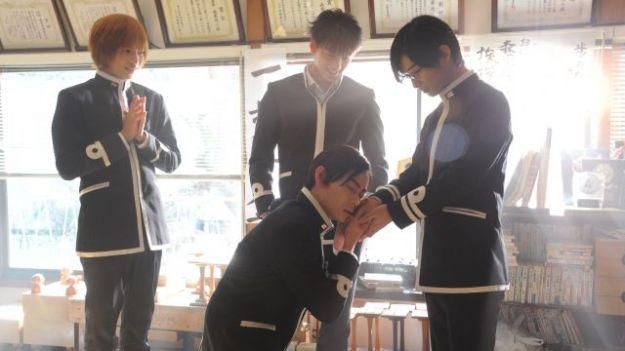
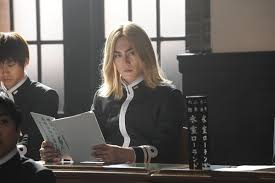 Teiichi has only one ambition: to become Prime Minister and to build his own empire. Luckily, he’s come to the right place. The prestigious Kaitei College is the place to be for future world leaders and all Tiichi needs to do is be voted in as chairman of the student council and he’ll be well on his way to power and glory. Trouble is, his longtime rival Kikuma wants it just as bad as he does. So the battle for Kaitei College gets pretty intense where everything, including wiretapping, sabotage, nipple pinching, and merciless tickling is fair game.
 prison for a crime she committed when she was 17. She’s in the midst of reconnecting with her biological daughter when a “fan” shows up with an inappropriate request. The productions values are great, the writing is fun; in less than 10 minutes director Don Swaynos gives us something truly satisfying…although I wouldn’t have minded even more!
 Director Geng Jun shows us a side of China rarely seen: crumbling, bleak, all but abandoned. This cold, deserted, post-industrial town in northeastern China is dotted with rural characters, and they’re all as shady as the salesman.
 ASSHOLES WATCHING MOVIES