Tag Archives: female directors

The Honor List

Once upon a time, four girls were best friends in high school. Like many young friendships, these four grew apart, drifting in different directions by senior year. But only 3 of them make it to graduation. Honor (Arden Cho) dies of an illness she kept from them, and leaves behind final wishes that they should retrieve the time capsule they once buried together and complete the bucket list found inside.

Piper (Meghan Rienks) is a popular girl (translation: mean girl) now, a party girl for whom the party never stops thanks to a water bottle filled with vodka that’s never not in hand. Isabella (Sasha Pieterse) is a social crusader, fierce in her beliefs, but vulnerable at home where her parents are divorcing acrimoniously. Sophie (Karrueche Tran) is the image of perfection, a straight A student and president of the virginity club, which she founded herself (and named only slightly more creatively). Even before we get to know their history through flashbacks, there are some pretty solid reasons why these young women might have grown apart. But grief is a powerful motivator and they resolve to complete the list, for better or worse.

High school is hard enough without throwing grief and guilt into the mix, and the movie is at its best when it’s dealing with these realities subtly with great character work from a cast who is actually (surprisingly) competent. But the tasks on the bucket list are wacky enough to be sitcom material, awkwardly ripe for trauma, painfully devoid of laughs. Their friendship is to be miraculously repaired through hardship even though it can equally be said that that’s what ripped it apart in the first place. Director Elissa Down confronts some jarring shifts in tone without enough of a plan, so even her good intentions can be sloppily offered.

The Honor List doesn’t live up to its name but is just watchable enough if you’re really jonesing for a potential tearjerker with a subplot of empowerment.
Blow The Man Down

It’s the day every woman dreams of since she’s a little girl: what dress you’ll wear, what flowers you’ll choose, the food you’ll serve, the heirloom hanky you’ll use to dab prettily at your eyes. Your mother’s funeral only comes once in a lifetime and you’ve got to get it right.

Sad but true: I’ll say any mean thing to get the laugh.

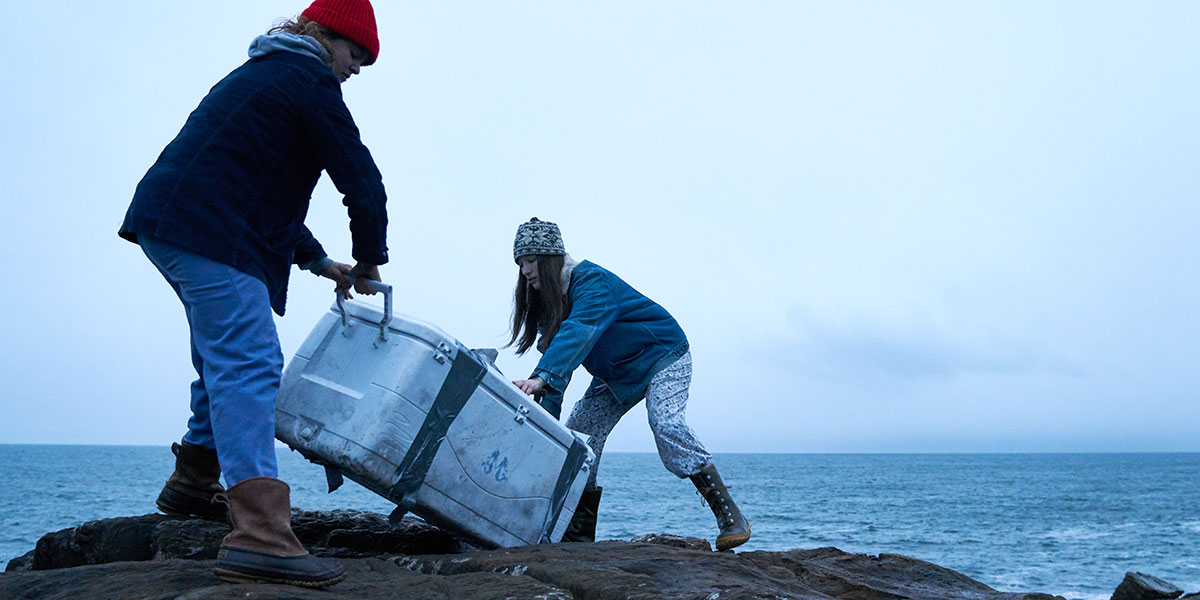
Anyway. For Mary Beth (Morgan Saylor) and Priscilla  (Sophie Lowe) Connolly it is indeed the day of their mother’s funeral. It feels like half the small village of Easter Cove in Maine shows up for it, paying tribute to a woman everyone seems to have loved. But it doesn’t exactly go seamlessly – clearly they don’t subscribe to Martha Stewart Funerals. The non-cheap flowers arrive late, there’s too much disgusting coleslaw, and oh yeah, they kill someone. Someone else. I mean, they never murdered their mother, she died of natural causes, more or less. I’m talking someone ELSE. A bad dude who we wouldn’t really feel too bad about killing except his death, and well, the concealment thereof, leads to the sisters uncovering some pretty shady stuff in their home town.

MV5BNTdkNTFlMzAtOTUxYi00ODVkLWIzYTItNTQ4YzVjNzMxOWIyXkEyXkFqcGdeQXVyMTkxNjUyNQ@@._V1_

Directors Bridget Savage Cole and Danielle Krudy delight in pulling up the respectable if threadbare rug to reveal not gleaming hard wood but black mould asbestos. Oh yes, there’s major rot to this picturesque little town, and behind every white picket fence is another secret being kept. Mary Beth and Priscilla have pulled a thread which threatens to unravel even the heaviest fisherman’s sweater.

This movie is oddly funny, in the blackest sense, establishing a real sense of atmosphere. Details are meted out like a sparse trail of breadcrumbs, each one a small but perfect moment, supported by a smart script and plenty of terrific performances.


Charlie’s Angels (2019)

Old Bosley (Patrick Stewart) out, new Bosley (Elizabeth Banks) in; turns out, Bosley wasn’t a name, it was a rank.

Sabina (Kristen Stewart) and Elena (Naomi Scott) are fellow Angels and kind of frenemies but not only are they going to need to get along for this next mission, they’ll also be training a newbie on the fly as mild-mannered, law-abiding layperson Jane (Ella Balinska) gets swept up into the fray.

Jane is a systems engineer who blows the whistle on a piece of tech that sounds revolutionary and life-changing but also dangerous and possibly weaponized. So of course the Angels are called upon to make sure it doesn’t fall into the wrong hands, and believe me, several grubby, evil little hands are doing the “gimme gimme” gesture in its direction. The Angels are willing to risk their lives to save us all, but they more they uncover the more their own agency seems compromised and nobody knows who to trust.

The movie got off to a rocky start for me because it was a little too “girl power!” And obviously I’m all about strong, capable women but let’s just show rather than tell. We don’t always need banners and slogans. But the movie seemed to get that stuff out of the way pretty early on, and then we hurtle through action sequences like it’s against the law to slow down.

The movie isn’t as bad as you likely heard from early reviews, but it never quite manages to be all that you want it to be either. If you’re remaking this particular movie in 2019, maybe make it subversive? Maybe challenge the status quo? Definitely justify its existence by updating some of the more dated concepts and definitely, definitely have fun with it. That’s its biggest problem: a lack of identity. It’s never really sure where on the spectrum of action movies it wants to fall and it never dazzles us with any distinguishing features. When the Angels’ closets are revealed, containing a to-die-for wardrobe, heavy weaponry, and a plethora of beautiful bobbles and accessories all hiding James Bond-type gadgets, there’s no zeal. I wanted pageantry. I wanted at least as much fun as the boys in the Kingsman movies, combined with the snappy chemistry between Melissa McCarthy and Miranda Hart in Spy.

Kirsten Stewart appears to enjoy showing off but otherwise there’s little fizz on the screen. It feels like work for them, and indeed I admit that I don’t appear to be having fun at my job either, and it would also make for a rather boring movie. But if you’re bothering to make this a movie, then I want glamour and I want fun. I want you to either embrace the silliness and really go for it, or I want you to skewer the concept and serve it on a silver platter with so much garnish I don’t know what to do with it. I do not want you to take the well-traveled, extremely trampled middle path of been there, done that.

Stargirl

Ladies and gentlemen, it is my pleasure to introduce the new Michael Cera, Graham Verchere.

I know, I know, where has the time gone if we’re already putting Michael Cera out to pasture. Well, technically he’s going to be the new Jon Cryer and Jon Cryer’s going to be the new Steve Buscemi and so on.

Anyway, that was a bit of a digression and I apologize. We first saw Graham Verchere at a film festival in Montreal where he was starring in a horror movie (a good one) called Summer of 84. And now here he is all grown up on Disney+, working for the very talented director Julia Hart, who we first saw at a film festival in Austin, alongside Giancarlo Esposito, whom we also met at SXSW, albeit the year before, directing a movie that was called This Is Your Death at the time and later got renamed rather lamely, The Show. Anyway, this was another digression because we’re already seeing film festivals (including SXSW) cancelled due to corona virus and we may lose our whole festival season, which is sad because it’s where we’ve discovered so many gems over the years.

Anyway, if Graham Verchere is the new Michael Cera then I suppose that makes his costar Grace VanderWaal the new Emma Stone (move over, you old cow). Which isn’t a bad comparison, really, because VanderWaal is both luminous and a talented singer. But Stargirl is no Superbad, and that’s not a (super) bad thing. While my generation settled for movies where boys were obsessed with popularity and sex and girls where afterthoughts at best (and often just a means to an end), Stargirl is a movie that embraces awkwardness and gives it a starring role.

Leo (Verchere) moved to a new town with his mom after his dad died. His sartorial tribute to his dearly departed father made Leo a target for bullies, so he learned to keep his head down and fit in. This all changes around his 16th birthday when a new girl, Stargirl (VanderWaal), starts attending class and soon disrupts the whole school. Stargirl is the kind of girl who can completely dismantle a marching band. Well, technically one lonely boy who falls out of step can dismantle a marching band, but Stargirl is the cause and the crush either way. She’s weird from the barrettes in her hair to the pompoms on her shoes, and startlingly, she’s unashamed. She owns her oddness in a way that is immediately fascinating to all, and her penchant for ukulele serenades is not just tolerated but celebrated, propelling her toward not just popularity but a spot on the cheer-leading squad. Sure it’s for the losingest football team in the history of sports, but still. Even her uniform outshines the rest. And it’s okay! Have these same kids who once bullied Leo for his porcupine tie are somehow woke enough to embrace Stargirl without a trace a jealousy.

At least for a while. Don’t worry: kids today can still be dicks. Interestingly, Stargirl is more than just a manic pixie dream girl – sure she casts a magical spell on everyone, but she has her own inner workings, her own growth, her own arc.

Stargirl is a John Hughes movie for the modern age – without all the racism.

Lost Girls

When Shannan runs screaming from a home in a gated community on Long Island and places a frantic call to 911, it takes police an hour to respond. They find nothing amiss but Shannan is never seen again. The cops’ lackluster investigation accomplishes very little but coincidentally they stumble upon a dozen bodies in this very same community, all of them sex workers fitting Shannan’s general description, but none of them her. And the police do truly treat it like a coincidence; they announce that her disappearance is unrelated and are largely unconcerned.

Shannan’s mother, Mari (Amy Ryan) doesn’t fit the profile of a grieving mother. Her family isn’t made for television. There’s precious little sympathy extended to victims like Shannan. They live a “high risk” lifestyle so when bad things happen, the victims are blamed, the police are unimpressed, the culprits allowed to disappear, or worse, to re-offend. Certainly in this case, the Long Island serial killer appears to have more than a dozen victims, and those are just the skeletons police have accidentally stumbled upon. Imagine if they were actually looking.

Shannan Gilbert was a daughter, a friend, a big sister. She was a real person. This is a true story. Her short life was filled with pain and because there were no easy choices for her, her death was not a tragedy worth investigating. This movie doesn’t have a real ending because Shannan’s murder remains unsolved. Director Liz Garbus allows us to sit with this reality, a small and meager tribute to a life cut short. The film flirts with different suspects only to highlight that the police do not. This entire investigation (or lack thereof) is either gross incompetence or a complicit coverup. The truths here are ugly, the endings aren’t happy. But the film is suffused with a roiling anger that is perhaps the important take away of Lost Girls – a sense of injustice for young, vulnerable women, whom society has judged not worthy of its concern.

Hail Satan?

I didn’t realize I would identify so much with the satanists, that’s for sure.

Not that I’d looked into it much. I don’t care much about what people believe, I mostly care when people form exclusionary clubs (which they often call church) that seek to divide people, shame people, judge people, and persecute those who don’t share their beliefs.

Turns out, satanists don’t worship satan. Most are atheists who don’t believe in a literal devil any more than they believe in a literal christ. But since atheism is just a term for what you aren’t, they’ve chosen satanism to represent their feelings, which are not so much anti-christ as post-christ. The satanic temple’s 7 tenets include compassion, empathy, respect, accountability, and science, all of which I find easier to endorse than an overemphasis on not coveting your neighbour’s crap and putting murder and swearing on equal footing in terms of badness.

Practically, the satanic temple chapters exist mostly in opposition to the christians encroaching on the American way of life. Logically we all know the importance of the separation of church and state. America was founded on the freedom of religion as people who were persecuted fled to build a country on their own terms. Colonial founders and founding fathers baked freedom of religion right into the constitution – in fact, it’s in the first amendment. And yet there are references to a christian god on American currency, in the country’s motto, even in the pledge of allegiance. And that’s particularly interesting because as mentioned, separation of church and state was pretty important to the founding fathers. Of course, there was no mention of god in the first version of the pledge, in 1892, and none in the next 3 revisions over the course of 60 odd years. It was only in 1954 that god suddenly popped up where god does not belong, in a time of increasing evangelicism.

So yeah. That’s how Netflix turned me on to satanism. They’re not trying to convert christians and they’re certainly not devil worshipers. If church and state cannot be separated, all they’re asking is that everyone be treated equally. If a school or courtroom or city hall has christian iconography, it needs to consider all other religions too – and there are BUNCHES of them represented in the American population. The first amendment forbids Congress from promoting one religion over others. That’s a basic American value. Apparently. America, what have you come to when the satanists are the level-headed ones?

The Last Thing He Wanted

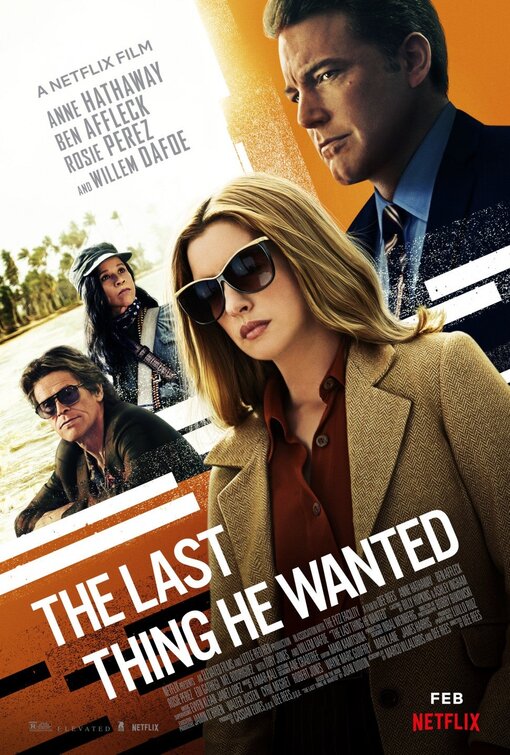
Do you like drama and intrigue and secret ops and exposing deeply classified cover-ups? Oh that’s too bad. This movie has none of that. The Last Thing He Wanted is the last thing anyone wants when they sit down to a movie. It’s sort of counting on you to turn it on and either take a two hour nap take a nap or walk out of the room for a snack and never come back.

Elena (Anne Hathaway) is a journalist who…covers foreign correspondence. She has a kid in boarding school since she’s never home and I have no idea what happened to the kid’s father other than he is indeed alive. Rosie Perez plays her friend/photographer. I think they get reassigned to cover the election at home, which pisses off Elena. She has a kooky father (Willem Dafoe) who is definitely into some shady business and possibly has dementia. He implores Elena to take care of a deal he’s sunk half a mil into but now cannot himself follow through. She does. Or she tries. And things get really shitty. Ben Affleck is around…pretty sure he’s CIA, possibly also into politics? Hard to say.


So this is a brand new Netflix Original that did two things very well: it confused me and it bored me. Granted, those aren’t generally things movies are trying to do, and maybe this one isn’t either, but that’s hard to believe given what a big fat mess it is.

IMDB seems to think it’s about a veteran D.C. journalist (that would be Hathaway) who loses the thread of her own narrative when a guilt-propelled errand for her father (Willem Dafoe) thrusts her from byline to unwitting subject in the very story she’s trying to break. So it turns out I did have the gist. I just didn’t give a fuck. I’m horrified to see this has been adapted from a Joan Didion novel. I hope she doesn’t have a Netflix subscription.

This isn’t a swing and a miss because it was never going to be more than a bunt. I lost track of motivations first, then plot. Anne Hathaway is…dogged. Either survived breast cancer or had a horrific boob injury. Her signature look is a chest covering scarf. She’s mad at everybody. She’s suspicious of nearly everyone but not suspicious enough. It’s so hard to get a handle on this and yet it was so underwhelming I can’t even be bothered to look it up.

Despite the brand name cast and director Dee Rees’ other successes, The Last Thing He Wanted is a real dud. It’s too late for me, but save yourself.


Rich Kid$

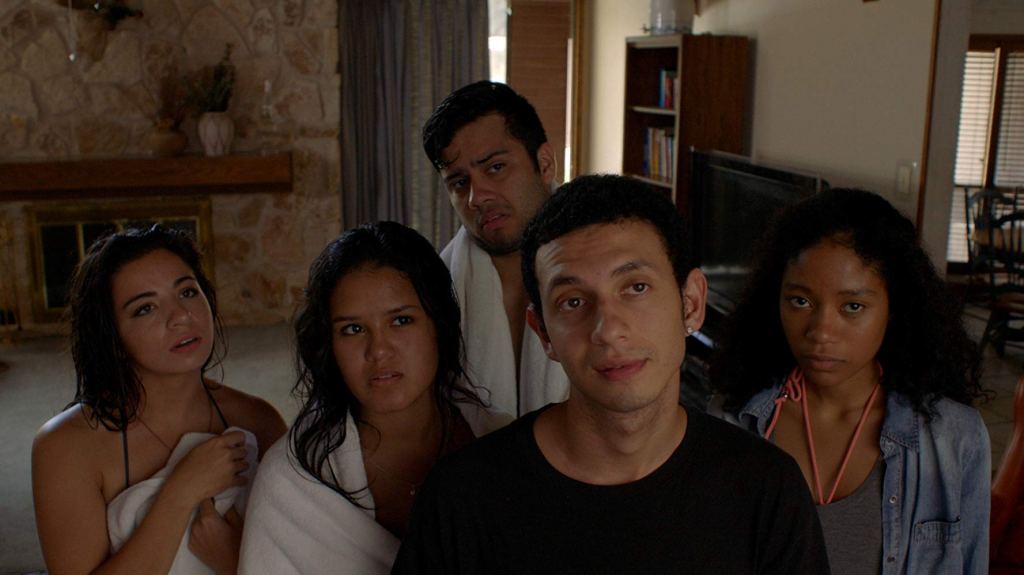
Matias (Gerardo Velasquez) has had a rough start to his day. The sheriff showed up with the landlord to evict his family. Mad at his father for being too proud to ask for help, he wants escape, but his neither his low-income neighbourhood or his similarly economically deprived friends offers much reprieve. So you almost can’t blame him when he and buddy Carlos (Ulysses Montoya) hop a fence to swim in the luxurious backyard pool of a wealthy neighbour who’s out of town.

They have such a nice time it seems almost criminal to keep their good fortune to themselves, so they’re soon joined by Carlos’ car-thieving, trunk-full-of-stolen-goods cousin Steve (Justin Rodriguez), and the girls: Vanessa (Michelle Magalon), Jasmin (Alessandra Mañon), and Isabel (Naome Antoinette). Of course, with the pool such a refreshing success, it’s only a matter of time before the group infiltrates the house as well, trying on clothes, microwaving food, inhabiting a life that, let’s face it, feels awfully good.

You can already sense that the stakes are getting incrementally higher; trespassing is one thing, breaking and entering another. But the kids aren’t doing a smash and grab, they’re cooling their heels on fine furnishings, drying off with plush towels, drinking top shelf booze. They’re pretending to be rich. They’re trying on wealth like a coat in a department store and it looks and feels so good they’re reluctant to part with it. But it’s not theirs, and thanks to subtle directing by Laura Somers, the audience never quite forgets it. Tension mounts the longer they stay; there’s a certain inevitability in the air, like the world they live in will want to put them back in their place.

Somers builds a line (or a wrought-iron gate) between the haves and have-nots. There’s no malice and there doesn’t have to be: the line simply exists. Wealth and privilege and the colour of one’s skin. It’s all tied together and it’s clear these kids have already felt how difficult these knots will be to untie.

A strong ensemble cast and some directorial restraint make Rich Kids a must-see.

Birds Of Prey

This is the Harley Quinn that Margot Robbie deserves. That we all deserve, really, away from the male gaze and into the capable hands of director Cathy Yan, writer Christina Hodson, and with Robbie herself producing.

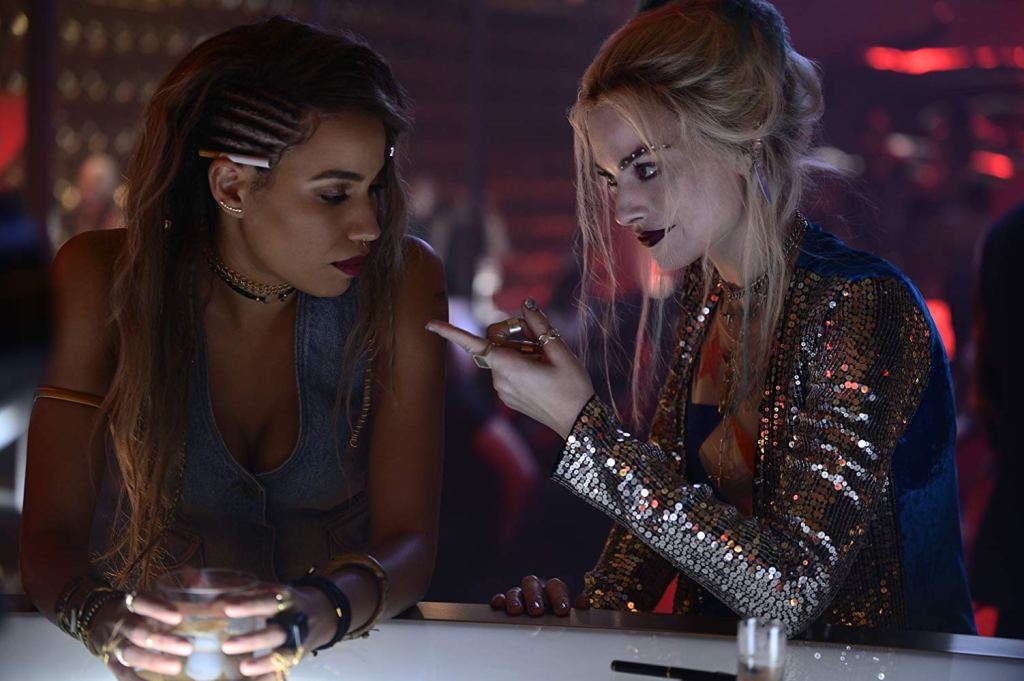
Harley to Black Canary: “Do you know what a harlequin is? A harlequin’s role is to serve. It’s nothing without a master. No one gives two shits who we are, beyond that.” Harley Quinn has broken up with her on-again-off-again longtime love, the Joker, this time for good. Without him as an anchor, she knows she’s vulnerable. Under his protection, no one could touch her, but it turns out she’s accumulated quite a few enemies, and now that she’s untethered, they’re gunning for her. Number one on her tail: a guy who calls himself the Black Mask (Ewan McGregor), who seems to think of himself as a rival to the Joker, though he styles himself more like a Miami Vice drug lord. He does have a bit of a fetish for peeling people’s faces off, though, so don’t go underestimating him. The only way Harley can keep her keister safe is to find the missing diamond he and literally every bad guy in Gotham would like to get their greedy paws on.

In Harley’s sparkly shoes, Robbie proves she can make this role her own, and without her emo boyfriend in tow, Harley Quinn is actually an interesting character in her own right. Her origin is glossed over with a couple of smartly and quickly tossed lines; the rest of the film is devoted to amped up action sequences. Yan doesn’t just have some tricks up her sleeve, she’s got entire confetti cannons up there, glitter bombs and rainbow grenades. Her violence is slick and beautiful, set to a perfect array of pop tunes you’ll be stomping your feet to even as someone one screen’s getting their skull caved in.

I’ve seen far too many reviews mention ‘female empowerment’ (of course in a derogatory manner, eye roll) and I can only assume those people are a) men and b) morons. Did anyone refer to the Avengers movies as ‘male empowerment”? No? Yeah, didn’t think so. Birds of Prey is better than 99% of the other DC movies released in the last decade, and if it happens to star women, well, so be it. This is not about female empowerment, it’s about empowered females, women with their own agency, women who can save themselves and best their male antagonists. The only thing being fetishized here is a breakfast sandwich. Feel threatened by that? Maybe you could do with a little male empowerment yourself. I believe the Batman franchise was built on the theory of overcompensation.

Meanwhile, Robbie has built herself a fearsome army: Jurnee Smollett-Bell, Mary Elizabeth Winstead, Rosie Perez, and even young Ella Jay Basco. And none of them are rolling around on the ground crying about mommy Martha.

Can’t get enough? We’ve got more thoughts on Birds of Prey here.

After Everything

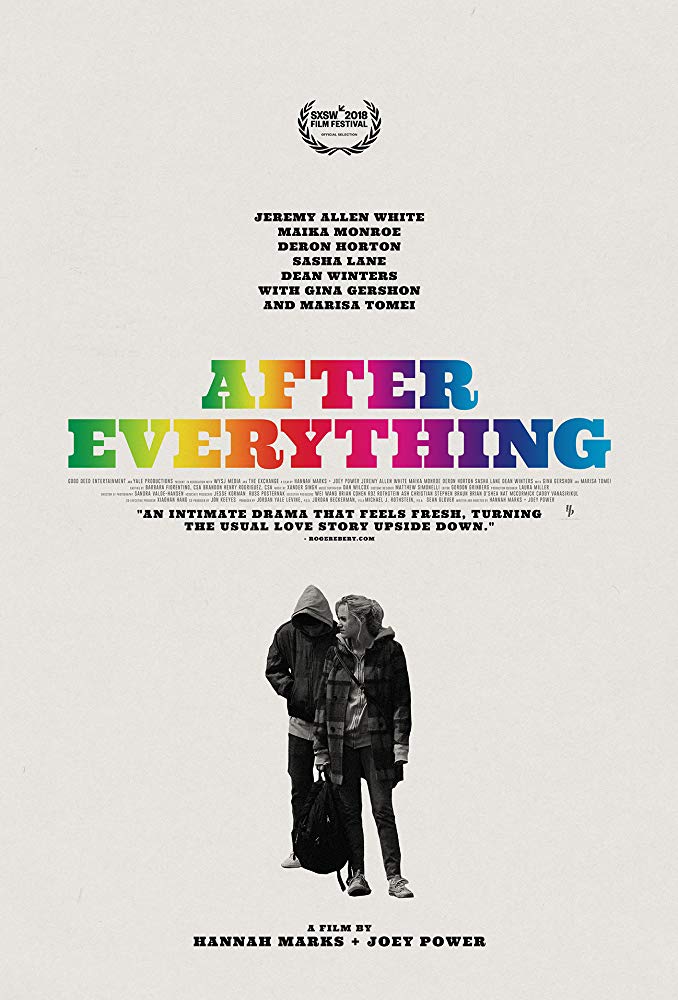
If Elliot hit on me the way he hit on Mia, he wouldn’t have gotten the time of day. Clearly Tinder has desensitized her – an unwanted intrusion and the implicit assumption that women somehow owe some kind of interaction to all men who ring the doorbell aren’t enough to dissuade her. She consents to a date, her roommates encouraging her to “get her dick wet” and he confesses: he was just diagnosed with cancer yesterday. It’s life threatening, and more importantly, sex threatening (ie, a tumor on his pubic bone, specifically Ewing’s sarcoma, if you’re the type who likes to Web MD that shit). With sex off the table, Elliot’s going to have to relearn how to talk to women!

So anyway, this puts kind of an awkward pressure on their relationship for a couple of kids in their early 20s who weren’t necessarily looking for anything serious. This pressure cooker means they get to know each other very intensely and soon they’re inseparable: chemo, radiation, surgery, and even a bucket list for broke 20somethings. The other people in his life get a little jealous that Mia’s monopolizing all his time, but they’re living like these might be his last days, because these might be his last days.

Jeremy Allen White and Mia Monroe are excellent as two people on this impossible trajectory. Either their love is doomed…or it’s doomed. Youth and passion may be enough to plow through the indignities of a medical crisis, but what happens outside those bounds? What will they even have to talk about if not tumors and ports and hair loss? Even if forever isn’t exactly a long time, it’s still further ahead than either of them has ever though. Cancer has launched them into a premature adulthood, which may be a flimsy premise for a love story. You think that illness is going to be the greatest test, but lots of mundane things topple relationships with deeper roots than theirs.

P.S.: it’s National Wear Red Day!