This is the story about the crazy relationship between two cousins, both queens. And the jealousy and the machinations between the two – one, the Queen of Scotland, who perhaps believed she should also be the Queen of England and everything else as well. But while this movie is obviously about politics, it’s more importantly a movie about gender politics.
Short history lesson:
Queen Elizabeth I was the daughter of King Henry VIII (the guy who liked to behead all his wives) and Anne Boleyn, who suffered her execution just two and a half years after her daughter’s birth. Their marriage thus conveniently annulled, Elizabeth was declared illegitimate, and when her father died, it was a half-brother, Edward IV, who claimed the throne. Not for long, though, and somewhere down the line, the crown did land on 25 year old Elizabeth’s head. Sometimes called the Virgin Queen, Elizabeth I was probably not a virgin, but she never married, and she never bore a child.
Her cousin, Mary I, became Queen of Scotland when her father King James V died when she was just 6 days old. 6 days old! Regents, including her half-brother, ruled in her stead. When she was 6 months old, King Henry VIII proposed (eventual) marriage between her and his son and heir, Edward, thus uniting Scotland and England under one crown, but when Scotland protested, a war dubbed the “rough wooing” ensued. To protect their young Queen, 5 year old Mary was sent to live in France, where that King also decided to unite France and Scotland under one crown by betrothing his 3 year old heir to Mary. They married when she was 15; he became King of France and royal consort of Scotland, but he died shortly after and she went home to Scotland to finally, officially, sit on its throne (and marry twice more). By this time her cousin Elizabeth I was also on her throne over in England, but there were some sticky points in the wills and order of succession, and it was always a thorn in their relationship that perhaps Mary had a claim to that crown as well.
Back to the movie.
 Elizabeth I (Margot Robbie) and Mary (Saoirse Ronan) are not that different. Elizabeth is said to have ruled by “good counsel,” relying on trusted advisors. History depicts her as moderate, cautious, and perhaps indecisive. Mary, on the other hand, was more forward, and clever, not that that stopped her own regents of plotting against her. She pushed Elizabeth to name her England’s heir presumptive. Elizabeth retaliated by proposing her trusted childhood friend as Mary’s next husband; Elizabeth felt she would be able to control him. Mary was too savvy to refuse outright but the relationship came to nothing.
Mary sought to strengthen her crown my marrying smart and creating alliances. And yet she understood that any man who married her would eventually try to steal her crown for himself. Still, producing a (male) heir would also strengthen her position, so marriage must be tolerated. Elizabeth, meanwhile, felt that marriage was too great a risk to her crown – that would only encourage plots against her. Of course she was expected to marry and produce an heir, but she refused.
The movie reminds us that in the 1500s, it sucked to be woman so much that even being the queen was not enough. Still the men would plot against you – your own sons, husbands, and brothers. Mary’s husband(s) and brother(s) both plotted against her. Her third husband was her second husband’s murderer, and her rapist. She was forced to abdicate in favour of her one year old son, James. Elizabeth, by contrast, ruled for 44 years, until her death. At which point the crown went to – yes, that’s right, it went to Mary’s son James. So this weird relationship exists between the two – they are sisters and rivals. No one else can understand this unique pressure to rule a kingdom as a woman with all the vulnerabilities that that entails.
While the movie may have benefited from a more focused approach to narrative, I found this endlessly fascinating and frustrating. I very much enjoyed the performances from both Robbie and Ronan, and I very much approved the race-blind casting. There are people of colour in the English and Scottish courts; this is a rather novel idea for a period film, but director Josie Rourke has a lot of experience in the theatre where this type of colour-blind casting is much more popular. As well it should be. We’re telling old stories, but those stories should be told by people representative of today.
I had not heard great things about this movie but I think people have just been watching it wrong. In 2019, women are still wondering if they can “have it all”: work, family, mental health, balance. In 1568, Mary and Elizabeth wondered if they could have it all: respect, religion, the freedom to marry whom they chose, agency over their own lives, and the ability to cut off each other’s heads if it came to it (and it always did).

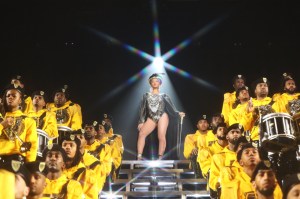 her style and her fame and her talent. She was a successful, powerful black woman, her success and power being so seemingly limitless that they transcended gender and race. And at the height of that power, Beyonce claimed both her blackness and her womanhood in a way that was political, artistic, and impossible to ignore. Now we need a word that is somehow more than Queen, and maybe the only name worthy is Beyonce itself.
 But a name is a powerful thing, and Kandahar, Saskatchewan (named in honour of the 1880 battle of Kandahar, Afghanistan) is about the only link to his home that Abdul Bari Jamal can find. Jamal came to Canada in 1991 with his wife and five children, refugees all, fleeing their conflicted homeland as the Taliban were taking control. On an impulse, and without telling any of his family, Jamal bought eight plots of land in Kandahar, Saskatchewan, for himself, his wife, and his kids. Ten years after that impulse purchase, Jamal takes his family on a trip to Canada’s Kandahar to let them in on the secret.
 Daniel (Jimmy Smits) can’t seem to keep the snide comments to himself. Turns out, that’s not the only thing he can’t keep to himself as he soon confessed to Sylvia (Amy Brenneman), devoted wife of a quarter century, mother of his children, that he’s seeing another woman and that leaving the other woman is non-negotiable. So. Jocelyn sets aside her own grief to take care of her flailing friend. Sylvia’s daughter Allegra (Maggie Grace) moves back in so she’s not alone and pal Bernadette (Kathy Baker) has the genius idea to establish a Jane Austen book club to provide a distraction. Since there are 6 novels to discuss, they’re in need of 2 more members. Bernadette brings aboard Prudie (Emily Blunt), an unfulfilled French teacher yearning for more than this provincial life, and Jocelyn recruits a young man and virtual stranger, Grigg (Hugh Dancy), as perhaps bait to liven up Sylvia’s gloomy divorce.
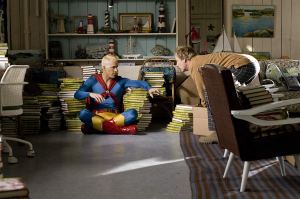 his own need and sorrow. This is further indulged by his imaginary friend, Captain Excellent (Ryan Reynolds, before he played Deadpool or even Green Lantern), a super hero type in cape and tights who tells him what he wants to hear.
 into her perfect man first, and he does this by stalking her on Facebook and getting into, or claiming to get into, every single thing she ever mentioned. It’s gross. And not just because it’s Justin Long, though that doesn’t help. Anyway, the most random cast of characters enables this travesty: an emo Peter Dinklage, an inexcusably Sam Rockwell, a puzzling Sienna Miller, and Vince Vaughn very much as you’d expect. Anyway, it’s hard to buy into the rom-com aspect when to romance is actually criminal harassment and the comedy makes itself scarce.
 plot will ensure that they depend on each other for survival. Zoe’s led a pampered life and is in the habit of sleeping with her bodyguards, but this time Sam is determined to teach her to fight back. And there’s no better time: though freshly bereaved, Zoe’s own stepmother Rima (Indira Varma) is more concerned with appeasing the shareholders than any rescue efforts. Not only are Sam and Zoe on their own in the middle of Casablanca, Rima may prefer if Zoe never returns since she’s a little bitter that her dead husband left the mining company to his spoiled daughter rather than to her.
 anything to get close to Jan, and Jan’s parents were naive and trusting and just plain dumb. I mean, dumb enough that they BOTH had their own sexual relationships with this man when all the while all he cared about was screwing their kid. Which they basically invited to happen as they allowed him to sleep beside her in her bed because he asked nicely.
 with the avoidance of too much tooth contact, it’s never nearly as noisy. So I already know that I hate kissing scenes in movies. And poor Georgia wants nothing more than kissing all the time. Scratch that. She wants snogging, because she’s British and therefore had to come up with a gross word for it that ruins it for the rest of us. I mean, first of all, snogging has always sounded to me like rather more than just kissing. In fact, it pretty much sounds like the whole enchilada. The whole kit and caboodle. But no, snogging is what twerpy little teenage girls do to the backs of their hands at sleepovers and such. Georgia is sadly snog-free at this stage in her life, but she’s devoted herself (at the expense of school, friends, and family, naturally) to correcting this void. And wouldn’t you know it: the eminently dreamy Robbie moves to town, and is the perfect target for all her lusty fantasies (which mostly involve running uphill???).
 ASSHOLES WATCHING MOVIES