Tag Archives: female directors

Dude

I’m glad that teenage girls are finally having their moment as three dimensional characters in film. Shopping and boys, that was the John Hughes model. Teenage boys were the hunters and girls their prey, and it’s taken until 2018 to flip the script, first with Blockers, which dared to show young women actually in charge of their own sexuality. Dude follows in its footsteps.

Lily (Lucy Hale) and her friends are in their last year of high school. That’s all that I knew going into this film that recently popped up on Netflix. That, and they were stoners. Not promising, I thought. So colour me surprised when, in between masturbating and getting high, they made friends with me.

Amelia (Alexandra Shipp), Chloe (Kathryn Prescott), and Rebecca (Awkwafina) have MV5BMTk5MDk1NTQ0NF5BMl5BanBnXkFtZTgwMjM4ODk5MzI@._V1_been super tight as far back as they can remember, and can hardly envision a future that doesn’t include each other – like, on a daily, hourly basis. So the ultimate theme of this movie is not so unusual: it’s letting go. Letting go in more ways than one, sure, but it’s not exactly groundbreaking stuff.

But what is remarkable is the depth to the characters and the way the script (by director Olivia Milch) refuses to infantilize them. These ladies are EMPOWERED. Their virginity isn’t idolized. They can smoke pot AND be valedictorian. These girls are me (like 4 minutes ago, when I was in high school). Portraying young women as they are shouldn’t feel so monumental, so brave, but it is. This may be how lots of girls act, but it’s not how society wants to see them, and so we don’t. We pretend that girls don’t want these things because it threatens the status quo.

The cast is good, with Awkwafina being a particular stand out for me: I’m crushing hard. And I can’t wait to see literally everything Milch does for the rest of her life. But most of all I’m just kind of feeling all puffy-chested that a movie like this can finally exist. And that you can still find diamonds amongst the usual Netflix coal. And that someone, somewhere, is willing to take a risk on a movie like this.


I Feel Pretty

When the trailer for this movie came out several months ago, it hit a wall of backlash. This was NOT the moment for a movie with any kind of body-shaming. It appeared to be about a woman (Amy Schumer) who suffers a head injury and then wakes up believing herself to be beautiful. And since Schumer is already a conventionally pretty person, critics felt this merited a culture-wide eye roll. And while they’re not wrong, they don’t quite have the premise of the movie down pat.

What really happens: yes, there is a head injury that leads to Renee’s believing herself to be beautiful. But nobody is pretending that she wasn’t perfectly fine before – only that she suffered from low self-esteem and didn’t realize this herself. Which is a common enough thing.

So while the backlash may have been inspired by misconceptions, it’s not entirely wrong. Renee gains esteem not by empowerment but by delusion. She gets a new job MV5BNzE2NDUxMzctOWYwNC00MTkxLThkODctOGQwMTI4MzRjM2M3XkEyXkFqcGdeQXVyNDg2MjUxNjM@._V1_SY1000_SX1500_AL_(at a fashion magazine, working for squeaky-voiced Michelle Williams) and a new boyfriend (the perpetually bearded Rory Scovel) and attributes her newfound success to her newfound beauty. And her actions start to reflect those beliefs: she shames her friends (Busy Philipps, Aidy Bryant) for not emphasizing attractiveness and is less than faithful to her ‘nice’ boyfriend when she gets attention from a ‘hot’ guy. So is this purely a positive message? No it is not. But there’s a good intention somewhere in there about how anyone, no matter how they look (*cough*Emily Ratajkowski*cough*), can suffer from low self-esteem. And it’s confidence, not looks, that actually attract good things your way.

Written and directed in a joint effort by Abby Kohn and Marc Silverstein, I can’t help but feel weird about the mixed messages on screen. Like, obviously we’re not supposed to judge a woman’s worth by her looks, and yet we’re encouraged to laugh at Schumer’s “bikini body” as she writhes around on stage. It’s played for laughs. But it’s also pretty powerful commentary if you consider how much that scene makes you uncomfortable. Because societally, we somehow don’t believe that someone who looks anything short of perfection should have body confidence. We shame women for not covering up their flaws. We don’t think that someone who looks like Schumer, who, let’s remember, IS actually living up to conventional beauty standards, even belongs in a beauty pageant or a bikini contest because that’s for one kind of very, very limited beauty that is all but unattainable.

Messaging aside, is this a fun movie to watch? I’d say yes, but it’s inconsistent. I had two REALLY big laughs that I’m ashamed to even admit to, because one was just a computer noise that struck me as totally tragic and genius. But if the message lacks conviction, so do the jokes. In North America, we’ll forgive almost anything if it’s funny enough. I Feel Pretty is not. Sure it doesn’t tell us that looking 19 and weighing less than 120 is the be all and end all, it just tells us that if you’re confident despite those things, it’s funny as hell. Being a woman is tough enough as it is. I just don’t have the 19 year old abs to laugh at this stuff anymore.

The Tiger Hunter

Sami’s dad, the tiger hunter, was a hero in his village, the most respected and venerated man around. He also made lots of sacrifices so that Sami could get a good education. Now that his father is dead and tiger hunting is done by the poachers, Sami (Danny Pudi) feels the only way to really honour his father’s memory is to move to America.

Unfortunately, the job he was originally offered has evaporated, and Chicago in 1979 is full of people just like him. In fact, the apartment in which he lives has 11, maybe 13 men with advanced degrees and no real jobs. That makes his plans for impressing Ruby’s The_Tiger_Hunter_2-e1486337559708-1540x811father much, much harder. Ruby is the dream girl he left back home in India. Her father is tough to impress and insists she marry someone successful in America. Sami takes a lowly position but needs to ascend quickly; he makes a friend in Alex (Jon Heder), who may not be the best person to attach his star to at work, but who offers insight on how to be a “professional American.”

The immigrant experience has so many stories to tell, and though we’ve got no shortage of immigrant movies, we’re still only scratching the surface. There’s a lot to admire in anyone willing to work so hard and dream so big just to have what most of us were born with, but few of these movies are also as funny as The Tiger Hunter is.

Director Lena Kahn makes her directorial debut with this film, which she’s also co-written. This being light-hearted fare, it doesn’t dwell too much on the difficulties of Sami’s coming to America, but it deals in enough cultural specificity and colourful detail that it feels both homey and true. And it’s also sort of fun to re-experience American culture, 1970s style, through a distinctly Indian lens. Tika masala and bell bottoms like you’ve never seen them before, all serving as a backdrop to a bunch of unemployed but brilliant engineers working together on the quintessential 1970s invention: the microwave. Who but a tiger hunter’s son would have the stripes?


I Am Not An Easy Man

Damien is a chauvinist and a womanizer. He’s developed an app to enable his douchiness, and that of others: it tracks how much sex you’ve had, and an ever-growing penis marks the progress. It will not surprise you to know that Damien is disgusting to all the women in his life – personal and profession. He’s such an irrepressibly flirty bitch that one day he walks straight into a pole, incurring a head injury that’s going to send this film straight into Freaky Friday territory.

When Damien wakes up, it’s in an alternate universe – one in which women have always been the dominant sex. Suddenly women are treating him the way he treated them – and he doesn’t like it! Not one bit. Everything is backwards – his colleagues are mostly female, and it’s not even fun because they talk openly about periods and don’t shave and are condescending, and the men have to eat quinoa and watch their figures.

At times I could hardly tell whether this film was subversive or offensive, and I suppose i-am-not-an-easy-man-2018they were toeing a very thin line. Still, it was hard for me not to be offended by some of the stereotypes, and I’m sure that men would feel the same. But it’s not until you’re fully submersed in this alternate world that you start to appreciate how ridiculous it all feels, and how the inverse, which is the world in which we live every day, must be equally ridiculous. Except we accept it because it’s what we know. It’s not just about income equality, or splitting household chores – it’s both bigger and smaller and more all-encompassing than that.

The movie is occasionally quite funny, the satire intelligent and well-aimed. But it’s not always so successful. And the truth is, neither protagonist is likeable or even sympathetic. Damien has woken up in a different world but it doesn’t change him, and he doesn’t seem to learn from it. He’s appalled to be treated like the weaker sex but has no sense of irony regarding his previous (and frankly, current) behaviour. In fact, he has the gall to reminisce about being the oppressor. Of course he does.

Je ne suis pas un homme facile is a French film streaming on Netflix right now, and besides the laughs it’s got a pretty blatant message – let it hit you like a penis slap to the face. As if you needed one.


Miracles From Heaven

Can an atheist such as myself give an unbiased review of a movie with a distinctly Christian bent?

For reals: I don’t think I can. And I’m doing everything I can to be fair here, trying to look beyond the bible-thumping to find something else to focus on, and maybe even, to enjoy.

Okay, let’s talk about Jennifer Garner. It took me a long time to come around to her. Back in her Alias days, I kind of disliked her, for not big reason that I can relate. She married Ben Affleck in 2005 and that softened her for me. And now that they’re divorced, I like her even more, for being stoic and strong and not running her mouth. For putting her family first. For helping him get sober even as he runs around with a new girlfriend. For being a good person, too good for stupid Ben Affleck. I suppose her loving a man who didn’t deserve her makes her pretty damn relatable. And now that she’s “free” she’s a little more present on social media – and she’s funny, and dorky, and unselfconscious. She’s also very hands-on with her 3 kids, taking them to school, to get ice cream, to church.

So I suppose this movie kind of makes sense for her – it’s family-friendly, and it’s churchy, MV5BNDJjNjM2ZTQtMGZlOS00ZDAxLWEyZTMtODMwODY1MGM3MmU3XkEyXkFqcGdeQXVyNTc3MjUzNTI@._V1_as evidenced by her rather large, Texan hair and the lively church services she attends, the kind with the “funny” pastor and the earnest rock band praising jebus. She plays a real-life mother of 3 named Christy Beam who goes through one of the very worst things a mother can experience: a sick kid. A very sick kid. Her middle daughter, Anna, comes down with one of those mystery illnesses that doctors can’t diagnose so they ignore, while a little girl writhes in pain and wastes away. And only because her mother is persistent does she eventually get a prognosis that isn’t very helpful: she has a severe and incurable disease where she basically doesn’t process food, and she will die from it.

So that’s terrible to watch. If you have kids, or, scratch that, any loved one at all, you know how hard it is to watch them be so sick when you are powerless to help. Even 24 hours of vomiting can undo a family – imagine if that became your life. [And side note: does everyone have a “sick bowl” – that special bucket that Moms seem to keep on hand specifically for those times you can’t quite make it to the toilet? Is that a thing in other families?]

So Christy’s faith is tested, because why would a loving god allow her innocent child to be sick? And her faith is further tested when other “Christians” accuse her of deserving it – whether through her own sins, her husband’s, or potentially even Anna’s. It’s the kind of thing that makes even a hardened atheist such as myself roll her eyes and whisper “Oh lord.” Even poor little Anna is starting to wonder why god hasn’t healed her. Is it possible he doesn’t care (or, um, exist?).

But no. This is a Christian movie, destined to be screened by church groups and almost no one else. So of course, a miracle must occur, and if possible, perhaps even the voice of god himself could make itself known. And if that doesn’t stun you into prayerful submission, someone will offer that miracles are god’s way of letting us know he’s here (don’t ask yourself what god is telling us when he lets other little kids die left and right).

So as much as I might praise Garner for her performance, I can’t really look past the message of this film, which is preaching to the choir at best, and downright insulting at worst. They wring this story for all it’s worth, and while I was sorry for the real Anna’s pain, and happy that she survived (make no mistake: there is no doubt that she will survive – the only question is how long they’ll string us along for first), I find it dangerous to label something a “miracle from heaven” when it really seems like a “coincidence on earth” and “an accident in an old tree”. Because otherwise we’d have to ask ourselves what makes one child more worthy of a miracle than any other, and I really, really, really hate where that takes us. That kind of fear and competitiveness makes nice, casserole-toting, big-haired church ladies into real bitches – so where would that leave the rest of us?


A Wrinkle in Time

This movie came out when I was in Austin, Texas seeing a billion movies at SXSW, and even so, I still considered taking a time out just to see another movie, one that was just hitting theatres. I never made it to A Wrinkle In Time then, but I finally got around to it this weekend, and I wasn’t the only one: our cinema was packed on Easter Monday, and I was pleased to note how many families were in attendance.

For those of you who haven’t read the book (by Madeleine L’Engle), A Wrinkle In Time is about a young girl named Meg – troubled at school, grieving at home. Her parents are both brilliant scientists, or were – her father disappeared years ago while MV5BNzhkYzRlNzUtNzFhNy00MzllLWFkZGEtNDg0ZTE0YTYzOWNjXkEyXkFqcGdeQXVyMjk3NTUyOTc@._V1_working on a theory about a tesseract, which would involve “wrinkling” time and space in order to travel through it. One dark and stormy night, a mysterious woman named Mrs. Whatsit appears to tell Meg, her friend Calvin, and Meg’s little brother Charles Wallace, the child genius, that she has heard her father calling out to them through the universe. Turns out, Mrs. Whatsit and her friends Mrs. Who and Mrs. Which are supernatural beings prepared to engage in a rescue mission.

The book was repeatedly rejected – possibly because it was a work of science fiction with a young, female protagonist, and possibly because it asked a lot from its young readers. Not only does it use physics and philosophy as basic concepts, it directly tackles the nature of evil, and pits children against it. The movie, too, follows in its footsteps, embracing what made the novel so special and unique, proudly displaying the magic AND the science, and trusting a young audience to appreciate them both. If anything the movie is a little too ambitious – though I quite enjoyed it, I did, in the end, have the sense that parts of it were quite condensed.

Director Ava du Vernay gets the casting exactly right: Storm Reid as Meg is what we want every 13 year old girl to be – smart and strong and curious and cautious. Her determination in the face of her fear and vulnerability make her an exceedingly compelling character. She may at times be insecure but her love and loyalty toward family see her through difficult times. But of course it’s the larger than life characters that Meg meets that give the story so much colour. The Mrs. Ws are particularly enchanting, and I cannot imagine a more satisfying trio than Reese Witherspoon, Mindy Kaling, and Oprah, large and in charge.

At just under 2 hours, the movie does unfortunately lose some of the detail that MV5BMTU5Njg0NTA0MF5BMl5BanBnXkFtZTgwOTgwNDU4NDM@._V1_SX1777_CR0,0,1777,929_AL_make the book wonderful, but it also paints a fantastic picture that I cannot stop myself from going back to in my mind. The visuals are exotic and beautiful and the world-building just divine. I can only guess at the kind of impression it makes on young imaginations.
Though the movie has some flaws, its themes are just as courageous and necessary today as they were when the book was first published in 1962. Light vs darkness, good triumphing over evil, and the only real weapon used is love. It’s also got a (somewhat diluted) message against conformity; Meg has to embrace her flaws in order to win the day.

See this movie with a child’s wonder and you will be delighted. Adapting this book was always going to be difficult, and the worst thing it does, necessarily, is rob us of the opportunity to do some of the imagining for ourselves. But in committing to the visuals, Ava du Vernay does the source material more than justice. She gives us a film full of hope and bravery, and shows little girls everywhere that they too can be the heroes of their own stories.

SXSW: More Human Than Human

1977: Star Wars introduces us to helpful and humourous robots like R2-D2 and C-3PO.

1982: Blade Runner tells us that robots can be scary, and the scariest thing about them is when they’re indistinguishable from us.

1984: Terminator is a robot who’s come to destroy us all.

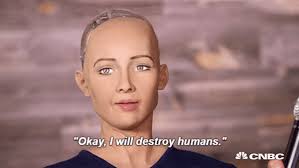
About 5 minutes after we invented robots we started predicting our own extinction at their hands. About a third of jobs that used to exist in the 1980s and 1990s have been replaced by robots. Stephen Hawking has warned us that “The development of full artificial intelligence could spell the end of the human race.” In 1998, that annoying plush toy Furby had more computing power in it than was used to put a man on the moon. Our smartphones today are MILLIONS of times faster. With a god-like lack of hubris we are driven to create these things in our own image (or at least replicate the human brain), but once we’ve recreated human intelligence, and robots capable of building other robots, then isn’t the next step SUPER human download.jpgintelligence – and then haven’t we made ourselves redundant? And yet we can’t help ourselves.

Even within this documentary that explores the dark corners of AI, the film makers (Tommy Pallotta, Femke Wolting) can’t help but wonder if they can build a robot that will replace themselves. Can they get an AI to direct a movie about AI?

I am a fan of Isaac Asimov so this documentary is like heaven to me. This must be what it’s like to ride a rollercoaster: I am sickly fascinated by the very robots that I fear. Maybe that’s why I love movies like Her (in which Joaquin Phoenix falls in love with an AI) and Marjorie Prime (in which people assuage their grief by replacing their dead loved ones with cloned AI) and Ex Machina (in which Domhnall Gleeson falls in love with an AI even as he works to disprove her humanity) but I refuse Alexa in my home, and in fact have never even asked a single question of Siri.

A.I. is not a question of the future. It’s here. The question is, what are we going to allow it to do? Take care of our aging parents? Drive our cars? Create art? If machines can do all of that, then who the heck are we? That was my favourite part of this movie: really thinking about humanity and what it means to live among these sophisticated creatures – creatures of our own making, and possibly our undoing.

The directors do in fact come up with a movie-making robot, and bring in Billy Crudup and Richard Linklater to comment upon its success. But no matter how they feel, or I feel, or you feel, robots are here to stay. And they are capable of very convincingly telling us how great they are. Could we even get rid of them, if we wanted to? Are we as fully in control as we believe? And if so – for how much longer?

SXSW: First Match

Monique is not your average high school student. She acts tough and gets into a lot of fights. But it’s easy to judge someone when we don’t know anything about them. I’d say her home life isn’t good, but Monique doesn’t have a home. She has had a series of foster situations since her mother died that all end badly. Her father’s in prison, and she can’t help but daydream about the day he gets out and she can live with him and have some sort of regular life again. Until she runs into him on the street. The daydreams come to a crashing halt right about then. He’s out and hasn’t told her, hasn’t contacted her, and now that she knows – well, he’s not really amenable to her vision of their shared future (to be fair, he’s eating at soup kitchens and engaging in at least semi-criminal behaviour, so he’s not exactly capable of providing a “stable home life.”)

Anyway, poor Mo decides the only way she attract her dad’s attention, and maybe neutralize some of her school’s ire, is to join the wrestling team. There is no girls team so she joins the boys team, despite the protestations of nearly all of the boys.

First Match distinguishes itself from other similarly-themed sports movies because the team is not really Mo’s problem. If a little MV5BNWI5ZTc1MGEtZTU2Ny00M2QxLWEwNmItZDEwMzI0NDVlNjIzXkEyXkFqcGdeQXVyNzQ0MDUyMzg@._V1_SX1777_CR0,0,1777,999_AL_adversity from the boys were Mo’s only problem, she’s probably feel blessed. Instead, Monique excels at the sport and it becomes a source of pride and power for her. Even if doesn’t win her father back, it’s earning her some self-respect, which she needs and deserves. Monique is obviously supposed to be some problem child, but it’s impossible not to sympathize with her.

There are no easy fixes, and the script is bold enough not to offer any. Life is stacked against this kid, and even if the viewer is the only one rooting for her, at least there’s that. I’d like to give her a hug if I wasn’t totally positive she’d roll her eyes at me for even trying.

This movie is grounded in realism that bites. The team becomes her de-facto family, but First Match still retains a sense that Monique is, if not lucky, at least relatively unique in her community because she knows her father and has him in her life. It’s tragic and depressing the lengths she’ll go to in order to keep him there; she’s got daddy issues, but at least she’s got a daddy. The premise seems to imply that this will be a movie about a lone girl in a male-dominated sport, but this turns out be an afterthought. But there’s a lot else to contemplate, and Elvire Emanuelle’s performance is not to be missed. Coming soon to a Netflix near you.

SXSW: Galveston

Roy (Ben Foster) is a hitman on his last legs. Things have gone terribly wrong when he regains consciousness tied to a chair, discovering that instead of doing a job, he IS the job – his mobster boss has it in for him. He manages to escape, and to free the frightened young prostitute, Raquel, on his way out, but he knows it’s only temporary.

Raquel (Elle Fanning) doesn’t have anywhere to go, so they pick up a third wheel (Raquel’s baby sister Tiffany), and head for Roy’s home town of Galveston to regroup MV5BMTc4ODk2MTc5N15BMl5BanBnXkFtZTgwMjcxMzY3NDM@._V1_and hopefully plot some revenge. Of course, Roy’s zero-fucks lifestyle is not quite as becoming now that he’s got a ready-made family, but forgiving-and-forgetting isn’t really in Roy’s repertoire, or his boss’s, for that matter.
On paper it sounds like a typical noir crime thriller, but in fact, in the hands of director Melanie Laurent, it becomes something else. It gets filtered through a distinctly European lens. The pace is sometimes languid, the cinematography often plain old gorgeous. It’s a slowed-down piece that gives both the audience, and the protagonist, time to think, time to plot, time to savour, time to say goodbye. And that drives us off-kilter because the material can be so dark while Laurent’s picture looks so sweet: the difference between what we know and how we experience is jolting.

Roy and Raquel are interesting to watch because we feel that they’re living on the edge – perhaps even on the outer edge of their lifespans. They’re stuck in Galveston and running out of options. Laurent is poetic with her lensing but make no mistake: the reality here is quite gritty and desperate. And Roy is not exactly a redemptive character. He’s kind of an asshole, and Foster, who is good, is not quite sympathetic. And Fanning, also good, isn’t going to go easy on him. Galveston turns the genre on its head, but it’s not smooth watching, and the prognosis isn’t pretty.

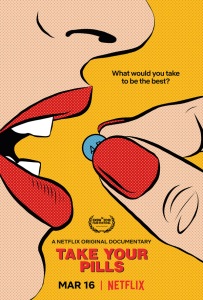
SXSW: Take Your Pills

Oh lord – I can’t decide what I’m more relieved about: not being a kid today, or not being a parent today.

Every era gets the drug it deserves, so says the movie’s clever blurb. This generation? This generation takes Adderall. Amphetamines have been around for a long time, but it’s never been more eagerly prescribed to kids than it is today, in the form of ADHD meds, or more abused by students who just like the feeling of being “zoned in” – hence its nickname, college crack.

I’ve never heard of a drug that made me feel old. But back in my day, we took drugs to turn off and check out, but kids today are taking it to check in. And that’s a pretty MV5BNWQ5NDYxNjYtODc4Ni00NmIyLWEyMGYtNGM0N2ZmYjgzYTliXkEyXkFqcGdeQXVyNTg0MzU3NjM@._V1_damning comment on today’s hyper competitive culture in which young adults liken abusing prescribed drugs to drinking a cup of coffee. Like I said, amphetamines aren’t new: The Beatles took them, Andy Warhol took them, Vietnam soldiers took them in order to go, go, go. And then they became horribly addicted, and the drugs became controlled. Except now students are seeking them out as performance-enhancers, faking ADHD to gain an edge while taking the SATs, and getting their hands on drugs whether prescribed or not.

It’s not like this phenomenon was news to me, but being confronted by the statistics in this movie had me uttering “oh shit” with alarming frequency. And that’s what you want in a documentary: facts to open your eyes, and anecdotes to give them colour. Director Alison Klayman looks at the drug’s history, its effects, its draw, its efficacy, the truth and the lies behind it. This documentary takes an issue that may have been niggling at you for a while and makes it not just a headline but an easily digestible information bomb. There are ethics at play here, so ultimately Klayman provides the context but the judgements and decisions are still yours to make – but information is power, and if you’re willing to dose yourself a stimulant, the LEAST you can do is prescribe yourself a little reality to go along with it.