Tag Archives: Half-assed

Films in this category have something to offer but also have one or more flaws that detract from the experience. Still, these movies are probably better than most of the shit on Netflix.

Miss Sloane

miss-sloane-32016 Golden Globe nominee Jessica Chastain plays Elizabeth Sloane, a notorious Washington anti-regulation lobbyist taking on the biggest challenge of her career when she’s asked to help take on the powerful gun lobby.

It’s timely and potentially divisive subject matter that will surely be attacked in many online comment sections as Liberal Hollywood Elites trying to take your guns away. But, honestly, can’t we use a rational discussion on gun control right now?

Well, you won’t find any of that here. Neither Sloane nor her opponents are particularly interested in facts or rhetoric. They are masters of spin, manipulation, and trickery. Never mind guns or politics, this is really a movie about sleight of hand. It has more in common with movies about magicians, con artists, or thieves  than movies about politics.

Film Review Miss SloanAnd maybe this is supposed to be the point. The only problem is that and Miss Sloane (the movie) seems to love the thrill of the chase as much as it claims to be outraged by her methods. For awhile, this behind-the-scenes look at what it takes to pass a bill in Washington (or keep one from passing) is almost fascinating and thought-provoking but the endless double crosses and Sloane’s nearly superhuman foresight make it harder and harder to take any of this seriously.

Needless to say, Chastain is pretty much the best thing about the movie. Any insight miss-sloane-2we get into her character comes more from her performance than Jonathan Perera’s script. But even she occasionally fails to convince during some scenes where she seems to be acting more for the trailer than the actual film. I can only assume director John Madden is to blame for this given that Miss Sloane also showcases inexplicable overacting from the likes of Michael Stuhlbarg, Sam Waterston, and Mark Strong that I can’t believe made the final cut. You’d think  a director of a Best Picture winner (Shakespeare in Love but still) would have done a better job of reining them in.

Madden may have had trouble keeping control of his hammy cast but he still manages to make a watchable film. It is slickly edited and never boring. And I have to admit, its most outrageous twists are the best ones. It just feels like a bit of a missed opportunity.

Maybe I shouldn’t complain. I knew almost nothing about this movie going in and expected something serious and dry. I was anticipating a chore and got a preposterous guilty pleasure that I’m still trying to forgive myself for kind of liking.



Collateral Beauty

collateral-beauty-trailerWhile searching for Will Smith’s filmography, I was surprised to see the pleasure with which critics are tearing this movie apart. The reason I was looking for Smith’s info was to try to figure out whether Collateral Beauty is his best dramatic performance (and I quickly realized that since I haven’t seen Ali, I’m disqualified from weighing in on that topic). With that lead-in, it probably goes without saying that I again think it’s been too long since the critics were thrown a juicy morsel, they’re searching for anything to bite down on as a result, and Collateral Beauty has been flagged as an easy target.

Collateral Beauty is not a great movie by any means, but it’s very watchable for several reasons. First, Smith reminds us that he can hold his own against anyone, no matter how many Oscar nominations/wins they may have (his co-stars in Collateral Beauty, Edward Norton, Kate Winslet, Helen Mirren and Keira Knightly, have two Oscar wins and countless nominations between them – incidentally, how does Michael Pena not have any yet?). Smith is consistently the most interesting person on screen even though for a significant portion of the movie he doesn’t say a word.

Second, there’s something undeniably watchable as the movie tries to take aim at cliches, even when it does so by using other cliches. Perhaps it’s just that the cliches that bother me the most were the ones under attack. I can’t really say any more without spoiling some of the characters’ arcs, so if you want more of a rant on that point then feel free to request more details in the comments section.

Third, I found out early on that I was wrong about how the movie’s plot would play out in a major way, which almost never happens nowadays due to the sheer number of trailers foisted on me (especially when half of them have no qualms about spoiling the best parts of the movie they’re promoting). On a related note, seeing a movie in Hawaii earlier this week was sobering because I think they showed every trailer currently in rotation. I am sure Canadian theatres will soon follow suit and it’s already too much here! Just let me watch the movie I paid for already.

Since I’ve started complaining (it never takes too long), it seems like a good time to talk about negatives from Collateral Beauty, and there are some significant ones.  The bigggest problem is that Smith’s character’s supposed friends treat him in the worst way imaginable during the worst time of his life, and it seems we are supposed to forgive them for it. The film attempts to make it easier for us to do that but its method requires a major swerve by Smith’s character that came too quickly to feel natural, as well as a twist that seemed too convenient a fix.

That same convenient fix also transformed the tertiary characters’ motivations from awful to divine and again the turn felt too abrupt. While it made thematic sense and actually tied the movie together well, the execution was too rough to be satisfying (and it also gave rise to a new (/old) complaint about the trailer that I can’t discuss without getting into spoilers so again, comment if you’re curious to hear more of a rant on this point).

All in all, Collateral Beauty is worth a watch and is definitely not deserving of the hatred it’s receiving from critics. It’s quite decent and gets bonus points for making me choke up a few times (something that doesn’t happen very often). Sure, it’s cheating a bit by focusing on death and loss, but Collateral Beauty is intended as a tearjerker and wholeheartedly embraces its nature. Is that such a bad thing? I don’t think so.

Collateral Beauty knows what it is and delivers exactly what you’d expect. If you’re in the mood for a sob story then this is your horse. I think riding this teary pony wore Jay out, though, so be prepared if you’re a real cryer like Jay as opposed to a robot who occasionally feels sad (which is the category Jay has put me in and I’ve really got no valid argument against it – beep-boop).

Collateral Beauty gets a score of six teary-eyed robots out of ten.

Absolutely Fabulous: The Movie

If you were a fan of the series, you’re going to be a fan of Absolutely Fabulous: The Movie because it’s an absolute hoot and a real tribute to the show. If you’ve never heard of it though, you’re kind of out of luck. Show creator\writer\star Jennifer Saunders isn’t looking for converts with her script, abfabshe’s simply paying tribute to those of us who will never get enough of Edina and Patsy.

The show wasn’t really “about” anything other than two fab women (well, fab in their own minds), PR reps Edina (Saunders) and Patsy (Joanna Lumley), who lived life in glorious, wondrous, oblivious excess. They worked little and spent lots, thinking mostly of themselves and the clothes they wore (mostly badly). Brand-obsessed and vain to their empty cores, I couldn’t help but love their ballsy hedonism. The show was vicarious fun and thanks to Saunders’s clever writing (not forgetting her brilliant partner, Dawn French), with frequent in-jokes and winks to the audience between scathing, cruel humour. The movie is very much like an expansion pack of a typical episode. This time Edina and Patsy fuck up on a world stage and for the first landscape-1455900130-colfertime they’re finding that perhaps being hounded by the paparazzi isn’t quite what they’d always hoped.

Saunders and Lumley have excellent chemistry (as they should – they’ve been playing these characters off and on since 1992) and just seeing them together makes me feel effervescent. Every familiar face was like unwrapping a sweet, and I couldn’t get enough. Saunders can still write a mean sting and by god can they both deliver. These comediennes are not to be underestimated: even their banal hijinks are riveting. There’s no new ground here and a movie feels a bit of a stretch, but these women truly are fabulous and I feel fortunate to still be able to bear witness to their acid. I would gladly spend my remaining years in a nursing home alongside them as long as we never ran out of champers, sweetie dahling.

Office Christmas Party

By my count it’s been at least 12 years since a holiday movie has earned Classic status (Elf is kind of a sure thing; The Polar Express pretty darn close) and Office Christmas Party is no where near in danger of being added to that hallowed list. It’s just funny enough, which seems to be the way with these things.

Jason Bateman plays the Jason Bateman character: bland 40-something white dude. Thanks to his horrible boss (Jennifer Aniston), the only way both the company where he works at and Christmas itself can be saved is by turning the office holiday party up a notch – to eleven – and letting the festivities turn near-apocalyptic.

Is it a dumb premise? Of course it is. I’m not sure I would have seen this movie at all had I OFFICE CHRISTMAS PARTYnot been deliberately trying to kill time AND had this particular movie not been playing in the convenient slot. Should YOU see it? Not unless you find yourself in similar circumstances. I mean, it’s not awful. Check it out next year on Netflix, maybe. It’s got a pretty good cast and the odd chuckle, so it’s not a complete waste of space. It just wouldn’t quite make it onto Santa’s Nice list, we’ll say. Is that generous of me? Am I in the holiday spirit? Gross.

Actually, I’m writing this from my desk, where I am currently going through some post-cruise symptoms, such as feeling my whole office list when I know damn well that I’m firmly on land. My body, however, has not yet adjusted. I am also wrapped up in fluffy blankets and slippers because while my skin has become adjusted to Hawaiian temperatures, we arrived home last night to a winter storm that made our morning commute particularly hellish.

Back to the movie: actually, I may as well be done this review. It’s what you expect from a cotd_utwaaekdh0non-denominational holiday mixer where Kate McKinnon is stretching out a 3 minute bit and she’s the best thing on screen.

For my office get together, we rent out a suite and watch the Ottawa Senators play some team, and usually get beaten. But there’s food and booze. What does your office do? Do you accidentally get clients high on blow? Bring hookers as dates? Wind up in the hospital? Flee in an epic car chase? Your office party might be a lot more tame than the one in this movie, but I bet the cliche factor is pretty similar, and it can’t possibly be any less original. Ho ho hold onto your money. They usually rerun It’s a Wonderful Life for free on TV.

Just Go With It

While I don’t always admire Adam Sandler movies, I do admire his work ethic. Every movie is just an opportunity for him to take another glamourous vacation with his family and friends, and call it a tax write-off. He seems to have a soft spot for Hawaii, and who can blame him?

maxresdefaultJust Go With It was worth another trip to the islands – Maui, to be specific. Well, the movie is deliberately vague, because sometimes they’ll start out on the island of Maui and then magically end up in Kauai: the magic of Hollywood, folks!
The title pleads for you to “just go with it” and you’ll have to in order to enjoy this thing even a modicum. It’s a sad little premise, in that Adam Sandler is a player who wears a fake wedding ring in order to pick up empathetic dates who he never has to commit to.  Until he meets his dream girl, played by bikini  model Brooklyn Decker, and now he has to orchestrate a fake divorce in order to be available to her. He blackmails  his assistant (Jennifer Aniston) into posing as his soon to be ex-wife, and her son cleverly milks it for a trip to Hawaii.

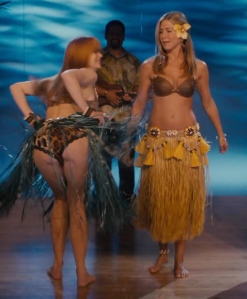
After some allusions to Pretty Woman, the movie is pretty much just a tropical setting and some classic Sandler shenanigans. Jennifer Aniston is a stand-out:nicole_kidman_just_go_with_it_pto5zmo_sized she really makes you remember what fine comedic timing she has. So while this in no way is a good movie, it’s kind of enjoyable if you squint hard enough. Actually, my favourite part is when Aniston and her college arch-nemesis played by Nicole Kidman do a hula-off. You could watch that scene, have a laugh, and not feel too bad about yourself.

Jennifer and Adam were friends for more than 20 years before they got around to making a movie together. They met before either was famous, and she’d go watch him do his stand-up before sharing a cheap meal. Now they’ve each had their mega-success, so why not take their respective crews to the most beautiful place on earth? Nicole Kidman maintains that she loved the experience of making this film no matter what the critics said. Her kids and even her parents were with her. Adam’s wife and kids appear in the movie, and so does Brooklyn’s hubby. Who wouldn’t want to work from Hawaii? This week, though, I’m not working. In fact, right about now I should be hiking up a volcano on Maui. Aloha!

The Runaways

The Runaways is a biopic-ish film about the rise and fame of all-girl rock group of the same name. The film’s script is based on Cherie Currie’s memoir, and is produced by Joan Jett. Unsurprisingly, the film mostly focuses on these two women, Currie on the mic and Jett on rhythm guitar. Lots of other ladies came and went – most wanted nothing to do with the movie, and their parts are fictionalized.

Curie (Dakota Fanning) and Jett (Kristen Stewart) were pioneers, therunawaysand came together under the influence of scuzzy manager Kim Fowley (Michael Shannon). Like any respectable rock band of the era, they eventually combusted, but not before releasing four albums in as many years. They never made it huge in North America but had some crazy success in Japan for a while, where their sound and aesthetic were appreciated.

The movie is just okay. The leads are phenomenal, stylish and electric performances from both Stewart and Fanning (and Michael Shannon is stellar, as always). But the “biopic” aspect is less bio,832729701403947af2c28f14dac46933 more pic. It barely scratches the surface. We don’t get to know anyone, and at any rate, Joan Jett’s post-Runaways life and music is where the real meat is. That said, it’s a clichéd ride about sex, drugs, and rock & roll, but it’s one worth watching to see Dakota Fanning get salty and Stewart own the role of rock’s first goddess. But it’s a condensed version featuring some character composites. The only member of the band besides the two front ladies that is touched upon is that of Sandy West, the drummer, but by the end they don’t give a shit about her, forgetting her in the title cards. She’d died before production began. Pesky cancer. The Runaways were revolutionary, a band about self-empowerment, but not all selves are created equally.

Thor

thor-movie-theme-song-1I finally saw Thor and to be honest, I’m not entirely sure what happened. I know Thor got hit by Natalie Portman’s car a couple of times after being banished to Earth for being a dick. Then he learned a lesson and could pick up his hammer again, so he smashed a rainbow bridge to save a planet. But then he couldn’t see Natalie anymore because he wrecked the bridge.
Except I know he got back to Earth somehow in time to appear in the  Avengers but he didn’t bother to check in with Natalie. That doesn’t bode well for them and yet she’s in Thor: The Dark World so I guess she didn’t hold much of a grudge.

Thor felt different than the other Marvel movies, which is sort of a good thing except in being different it felt much less super-heroey than the others. Then again, that might be my anti-Thor bias showing. I never cared much for Thor in the comics. I always found him snooty and boring. He’s no Spider-Man, that’s for sure.

So while kudos may be due to Kenneth Branagh for trying to put a fantasy spin on Thor’s cinematic debut, I guess I would rather have seen him fight the Hulk than some random fire-breathing robot. The good news is that I might get my wish now that Taika Waititi has been handed the franchise’s reins!  November 2017 can’t come soon enough, as Thor: Ragnarok is arguably my most anticipated Marvel film yet.

While I’m waiting, I suppose I could take in the other Thor movie between now and then. After being underwhelmed by Thor, I’m in no real rush to take in Thor: The Dark World. I’m far more likely to rewatch Hunt for the Wilderpeople instead. Because unlike Thor, Ricky Baker is definitely my kind of superhero.


The Man Who Knew Infinity

India is crazy with population: 1.2 billion people or so. Why, then, does Hollywood think a man born in London is the only one for hire? Nothing against Dev Patel, but he can’t be the only brown person around. On the other hand, I hate to take work away from him because of course he’s only allowed to play Indian dudes, despite being British. Rant aside, I only half-enjoyed this movie, despite being originally pleased to find it on Netflix.

Dev plays Srinivasa Ramanujan, a poor, uneducated man in India who happens to be a math the_man_who_knew_infinity_2015_12516184prodigy. Of course, India rejects him because he’s from the wrong caste, and he has no degree and he looks like he sleeps in the street (to be fair, he does). So he writes a ballsy  note to professor G.H. Hardy (Jeremy Irons) of Trinity College, Cambridge, and Hardy’s just intrigued enough to send for him. It’s 1912 though, so Cambridge is not super friendly to brown-skinned people. And Cambridge is really unfriendly to self-taught brown people who think they’re better than them. So everyone hates on him and even Hardy stifles him. Ramanujan is just vomiting brilliance everywhere and no one wants to accept it.

Patel and Irons are great. You can’t knock the acting. But math is boring and this biopic is conventional as hell. Ramanujan was a real man who overcame real adversity and left behind a legacy only now begun to be understood. I don’t think the film needed to add a further layer of intrigue that involved him not being allowed to walk on the grass. I felt like he wasn’t served well by this documentary – not his life, not his work, not his memory. And that’s really too bad.


Man vs Snake: The Long and Twisted Tale of Nibbler

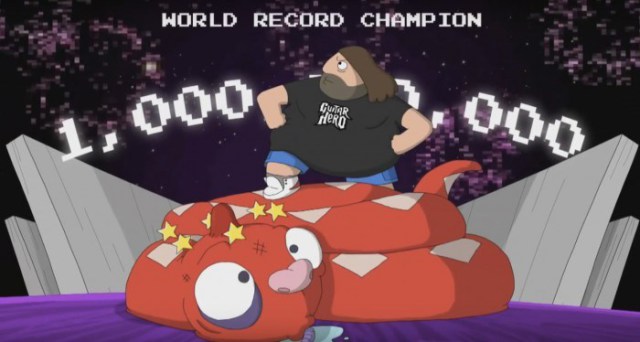
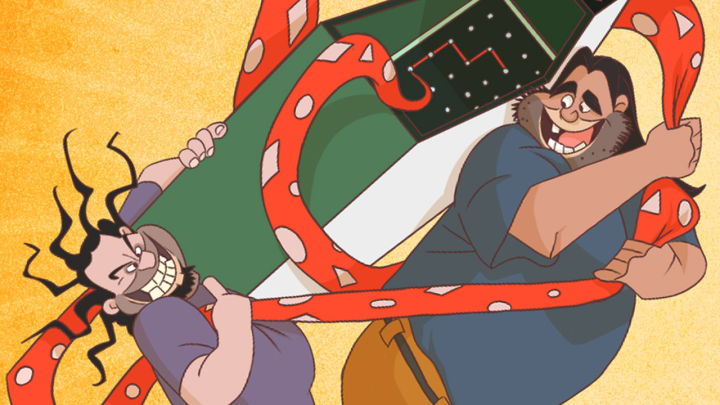
I am too young to remember Nibbler from the arcade but it was on my computer at some point during university, along with Solitaire, Hearts, and Free Cell.  In Nibbler, the player controls a snake with the goal of eating all the dots on the board.  But every dot you eat makes your snake get longer (in a very non-sexual way), and if you let the snake run into itself then it dies (I guess because it is super poisonous?). All in all, a pretty simple concept, but like most 80s games, you can playmanvssnake-cartoon-billionpoints-700x374 the game forever doing the exact same thing over and over, just a little faster each time.

As a natural-born procrastinator, I played a few rounds of Nibbler while avoiding writing research papers.   Is it just me or has YouTube/Facebook/Twitter made all those games obsolete?  Anyway, back in the day I became quite good at Free Cell but mastery over Nibbler always eluded me.  Part of it was that I found the game extremely boring (possibly more boring than writing the paper I was trying to avoid), so I’d only last one or two games and then I’d move on to something else.

Unlike me, there are 40+ year olds who seem not to get bored by Nibbler, and who play that game for marathon sessions, 30 hours or more, in order to score a billion points.  Nibbler’s claim to fame is that the developer had the foresight to display a score nine digits long instead of the usual six, so Nibbler’s whirring numbers went that much higher than its contemporaries before flipping back to zero (which may be part of why we feared Y2K so much, because in all these games you could lose everything by playing just a bit too long).  Nibbler focuses primarily on the first player to hit a billion in the game, the unfortunately named Tim McVey.  He hit the high score back in 1983 and promptly moved on to other games because after playing the game for 40 hours straight he couldn’t bear to touch a Nibbler machine ever again, but hemanvssnake_1280-720x405 returns to the competitive Nibbler arena in his 40s when he learns he might not actually have held the world record all those years.

We’ve reviewed some very good documentaries on Netflix recently (like Ava DuVernay’s excellent 13th).  Man vs Snake does not come close to those heights.  It is unlikely to inspire you or educate you or show you anything worthwhile.  This lifelong quest for high scores in a dull, repetitive game is led by people who like dull, repetitive things and inevitably are stuck in the past due to their nature.  Certainly, the gameplay footage, which features prominently in a whodunit-type post-mortem of one marathon attempt, is going to hurt your eyes because it’s painfully archaic.  I don’t know how I ever stared at any of those screens.  It’s impossible for me to stare at them now or hear the incessant beeping that was a staple of the arcade experience back then, the equivalent of the bells on a slot machine, over and over and over.

While it is interesting to peek inside these people’s lives for a few minutes, my interest faded long before the movie wrapped up.  At its core, Man vs Snake is a dull, repetitive experience, much like Nibbler itself.  It’s a decent time-waster that you will likely get bored of before it ends, and you may want your quarter back.  There are much better documentaries to be found in the Netflix arcade.

Made In France

It starts out reasonably enough: we hear a lecture against pornography. But the words are angry, vehement, and even if we agree with the content, you can’t help but worry about the tone. Then it continues: the Internet is evil too. And so is “fraternization” – males and females hanging out together. Merely looking at each other. It’s all decadence that leads to adultery, and adultery is worse than murder because murder is permitted under certain circumstances, but adultery, never. Which is why women should be made to stay in the home.

This is of course rhetoric coming from a Muslim imam in an underground mosque in Paris. The worshippers gathered to hear him are mzfq1g0XnDg9STDVZPT219LTQh6.jpgdiverse. One, Sam (Malik Zidi), or “red beard” as they call him, is an honestly devout Muslim but also an undercover journalist hoping to get a juicy story on jihadism. His Muslim buddies are all young guys like him from a range of backgrounds, easily mistaken for a group of soccer-loving 20 somethings. But one of the gang, Hassan (Dimitri Storoge), leaves France because he’s ready to make holy war. When he comes back, he tells his friends they’re charged with forming a terrorist cell right there in Paris.

It’s scary to watch something this topical when in fact Paris has been hit several times now by terrorists. The threat is real. Al-Queda isn’t just “over there”, it can be home-grown and just as serious. That’s why this movie strikes such a nerve. As Sam says in the film, the mosque is very good at radicalizing young men. The imam have the subtle traits of cult leaders, and though the young men may originally wander in out of curiosity, they stay out of belief, and then develop fanaticism. The inherent misogyny in the system seems to be attractive to a certain kind of disenfranchised young man.

Made In France is scarier than any horror movie you’ll see this year, and for that reason I wish the film was more analytical as to what would truly encourage a regular Joe to turn extreme. As it stands, the movie’s characters are one-dimensional in terms of motivation. It’s a fairly effective thriller but not overly insightful. Shot before the attack on Charlie Hebdo, director Nicolas Boukhrief struggles to find a balance between the genre and its real life inspiration. He achieves a tense atmosphere that’s gripping and heart-pounding, and a couple of punchy, taut action sequences. Ultimately succumbing to generic twists and beats, though, Made In France doesn’t quite deliver on its socio-political promise. But it does serve as a reminder that anyone can be a terrorist, with a camera’s simple panning of a nondescript residential street that could be my neighbourhood or yours, and the clever casting of “the guy next door”, Made In France taps into our panic and forces us to confront our worst fears.

This review appeared first at Cinema Axis – check them out for more CineFranco coverage!