Tag Archives: Half-assed

Films in this category have something to offer but also have one or more flaws that detract from the experience. Still, these movies are probably better than most of the shit on Netflix.

Wonderstruck

Wonderstruck tells two parallel stories, set 50 years apart. In one, a little girl named Rose travels to New York City to track down her mother, a famous silent film star, circa 1927. New York City is no place for a kid traveling alone but Rose, who is deaf, is brave and smart. Meanwhile, in 1977, Ben is another runaway on the loose after his mother dies and an accident leaves him newly deaf. Determined to find the father he never knew, he too heads for New York City. And since you’ve surely seen a movie before, you can probably guess that at some point these stories will somehow intersect.

Millicent Simmonds, deaf in real life, had no prior acting experience before being 20Wonderstruck-web1-superJumbocast, but she wowed both director Todd Haynes and Julianne Moore with her audition. On set she communicated primarily through an American Sign Language interpreter, while Haynes sent many cast members on a walk through NYC wearing noise-cancelling headphones to get a sense of the city’s quiet side. Rose’s portions of the film are shot in black and white, and Simmonds has a terrific face for it – curious and expressive, her eyes lighting the way.

Oakes Fegley plays Ben, a kid who feels orphaned and is further isolated when he loses his hearing. Unlike Rose, his deafness feels more like an obstacle – he  hasn’t yet learned to navigate the world without hearing. And neither have we, but Haynes occasionally immerses us is quiet, the sort of quiet that feels pregnant with possibility.

Todd Haynes is the king of period pieces, and Wonderstruck affords him the opportunity to hit the jackpot: double periods! Nobody could embrace it any better. And he certainly has a knack for delighting us visually, bringing art to life, and cities to life, and museums to life, and inner life to life. What he stumbles with are the required shifts in tone. We flip back and forth between the two children’s stories and Haynes has tried to make each story line look and feel distinct. But those shifts can feel abrupt. Haynes drenches us in visual poetry but there’s an emotional disconnect that kept me from being truly wonderstruck. The sets are great, the costumes are great, the score is really something, but the parts somehow add up to just an okay whole. It lacks in whimsy but there is still joy to be found in discovering something new.


***And since we’re all here and you’re every so kindly reading, can we just take a minute to consider this: first-run movies are rarely accessible to deaf people. They often have to attend special screenings, or use special equipment, and if those aren’t available, they’re waiting for a DVD. There’s an easy fix. Why not make movies more accessible by simply captioning them?
Mute

muteFor me, the most memorable scene in Mute was a few-second long callback to director Duncan Jones’ debut, a marvelous little movie called Moon, starring Sam Rockwell, that you should track down immediately if you haven’t seen it yet.  Apparently, Mute is intended to be the second entry in a very loose trilogy, an approach that Netflix seems to be very keen on at the moment (as evidenced by The Cloverfield Paradox along with Mute).  Come to think of it, we saw this same thing happen with Split not so long ago, where two movies really have nothing to do with one another except that they happen in the same “shared universe”, with that link often seeming to constitute a big reveal.

I have asked before and, thanks to Mute, have to ask again: why is it becoming a thing to tie movies together in this way?  What is the point, when Mute is a totally separate story not at all influenced by the events in Moon (and vice versa)?  Why does it matter that these movies occur in the same world at the same time if the events of one film do not impact the other in any way?  Why are we even mentioning this link and including a scene with Rockwell in Mute (other than the fact that he is so hot right now)? sohotrightnow Are people being drawn to Mute because it’s related to Moon?  Did anyone choose to watch Mute because of that link who otherwise would not have?  Is Rockwell such a big box office draw that his inclusion got Mute off the ground?  I have a hard time believing this one little throwaway scene helped Mute and yet, why else even bother?

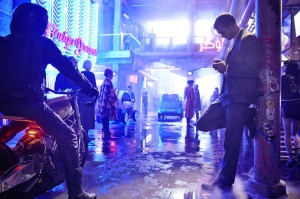
Really, the only benefit of Rockwell’s inclusion was that it made this review easier to write, because Mute is otherwise forgettable even as you are watching it.  Visually, it is for the most part a shameless ripoff of Blade Runner only it’s bereft of any philosophical discussions about anything meaningful, with the only takeway being that parents should not make friends with pedophiles, a point which, much like the movie itself, did not really need to be made.

I Could Never Be Your Woman

This was such a weird movie I’ve waited two weeks to write the review and still haven’t found the angle. Not that it’s urgent: it’s from 2007, so you’re not exactly waiting on the edge of your seat to hear my proclamation. You’ve maybe even already seen it, but then again, probably not. It didn’t exactly make a big splash in the land of movies.

Here’s an interesting thing: it’s a film by Amy Heckerling, the woman who wrote and directed Clueless. This movie is about a woman, Rosie (Michelle Pfeiffer), who writes a MV5BMTk3NDc3ODk2M15BMl5BanBnXkFtZTYwNDc3NDI3._V1_TV show that looks and sounds a lot like Clueless. It’s about the very coolest of high school students, and stars adults who don’t quite pull off their roles. Among them – Stacey Dash, a crazy lady who was 28 when she played Dionne in Clueless and 40 when she reprised the role of too cool for school adolescent in this film. Paul Rudd, only a couple of years younger, turns up in this one too, playing a teenager on set and the role of younger suitor to Rosie, who is mortified. And, of course, flattered, and maybe interested.
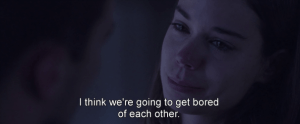

Not that Rosie has a lot of spare time to consider younger lovers. She’s trying hard to save her show, and to co-parent with her youth-obsessed ex-husband (Jon Lovitz), and to parent her wise-beyond-her-years actual teenage daughter Izzie (Saoirse Ronan in her film debut – yeah, this kid was always going to be a star).

Anyway, there’s three paragraphs to distract from the fact that I still can’t quite make a pronouncement. The truth is, there’s some juicy satire here. It has lots to say about a woman’s insecurities, and generational differences in falling love, and the impossible standards of show business. But for every great little quirk (many provided by Ronan – her character parodies songs sort of a la Weird Al, but with a feminist twist, likely years beyond her grasp) there’s a lot of rom-com cliches to wade through. But there’s the added bonus of Tracey Ullman as a personified Mother Nature, guiding us through the dark forest of female self-esteem. Heckerling clearly has a lot to say and I bet this film was quite personal to her, but she spirals out of control a few times. In the end, if you’re a sucker for Paul Rudd (and let’s be honest: who isn’t?) or if you’re curious how a little girl with a strong Irish lilt fares blasting out the angry lyrics of a certain Canadian songstress, go ahead and look this one up.

Newness

Two horny millennials, Gabi and Martin, listed as DTF in their social dating aps, meet up one night for some NSA fun. The sex is so hot, they accidentally fall in love. They’re both as pretty as they are restless so it’s a surprise to both of them that their one-night stand turns into a live-in relationship. This is unfamiliar territory amid their hookup culture and they have to invent games and rules to keep things interesting, but connecting is actually refreshing, and they’re intoxicated with that first blush of love. But as the newness fades, the lengths they’ll go to to keep things spicy become extreme.

Open relationships are not for everyone. I’m pretty okay about anything consensual that makes people happy and fulfilled, but let’s be honest: open relationships are hard to

Nicholas Hoult open relationship movie Newness

Um, no shit.

maintain. Also true: monogamous relationships are hard to maintain. Half of those end in divorce. Some people think they can solve the challenges of monogamy with polyamory and perhaps some are right. But if it’s difficult to make one person happy, it’s much harder juggling two or more.

Gabi and Martin are of a generation needing constant stimulus and feedback. They’ve gone from a phone full of potential lovers to one, single lover, night after night. At first it’s exhilarating to fall head over heels, but eventually monogamy starts to feel constrictive. Relying solely on each other to have their needs met becomes “boring.” So they open things up. Soon they’re swiping left and right harder than they ever did before. Does this save their relationship, or does a certain ugly green monster pay them a visit?

Laia Costa and Nicholas Hoult slide into their roles effortlessly. The camera is penetrating, the script languid. We get sucked down the rabbit hole of their relationship along with them. And you know what? Down there, it looks exactly the same as all relationships from the beginning of time. And it’s kind of dull. Director Drake Doremus doesn’t really have anything new to say. You don’t so much root for the characters as you root for their mistakes to catch up with them. Which is probably quite a bad sign, in retrospect.

Miles

Ron’s heart bursts while reading the Saturday morning paper in his lazy-boy. He leaves behind a wife, Pam (Molly Shannon), and a teenage son in his senior year of high school, Miles (Tim Boardman). His family is devastated, but not in the usual way. Miles is desperate to escape the confines of his small town for film school in Chicago next year, and Pam has been slowly asphyxiating in her crappy marriage for years. Turns out Ron wasn’t a very nice person, and he recently used his son’s college fund to buy his mistress a Corvette. The mistress is the only one without dry eyes at the funeral.

Pam copes by flirting with a widower (Paul Reiser) in her grief group, and by threatening the mistress, and the mistress’s mother. Miles copes by joining the girl’s volleyball team. Apparently it’s the only scholarship he’s eligible for.

The movie is set in 1999, which means the AV club consists of rolling a large tube TV around on a trolley and chatting looks boxy and pixelated and awful. But it still encompasses a pretty big chunk of the plot. There’s really to recommend setting the movie in 1999 except it’s based on a true story, which is also an awkward implication.

But anyway: we’re going to rock the boat in small town wherever, circa 1999, when boys didn’t play on girls teams and coming out to your parents was still an occasion. So maybe there’s still room for this kind of courage, whatever that means. There’s an effort here to be relevant but the truth is, our protagonist is narrow-minded in his own way. He sees only his own needs and wants, not the larger picture, so it’s hard to really extrapolate the kind of meaning that would make this film feel satisfying.

Roman J Israel, Esq

Roman Israel is part of a two-man law firm: he does the research and the writing, while his partner makes the court appearances. But when his partner is suddenly taken out by a heart attack, it becomes clear that the firm isn’t financially solvent, and that Roman (Denzel Washington) is ill-suited to work both sides of his cases. When a large firm comes to swallow him up, headed by George (Colin Farrell), it looks bleak for Roman’s future.

But the interesting thing about Roman is that he uses the law for social justice. He’s been working on a case for years, maybe decades, that he believes could reform the system. topelementHe is well-respected by activists and has collected clients simply by treating people like human beings. George decides to keep him around, thinking it might be good for his firm to do a little pro-bono for once. This is weird timing for Roman, who has just decided that he’s tired of working for ingrates and wouldn’t mind making a little money for once. And that’s the frame of mind he’s in when he makes a terrible, unethical, life-changing decision that could ruin or cost him his life.

There is no doubt that Denzel Washington turns in a stirring performance. Roman Israel is conflicted but he asks a lot of interesting philosophical questions. However, the performance does not make the movie. Everything else is a mess. I never fully understood what the movie was telling us: is Roman autistic? Why is he so bad with people, so out of touch, so obsessive? And it turns out that this was the least confusing part of the movie, because once it branches out from character study to mild intrigue it really spirals out of control. There’s no focus. For a film that seems poised to preach about morality, my biggest concern was whether I could write a review for a movie I walked out on.

Roman is a little too quirky and the script is a lot too unbelievable. Nothing came together for me and I was not entertained or even interested. Pass.

A Futile and Stupid Gesture

A Futile and Stupid Gesture is a Netflix original film that takes some chances. Netflix knows it has some leeway for experimenting in film, and this one was a particularly obvious choice for a little outside-the-boxing. It’s a biopic of sorts for Doug Kenney, the founder of National Lampoon. He was a funny guy who coloured outside the lines and this movie is a fitting tribute to him; it keeps you guessing.

Told in retrospect and narrated by an older, wiser, omniscient Doug Kenney (played by Martin Mull) who watches the events of his life unfold with a little disdain and a huge grain of salt. This device allows for a fair amount of editorializing and joke making at his own expense.

Will Forte plays Kenney, ages 18-33, and despite the fact that he’s 46 in real life, he’s a A-Futile-and-Stupid-Gesture-trailer-700x300great choice. He can pull off the sadness and the savage humour, playing it straight, breaking the fourth wall, talking directly to us, talking to himself. Doug Kenney was the Harvard editor of the Lampoon, and he had such an epically good time just fucking around with his good buddy Henry (Domhnall Gleeson) he decided to just keep it going and took their little humour magazine national. And as if the phenomenal success of the National Lampoon wasn’t enough, they expanded into radio shows, during which they enlisted the talents of Chevy Chase, Harold Ramis, Christopher Guest, and Gilda Radner. And then they started writing movies like Animal House and Caddyshack.  And while some might feel content with having their dreams come true and writing the most successful comedy movie EVER, Kenney never can be. He tries to fill the hole in his heart by shooting stuff up his nose. It’s a circuitous route that doesn’t work very well, but not for lack of trying.

Director David Wain assembles an incredible ensemble to help him out, and by incredible I mean, lots of recognizable faces, but not necessarily well-suited for the parts. Joel McHale gets to play Chevy Chase, and even though the two were on a TV show together for many years, it’s like McHale doesn’t realize he’s a real person with tonnes of footage on which he could base his performance. Instead he does Joel McHale in a bad wig and unless someone is loudly calling him Chevy, I forget which one he’s supposed to be.

I admire this movie more than I like it. I think it’s okay, and at times quite funny, and probably worth a watch if you don’t mind weird stuff. But the thing is, the writers and director are a complete mismatch. The writing is unconventional and wacky and striving for something extra but the director is a little more conservative and a little less inspired so the whole thing just sort of clashes awkwardly. Forte and Gleeson are kind of wonderful though – maybe a little futile, but definitely not stupid.

Ferdinand

Ferdinand is a big, beefy bull who accidentally destroys a village and gets branded a beast. The biggest, most monstrous bulls get chosen by the matador for bullfights, MV5BZWQ5ODZiMWMtYjM1Yy00ZDlhLTkwYzctNTQxNzE5MDRhNmIxXkEyXkFqcGdeQXVyNjA0MTc4OQ@@._V1_SX1777_CR0,0,1777,738_AL_but Ferdinand has never aspired to such fame. He’s a gentle soul, really, a pacifist. The other bulls are quite judgmental about his lack of fight but Ferdinand stays true to himself.

And that’s all I really have to say about it. This is not Pixar; it’s not intended for adults, or particularly bright children. Ferdinand is forgettable. It doesn’t even try to surprise you. But John Cena as Ferdinand is pretty okay and Kate McKinnon as a “calming goat” is sometimes nearly funny, so I guess there’s that. It just feels lackluster, and lazy.

Phantom Thread

I fell in love with Punch Drunk Love, and by extension its director, Paul Thomas Anderson. Since I’d already loved Boogie Nights I re-visited Magnolia and found lots to love there too. Punch Drunk Love was the start of my affair with PTA, and also the end. I’ve seen and not really liked everything he’s done since: There Will Be Blood, The Master, Inherent Vice. It makes me feel like a failed cinephile to admit my inability to get behind these movies and I was itching to break the spell with Phantom Thread. It currently holds a 92% approval rating at Rotten Tomatoes and is being lauded for Daniel Day-Lewis’s committed (and final) performance, but no, Phantom Thread did nothing for me.

Set in London, 1950’s, Reynolds Woodcock (Day-Lewis) is a genius dressmaker whose fashion house is coveted by all ladies in good standing. His life is rigorously regimented the-phantom-thread-trailer-1e98fcf2-7417-4ff9-bb81-a75e0cabd04band he turns out perfection in taffeta and the finest silk. His sister Cyril (Lesley Manville) runs his business and his home. Neither tolerate the slightest deviance from their prescribed lifestyle. BUT then a lovely young woman causes a disruption. Alma (Vicky Krieps) turns out to not be the meek muse that Woodcock first took her for, and his world is soon turned more inside out than the discarded gowns on a dressing room floor.

Is Daniel Day-Lewis quite good? Yes he is. His performance is measured and he puts you under his spell – almost. The trouble with Woodcock is that he’s thoroughly detestable. Alma is plain but transformed by his designs, made to feel beautiful and important, but it’s his attention that she desires and his alone. And of course he’s too fastidious, too devoted to his work to give it. But why does she want it? Women, to him, are basically just objects. They’re either housekeepers, muses, or clients – and he’s already got a housekeeper, and loads of clients. So Alma needs to find herself a niche, and she’s not afraid to carve one out herself.

Phantom Thread is undeniably meticulous in its execution, but I found it slow and I felt uninvolved. Not caring for any of the lead characters makes you feel so removed no matter how stirring the colour palette. The dresses were sumptuous and incredible really, but it felt more like flipping through the pages of a beautiful catalogue. The emotions are so inaccessible Alma may as well be a mannequin and not since Today’s Special has that been a compliment. The internet is filled with positive reviews for this movie but this is not one of them.

Goosebumps

20151007fdGoosebumps.6c5f8Turns out, it’s Jack Black week around these here parts. Today’s instalment is Goosebumps, a movie written for (and possibly by) people a third of my age or less. And those damn tweens must have seen this one a LOT of times because a sequel is coming out this fall just in time for Halloween.

First things first: Goosebumps is not scary at all. Planet Earth II is more harrowing.  Though in fairness, the Planet Earth segment with the snakes chasing an iguana is one of the scariest things ever:

There is no chase sequence in Goosebumps that even comes close to that level of terror, but that’s by design. Goosebumps is completely non-threatening right down to its protagonist, who you might recognize as the non-threatening guy from 13 Reasons Why if, like me, you watch too much Netflix.  He is perfect for Goosebumps because in his spare time he is a singer/rhythm guitarist for a band that got its break at a social inclusion and autism awareness concert (that’s right, two non-threatening causes at once)!

There are monsters in Goosebumps but they are the kind that chase you with a smile on their face. The kind that Jay would adopt and make me build a shelter for in our backyard. The kind that I can watch with my nephews and not get dirty looks from their parents. The kind that must make Goosebumps author R.L. Stine pat himself on the back for being as non-threatening as the guy from 13 Reasons Why (it helps immensely that Stine has written dozens of joke books and G.I. Joe choose-your-own-adventures under the pen names “Jovial Bob Stine” and “Eric Affabee”).

The only way Goosebumps will give you goosebumps is if you watch it while your furnace is broken. But I’ll take that over nephew nightmares any day of the week.