First, understand that OJ Simpson, to me, is the murderer. I was a kid when he killed his ex-wife and her friend, so I hadn’t known him as a football player or movie star or celebrity before then. The first I ever knew of him was when his white Bronco interrupted my Saved By The Bell marathoning.
This documentary doesn’t just seek to illustrate the life and times of one Orenthal James Simpson; rather it places his career and his crime within the context of L.A.’s race wars in the 1980s and 1990s. While the things you thought you knew about his sensational murder  trial aren’t wrong, they’re explored with new understanding, through a lens of his being a black man, sort of, but not really.
What on earth do I mean by that? OJ grew up in the projects, as he is fond of saying when it’s convenient. He dreamed not of glory or achievement or wealth, but of fame, of being known. Certainly his football career granted him that. He was a big deal in college football circa 1968, kept his nose clean, stayed out of politics, and earned himself the Heisman trophy. He was drafted to the NFL where he suffered a bit of a slump but had a rebirth by 1973 when he set a record rushing for 2000 yards in one season. I walk my dog further than that nearly every day, but apparently that’s some sort of accomplishment in football.
OJ became a star athlete and celebrity whose fame transcended his race. White American embraced him, and OJ played his part. He courted white culture and did his best to never remind anyone that he was still technically a black man. He was the first national black spokesperson, for Hertz rental cars, and that meant he’d arrived. When he retired from football, he traded in his black wife for a white one and transitioned to Hollywood.
Yeah sure he beat his wife on the reg, but with a wink and an autograph the cops would be slapping him on the back, making no reports, casting no aspersions. Life was good until Nicole up and left him and his jealousy surged. The one night Nicole was found dead, nearly decapitated in fact, in a small ocean’s worth of her blood. A friend who had had the misfortune of stopping by at the wrong time, Ronald Goldman, was also killed. And this time the cops couldn’t deny that the crime had OJ’s name all over it.
We all know that OJ was acquitted, but this documentary shows his acquittal as an act of vengeance. The jury was stacked largely with poor black people who had seen members of  the LAPD be acquitted in he Rodney King beating. Here was a chance to right that wrong and make the system work for a black man for once. Everyone conveniently forgot that OJ had spent his entire adult life distancing himself from the black community and they made him a civil rights hero. His lawyer, Johnnie Cochran, played the race card and he played it hard “dealt it from the bottom of the deck” it’s said. And he got off. But instead of relishing his incredible good luck, OJ’s life continued to derail until he found himself in court once again, this time found guilty and sentenced to some 33 years in prison, whether or not his crimes truly warranted it. This, again, was retaliation rather than justice.
At 467 minutes, this documentary achieves a depth we haven’t seen before and earns itself an Academy Award nomination – but is this fair? It had a qualifying run in theatres (though who would pay to sit for nearly 8 hours is a mystery to me) but it was produced and aired on television, in 5 parts on ESPN. Every other documentary had to play by different rules, hovering around that 90 minute mark that makes a film viable and marketable. This is the longest film to ever receive a best documentary nomination, and I can’t help but wonder if this will change things moving forward.
I can’t ignore that this film is very effective, juxtaposing the American dream with American reality, pinning OJ’s circumstances in a time and place that were far from ideal. It is balanced and cheese almighty is it ever thorough, complete with Marcia Clark in a redemptive hairdo. Glory be! It doesn’t waste any of its 467 minutes, nor are any redundant. There is much ground to cover and the film makes clear that OJ is not just a man of his own making, but an idol that a whole culture had a hand in creating (and destroying). There are so many insights here that I sent constant missives to Sean, just venting my hurt and frustration. I’ve come away with a breadth of understanding that his filled a gulch I didn’t even know existed in my awareness of this epic and polarizing event. There are discoveries to be made here, if you’re willing to follow director Ezra Edelman’s trail of breadcrumbs for the requisite 7 hours and change.

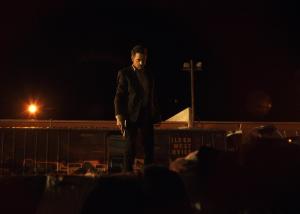 No matter how hard you try, you can’t see everything at a festival like SXSW. To prepare for these big festivals, we study the schedule like our lives depend on it, read the synopses repeatedly, and try to see as many of our favourite artists as possible. All that prep work helps a lot, but sometimes a tight schedule makes a choice for us. That happened today with Small Town Crime and we were better off for it. Put simply, Small Town Crime is an indie gem that is one of the best films I’ve seen in 2017.
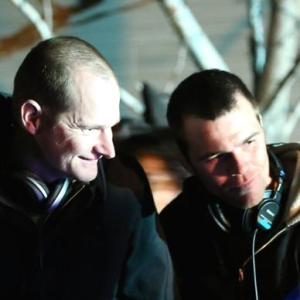 Functioning both as a whodunnit and an offbeat action-comedy, Small Town Crime is consistently good, especially when Hawkes’ character shares the screen with Forster’s concerned grandfather and Clifton Collins Jr.’s refreshingly self-aware pimp. Writer-directors Eshom and Ian Nelms clearly recognized what they had and give those three characters a hefty share of screen time. That must have been particularly difficult here since the cast is extremely deep. Even with the focus on that trio, I was left wanting to see more of them. I’d be first in line for a sequel (or a television series) showcasing more of their adventures.
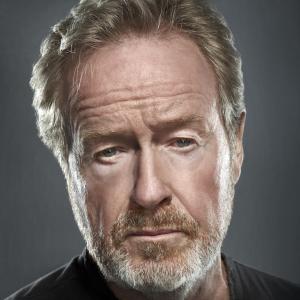
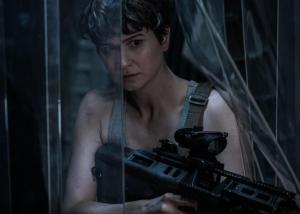 Anytime you get a chance to watch Alien with Sir Ridley Scott, you take it. How great is it that we got that chance? Even better, Scott was not alone. He brought Alien: Covenant footage with him, as well as Covenant stars Katherine Waterston, Danny McBride, and Michael Fassbender. An entertaining Q&A took place after the bulk of the new footage. We didn’t learn any big secrets but it’s obvious that all three actors were thrilled to have had the chance to work with Scott, particularly McBride who joked that his parents were thrilled he was finally making a real movie.
 The new footage proves that Scott is not afraid to rip himself off, and that’s great news as far as I’m concerned. You would expect Alien: Covenant to bear at least a passing resemblance to Alien (as the former’s purpose, aside from making tons of money, is to bridge the gap between Prometheus and the original quadrilogy. But the similarities are greater than that, they’re intentional callbacks to the original. That made the footage from Covenant FEEL like Alien, as it took us to the same places that Alien did, only now we know what’s going to happen (and what has to happen). Scott delivers on his setups with glee, letting us know he’s right there with us. A facehugger scene featuring Billy Crudup was especially awesome. It’s a good bet there will be more moments like that in the footage still to come.
 They want something temporary, first of all, so as not to permanently alter the land. Think of sutures: something that dissolves after the healing is done. To that end, they come to a beautiful and striking solution of tethering helium-filled balloons. However, the fence is not just symbolic of connectedness, but represents an awful lot of actual collaboration between peoples and communities to make this art happen.

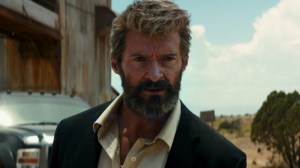 We reached comic book movie overload several years ago and the number of those movies has only increased since. It seems clear they are not going away anytime soon. At least there are a few I can sell to Jay as having something original to offer. It helps that she has endless patience for the things I enjoy. Based on its trailers and positive reviews, Logan was one of the easier sells in recent memory. And while I doubt it justified the superhero movie genre’s continued prominence for her, I think she may have enjoyed it. Well, once the Deadpool trailer ended – I’m pretty sure she hated that especially since it pretended to be the start of the film.
 Logan is an interesting take on a superhero movie. It’s based on Old Man Logan but barely. It includes X-23 and Professor X, but that’s about it for recognizable mutants. It’s not a franchise builder; it’s a coda. And that’s a refreshing change that helps the movie immensely. We’re so used to these movies going bigger and bigger that I found it immensely refreshing that Logan chose to act like a regular, standalone movie, and tell a self-contained story that entertained on its own merits.
 Thanks to the election of Donald Trump, the collapse of the U.S. in the next 12 years feels like a realistic scenario. So you best be nice to us or we will build our own border wall at your expense. Yeah, it sounds just as stupid when I say it as when Trump does.
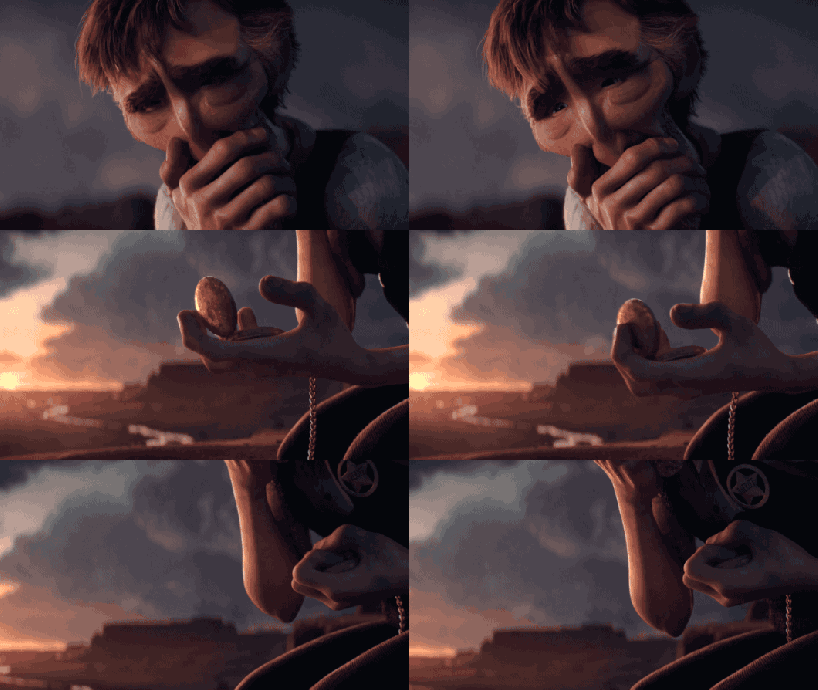 of his grief. The animation is twelve steps above incredible, from the flecks of gray in his beard to his slightly crooked teeth and the just-noticeable ripple of his mustache in a gentle breeze, the animators clearly know what they’re doing. Directors Andrew Coats and Lou Hamou-Lhadj tell the story precisely and economically, every frame adding a tragic detail. Builds to an impressive emotional valve in just under 7 minutes.
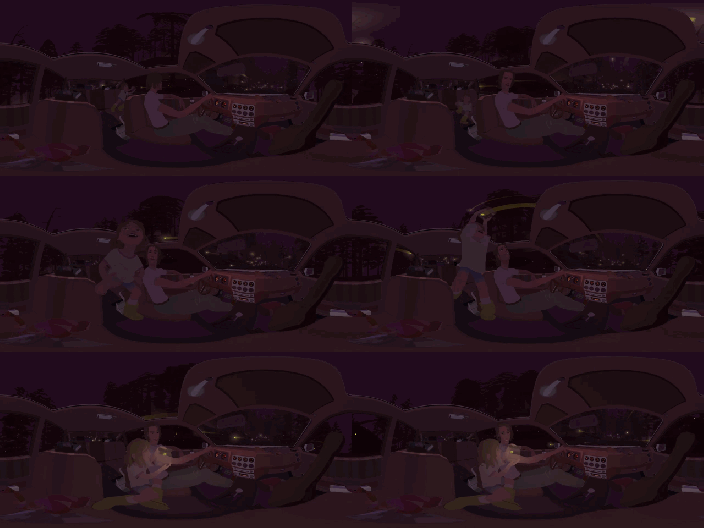 Pearl is the story of a girl, her father, and their music, clearly a family gift. We got to see this short in the Oscar package at the fabulous Bytowne theatre, which means we saw it on the big screen, which is actually not how it was intended to be shown. Pearl is the first virtual reality movie to be nominated for an Oscar. Director Patrick Osborne chooses a blocky animation style paired with endearing music that makes me wish that I too had enjoyed the VR experience, because it’s a whirlwind of pride, sacrifice, and in virtual reality, you’re the one with camera: every viewing would literally be a slightly different movie.
 own food. The beach is not always as serene as it looks and an unexpected wave leads to some PTSD for one cute little birdie. But she learns confidence and resilience, and the joy of helping others, all in less than 6 minutes. The animation is stunning. The ocean’s foam impressed me, the movement of each individual grain of sand. In great Pixar tradition, writer-director Alan Barillaro offers us something truly beautiful.
 describe it more like wood-cuttings, if I was feeling generous) tells a parable of a little girl born effectively blind – her left eye seeing only the past, her right only the future, which means the present is one big blind spot. And guess what? There isn’t any happiness in the past or in the future, it’s all happening right now and if you can’t see that, you can’t really see anything. Director Theodore Ushev has a great theme and plays on it with swirling visuals, challenging the audience to experimentation.
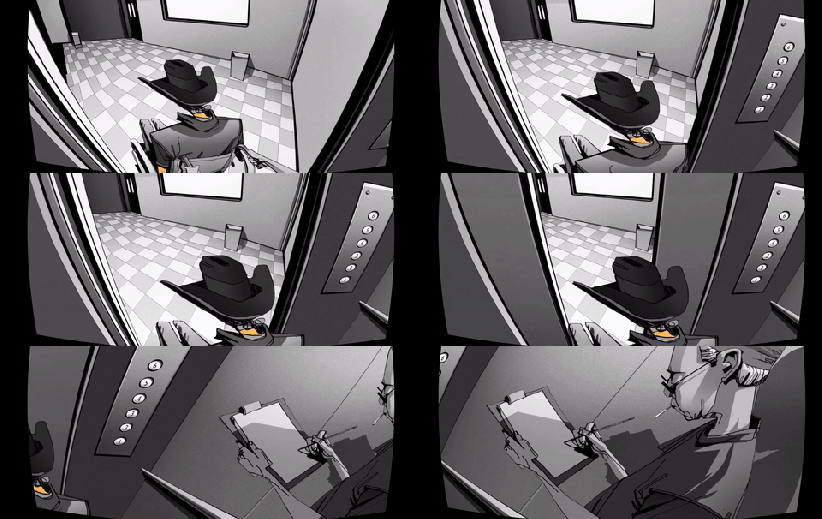 Rob’s charismatic but troubled friend, Techno. Techno’s near god-like status comes crashing down as he slowly poisons himself to death with alcohol. It’s definitely the only animated short with full-frontal nudity. It was originally a graphic novel, or novels, comprising several volumes, which is why this short film clocks in at a hefty 35 minutes, every single frame of which is hand-drawn by Valley himself, over the course of half a decade or so.
 It’s hard to believe it was about three years ago that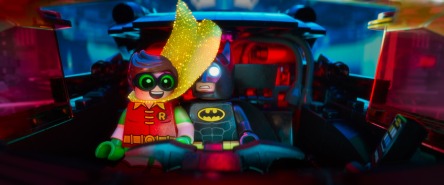
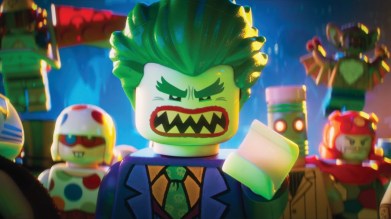 d remember just as Zach Galifianakis’ Joker suggested.
 retiring music throughout, but manages to speak directly to your heart. That’s sort of the catch with this film, you have to let go of the normal film-going experience, and just feel your way through this one.
 ASSHOLES WATCHING MOVIES