
 Rogue One is the movie the prequels should have been. It is fresh, entertaining, and necessary. Rogue One’s humour works for adults as well as five year olds (though any self-aware Star Wars fan must acknowledge that the gap there for us is not all that wide). Rogue One links to what we’ve seen before in a way that feels natural and rewards fans who are familiar with every scene of the original trilogy, and leads into the known end point of A New Hope without any trouble whatsoever.
Rogue One is also a movie that could never have been made under George Lucas’ watch. I do not even want to imagine how he would have approached this story, but tonally Rogue One is entirely different than all the movies that have come before, and better for it. This is not a classic adventure serial, it is a war movie with high stakes, and we quickly realize that the stakes are appropriately high considering the evil dictatorship that runs the galaxy is constructing a superweapon to crush its opponents once and for all.
At the same time, Rogue One gives us the funniest character of any Star Wars movie. Fittingly, it’s a robot. But where R2-D2 and BB-8 were funny in a sweet, childlike way, K2-SO is funny because he is an asshole. It’s fantastic and he is absolutely one of the best parts of this movie.
Felicity Jones is great as well as the leader of the motley crew trying to save the galaxy. Her team (and the movie as a whole) is refreshingly diverse. Though this welcome injection of diversity is, on a meta-level, unintentionally remiciscent of South Park’s Operation Human Shield, since the multi-ethnic team is the one on the suicide mission while the all-white crew from A New Hope is (or soon will be) galavanting around in the fastest, most indestructible ship in the galaxy.
Rogue One has some cheesy parts that took me out of the flow a bit, but Jay rightly pointed out that I should expect nothing different from a Star Wars film. The end result is a movie that 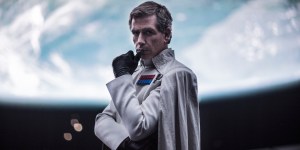 occasionally feels like an awkward mix of serious war movie and hopeful space odyssey, but only rarely did I have that feeling. It definitely did not ruin the movie for me and that Star Wars feel is an overwhelming positive overall (especially an amazing Darth Vader scene during the climax that shows us the power we always knew he had).
My only other complaint is the use of CG to add a few familiar faces to the film. I found it distracting and yet I also thought it was kind of a nice tribute to one of the great characters from A New Hope. Maybe we’re just not quite there on the FX front but we are incredibly close.
This is a worthy addition to the Star Wars universe. If you’re at all a fan you should see it, but if you’re at all a fan you probably already have! Rogue One gets a score of eight May the Force be With Yous out of ten.

 has made a fantastic film about family, grief, and how easy it is to push people away when we’re hurting. It’s one of 2016’s best films not because it has any particularly new ideas or innovative style but simply because it’s refreshingly honest.
 friend Maggio (Frank Sinatra) keeps running into trouble with a stockade sergeant (Ernest Borgnine) with a mean streak. And Prew himself is falling in love with Lorene (Donna Reed). It might seem like normal every day stuff, except you and I know what’s coming: Pearl Harbor. It’s awful to know what’s around the corner for them, how petty all of these problems will seem soon enough, if any of them are left to still have them.
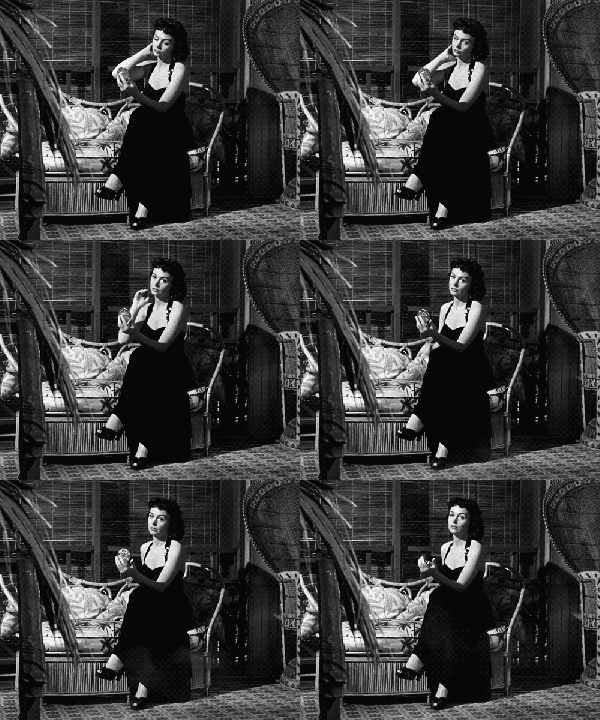 performances from his cast mates. Burt Lancaster was so nervous to act alongside him he’s visibly shaking in their first scene together. Sinatra was just grateful for the part. You may know that Mario Puzo fictionalized his movie career in The Godfather; a certain studio exec is convinced to hire him after finding his prized horse’s head in his bed. In real life, it was a lot less dramatic: Sinatra was married to Ava Gardner at the time, and she happened to have some pull with Columbia. Or at least that’s the version everyone agrees to.
 lots of naughty projectionists would cut out a slice to keep as a souvenir. Censors demanded that Kerr’s swimsuit be skirted so as not to be too “provocative.” And that wasn’t the only modification made. In the book, the captain’s wife gets gonorrhea from her philandering husband, but that part is conveniently edited out. And in the credits, Donna Reed is credited as a “social club employee” which is 1950s code for hooker. And the military had their own standards to contend with: you couldn’t portray military sloppiness, hypocrisy, brutality…or homosexuality. Not to worry. The gay stuff was also left out, along with all the other juicy bits that led to the novel being called From Here to Obscenity by some. But that scene. The scene on the beach. Makes me want to recreate it when we’re in Oahu today (it was in Halona Cove), but only if I can find a modest skirted swimsuit.
 and no healthy relationships. But then he starts collecting pudding. It’s only half as strange as it sounds: he discovers a contest loophole where if he buys an enormous amount of pudding, he gets to fly for free. This is the only bright spot in his world of self-loathing until two people pull his life in different directions.
 directing, and Sandler would go on to be nominated for a Golden Globe. Anderson had become somewhat known for his multi-character films and wanted his next work to subvert expectations, and boy did he. He was the first director to cast Adam Sandler and expect great things from him. He gave him real material to work with and Sandler rose to the occasion.
 during the film’s music. The score’s unusual tones and sounds would then be played on set, influencing the atmospheric tone of the film. Anderson brought it Gary Rydstrom on sound mixing, an atypical move as Rydstrom, the chief sound editor for Pixar, normally works on big special effects movies, like Spielberg’s Jurassic Park and Saving Private Ryan. All of these abnormal pieces form a whole that’s off-kilter and intoxicating.
 bought a lot of pudding in order to see the world? The first place he goes is to Hawaii. His Hawaiian trip, inspired by love, is the first self-actualized thing he does for himself. The framing and composition open up as Barry steps outside of his comfort zone, and the confines of his loneliness. Barry is often shown wearing blue, a blue boy wearing his depression, but in Hawaii, pink becomes the colour of prominence, the colour of sweetness, empowerment, and romance. It literally chases the blues away. Although, to be fair, I think Hawaii has the tendency to do that for everyone.

 corrections work on Rikers Island. But then the music business started paying attention and audiences marveled at her powerful energy and her joyful performances. Touring with her band, the Dap-Kings, Jones’s career was taking off when she was suddenly diagnosed with pancreatic cancer in 2013. Director Barbara Kopple is with Jones during her treatment, and Miss Sharon Jones! is a testament not just to the music, but to the immense effort Jones goes through in order to make it.
 recounting, it’s more about facing down death with graciousness, gratitude, friends, and yes – music. Always music. It’s clearly Jones’ passion and her greatest motivator. But the people she plays it with and shares it with are just as important, perhaps even more so as her health fails and her recovery is rocky. There is a stark contrast between her life as a performer and that as a cancer patient, and the best parts of this film are found right in that crack, where Miss Jones is unafraid to be honest, and to share this journey with her fans just as she shares her music, and her best self on stage, where Jones is really, truly alive.
 Until Bill Koch noticed something peculiar in his wine cellar that has more square footage than my house. Among his 43 000 bottle collection (including 4 bottles reportedly owned by Thomas Jefferson for which he paid $100k per bottle) he started to notice some fakes. Those fakes were traced back to none other than Rudy Kurniawan.
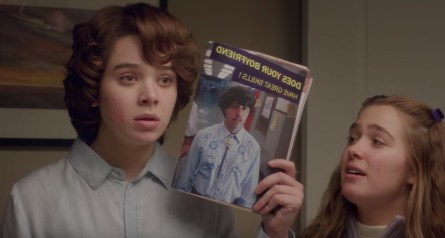 awkwardness just goes on and on. To make matters worse, her brother Darian (Blake Jenner) has it easy: perfect skin, perfect grades, the perfect apple of his mother’s eye, and a perfectly terrible person to be compared to for the rest of your life. To make matters EVEN worse, Darian starts dating Nadine’s best friend (read: only friend), which means he’s getting all the comfort that used to be hers, and she’s forced to be at war with them both while still, you know, blundering her way through life and high school, with only an irascible teacher (Woody Harrelson) in her corner – and believe me, that’s a bit iffy.
 time in one’s life.
 Moonlight is the quietest tour de force I’ve probably ever seen. Never have I rooted for a drug dealer in this way, and never have I sympathized so much with a kid who wanted to follow in that drug dealer’s footsteps. Moonlight is spectacular in its simplicity. It is also entirely different than the movie I expected.
 Chiron’s adolescence is the subject of three tightly focused vignettes. It’s a wonderful storytelling choice that perfectly explains Chiron’s choices as he grows up, without having to engage in any exposition. Moonlight is brave in many ways but to me it’s the choice to let us figure things out for ourselves that makes this film great. It makes the journey more fulfilling, the experience more real, and greatly increases our empathy for Chiron. Moonlight helps us understand Chiron to a degree that I would not have thought possible. Regardless of your race, wealth, or sexual orientation, we are all a lot like Chiron.
 Alex Hibbert, Ashton Sanders and Trevante Rhodes each take remarkable turns as Chiron and the extent to which they feel like the same person is incredible. Mahershala Ali is not the only other actor deserving of mention (the supporting cast is consistently great) but for my money his performance as the aforementioned drug dealer shapes Chiron’s life and makes us understand his growth to a degree that is virtually unmatched in film.
 the 2016 American Election’s worst-case scenario. Misogyny and xenophobia seem to have its place in American political discourse after all- the Oval Office on weekdays and Trump Tower on the weekends. A lot of people have said a lot of things to try to make me feel better. “Geez, give him a chance. If he succeeds, we succeed,” they say. “He’s not going to do any of the things he said,” seems like a popular response, which even if true seems to miss the point. One person even made the bizarre claim “Don’t worry. Orange people never do anything”.
 “Sure, he’s unprepared and easily distracted but give him time,” would makes more sense if the world was a simple place where nothing all that important or complex were going on. Zero Days, the new documentary from Alex Gibney and the film I’m using as an excuse to talk about the feelings I can’t shake since the election, paints a scary picture of the complexity of the security threats that face the United States and the world. Specifically, Zero Days is focused on cyber security and the story of the Stuxnet virus.
 Gibney (Taxi to the Dark Side, The Armstrong Lie, Going Clear) takes his subject seriously, his documentary can’t help feeling like a Hollywood thriller and the twists can feel pretty exciting until you remember that this is real life. The director is wise to play up the suspense given that all this talk of worms and centrifuges can get a little technical and continually reminding us how high the stakes are is an excellent motivator to pay attention to all the tech talk. The interviews with the security company that discovered Stuxnet, the politicians who can neither confirm nor deny anything, and the NSA whistleblowers are all gripping.
 ASSHOLES WATCHING MOVIES