
Auggie is a very special little boy. Born with a genetic condition called Treacher Collins syndrome, Auggie’s facial deformities are the least threatening of the complications but they’re what make him look so different. He’s most comfortable when he’s wearing an astronaut helmet that keep prying eyes and hurtful comments at bay. For the first ten years of his life he’s had countless surgeries and has been schooled at home, but he’s about to start middle school for real, and a classroom of students is more daunting to him (and his mom) than any operating room.
Wonder is based on the wonderful YA novel by R.J. Palacio, which you should, should, should definitely, definitely read. But happily, this is a rare case where the movie does  the book justice. And even happilier, the movie doesn’t suck, period, which was a major concern of mine. It seemed far too easy to just let it coast on its sentimentality. But while director Stephen Chbosky doesn’t have a lengthy track record to ease my worrisome nature, he does have one credit under his belt that’s all I really needed to hear: he adapted and directed The Perks of Being a Wallflower, which he’d also penned.
Wonder is a much different beast, however. First, it necessarily involves casting the perfect but very young star. A bad child actor in a lead role will ruin the whole thing, and in this case you have to find someone who can convey a whole range of complicated emotions from underneath a mask of scars. Chbosky went with Jacob Tremblay who’s already proven his chops with the most trying and powerful of roles in Room; Chbosky calls him “a once-in-a-generation talent” and I think he may be right. But we can’t discount the fact that Chbosky surrounds Tremblay with talent.
The secret to Wonder’s success, both in novel and in film, is that yes, it tells the story from the perspective of a sweet and brave 10 year old boy who’s been through hell and is still going through it. BUT it also shares the stories of the people around him. His mother Isabel (Julia Roberts) has had to pause life itself in order to become his warrior. His father Nate (Owen Wilson) copes with humour and cries by himself. His big sister Via (Izabela Vidovic) feels like a mere planet revolving around Auggie, the sun. A disease like Auggie’s is a family affair, energy-stealing, all-encompassing, leaving no one unaffected. And no one likes to complain about that because it seems petty in the face of something life-threatening, but it’s true and Palacio’s book as well as Chbosky’s film really add legitimacy to a family suffering as a unit. Even Auggie’s only friend isn’t untouched – being his friend is a social sacrifice most 10 year olds won’t be strong enough to make. Another formidable young actor, Suburbicon‘s Noah Jupe, lands and aces this role.
Wonder is not about the suffering though; that would be too easy. It’s about overcoming that suffering, in ways that are clunky and ungraceful and sometimes accidental. That’s why Auggie’s family seems so real, and why so many real families with sick kids can relate to the material. It’s emotionally raw stuff and you may find that it touches a nerve. But it’s got a takeaway message of positivity that’s irresistible, and will help justify the numerous soggy kleenexes in your lap.
 Anyway, as if a dog’s repeated death wasn’t enough to deter me, there was some controversy prior to the film’s release when a video of one of the actor dogs revealed it looking completely terrified during a stunt. Abuse was alleged, which led people to boycott the film. Not that it mattered; A Dog’s Purpose is not terribly good. It was never going to win the box office. It preys on your heartstrings. The director is so shamelessly over-sentimental that I felt like a dog on a leash being yanked along against my will.
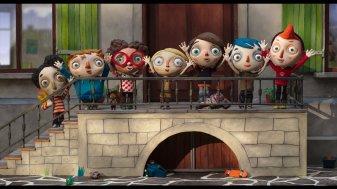 My Life As A Zucchini is stop-motion animated in a very compelling way. It’s a simple story with colourful characters and a strange title but make no mistake, there’s little silliness awaiting you. It’s a pretty bleak story.
 to breathe. Everything is still right in your head though, so you’re still smart and alert and you see everything happening to you, helpless to do anything about it. There is no cure. It is fatal, and will likely be so within 2-5 years of diagnosis.
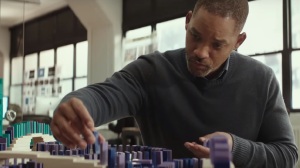 While searching for Will Smith’s filmography, I was surprised to see the pleasure with which critics are tearing this movie apart. The reason I was looking for Smith’s info was to try to figure out whether Collateral Beauty is his best dramatic performance (and I quickly realized that since I haven’t seen Ali, I’m disqualified from weighing in on that topic). With that lead-in, it probably goes without saying that I again think it’s been too long since the critics were thrown a juicy morsel, they’re searching for anything to bite down on as a result, and Collateral Beauty has been flagged as an easy target.
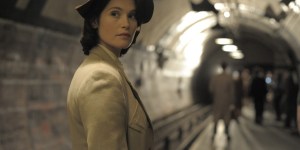 Catrin (Gemma Arterton) hired to write “slop” (ie, the female dialogue) appeases him by enlarging the role of the drunk uncle just for him. Convincing her boss Tom (Sam Claflin) to let her do this is as infuriating and degrading as you’d imagine – until he starts to fall in love with her, of course.
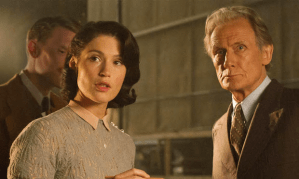 She mustn’t get too attached to feeling useful or creative. The war makes everything tenuous.
 It stars Mark Duplass and Sarah Paulson, almost exclusively. They play high school sweethearts who bump into each other 20 years later. Agony and ecstasy, right there on the screen. And heaping spoonfuls of awkwardness, don’t forget that. Because they were in luuuuurv. The real deal. And now they don’t even know each other. It reminded me of a friend who had recently posted on Facebook that it was her ex-husband’s birthday, a date she can’t help but remember even if she no longer even knows if he’s alive. Isn’t it weird that we can lose track of people who used to be our whole worlds?
 sex was hot and heavy, and Annie Lennox was everything. Jim and Amanda will take you down your own worm hole, and if you don’t end the movie thinking about your own First Love, then you my friend have a cold, cold heart.
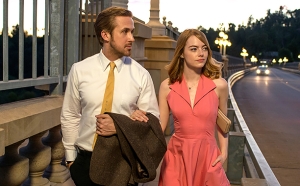 things to love a movie: sports, explosions, boobs. La La Land has none of those. It has singing and dancing and old-fashioned romance. Yet Chazelle has breathed new life into the genre, with riots of primary colour, energy so vivid you can taste it, and music that evokes deep troughs of emotion. And by ‘breathed new life’ I mean that he’s actually found a way to bring great musicals from cinema’s past into modern times. Forget made-for-Broadway musicals like Chicago or
  the stars in your sweetheart’s arms, you sort of know how it feels. But this great passion never lasts. It tapers off. Songs repeat. Sean felt himself longing for the exuberance of the beginning of the movie, and realized that was the point. Seb and Mia were missing it too.

 ASSHOLES WATCHING MOVIES