Tag Archives: movies based on books

Movies Based on Novels for Young Adults

It’s Thursday again, and we’ve got some real beauties lined up! Our friend at Wandering Through the ShelvesTMP had us tackle Fairy Tales last week, and black & white movies the week before. This week we’ve been tasked with listing our favourite movies based on books for young adults. And so, ladies and gentlemen, without further ado-

Jay

I felt really repelled by this week’s topic, which is kind of okay with me. I like a challenge. But the young adult genre is just not my thing. I can’t even claim that Hunger Games, Harry Potter, and Twilight are bad because I haven’t and won’t give them the time of day. They’re not for me, and they don’t need me – there are plenty of teenage girls to keep these franchises going.

I think it’s a little weird how franchises like Hunger Games and Divergent seem to put teenagers in mortal danger, in order that they may save the world. It’s sort of asking a lot from people who, by and large, don’t get out of bed before noon. It made me remember movies from my iknowown teenage years, the 90s, a time when teen movies featured parties, prom, and the gosh darned mall. And the occasional nerd makeover. But then I thought about our own teen franchises – Scream, and I Know What You Did Last Summer – and realized that maybe we’re not so different after all. We had teens running for their lives as well.
So for my first pick, I’m going with an even older selection that pit teenager against teenager, putting them in intense mortal danger: The Outsiders. I remember reading this book for the first time in the 7th grade. Our teacher followed it up with an in-class viewing of the movie and my teenaged hormones selfishly hijacked the situation, forcing me to weep buckets, turn purple, TheOutsiders4and lock myself into a horrible washroom stall until I could ‘compose myself’, whatever that means to a white girl with a perm so bitchin she needed a pick comb. To this day I can never decide if the casting was brilliant (Tom Cruise, Matt Dillon, Patrick Swayze, Rob Lowe, Emilio Estevez, all in their peach-fuzz glory) or if it totally missed the boat (everyone else went on to amazing careers while the lead totally fizzled after a controversially racial comedy flopped – Leonardo DiCaprio auditioned for but didn’t get the part). In any case, it tells the story of two teenaged gangs (if they can be called that), really just right side of the tracks vs the wrong side, the Greasers and the Socs, as they tussle and rumble and occasionally kill each other. SE Hinton wrote the book when she was just 15 years old (and what have YOU been doing with your life?) and it took a class full of junior high fans of the book to elect Francis Ford Coppola the most eligible to direct, and sent him a copy of the book. He agreed, shot the movie with Hinton’s help, and 20 years later restored all the scenes got cut when his own granddaughter was about to study it in school.

The old white men who reviewed Nick & Norah’s Infinite Playlist didn’t much care for it, but what do they know? They didn’t get the excellent soundtrack, couldn’t relate to the nonchalant inclusiveness, and NickNora_2lgdidn’t tap in to sarcastic chemistry between the two leads. Based on the novel of the same name by Rachel Cohn and David Levithan, it tells the story of Nick, the token straight guy in an all-gay band, freshly heartbroken by bitchy ex-girlfriend Tris, and Norah, the girl who falls in love sight-unseen with the guy sending frenemy Tris all those great breakup mixtapes. They meet up one night and run all over the city in pursuit of an elusive indie band called Where’s Fluffy. It’s got all the makings of great teenaged shenanigans: live bands, party rockin, neglectful parents, unlimited allowance and no curfews.
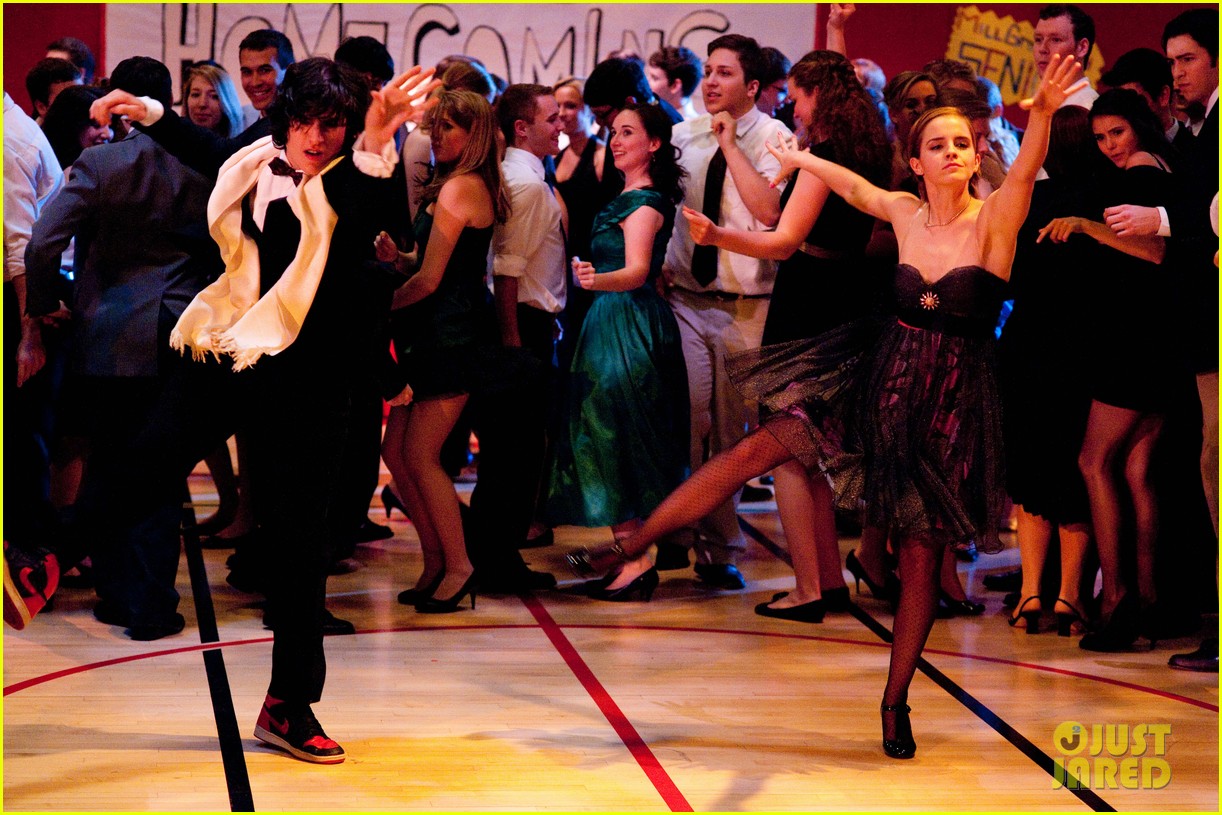
Another more recent pick, The Perks of Being A Wallflower, I somehow find charming despite my advanced years, probably because the three leads are so earnest and bright and perfect. Youth is infuriating. The fact that they don’t know a David Bowie THE PERKS OF BEING A WALLFLOWERsong is double infuriating. But the teenage trappings are all there: angst, awesome dance routines, riding in cars with boys, and even Paul Rudd – although this time, he’s (tragically) not playing the heartthrob but the teacher. Oh, I feel sick to my stomach. This story is a real testament to its time – the three leads are all outcasts but get this – they’re actually cool. I know. It’s strange. Counterintuitive, even. Goes against pretty much every teenage movie we’ve ever seen. But in 2015 (and apparently as far back as 2012), it’s cool to be weird. What a revelation. John Hughes was eyeing this as his next project before he died, but in the end it was directed by the novel’s author himself (which almost never happens), Stephen Chbosky, who also got to write the screenplay.
Matt

The young adult novel is an elusive concept. When I asked Wikipedia, examples seem to include books for children (Harry Potter), teens (Twilight), and twenty-somethings (The Notebook). When I first heard about this week’s Thursday challenge, I was worried I would be choosing between Divergent and The Hunger Games but, after working on it all week, I have managed to find 3 movies worth celebrating.

Coraline-  Adapted from what I just found out was a novel by Neil Gaiman, this 2009 stop-motion fantasy is as different from Disney as American animation gets. My local video store even had it filed under Horror. The bizarre alternate univCoralineerse to the already bizarre regular one isn’t as perfect as it first seems when a young girl discovers that her Other Mother, although more attentive and permissive than her real mother, wants to sew buttons over her eyes. Eye phobics beware. Darkly funny, oddly beautiful, and genuinely unsettling.

The Lord of the Rings trilogy- I’m still not fully convinced that this counts but who am I to argue with Wikipedia? I’ve never read J. R. R. Tolkien’s epic trilogy but have always assumed them to be a more demanding read than most in this genre. Peter Jackson’s ambitious nine and a half hour adaptation certainly expects more of its audience than anything else I’ve watched this Lord of the Ringsweek. I’m counting the whole trilogy as one movie to make room for other films on the list. Besides, I am not sure I trust myself to remember what happened in which film well enough to be able to write about them all separately. Together they make up one of the great American films of this century.
The Spectacular Now-  It’s hard to find a movSpectacular Nowie like this from a young adult novel. There are no vampires, wizards, or dragons. The Spectacular Now is a story of young love without the usual gimmicks. Miles Teller (Whiplash) and Shailene Woodley (Divergent) showed great promise in this adaptation of Tim Tharp’s novel in 2013 and it’s no surprise that they both got to star in higher profile movies the next year. Teller is especially good as a superficially charming teen alcoholic.


Sean

Hugo – this is a very nice love story film, fittingly brought to us by Martin Scorsese. It meanders a hugo__120124150122bit but it is an enjoyable ride, and the whole thing has a fantastical sheen. Having been to Paris and passed multiple times through Gare Montparnasse, where the movie is set, I will be watching this movie again in the very near future (I did not get to it this week because we were too busy sifting through typical apocalyptic YA filler).

Holes – it is sad that all that has gone on with Shia Leboeuf takes the focus off the movies he is holesshiain. I feel he retroactively takes something away from this movie but if you can get past that, Holes is an enjoyable story about family curses. Things wrap up a little too neatly (which I can’t believe I said because I usually love a tidy ending) but it’s an enjoyable movie nonetheless and one worth checking out.
Scott-Pilgrim-vs-The-World-ladyspaz-E2-99-A5-26058602-500-269Scott Pilgrim vs. The World – we have had a ton of comic book adaptations recently and of all of them, Scott Pilgrim feels most like a comic book (and that is a very good thing). It’s a fun movie with a ton of recognizable faces. I feel I’m stretching the category a bit with this pick but it has been tough this week to find anything halfway decent, and Scott Pilgrim is a favourite of mine!
Still Alice

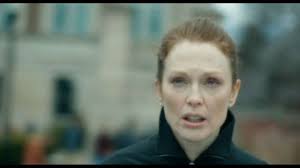
We wstill aliceouldn’t even be talking about Still Alice, about a world renowned linguistics professor who is diagnosed with early-onset Alzheimer’s disease, if it weren’t for Julianne Moore. Michelle Pfeiifer, Julia Roberts, and Nicole Kidman all apparently passed on the part before anyone got around to considering Moore, which is baffling to me. Who among Moore’s peers is more up for the challenge? Who can play confused just as well as they can play sharp or as vulnerable as well as strong. Or, as Jay was right to point out in her review of Maps to the Stars, who else is so unconcerned with how she looks while she’s doing it? Because there are so many sides to her persona, we believe her as a respected academic, as a mother, and as a wife which is just as important as believing her as an Alzheimer’s patient. Because of Julianne Moore, we’re talking about Still Alice as an Oscar nominated film (Best Actress in a Leading Role).

The movie, as written and directed by Richard Glatzer and Wash Westmoreland, may not be as beautiful as Away from Her or L’Amour but it gets it right mostly by not doing anything wrong. It’s never corny and doesn’t search for easy answers. This may not seem like high praise but I can imagine so many ways this could have gone wrong by being too pandering or by focusing on the disease instead of the person. I give it credit for not falling into these traps.

Julianne Moore is still the best reason to see Still Alice though. She’s been great since short Cuts but hasn’t had such a great opportunity to show it for years. Smart money is on her winning the Oscar.

If one asshole’s opinion isn’t enough, check out Jay’s review.

Gone Girl

Gone Girl is director David Fincher’s most successful film to date and most people are familiar with it and, if you’re not, the less you know the better so I will skip the usual plot summary.

Despite Golden Globe nominations for best actress, screenplay, director, and original score, only actress Rosamund Pike walked away with a shot at an Oscar. Her best actress nomination makes sense, especially this year where the pool of strong female lead performances seems more shallow than it was over the last few years. We get to know Amazing Amy mostly through flashbacks and Pike’s eyes and haunting narration suggest she’s got secrets and we really want to find out what happened to her.

gone girl review

The fact that Gone Girl works so well though has a lot to do with Ben Affleck, who plays Amy’s husband. The press has picked on Ben almost as much as they did his Gone Girl character. It’s probably partly because he’s made more than his share of shitty movies. He also has this way about him though. He’s a charming enough guy but often can’t seem to help seeming insincere. Maybe it’s his, as Amy puts it, “villainous chin”. Or maybe it’s just hard to seem sincere under a media microscope, where your every gesture is examined for signs of insincerity. Either way, he knows what it’s like to be bullied by the press and he seems to draw on that experience to deliver probably his best performance so far. Ben’s public life serves Gone Girl just as well as Michael Keaton’s did Birdman. Even that famous smugness of his works. His character’s a nice guy but we’re not always sure we believe him, as much as we’d like to. The way Affleck and Pike play it, we’re never quite sure what the truth is.

For another asshole’s point of view, click here.

Inherent Vice, sort of

A movie theatre is like a womb. It’s dark and ambient, sound thrums from every side.

Including pre- and post-production, a film may take many months to complete, but for the sake inherentviceof argument, let’s say it takes, on average, nine. Not unlike pregnancy, the director has spent 9 months thinking about YOU – about how to tell you this story, how to appeal to you, how confront you, console you. She’s thought about your comfort and your attention span. She’s thought about what you need and what you want, and how much of either you can take. You spend an hour or two under her care and control, in a dark little cocoon, maybe learning something, maybe growing a little as a person. And then you come back out into the world, blinking at the sudden change in light, maybe wiping away some tears. If the film was any good, then you are reborn a slightly changed person.

There’s a slight adjustment that we all make upon exiting the theatre, transitioning from the director’s world where we’ve been immersed back into the real world where bladder concerns and a cold walk to the car need to be addressed. Yesterday evening Matt and I were at Landmark Cinemas taking in Inherent Vice, and upon our egress, I felt slightly off kilter. A man was sitting at a table, eating frozen yogurt and watching the theatre empty. “How was it?” he asked us, and for a couple of film reviewers we were oddly quiet. Sometimes you come out of the theatre mournful and needing a hug, other times jubilant and wanting to celebrate with a drink at Bier House or The 3 Brewers. And sometimes you come out needing time and space to digest what you’ve seen. You need to chew on it a bit before you can pronounce it good, or bad, or ugly.

That’s how I felt, and still feel, about Inherent Vice. Although not as impenetrable as Paul Thomas Anderson’s The Master, I still feel like the movie was an inside joke to everyone who read the novel, and booey to those of us who hadn’t. I was lost a lot. There’s a lot of characters to keep track of, and so many story lines that PTA doesn’t even bother to wrap them all up. Matt and I laughed, but we laughed alone. There were maybe half a dozen other people at this early showing but if anyone else thought the movie was funny, they kept it to themselves.

But this movie isn’t meant to be watched in a conventional way and it’s not fair to judge it based on plot or logic or basic human understanding. But what then can I say? PTA’s story telling is bold, intuitive, and intentionally hazy. You aren’t meant to watch it in the typical linear fashion of the mainstream, with a start, a middle, and an end; you’re supposed to enjoy each meandering scene as it comes, pausing on the sun-dappled textures, nodding your head in much the same way Doc (Joaquin Phoenix) does throughout the movie. Can you let go and appreciate the lack of structure and cohesiveness?

This movie isn’t for everyone. Frozen yogurt guy, who solicited our opinion, was about to go in and see it himself. Said he picked it because it looked “different.” “It is!” I assured him. It really is.

Edge of Tomorrow

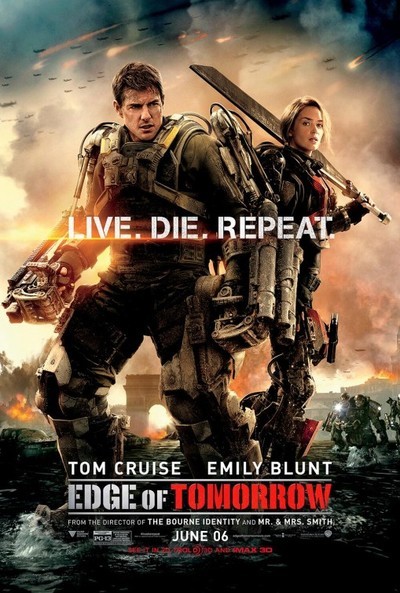
Tom Cruise plays Major William Cage, an officer used to in front of a camera rather than in the front lines. He is forced to join in combat against the invading alien race and is killed in the mission, though he “wakes up” to find himself in a time loop, repeating the battle in which he dies over and over again. It’s a military, sci-fi Groundhog Day with fewer jokes but buffer bodies. Cage teams up with Special Forces warrior Rita Vrataski (Emily Blunt) to improve his fighting skills so that he may live long enough on battle day to defeat the alien invaders. edge

I liked this so much more than I was supposed to. It’s an action-y-science-fiction-y movie that should appeal to Assholes like Sean, not Assholes like me. But it did. Probably because Emily Blunt is so fantastic, beautiful and feminine and tough as hell and totally believable as a feted warrior. And because for once, Cruise portrays this inept guy who has to be trained and guided by a woman in order to become the soldier they need him to be. It’s probably the most feminist action flick made in years. Or ever.

The movie is really cool to watch. The special effects contribute to a video game feel (and now that I mention it, I guess the constant re-levelling of the characters might have something to do with that too). The editing is pretty brilliant: the battle scene is overwhelming and unrelenting and although Cruise and Blunt relive it many times, it never feels as repetitive as it should. Actually, I felt moved and heartbroken by how much of their lives were spent on a mission no one would ever credit them for.

I mentioned earlier that this movie had fewer jokes than Groundhog day, and I stand by that statement, but this movie is not without its own brand of (dark) humour. And maybe we’re also slightly laughing at Tom Cruise, perma-action-hero, who in this one, has to take the back seat. It’s a war action movie that doesn’t glorify war. It’s got more storyline than weaponry. It feels like effort has been made, and for me, someone who doesn’t appreciate “cool” explosions for no apparent reason, this was a clever gem in the genre. It made me remember why Tom Cruise is a movie star and realize that Emily Blunt is just at the start of an amazing career.

A Most Wanted Man

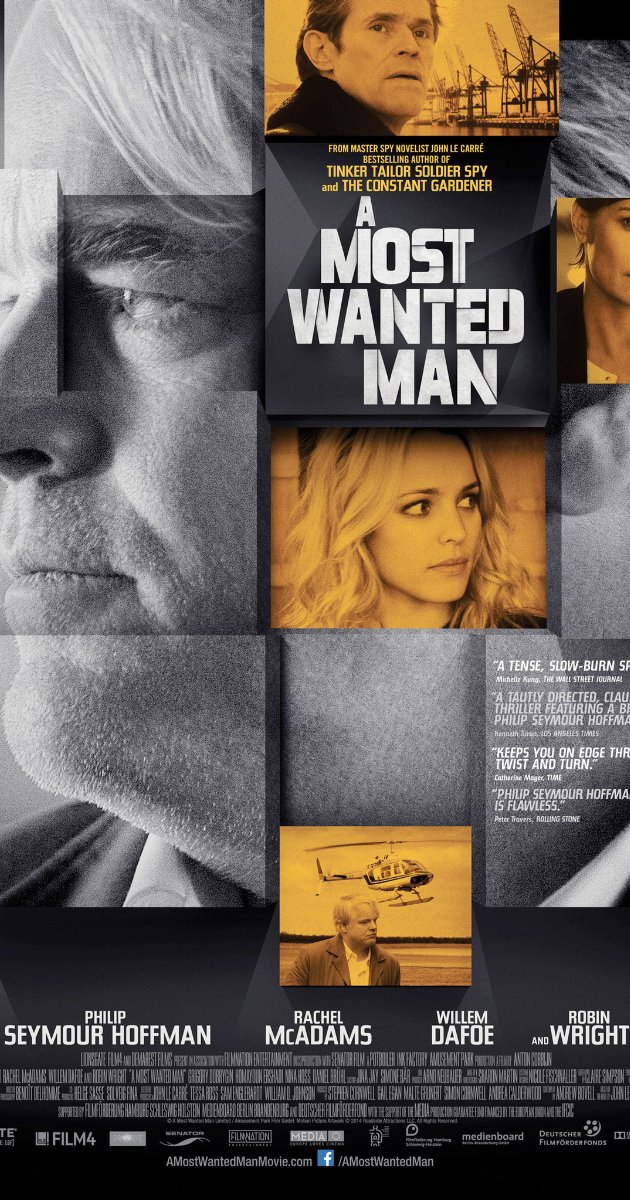
Post-911 Germany is scrambling to make sure nobody uses their country for terrorist organization again. Gunther Bachmann (Philip Seymour Hoffman) is one of the few “good” ones left in an intelligence unit largely corrupted by CIA, but his burnout is evident. When a young Russian-Chechen enters the country illegally, ostensibly looking for asylum, Bachmann decides to use the refugee to move up the ladder, hopefully toward a Muslim philanthropist who Bachmann believes is using charities as a front to fund extremist operations.wanted

Hoffman looks terrible in this film, which kind of fits with the character, who’s a bloated wreck, but it’s still painful to watch. He’s good though, if you overlook his German accent occasionally sounding Irish. Rachel McAdams plays a lawyer trying to help the refugee Issa Karpov (Grigoriy Dobrygin) claim political asylum. Dobrygin plays tortured and traumatized very well but McAdams seems miscast and out of her depth.

This movie is interesting but seems to have tried to pack too much into one single movie, so it’s a bit hard to follow. It’s also the least thrilling espionage thriller I’ve seen in a long time.  It’s not gripping because it gets bogged down in the details. And there’s no real heart. Who are we supposed to care about? The titular character, supposedly this Issa, is supposed to be mysterious. People are arguing over whether to arrest him now, or use him as bait to uncover his hidden motives, not just because he could lead them up the chain, but because they believe he himself may actually be a jihadist. The audience is meant to see him as a threat lying in wait, only he’s such a pathetic character that there is no real urgency, no real menace. In fact, the movie’s strongest sense of sinister undertone comes from conversations between Hoffman and Robin Wright, playing a CIA agent. The actors and director Anton Corbijn hint masterfully at malevolence.

It’s a mostly subtle film that makes you wonder how far is too far. How much should we infringe on someone’s rights in the name of “fighting terrorism”?  This movie will leave you unsettled, with a bitter taste in your mouth, both for the frustrating geopolitical policy, and for Hoffman’s swan song, his last completed movie.

Jodorowsky’s Dune

This documentary tells the story of arty film director Alejandro Jodorowsky’s inspired but ultimately doomed film adaptation of Frank Herbert’s sci-fi novel, Dune.Jodorowsky's_Dune_poster

To help realize the ambitious plans he had for this film, Jodorowsky recruited the very best talent available. He tapped Mick Jagger, Orson Welles, and Salvador Dali to star, Pink Floyd to do the music. A quarter of the budget was spent in pre-production, but the art and storyboards produced were stunningly surreal and top-notch. Maybe even a little too aspirational, because Hollywood studios balked at the high concept (and at the projected 14-hour runtime) and it never got made, despite having influenced countless sci-fi movies over the past four decades.

Jodorowsky is a great man to capture on film. Talking about his movie, it’s obvious that this was his passion project, his life’s work. Flipping through costume designs, camera angles and script changes, it’s astonishing and heartbreaking to see so much work and so much talent go to waste. Deflated over his Hollywood rejection, Jodorowsky stopped making movies. And it was with a heavy heart that he trudged to theatres in 1984 to see David Lynch’s Dune. He admits that if anyone could have done justice to his movie, it was Lynch, but he also gleefully tells us that his spirits soared when he realized the film was awful, a flop.

Jodorowsky speaks knowledgeably about the messiah complex that’s a running theme in the material without seeming to realize that he is the epitome of the expression. He admits that he “raped” the novel, albeit “with love” – it was rumoured that author Herbert was none too pleased. He took the story to places never imagined by the book itself, and perhaps it was this conceit, this unbowing grandiosity that was his undoing. Studio execs did not believe that this epic film, straying so far from the beloved source material, would ever find an audience. And maybe they were right. But between the conceptual art and the passionate storytelling of Jodorowsky, I wish that the choice had mine, had been ours, to see or not to see his masterpiece: Dune.

This is Where I Leave You

When Judd (Jason Bateman) comes home to find his wife fucking his boss, he moves out and is blind-sided by another piece of good news: his dad’s dead. So he and his 3 grown siblings return to their childhood home and are manipulated by their mother, the fabulous Jane Fonda, to stay for a week under the same roof to sit Shiva.  306995id1b_TIWILY_INTL_27x40_1Sheet.indd

It’s been a long time since these people were all gathered together with nothing better to do than nit-pick each other’s lives and observe each other’s failures, and what with other mourners randomly dropping in with secrets and casseroles, there’s a whole mess of drama that unfolds.

I wanted to like this movie more than I did. There’s nothing really wrong with it, and it definitely has its moments, but you just expect more from such an all-star cast. Why assemble so much talent only to waste it? The source material is pretty strong, and if this movie (now on DVD!) catches you at the right moment, you may find yourself identifying with it. Not that your family is this crazy, because it’s not. But maybe because when you go home to grieve your father, you also find yourself grieving the dreams you’ve given up on, the person you never became, the opportunities you left behind. Unfortunately, director Shawn Levy doesn’t show a lot of maturity with what he chooses to present on film. If he’s this afraid to scratch beneath the surface, then maybe he should stick to soulless movies like Night at the Museum and let someone else helm movies about grownups.

You won’t hate this movie, but you’ll probably forget quicker than Jane Fonda can shake her big, plastic boobs.


Scrooged

If you’ve seen Scrooged then you might know, and if you’ve never seen it you still may have billguessed, it’s not a great movie. It’s not bad, but there are better Christmas movies out there. In fact, there are better Dickens-inspired Christmas movies out there. But do you know what this movie has and others do not? Bill Fucking Murray.

The man’s a legend, so any movie he deigns to appear in has immediate cool factor. And in Scrooged, you get 4 Murrays for the price of 1: three of his brothers appear in this movie with him, one playing his brother, and another playing his dad! (The third plays “party guest” – you can’t win em all).

Murray plays the would-be-Jacob-Marley character, and there’s no one better suited to play such a depraved, misanthropic, crotchety role. That’s him at his best. So why then did director Richard Donner muddy it up with gimmicks, forced laughs, and production values that nobody asked for? It feels like Donner didn’t trust his leading man, but this movie would have been a heck of a lot funnier if Murray had been allowed off his leash.


In the holiday mood? Feeling Christmassy? Read Jay’s review of Love Actually here, and be sure to cast your vote for all-time favourite Christmas movie. Expect more Christmas reviews in the days and weeks to come.

Gone Girl

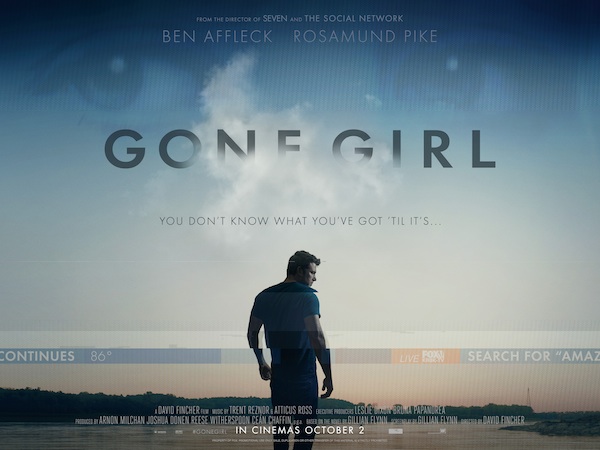
I didn’t like the book. It was too slick. You see it coming a mile away. It felt like an airport book done up in a fancy dust jacket so we’d mistake it as “lit”. It wasn’t.gonegirl

The movie? Trash. But exquisite,moody, sexy, noir trash that you can almost picture in a fast-talking, black and white, Hitchcockian way. Which is maybe what it should have been. Or maybe what it aspired to be.

It’s juicy and entertaining. The who-dunnit aspect is over surprisingly quickly, which is probably for the best since the book relied on the reader being really really dense and the movie gives us a bit more credit.

The movie succeeds with its portrayal of the media coverage of the disappearance of a beautiful blonde woman. Of course they’re going to jump allll down Ben Affleck’s throat, and of course Ben Affleck is a pretty good choice to play someone being hounded viciously by press (not to mention the brilliant casting of his chin!). The woman who does the Nancy Grace impression is spot-on. Rosamund Pike is also well-cast, and both she and Affleck handle their ever-evolving characters with subtety and competence. As an audience, we are constantly asked to re-assess what we feel about them as we learn more and like them less. Affleck excels at smug; Pike does chilling with panache. You can believe in the polarity of the characters, and that’s the hinge of the movie.

There’s a creepiness lurking about in this movie, even during the flashbacks to better times. They’re flirty, but they’re also just playing a game, and then that game gets serious, and then it gets out of control. Enter NPH, a slimy character if ever there was one. As much as I love me some NPH, I could have done with less of him in this movie, and more of Tyler Perry, playing a suave and yummy lawyer who takes the reins  and steers Affleck confidently into manipulating the media.

The questions in this movie will make you squirm (although, the sheer length of the movie may already have had you squirming anyway). Do we ever really know our spouses? Can we? And what is “true self” anyway – if we present ourselve very carefully and consistently one way, isn’t that what we mean by “identity?” And if nothing else, the movie’s ending will leave you in agony. Sweet, sweet agony.