
Simone and Claire are celebrating their 3rd anniversary together. Simone promises that should she blow out all the candles at once, she’ll finally come out to her family. She gives good blow, but can she keep her word?
Simone (Sarah Stern) insists that she’s ready, in fact beyond ready, to come out: the problem is her family. And when we meet them, well, it may be true. Her mom already treats her like an odd duck because she’s a non-practicing Jew. Of course, all the idiosyncrasies that Simone nitpicks about her mother are also true of her, she just can’t see it yet. Give it some time. We all turn into our mothers, ESPECIALLY the crazy ones. And it turns out there’s already a disappointment in the family; Simone’s brother is gay, and her father is very clear on the “fact” that homosexuality is a  disease, one that he does not want brought into his home. Simone fears that a second coming-out will prompt a heart attack, but her father’s health concerns seem, frankly, a bit brought on by himself. Perhaps worst of all, her oldest brother operates a Jewish dating site, and neither he nor his mother can think of a better way to marry her off, with or without her consent.
Does all of this create problems for poor Simone? Of course it does. But, um, so does the handsome Senegalese chef (Jean-Christophe Folly) at her favourite restaurant. The way things are going, Simone may not have a Claire (Julia Piaton) to come home to for much longer. Is this movie merely masquerading as queer cinema? It feels a tad, I don’t know, homophobic at times, like it really doesn’t respect lesbians or their relationships very much at all.
What To Each, Her Own boils down to is a lot of stereotypes and a lot of ideas that don’t quite amount to much, and certainly not to a very satisfying conclusion. If this is a comedy, it isn’t an overly comedic one, but it’s certainly not super romantic either, so it kind of waffles about in the farcical gray zone, sort of toying with stepping over the line in racial, religious, and sexual spheres, so in that way it’s a real triple threat. Or a triple non-threat. A triple mistake. A triple cringe. I guess this is me not really recommending this movie at all, unless you’re that rare, self-hating gay Jew who enjoys taunting fathers into cardiac arrest.
 as Esti’s present life is, even the memories of her past with Ronit are scorching enough to make everyone nervous. In their community, straight marriage is the only option, and it’s not so much an option as an obligation. Esti stayed, and conformed; Ronit left, and flourished, though she has all but abandoned her faith.
 such a way that things feel authentic and raw, and the intimacy translates so that we too are made uncomfortable by the too much, too fast. I totally get the wanting to fast forward past the awkward part of dating, the artifice of it,the hiding of one’s true self, but if there’s a way past it, all this movie does is prove that this isn’t it.
 and pure and wholesome and innocent. It’s funny how when you’re a teenager yourself, everything feels like drama, but watching it as a grown-ass woman, I realize how exceedingly easy it all is, and I just want to make them all grilled cheeses and tell them to just enjoy this. Finding yourself is a magical time, if not always an easy one. But Alex’s coming out isn’t going to be traumatic. His friends want nothing more than for him to be happy. I hope that is increasingly the case in 2018 but I know it’s still far from universal. It sucks that for some people, a certain amount of bravery is still required in simply claiming your truth and identity.
 Youtube and make a scene wherever he landed. But one of his absolute greatest accomplishments is a musical that he wrote and produced himself. Biographical, and inspired by The Wizard of Oz, Straight Outta Oz is an all-original production that covers the yellow-brick road he followed from being gay in small-town Texas and the struggles and hurdles that led to fame and acceptance and being fabulously gay anywhere he goes, including but not limited to small-town Texas.
 wrapping himself up in the city where he last knew he was alive, and he finds himself in the cafe of Oren’s widow, Anat. Thomas (Tim Kalkhof) takes solace by inhabiting different aspects of his dead lover’s life, and it’s not long before he’s helping out in Anat’s cafe, and erm, doing other things for Anat (Sarah Adler) besides. Of course, Anat is unaware of the relationship her husband had with Thomas, so it’s only her grief pushing her into Thomas’s strong but unfamiliar arms.
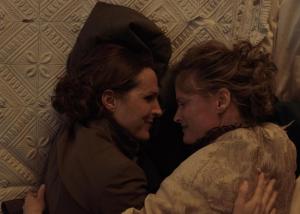 posthumously, a narrative was created about her that has ever since called her a recluse, a virgin, a socially awkward spinster, which are all words attributed to women who just didn’t fit the mold. In reality, Emily had a passionate love affair with her brother’s wife, Susan. Many of her fieriest poems are dedicated to her – and name her. Traces of their relationship were of course literally erased from history in order to sell her poems to a conservative market. Dickinson was a woman ahead of her time in so many ways and this movie’s ambition is to have us reconsider the things we think we know about her.
 film, Simon (Nick Robinson) has that stolen from him. Another kid, Martin (Logan Miller), learns his secret and exploits it, uses it to blackmail him for his own ends. Which, okay, further illustrates that everyone in high school is desperate and scared and going through something. But saving yourself should never be at somebody else’s expense. Unfortunately, that’s a lesson both Martin AND Simon will have to learn, because to protect his secret, Simon makes some bad choices that will hurt the very friends who will love and support him if and when he does choose to be out.
 ASSHOLES WATCHING MOVIES