Tag Archives: Streaming on Netflix

MILF

Three middle-aged best friends are on vacation, more or less. They have left behind children, lovers, and burdens to spend some quality time together, although they may not all agree to which degree they are technically vacationing. Elise’s (Axelle Laffont) daughter is spending time with her father, Sonia (Marie-Josée Croze) is planning to meet her married lover in Spain, and Cécile (Virginie Ledoyen) is hosting them at her former family home. She hasn’t been there in 3 years but finally intends to clean it up and put it up for sale. She has mourned her husband and will now mourn the house. Elise and Sonia, however, are a little more open to fun.

In between packing and dusting, Elise and Sonia lure Cécile to the beach where they catch the eyes of some handsome young men who are leading a junior sailing expedition. Desperate to be noticed, Paul (Waël Sersoub) deliberately capsizes a child in his care so he can showily strip off his shirt and engage in some heroics. Most seasoned ladies would be wary if not downright insulted by such an obvious pick-up scenario, but Elise and Sonia are at least down for some harmless flirting. When they are spotted by the same guys at a club later that night, it seems like the vacation god Tequila is determined to make a match. Elise pairs off with Paul, while Sonia, still waiting to hear from her married boyfriend, spends time with shy and sensitive Julien (Matthias Dandois), who is easily smitten. The next day the boys bring a third friend for the ladies’ third friend, though Cécile, who is already scandalized by the age difference, is horrified to recognize Markus (Victor Meutelet) as her children’s not-so-long-ago babysitter.

The world has long since come to expect May-December romances and is usually fairly tolerant of them, so long as the December is male. In this case, the ladies are the more mature (and for their sake I feel compelled to point out that the boys are April-ish at best, and the ladies are perhaps late August to mid September). Is such an age difference the end of the world? Surely not. Has it the makings for an exciting summer fling? God yes: boys in their 20s are in their sexual prime – athletic, energetic, full of lust and dripping with stamina. Nearly a perfect match for a woman in her mid to late 40s who is just now hitting her own sexual peak; unburdened by the fertility aspect, she’s learned what she wants and how to get it. There may be fireworks in bed, but considering how women already mature faster than men, can this dynamic really work outside of the bedroom? MILF doesn’t really have an answer. It lacks purpose, and frankly, even passion. When Stella got her groove back, both Angela Bassett and Taye Diggs brought the heat. Their Jamaican romance may be partially responsible for global warming. MILF doesn’t come close, except as a cautionary tale for young men to get the fuck off of YouPorn before it ruins you for good.

The movie thinks MILF is a compliment (as opposed to cougar, which suggests that the older woman is purposely hunting), but for most of us, it leaves a bad taste in the mouth, and even isn’t accurate since one of the women isn’t even a mother.

Axelle Laffont’s direction isn’t particularly inspired, a fine pairing for a decidedly lacklustre script, though it must be said that she’s certainly not afraid to objectify her own body through a camera lens. There was no need to convince us: these 3 ladies are hot and could believably land any man they wanted. What of it? Well, no one’s really thought much beyond the sex, and if nothing else, these experienced ladies should have known better.
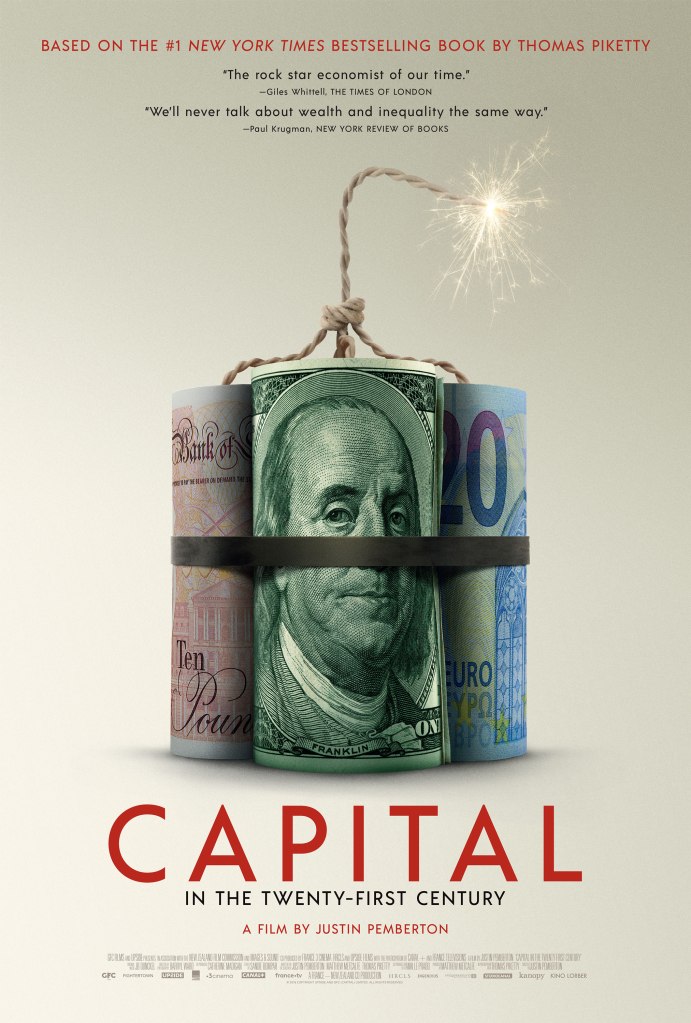
Capital in the Twenty-First Century

We’re fucked.

We’re fucked we’re fucked we’re fucked.

Capitalism is a no good very bad thing and we’ve rather negligently allowed a very few elites to accumulate all of capital. And land and resources and everything! We’re fucked. We’re fucked we’re fucked we’re fucked.

We are rapidly heading toward the old 1% aristocracy vs. your unwashed masses in a very real and alarming way, and may I remind you that the unwashed masses were dying of dysentery in the streets. We are fucked.

The middle class is disappearing. Or has perhaps already disappeared and we’re not willing to admit it yet. Upward mobility is nearly impossible. Parents can no longer guarantee a better life for their children.

Meanwhile, the very rich amass fortunes that are so vast they’re meaningless. They avoid paying taxes, which means countries have fewer resources to provide safety nets for the rest of us. And then that wealth is inherited by the next generation, keeping it out of the economy and out of the hands of those who actually worked to earn it. Every year, owners take a bigger and bigger slice of the profits while the labourers receive less and less. There is no way to get ahead. Debt is rampant, home ownership declining; we only just started to climb out of the 2008 recession and now thanks to a pandemic, we’re likely to face another. Minimum wage frontline workers risk their lives to keep society functioning while corporations race to monetize a cure.

We’re fucked. If you want to better understand just how fucked we are and who exactly to blame, watch Capital in the Twenty-First Century on Netflix.

.

Color Out of Space

1. Do you like horror movies? If yes, proceed to #2. If no, proceed to Becoming, a documentary about Michelle Obama that will fill your spirit with hope and strength.

2. Do you like b-horror movies? Perhaps not super low budget, technically, but definitely campy, outrageous, and grotesque. Not going to be mistaken for Ari Aster or Jordan Peele. If yes, proceed to #3. If no, proceed to The Invisible Man, a horror that’s both smart and well-acted.

3. Are you okay with body horror (defined as: intentionally showcasing graphic or psychologically disturbing violations of the human body)? If yes, proceed to #4. If no, proceed to Knives And Skin, a film that mixes fear, desire, and deadpan black comedy.

4. Are you cool with unexplained supernatural or paranormal events? If yes, proceed to #5. If no, proceed to Dead Shack, an ode to 80s slashers and practical effects, it’s a fun, severed-tongue-in-cheek horror that’s been underappreciated.

5. Do you think teenage girls who complain about their rural address and long for fast food but ride barefoot on a horse dressed like Robin Wright in Princess Bride are a) confusing, probably badly drawn characters, or b) exciting and full of intrigue? If a), proceed to Gwen, a spooky and haunting story about a no-nonsense teenager. If b), proceed to #6 and I promise, no follow-up questions even though I have many.

6. Are you comfortable with toxic parent-child relationships? If yes, please proceed calmly to #7 without making eye contact with other readers. If not, feel free to enjoy Game of Death instead – a horror so good it’ll make your head explode!

7. On a scale of 1-10, what is your tolerance for Nicolas Cage gone completely gonzo? If you answered anywhere from 1-8, please check out Prevenge, a film that is daringly transgressive. If you’re sure you can handle a fully bonkers Cage, please see #8, but be prepared to put this in writing.

8. Repeat after me: I, ______________________ (please say your name out loud for the witnesses), do swear not to hold Jay personally responsible, or AssholesWatchingMovies.com generally responsible, if Nicolas Cage adopts and then loses and then finds and then loses and then picks up and then discards an accent that makes no sense, or if he goes completely apeshit on some innocent produce. If you have solemnly taken this oath, you may proceed to #9. If you can’t do it, and I don’t blame you one bit, check out The Orphanage if you got this far and you want a good scare without Nic Cage Nic Caging all over the place.

9. Do you love alpacas? Do you mildly like alpacas? Do you feel fairly neutral about alpacas but wish them no harm? The Cleanse, a horror about loneliness and poop, may be a better choice for you. But if you’re like: “Fuck alpacas!” then by all means, proceed to #10.

10. Wow, okay, you’re still here. Maybe you deserve this movie. I’m partially joking here. This movie is actually well-received by people and critics who are receptive to this kind of thing: a highly stylized, super weird, fairly pulpy, crazy hokey, occasionally downright goofy horror movie that is totally unique, and perhaps fated for cult status. If you’re dealing with any lingering doubts at all, there’s always Zombeavers. Yes, it’s about zombie beavers, but I assure you they’re considerably less ridiculous than Nicolas Cage in Color Out Of Space. But if this is your thing, by all means, have at it. For your efforts, I bestow upon you the following honour.

Trauma Center

Madison Taylor (Nicky Whelan) is having a heck of a day. First she has the misfortune of walking in on a murder in progress, and then she takes a bullet to the leg in the crossfire. She wakes up in the hospital with dependable Lt. Steve Wakes (Bruce Willis) assigned to her protection; she is a key witness to the crime. But Wakes leaves almost immediately, and sure he’s doing his job “solving the murder” but he’s kind of “a really shitty protector” since he LEAVES HER ALL ALONE. So of course the murderers seize their opportunity, and now poor Madison is limping away through the halls of a locked down hospital, desperately trying to evade some very bad guys who, ironically, would very much like to shoot her dead. I’m calling it ironic because the reason they want her dead is because the bullet in her leg is evidence of their crime, so they want to plug her with a few new ones, but scoop that first bad boy out, because some dirty cop went and pulled his service revolver during a crime and that shit is traceable.

Three things to know:

He doesn’t look half as baffled as I feel. Believe me.
  1. The hospital is on “lockdown” which basically just means that the exits have been sealed off. It is still a functioning hospital, at least upstairs, where Madison’s little sister is a patient (panic attack? asthma attack? something like that). Madison and her stalkers are mostly in the basement, which has an abandoned, horror movie feel.
  2. Lt. Steve Wakes has abandoned his post, and the basement obviously gets very poor cell service. But can he even be trusted? The criminals are cops and trusting one of them, especially a flake, is a lot to ask of a woman who’s got police force ammunition buried in her flesh.
  3. Steve Guttenberg plays a doctor. That’s actually not at all important, it’s a blink-and-you’ll-miss-it part. You’d call it a cameo if he was at all famous anymore, but in his case it’s probably better called a “bit part.” But still: Steve Guttenberg! If you’re at all prone to pity spirals or second hand shame, do NOT read his IMDB page.

Anyway, the killer cops just basically hunt her in some creepy medical settings, unsuccessfully enough to really stretch the bounds of credibility, while Whelan does her best to look sexy in a hospital gown.

Bruce Willis is…not good. His character is MIA for a good chunk of the movie and he’s still remarkably bad. I blame Die Hard, really. It convinced Sean to always bet on Bruce, and he always does, and somehow I’m the one who always loses. Does anyone even remember the last time he was good? Please get back to me ASAP – my Netflix queue depends on it.

Replicas

Neither critics nor audiences seem to like this one much, but everyone’s game to give it a try because Keanu Reeves is in it. Should you?

Replicas is a sci-fi film, not unlike Altered Carbon in terms of the science, but very much different in terms of the fiction. In the future, a dying person’s “self” (the content of their minds) can be uploaded to a server, and then downloaded into another body. Keanu plays William Foster, a brilliant scientist trying to make that concept workable at a secret facility in Puerto Rico. The upload and the download both go well, but the robotic bodies always seem to reject the process, sometimes even destroying themselves in the process. He’s been working on this for a while, but if his breakthrough doesn’t come soon, they may lose their funding. Even so, William opts to take his family on vacation – after all, he has asked wife Mona (Alice Eve) and their three kids to uproot for him, but he hasn’t been around much. So of course he accidentally kills them all in a terrible traffic accident that very night. In a grief-crazed panic, he calls fellow researcher Ed (Thomas Middleditch), and forces him to quickly upload all 4 of the recently deceased. William knows that the download into robot bodies isn’t viable, so he guilts Ed into using his own area of research to help: human cloning. And as if having a whole family of secret clones isn’t difficult enough, they have to steal very expensive lab equipment to do the job, and then lie about their success to their boss.

This premise is loaded with potential, and the film contains lots of threads that justify anyone choosing this material. So why don’t we like it?

In part, something researchers call  “uncanny valley” which basically posits that as robots become more human-like, we go from admiration to revulsion. Anything that we know is unreal, but seems real, makes us feel a bit uneasy. And now William’s living in a whole house of them – very good copies of his family, but copies nonetheless, and not entirely perfect either. As humans, we have a natural revulsion to this. 2001’s Final Fantasy: The Spirits Within had ultra-realistic human animation, and suffered defeat at the box office. Steven Spielberg’s A.I. made some serious money, but the movie creeped out both audiences and critics, some of whom have since revised their originally ambivalent reviews. But still: this stuff makes us uncomfortable, and usually for good reason.

The uncanny valley isn’t Replicas’ only problem though. Ultimately, its own ambition topples it. The first half sometimes feels a bit silly, and William’s choices are consistently problematic. Of course we’d all like just a little more time with our lost loved ones, but William takes it to extremes, and drags his buddy into the mess with him, which is a lot to ask of a coworker who only ever consented to looking after a fish.

The uneasiness generated by a family that now consists mainly of the undead (not zombies, but kinda definitely zombies) would do better in a horror film, but instead director Jeffrey Nachmanoff commits to a family drama but can’t quite make it work. And there was plenty to work with: grief, survivor’s guilt, basic human existential questions of identity of self – but instead Nachmanoff gets bogged down explaining imaginary science as if this was a term paper and not a piece of entertainment. Keanu manages to stay serious even whilst wearing the silliest hat of the future AND waving his hands in the air like he just don’t care, but the script goes from suspicious to limp and I’m pretty sure the director was in the can for the entire back 9. Replicas does not work well as a movie, but it does star the internet’s boyfriend, and for his presence alone, I bet people will continue to watch.

The Show Must Go On: The Queen + Adam Lambert Story

By the early 1980s, Queen was one of the biggest stadium rock bands in the world. Their set at the 1985 Live Aid concert is basically the most significant live performance of all time. Queen meaning Roger Taylor on drums, Brian May on guitar, John Deacon on bass, and Freddie Mercury on piano and vocals. Mercury was a flamboyant showman on the stage, an inimitable presence with an incredible voice. When he died in 1991, the band more or less died with him; his bandmates were his friends, and they needed to mourn him away from the music.

I can’t remember when I was first aware of Queen because I was born into a world already obsessed with them. I remember being in my mom’s van and hearing the telltale bassline of Under Pressure and being mad, SO mad, when it turned out to be “that old song” by Queen, and not Ice Ice Baby by Vanilla Ice, a flash in the pan hip-hop monstrosity that sampled from Queen/David Bowie without crediting them. Imagine being disappointed by Under Pressure. Imagine. I have been atoning for that musical folly ever since.

I have probably never been to a hockey game that didn’t play We Will Rock You at least 5 times. As a kid I probably thought it was specifically written for hockey. But in 1992 the band got an even bigger boost from a different Canadian export, Mike Myers. Wayne’s World was released just a few months after Mercury’s (AIDS-related) death, and the studio begged Myers to go with a Guns N Roses instead, but Myers was insistent. The film propelled Bohemian Rhapsody to #2 on the charts 17 years after its first release. Mercury saw the head banging scene before his death, found it hilarious, and approved the song for the film’s use. It was a nice way for new fans and old fans to appreciate Queen once again. Just two months later, in April 1992, the remaining Queen members put on a benefit, The Freddie Mercury Tribute Concert, to which 1.2 billion viewers tuned in (they made the Guinness Book of Records!). Performers including Robert Plant, Elton John, Annie Lennox, George Michael, and David Bowie performed alongside the original members, and they raised over £20M for AIDS charities.

This would prove a wise and prophetic move: Queen never tried to replace the irreplaceable Freddie Mercury. When they were ready to perform again, they performed as Queen + ________. John Deacon retired in 1997, but a new Greatest Hits (III) album was released in 1999, Queen + Wyclef Jean on Another One Bites the Dust, George Michael on Somebody to Love, and Elton John on The Show Must Go On (among others). And beginning in 2005, they toured + Paul Rodgers. Fans could enjoy the music they loved without feeling their Mercury had been replaced. May and Taylor could play again, in tribute to their friend of course, but also because this was their music too, their passion.

In 2011, Queen began playing with American Idol loser, Adam Lambert (that year’s winner, Kris Allen, has long since been forgotten – the show has a pretty crummy record: out of 17 seasons, only 2 early winners ever had any lasting success, Kelly Clarkson and Carrie Underwood). But Queen knew a winner when it saw one.

This documentary covers a lot of ground. A LOT. But it’s Queen, so let’s gobble it up. And it’s kind of cool that this iconic band, now consisting of two aging rock stars, can see in Lambert a little bit of their old friend. Adam Lambert is himself a flamboyant showman, but he doesn’t invite comparison to Mercury, which is what makes this union work. He is a confident performer in his own right, and May and Taylor seem re-energized in rediscovering their old hits with him, old hits that, like me, Lambert has grown up just knowing. And though he’s also passionate about his solo work, Lambert knows what a huge opportunity this is, how lucky he is to perform to arenas filled with people. But most of all, it’s just cool to see how things have changed, from Freddie Mercury’s deathbed confession of AIDS, to Lambert being able to perform as an openly gay man. Many great bands continue to tour long past their prime, eventually becoming a sort of cover band of themselves. Queen, however, has lasted because it’s been open to change, it has evolved. They never wallpapered over their past. They knew they had a once in a lifetime thing with Freddie, but they also admit they’ve somehow found it again with Lambert.

Can’t get enough? Join the conversation on Youtube!


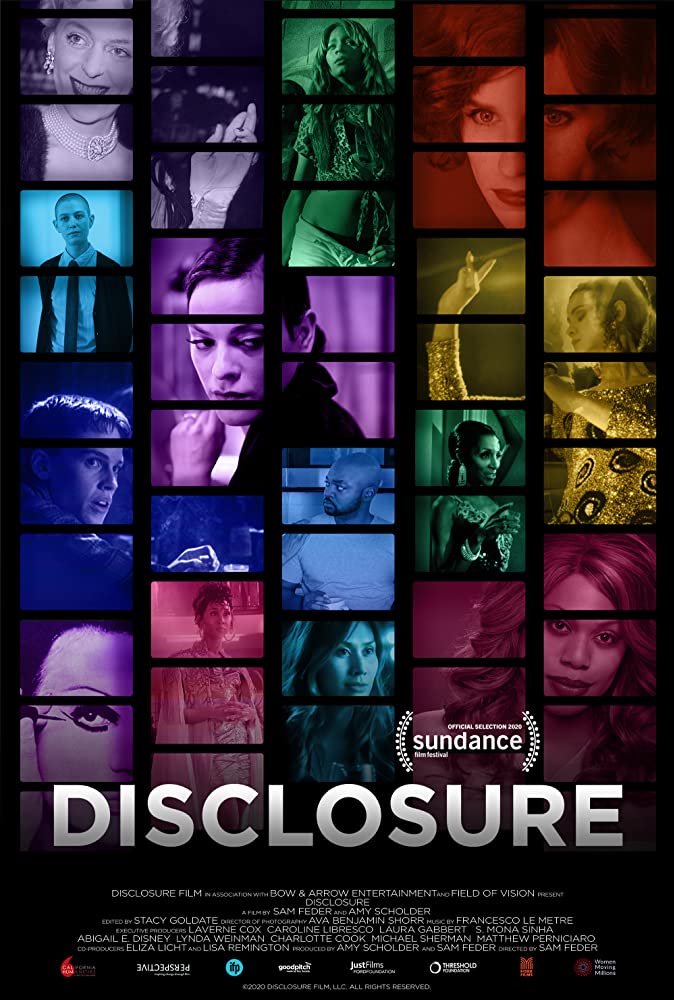
Disclosure: Trans Lives On Screen

Disclosure gives us an in-depth look at Hollywood’s depiction of transgender people and the impact those stories have had not just on a transgender lives but on American culture as a whole.

Director Sam Feder puts together a documentary of enormous value, not just because of the breadth and depth of its interview subjects (actors certainly, but also historians, researchers, activists and more) but because this film acts as a valuable resource for cis-gendered people to learn and reflect more on the topic without burdening the trans community. Often we lean on minority communities to teach us how to value and respect them when we should be doing the work ourselves. Feder has generously accounted for our laziness and apathy and has made this easily-digested anthology on trans representation widely available through Netflix. No excuses: just watch it.

Let trans people tell you how it’s felt to grow up watching what few transgendered roles there are be of trans people being trafficked, raped, beaten, and murdered. And yet still they were grateful just to know that somewhere out there, someone else felt like them. Or what it’s like to see cis-gendered people playing trans-gendered characters, perpetuating the notion that some sort of trick is being played, or that gender is a kind of performance. And how important it is just to have any kind of representation at all, since the vast majority of us either don’t know someone who is transgendered, or don’t know that we do – and this includes most young people growing up who are trans themselves. Movie and television characters, however, come into our homes and our consciousness, so we need to get them right.

This documentary could easily shame me for not asking the right questions, not saying the right things, not knowing the right people. Instead, it just allows us to be a part of the conversation, to start thinking in the right direction, to start noticing the gaps, and to meet some people outside of our normal circles. They have every right to be angry and yet Feder and company flood us with hope and optimism. They show us the path forward with respect and dignity, and the very least we can do is take that first step.

Join us on Youtube for further discussion.

The Courier

Ezekiel Mannings (Gary Oldman) is a very bad man. His job title is literally “crime lord” on his business cards (okay, the business cards are unseen in his wallet but I’m SURE they’re there) and he’s awaiting trial for what I’m also certain is just a small fraction of his many crimes. Or perhaps I should say he is not awaiting trial so much as the trial is waiting to hear from one key witness – Nick Murch (Amit Shah) – whom a federal task force has been protecting so he can deliver his crucial testimony, ie, he saw Ezekiel Mannings murder someone right in the head.

You don’t need to see Mannings’ business card to know he’s a bad guy: he wears an eye patch. Which is a statement. Of Evil. I’ve known a few people without a full set of eyes and they’ve never elected to go with the patch. Glass eyes look surprisingly good if you’ve got a socket that wants filling. The only eye patch I’ve ever seen in real life is the little band-aid coloured ones that kids sometimes wear to help correct a lazy eye, and those are quite adorable and definitely don’t count. I’m talking all-black, special ordered from the pirate store, cover of Evil Monthly magazine, doubling down with a goatee, eye patch.

Nor do you need to see Nick Murch’s business card to know that he’s a nerd. Probably an IT guy. He’s nervous and jittery, and his outfit has definitely not been approved by a woman. I mean, he’s got reason to be nervous and jittery. He IS about to testify against a really bad dude, and the whole case basically hinges on him as a witness. But before he can video conference in (from an unspecified European location), a courier (Olga Kurylenko) arrives at the safe house to deliver a package. Spoiler alert: it’s a bomb. A lot of people die, and someone’s even trying to kill her, but instead of fleeing for her life, she volunteers as Nick’s defacto bodyguard and personal protector. Basically, she and Nick end up fighting for their lives in an underground parking structure, and they’ll have to do it for an hour before the cops arrive (why an hour? who knows. but it’s a great little conceit to put some real-time pressure on the situation). Agent Bryant (William Moseley) and his sniper (Greg Orvis) are particularly persistent.

Is this a good movie? No. We never get a satisfying explanation for why this nameless bike courier would stick around to fight a fight that isn’t hers. Or why she’s so darn good at it; “military” hardly covers it.

The violence is…extensive. As in face caved in. As in literal terminal velocity when a body hits a brick wall so hard the skull cracks open like an egg. As in any foreign object with a somewhat pointed end will soon be lodged in someone’s body cavity. And the victim will always agonizingly pull it out, with a flourish of spurting blood. This became such an odd pattern I started chanting “pull it out!” pull it out!” and they always did, even when it was a 3 foot metal rod through the throat.

And to even out the odds, the bad guys were of course prone to soliloquizing, always pausing for one last smug speech just long enough for the heroes to once again narrowly escape certain death. The brutality was so unending that I didn’t really care which side won as long as everyone just stopped getting up. And also: what’s up with this parking garage where a gun battle to the death can be staged for over an hour and not a single person even ran to their car for a stick of gum? I’m suspicious.

Now there is some merit to a movie with mindless violence, I suppose. A time and a place for it, at any rate. But this wasn’t so much mindless as mind boggling. Turns out the eye patch was the least of my worries.

Dying to know more?

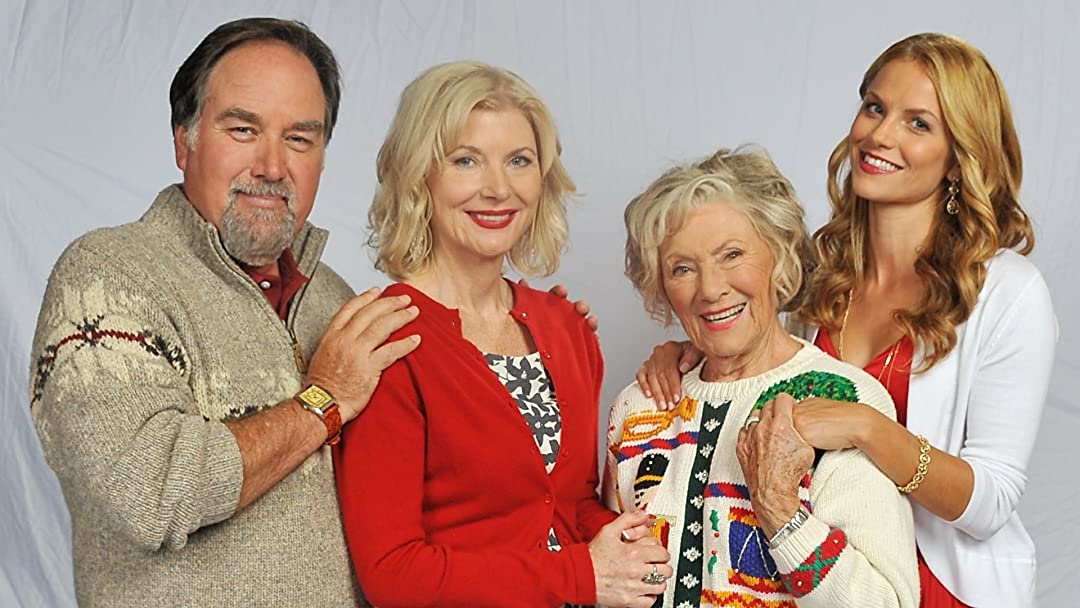
A Perfect Christmas List

Never say a dying grandma can’t milk her last breaths for all they’re worth – Evie (Marion Ross) certainly does. Recently discharged from the hospital, she’s laid up in her daughter’s home, and with granddaughter Sara (Ellen Hollman) home for Christmas too, she schemes to reconnect the estranged mother-daughter duo with the perfect Christmas list. Will it work? And will grandma still be around to see it?

Evie’s list has some fairly banal items for Sara and mom Michelle (Beth Broderick) to cross off together: bake cookies from scratch, cut down a real tree, do some work for charity. Typical stuff. Normally they’d be triggering each other left and right and tearing each other’s hair out, but with grandma’s imminent death hanging over them, their usual bickering seems trivial and they’re managing to mend the rift.

Don’t worry, don’t worry, there’s a little wiggle room in there for romance. Grandma’s hot doctor makes house calls. Dr. “call me Brandon” Reed (Aaron Hill) is, like so many men in holiday romances, almost too good to be true. He’s an attentive doctor but he’s also Mr. Fix It, working a side gig as a handyman to make spare cash for an orphanage where he spends all his free time. His only flaw is that he buys bacon flavoured butter, and let me be clear, that’s not necessarily a flaw in my book but in Sara’s, and clearly it’s not a deal breaker for her either.

A Perfect Christmas List deviates slightly from the normal formula in that its main focus is on the three generations of women, and repairing a broken relationship before it’s too late. These types of movies often espouse family values, and they always make sure the heroine has interests and friends outside of her romantic relationship, which is kind of refreshing if you think about it, and very nearly (dare I say it?) feminist. She’ll always have a best friend, or a close coworker, or a solicitous sister, or a mother she doesn’t go a day without calling, and she doesn’t drop them just because she met a man. And the holiday romance man is not only okay with that, he actually likes your mouthy best friend. He checks on your mom. He fits in seamlessly with your family. Dr. Brandon has a crush on Sara but understands that she’s making time for family right now. And when she does have a free moment, he doesn’t jump to her beck and call, he honours his commitment to the orphaned children and trusts that Sara will wait. Call it corny, call it idealistic or even unrealistic, but let’s also think about calling it GOALS.

Da 5 Bloods

The Vietnam War. Yeah, we all flinch at the words. As a Canadian, I actually didn’t learn about this in school as we were “non-belligerent” (what a term!) (also, we were busy learning about our contributions in WW2, a war America remembers fondly by screaming at random Europeans “we saved your asses!” but Canadians remember as the war we joined immediately because we “thought Nazis were bad” and America ignored for two whole years because “Nazis were maybe okay” and finally joined when “something bad happened to us, on our soil.” Ahem) and I was born long enough after it that there was already a hit Broadway musical about it. But we can’t help having absorbed quite a bit about it, through pop culture of course, and by sheer proximity to our war-mongering neighbours to the south. I knew that it was a tough war because many Americans came to oppose it, which was probably the right attitude, but it meant that a lot of returning vets didn’t get the respect they deserved or the help they needed – which is an American hallmark, actually, by no means exclusive to the Vietnam war. And I knew that bad shit had happened there: we called it the My Lai Massacre; the Vietnamese call it the Son My Massacre, but either way you slice, it meant that 500 unarmed civilians – men, women, children, babies – were slaughtered by U.S. soldiers. Women were gang-raped and their bodies mutilated, as were children as young as 12. When their cover-up was eventually busted, 26 soldiers were charged with criminal offenses but only Lieutenant William Calley Jr. was convicted. Found guilty of killing 22 villagers, he was given a life sentence but served only three and a half years under house arrest. And for me, the Vietnam war was oddly muddled up with hippies and their peaceful sit-in protests and with civil rights and their peaceful marches. And historically, that’s correct. Some were putting daisies into guns for peace and others were being sent to war, and those things were happening concurrently but not equally. Young black men were being sent to Vietnam in disproportionate numbers while young white men could easily avoid it simply by attending college: Bill Clinton deferred once for college, Joe Biden and Dick Cheney each deferred 5 times. And if staying in school indefinitely wasn’t your bag, your wealth and privilege could work for you in other ways; Donald Trump avoided the draft 4 times with educational deferments but the 5th time Uncle Sam came calling he out and out dodged it – his father called in a favour from a Queens podiatrist who wrote up a false diagnosis of “bone spurs” even though he’d been found physically fit to fight just two years prior and has since said it just “healed up on its own” with no treatment necessary!

Anyway, black civil rights leaders, including Martin Luther King Jr., were opposed to the war for exactly this reason. Once again, black men were being asked (well, told) to serve their country, and there weren’t any colleges or doctors writing bogus deferrals for them. They were asked to protect the freedoms of people in other countries when they still didn’t have that at home for themselves. They were called up in greater numbers of course, and were a higher proportion of combat casualties in Vietnam, and African American soldiers encountered bigots in their ranks, discrimination in the field, disadvantage when it came to promotions and decorations, and fewer services if and when they returned home. That’s a whole lot to untangle, but have no fear: Spike Lee is reaching back into the baggage of his righteous anger, and he’s not afraid to tackle these iniquities.

In Spike Lee’s Da 5 Bloods, Norman (Chadwick Boseman), a soldier in 1970s Vietnam, tells us “War is about money. Money is about war. Every time I walk out my front door, I see cops patrolling my neighborhood like it’s some kind of police state. I can feel just how much I ain’t worth.” Spike Lee always ends up sounding prescient in his films, but his trick is simply having the temerity to acknowledge that the patterns in our shameful history march on today.

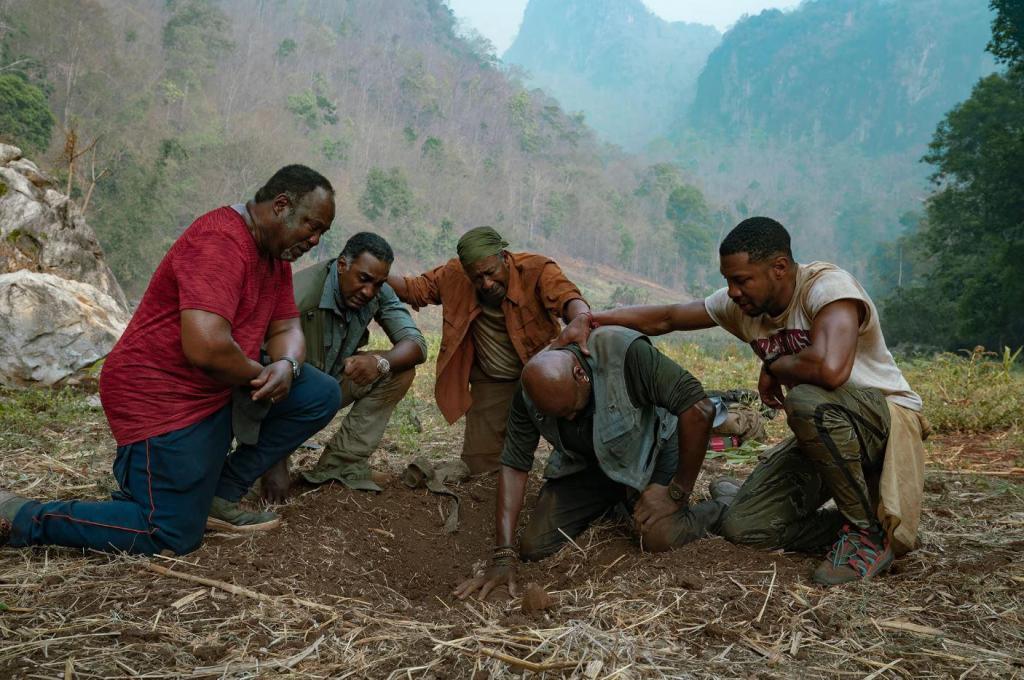
Many years later, four Vietnam vets, Paul (Delroy Lindo), Otis (Clarke Peters), Eddie (Norm Lewis), and Melvin (Isiah Whitlock Jr.) return to Vietnam to repatriate the body of their fallen comrade and 5th Blood, Norman…and also the pile of gold they stashed along with him. Now surely worth millions of dollars, you might guess that this buried treasure is not going to bring out the best in even the most devoted of brothers in arms. Greed, guilt, nostalgia, regret – these we understand, but Paul’s motivation is particularly murky. Unabashedly sporting a MAGA hat, prone to racist outbursts, he’s convinced himself that he’s doing this for Norman’s honour. But propelled by fury, by a barely-restrained rage for the many ways he and his African American servicemen were vilified for their role in Vietnam, that pile of gold bricks starts to feel like reparations. And this recovery mission starts to feel more like one of revenge – against an enemy that Paul can no longer distinguish.

Delroy Lindo’s performance is the sun around which all the other planets orbit, and like all bright balls of fury, Paul is flirting with supernova. And for his part, Spike Lee has of course never been known for his reticence. As a director, he’s prone to flourishes, allowing Paul’s stream-of-consciousness mutterings to morph into a rousing monologue, staring down the barrel of the camera, staring us down, charging us with his passion and urgency. Lee splices the story of his 5 Bloods with real life footage – Muhammad Ali’s conscientious objections, the Kent State massacre, the Black Lives Matter movement (yes, his film is once AGAIN that prescient, he’s taking the pulse of America right from the jugular, right from its crushed windpipe, his alarm and his agitation a perfect reflection of today simply by being unafraid to hold an honest mirror up to the ugliness of yesterday). His script stresses the cyclical nature of the violence without letting anyone off the hook. Spike Lee’s strength as a filmmaker has always been his point of view, his authorial voice resonating backwards and forwards through time, the immediacy of his plea undiminished.

Da 5 Bloods is as potent as anything Spike Lee has ever done, and possibly the boldest feather in Netflix’s cap. The film is visually arresting, the aspect ratio in constant flux as we travel through time (and our four main actors embody their characters in both timelines, a choice I can only assume is deliberate since Netflix has proven willing to splash out for de-aging, perhaps a nod to these men wanting and needing to believe they are still heroic, still capable, still virile, or a symptom of having glorified the time in their heads, and wanting to recapture that now, before it’s too late). But most of all I admire Da 5 Bloods as an allegory for reparations. Not even an allegory, really, but a template what financial amends might look like and how we can begin to take the next steps forward.