Tag Archives: strong female leads

Suicide Kale

Moral dilemma: one couple hosts another for a pleasant, mostly-vegan dinner party, and a little light snooping on the part of the guests turns up a suicide note.

What to do, what to do? Obviously the visitors, Penn (Lindsay Hicks) and Jasmine (Brittani Nichols), themselves a newish couple, are concerned for their friends, who up until now have been role models for a happy relationship. But you can’t be blunt about a note you just stumbled upon, can you?

BillieAndJasmineThe brilliance of this film is that it makes you question what you would do, and it challenges our notions of propriety.

The quality’s a little wonky. It doesn’t quite have the production values you might hope for, and during the dinner scene the camera jitters around so much I had to look away to settle my stomach. Luckily, the conversation is jaunty and captivating enough to conquer some of the flaws. It flows authentically, and you’ll feel like they should have set a 5th place setting for you, the guest who definitely would have went for some wine.

The trick is that there’s a subtext that we’re aware of but not everyone at the table is. PennJordan and Jasmine know a dark secret and are steering things to play sleuth. Billie (Jasika Nicole) and Jordan (Brianna Baker) know that something’s up but the note is the furthest thing from their minds. They’re just trying to navigate this incredibly uncomfortable encounter – and we’ve got front row seats!

So it’s noticeably an indie, but it’s also smartly written and well-acted and I’m very glad I gave it a chance because it’s quite endearing, and an interesting little slice of life.


This review first appeared on Cinema Axis as part of the Inside Out film festival coverage, a festival dedicated to showing LGBT movies.

Clouds of Sils Maria

To be honest, I watched this movie some time ago, it’s just that writing about it in any meaningful way was a little daunting.

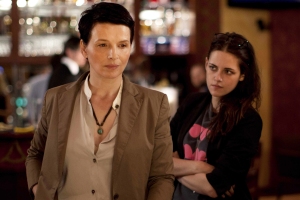
It’s about an actress, Maria (the fabulous Juliette Binoche), who has had a CLOUDS OF SILS MARIAlauded career after being launched in the theatre playing Sigrid, a sizzling ingénue. Now, years later, the playwright and her mentor has died, and there’s interest in re-staging the play, and Maria is approached to star. The catch? This time she’d of course be playing the role of the older woman, Helena, in a complicated May-December lesbian office unrequited romance (whoa, that’s a mouthful).

Should Maria take the role? Initially she declines. She finds the older character to be a bit pathetic, too much of a doormat. But the director is tenacious and Maria is not exactly afraid of a challenging role, so she accepts. She retreats to a remote chalet with her personal assistant (Kristen Stewart) and they begin rehearsing the play, only in the rehearsing, Maria again grapples with her distaste for the weakness of the character, and must face her own feelings about aging.

Chloe Grace Moretz floats in as the scandal-prone Hollywood It Girl who is to play the younger woman. She flatters Maria with fandom but ultimately plays the role much differently than Maria did, which further drives Maria to feel obsolete, and to wonder if this older character is perhaps an uncomfortable reflection of herself.

Clouds-of-Sils-Maria-14I didn’t find the story-telling in this movie to be quite satisfactory, but the performances were top-notch. There’s an intense, almost sexual chemistry between Binoche and Stewart that makes their rehearsals a rare treat to watch. Not often are two such strong female characters allowed to shine on the screen together with such naked feeling.

Binoche loved the idea of this movie so much that she approached director Olivier Assayas with it and convinced him to write the script as well. In a funny meta twist, Assayas co-wrote the script of Rendez-Vous, which was the film that helped make Binoche a star. Binoche claims she strove for such authenticity that she accepted a brief role in Godzilla just so she could o-CLOUDS-OF-SILS-facebookbelievably deliver a line about acting in blockbusters.

Chanel (the fashion house) stepped in not only with wardrobe but with financing so that Assayas could film in 35mm. The movie does in fact look totally gorgeous, not least because it’s filmed on location in Sils Maria, Switzerland. And Binoche reins over this film with stately grace, simmering jealousy, raging insecurity – every bit of it layered and nuanced to perfection. Maria is dealing with a changing industry and a role that requires alarming introspection, but what Binoche and company accomplish is to make us ask ourselves – are we Sigrids, or are we Helenas?

The Boss

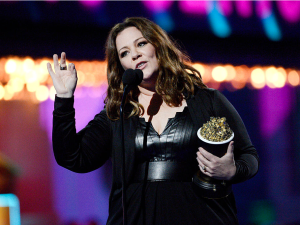
Melissa McCarthy was given the coveted Comedic Genius popcorn statue at the MTV movie awards this weekend, the first female to ever take home the honour. Of her historic status, she said “I am certainly, certainly not the first one to deserve it.”

gettyimages-520353144%20(1)McCarthy is, in fact, a tour de force, and “not afraid to be the butt of the joke” according to her speech (invaluable advice from her mother). She’s a frickin national treasure who keeps making very mediocre movies. What gives?

Paul Feig knows how to handle McCarthy – he directed her to breakout success in Bridesmaids, replicated it with The Heat, and wrote for her beautifully in Spy. But McCarthy keeps sneaking in movies between those triumphs, movies she ostensibly has a hand in writing herself, along with husband Ben Falcone, and those ones tend to crash and burn with big fat flames. That said, Melissa McCarthy has never had a flop. Of her worst-reviewed films, Tammy made $85M, and Identity Thief took in $135M. The Boss will likely nestle among them critically, but it was McCarthy who finally unseated Batman v Superman at the box office this weekend. Someone’s buying tickets.

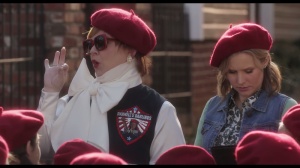
I am buying tickets. I love her. I’ve loved her since her stint on Gilmore Girls boss(and am thrilled that she’ll return for the reboot). But falling in love with her on Gilmore Girls means I like her at her bubbly, beautiful best, not as the slob who falls down stairs. And I tend to think that Paul Feig, and most of the film going public, agree with me. The gags and the prat falls are beneath her. We’re tired of such juvenile physical comedy. She’s already proven that she’s better than it, and capable of so much more.

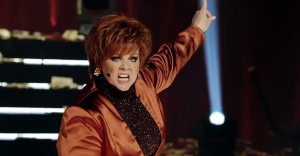
the_boss_melissa_mccarthy_afprelaxI can’t tell you that The Boss is a great movie, because it’s not. It’s totally uneven. But the thing about “uneven” is that it’s not universally bad either. In fact, it gave me the giggles (Her opening number? A delight. She had me at T-Pain). But then she’d get launched across the room again, her face splat against some unforgiving surface, and I’d be shaking my head again.

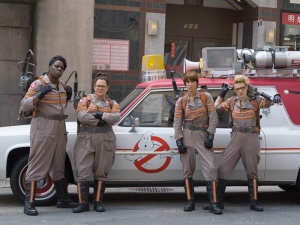
Melissa McCarthy is charming and lovable. She’s got great timing and she recruits some very talented co-stars (Kathy Bates being a particular favourite of mine). She’s not a buffoon, and any movie that attempts to make her into one isn’t going to cut it for me. I needed a little taste of McCarthy to get me through this godforsaken, unending winter (I know it’s spring, but try telling that to my home underneath 3 feet of snow) andghostbusters-1-800 I got it. The Boss is unsatisfying, leaving me doubly impatient for this summer’s Ghostbusters reboot – luckily, with Paul Feig at the helm. I have every confidence that she’s going to deliver exactly what I’m hoping for, and here’s why. The big, brash McCarthy character? It’s being played by Leslie Jones. Melissa taking on a straighter character, and I bet that will suit me just fine.

Testament of Youth

See Alicia Vikander before she was famous, Dominic West in his authentic accent, and Emily Watson being stellar as always in increasingly diminished roles.

Vera Brittain was a real-life independent spirit. She vied for and won a spot at Oxford and vowed “never to marry”, even if those sounded like famous last word when uttered just as a very cute boy enters the picture. Turns out, he has Testament-of-Youth_3141581ka thing for sharp and feisty young women, and the two are a love match and plan to be at Oxford at the same time (unchaperoned, even). But every great love story needs an obstacle and feminism wasn’t enough, so along came The Great War to shake things up.

Tag line: Divided by war. United by love. Did you just puke a little in your mouth?la-et-mn-testament-of-youth-review-20150605

Luckily the tagline writer was an aberration and the film itself is quite good. Vera’s mind expands and excels at Oxford, and no one is less grateful for her education than she. Women still have to prove themselves worthy of degrees and now she’s feeling left behind again, when her brother, her friends, and her love are all leaving for the front. But Vera’s not one to take a back seat – soon she’s giving up her beloved scAlicia-Vikander-as_3141524bhool to become a nurse.

Vikander (who replaced Saoirse Ronan) is every bit the revelation that Ex Machina proved she was. She’s poised and luminous, and while the movie doesn’t contribute much that is new to the war genre, Vikander makes it more than worth a look.

Her The Danish Girl co-star, Eddie Redmayne, also starred in his own WW1 eddieepic, called Birdsong (based on the Faulks of the same name). He plays a young man who goes off to war remembering the affair he had with his French (married) sweetheart. Clemence Poesy is beautiful as ever, but this one may leave you feeling faintly unsatisfied.

Sisters

Sisters-Tina-Fey-Amy-PoehlerThis is not technically a movie that needs to be reviewed. You’ve seen the trailers? You’ve seen the movie. Two people who look nothing alike with their wildly different heights and eye colours still manage to play sisters convincingly. Why? Because Tina Fey and Amy Poehler are real-life sistahs.

The movie’s okay. There are laughs to be had. The script is not what you would call original, and what starts out as a story about two grown women who regress when their parents decide to sell the old family home quickly degenerates into just another party movie (although this one populated by people old enough to know better).

What saves the movie is the remarkable chemistry between its two leads, Tina Fey and Amy feypoehlerPoehler. These women have worked together far longer than we’ve been watching them, harkening back to Chicago’s Second City in the early to mid 90s where they were the only two women in the troupe. A former member of Second City named Adam McKay (who you may remember as the writer\director of MANY of Will Ferrell’s ridiculousest movies) was the head writer of Saturday Night Live in 1997 when he first encouraged Tina to submit scripts. Of course she was hired, and the very sketch she wrote for the show (that made it on air) was a Chris Farley satire of Sally Jessy Raphael – genius, of course. When McKay left in 1999, Lorne Michaels made Tina Fey SNL’s first female head writer.

Fey soon appeared on-camera and became co-anchor of Weekend Update in 2000. Amy Poehler would join her on the sweekend-update-tina-feyhow just a year later, Poehler’s first episode being the first one produced after 9\11. Amy was promoted from featured player to full cast member during her inaugural season, making her only the third person to earn that distinction (joining Harry Shearer and Eddie Murphy).

Fey and Poehler became co-anchors on the Weekend Update desk in 2004, marking the first time that two women held the position. Fey left the next year as her new show 30 Rock began to take off though her tenure would hardly be forgotten; she’s been ranked as the third most important SNL cast member ever, just behind comedy gods John Belushi and Eddie Murphy. This left Poehler in a position to earn an Emmy nomination for Outstanding Supporting Actress in a Comedy Series – the first SNL cast member to ever be recognized in the category. Then she reg_600_GGlobes_Amy_Tina_mh_010213too left SNL to star in her own show, Parks and Recreation. Both women met with tonnes of success, 30 Rock garnering a staggering 112 Emmy nominations over its run, and Parks and Rec giving Amy the opportunity to write and direct as well. Both women won Golden Globes for Best Actress in a television series, musical or comedy, and then went on to host the awards ceremony itself together for 3 of the roastiest, juiciest years running.

They’ve both also written books about their experiences as wives, mothers, and being the funniest people on the planet. Amy Poehler also helped launch Smart Girls at the Party with a couple of her friends, a show that  “aims to help girls find confidence in their own aspirations and talents.” In each episode, Poehler interviews a girl with a “unique talent, community interest or point of view” and if you haven’t checked it out yet, you probably should.

These awesome, barrier-breaking ladies have a long history together, and even if they’re not tumblr_mgjv3h7q6e1qz9qooo2_1280blood, they call each other “chosen sisters” and that’s good enough for me. Screenwriter Paula Pell wrote Sisters with these two in mind, though she may have been imagining them cast in the opposite roles – which is what I liked about Sisters, actually. For once we get to see Tina Fey be all crazy. There’s a heaping helping of vulgarity too, but man does it almost sound sweet coming from the likes of Fey and Poehler. Paula Pell has a process for coming up with altnerative jokes, which the director would pass to the actors on post-it notes so nobody else would know what’s coming. Fey, Poehler, and the rest of the cast, including SNL alums Maya Rudolph, Bobby Moynehan, and Rachel Dratch, are all masters of improv, and that spontenaety was well-used. Paula Pell, mind you, was also an SNL writer, and has appeared on – you guessed it – both 30 Rock AND Parks and Recreation. Smart ladies stick together, and funny ladies keep us coming back.

Whistler, Day 3

Amerika: A documentary about a Canadian grad student who goes over to the Czech Republic (where her parents immigrated from) to Amerika_Poster_A1_Final_ENGdiscover “tramping” and have an adventure. The film fails to introduce us to our two main characters. She, we come to know, is the Canadian, and he…well, he’s just there. No word on how they hooked up or how they came to be travelling together. Tramping is an alternative way of life for Czechs. It’s leaving everything behind and hitting the road, living on the land, sleeping in the open air. Some live like that permanently, off the grid and housed in a forest that feeds them. Others tramp on weekends and go back to their white-collar jobs during the week. It’s an idealized but dying culture, and interesting enough I suppose, but I felt pretty disconnected from the film, and not just because I really loathed the Canadian, applauding silently in my heart when she got dunked into a river. Of course the Canadian was on hand at the screening to answer all of our burning questions (I did not ask “Why couldn’t you have gotten eat by a bear?” or even “Does the Czech Republic even have man-eating animals in its eyoGykp0yNvBPvn587DGIXxXoAML9rVgvLqVvqjdtdkwilderness?”) and it was revealed that the random travelling partner was in fact the film’s director. We didn’t notice that ourselves because he uses a “character” name in the movie. He recruited her for this film and set up all of their itinerary, and arranged for the tramps to be met along the way, the “cast” and crew sleeping in hotels at night while pretending to hike during the day. The whole thing was contrived and while I struggle to call it a documentary, I have no qualms at all about calling it bad.

Angry Indian Goddesses: This one won runner-up for People’s 31190-Angry%20Indian%20Goddesses%20(2015)Choice at TIFF this year (Room nabbed the title) but we didn’t get to see it then and are happy to take it in now. Billed as India’s first female buddy movie, it’s a comedy-drama about the wild, bachelorette-style female bonding rituals enacted after one woman announces her engagement…and then it gets turned on its ear. Actually, that’s putting it too mildly. The shifts in tone in this movie are JARRING. On the whole I really liked this movie. It’s a lot more grown up than what Bollywood usually offers. The women are all compelling and we get to see a side of India not normally presented to us. But when the movie goes dark – and it goes DARK – there’s little warning. It’s pretty abrupt after the hijinks and singing and dancing. So steel yourself. But do see it. There’s not a lot out there like it.

Chasing Banksy: After Katrina, street artist Banksy arrives surreptitiously in New Orleans and leaves behind some mysterious pieces of art on the city’s abandoned, derelict buildings. Anthony, a starving artist in New York, knows that Banksy’s work goes for chasingbanksy_2501upwards of a million, so he plots to track down the artwork and retrieve it. He and a couple of buddies take the road trip of a lifetime to see if they can become rich stealing art. This movie appealed to me because its concept is really interesting. Is art that’s made for the public allowed to be taken by the public? Is it meant to be transitory? Should it be allowed to rot or be demolished? Or should it be preserved, even if preserving it means stealing it? Can you steal something that doesn’t belong to anyone? Does it belong to everyone? And should you monetize art that’s meant to be free? So many interesting questions and this movie just killed me because it failed to really wonder about any of them. It’s not a good movie no matter how you define the terms, and that’s a real wonder since the star and co-writer actually went to New Orleans to steal some Banksy art. Why, then, is he so bad at pretending to be himself?  I’m not sure, but this movie really let me down.

Suffragette

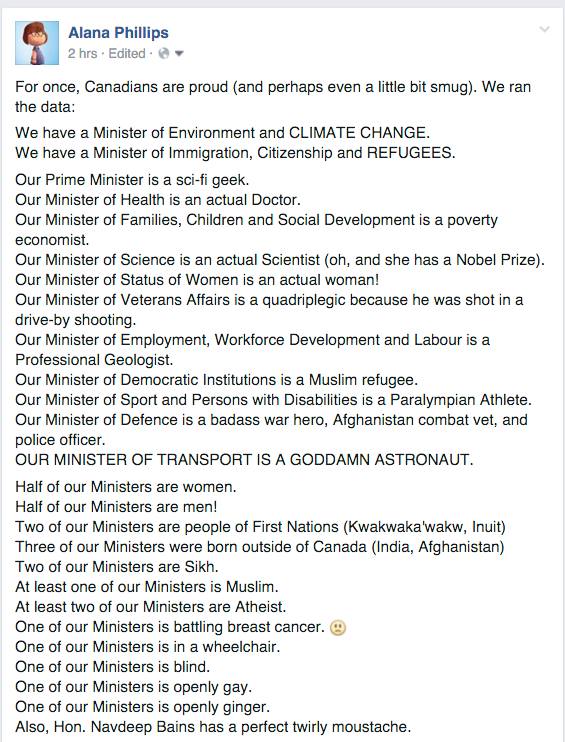
Just a few weeks ago, Canadians voted for “change” and for “sunny ways.” We elected a young Prime Minister with a famous last name and idealism still twinkling in his eyes. He was sworn in last week and presented us a cabinet that among other things, had gender parrity.
jt

That’s right. Half men, half women. So of course the very first question journalists needed answered about this tall list of accomplished people was why “he went with gender equality” in his cabinet. Why? Why did he “go” with “gender equality.” Is that really a question you can still ask this day in age? Okay, you know what – it is. Because sadly, this is the first cabinet to achieve this status. But Trudeau seemed to agree in spirit, answering simply “Because it’s 2015” – a mic-drop response that was heard around the world.

But the fact remains that if a Prime Minister chooses a cabinet that has a representative amount of women in it, he’ll have to answer as to why.

Isn’t that incredible? And incredibly sad?

As you know, the boys were dragging me off to see Spectre this weekend, and James Bond is probably the human embodiment of the antithesis of gender equality. To correct the imbalance, Sean agreed to hit up Suffragette with me first, because he’s a 2015 kind of gentleman, even if his movie idols aren’t.

Suffragette focuses on some of the lesser known but pivotal “foot soldiers” of the early feminist movement in Britain. After 50 years of peaceful protest, the women have amped up their right-to-vote rhetoric and are ready to engage in civil disobedience for the cause.

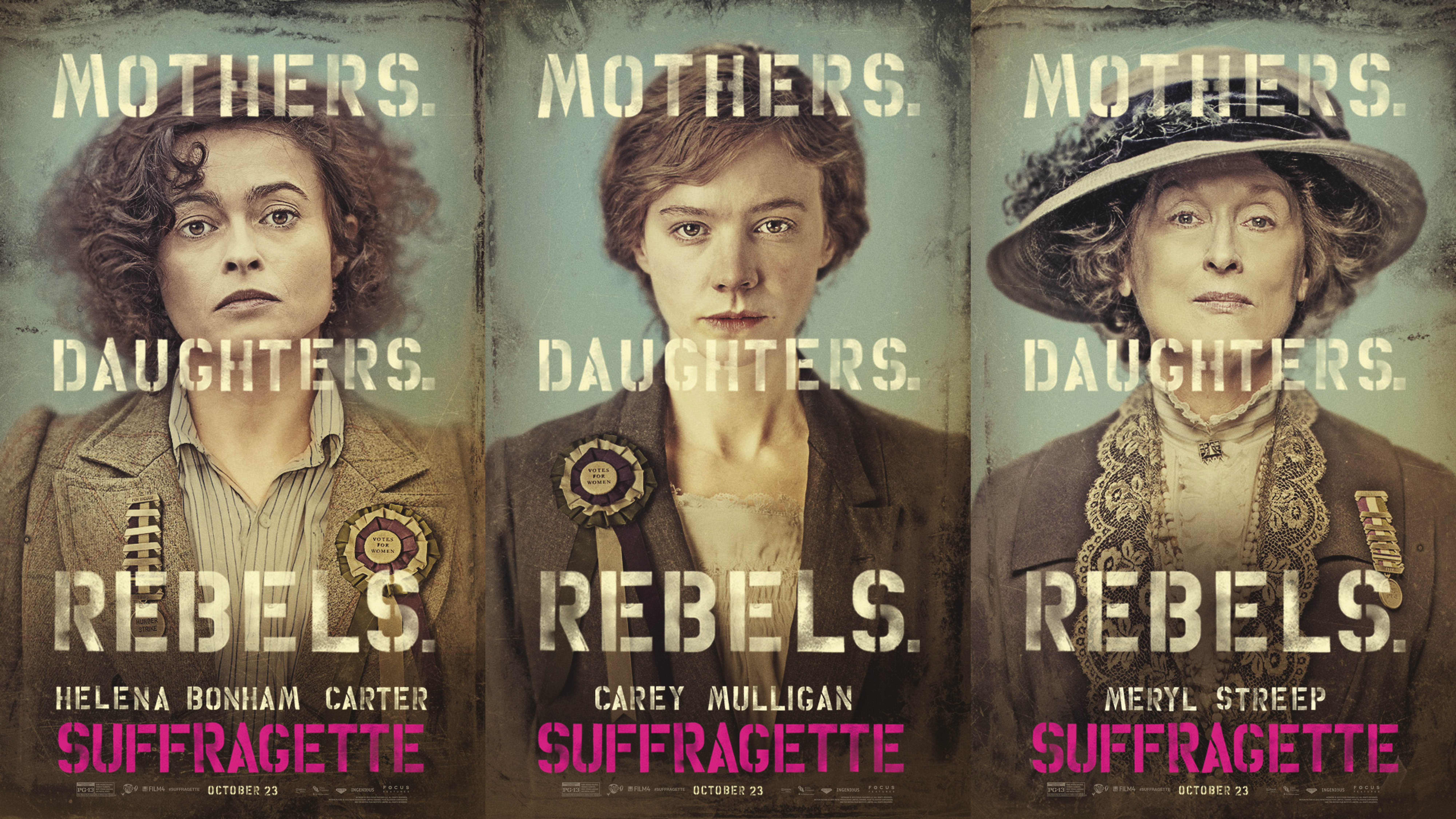
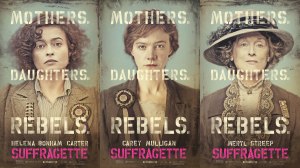
suffCarey Mulligan plays a young woman who was born in a laundry facility and has worked there all her life, working herself raw and having her boss force himself on her just to earn a third what the men take home. And then it goes directly into the pocket of her husband to do with as he sees fit. Not a naturally political woman, she gets dragged into the movement almost unwillingly but once she’s there, you can bet that neither her boss nor her husband are pleased. But it’s the vitriol from her fellow women that’s most upsetting. She doesn’t know her place, and this upsets everyone.

And it’s also enough to have her freedom taken away, and her child too if she’s not careful, so AAantithese are pretty high stakes. The laws are against her – but that’s the point. She is subject to laws she’s not allowed to influence let alone make. Women were property or commodities and laws existed to keep them that way.
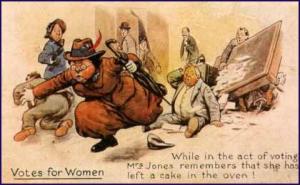
Helena Bonham Carter plays a semi-educated pharmacist who is not only a pillar of her community, but an agitator and grass-roots activist. She’s recruiting and planning things when it’s time to start smashing windows and bombing letter boxes. HBC played her part well, suffragetteinjecting a little back bone into the character while still ultimately being subject to her husband’s whims. Helena Bonham Carter is the real-life great-granddaughter of H.H. Asquith, who served as the Prime Minister of the United Kingdom from 1908 to 1916, during the height of the suffrage movement. He was of course a staunch opponent of votes for women.

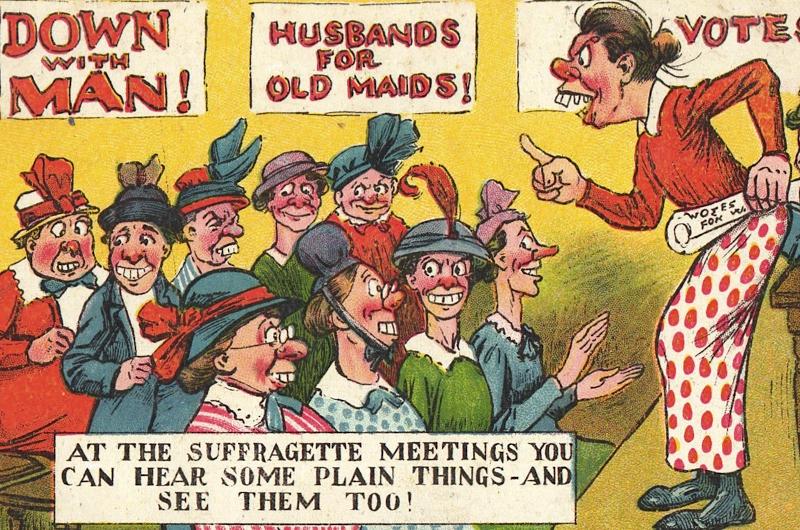
Mulligan is the perfect choice for a young mother who goes through quite the character arc, from wife and labourer to militant feminist – of course, you might find that the first two under such terrible conditions would inspire desperate reactions from anyone. Brendan Gleeson and Meryl Streep also having juicy roles, though Streep’s there in little more than a cameo, she’s nevertheless the perfect choice for theimg095 down with man movement’s heroine, Mrs. Pankhurst (this is the little detail that got to me – that all of these brave, notable women were known only by their husband’s names, ie, Mrs. Pankhurst. It killed me). Streep is strong and steady as ever. All of this capable acting smooths over some of the flaws in film making. It’s not a perfect piece of art, but it is an important one, and it’s hard not to be stirred by it.
Women in Canada got the vote in 1916, for the most part. It was not granted in the province I layout.inddlive in until 1940. American women got the vote in 1920. Some women in the UK were granted the vote by 1918 but it wasn’t unconditionally granted until 1928. That’s less than 100 years ago: way too close for comfort. Is there a woman alive today who hasn’t wondered what it would have been like to live through that? To still be all that we are and yet to be so diminished in the eyes of the law – and society? It’s boggling. And yet, in 2015, when a Prime Minister hires women to work in his government at an equal rate that he hires men, he is still asked why.



Amelie

Sean and I are celebrating our wedding anniversary in Paris; today we’re actually renewing our wedding vows at the Eiffel Tower so I’m posting about a wonderfully romantic French film about love and life in Paris through the eyes of an idealistic and imaginative young woman.

Gloriously known as Le fabuleux destin d’Amélie Poulain (translation: The Fabulous Destiny of Amelie Poulain), this film introduced the rest of the world to Audrey Tautou, seemingly born to play the role though it was actually written specifically for Emily Watson, who turned it down because she doesn’t speak French. A passion project for director Jean-Pierre Jeunet, he’s been collecting the various memories and curiosities that make up the story of Amélie since 1974. Who knew that the guy who brought us Alien: Resurrection had such magic and whimsy in him?

audreytautou

Amélie was brought up in a rather protected fashion, her father being very concerned about her supposed heart condition. To make up for her isolation, a young Amélie lives in her imagination, and her grown-up self is still very much a dreamer, a wondrous observer and devoutly introverted. She devotes her life to making others happy, and lucky for us, she’s surrounded by a very quirky bunch.

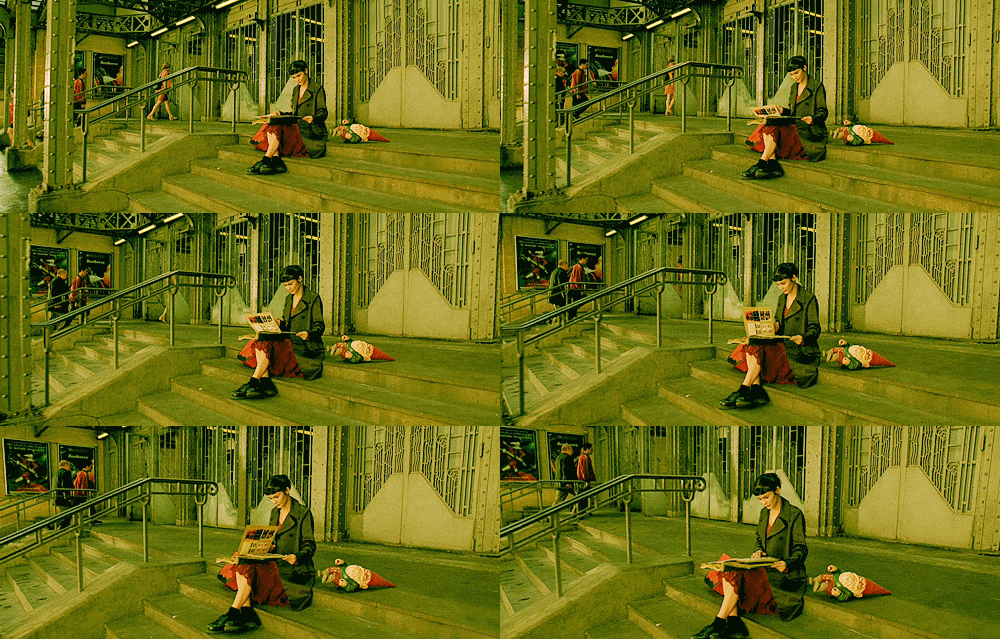
For her father, she fulfills his lifelong dream of travel (tough for a recluse) by stealing his treasured lawn gnome and sending it all over the world. This was inspired by true events – in fact, a rash of pranks perpetrated in the 1990s in England and France.

amelie

The traveling gnome was inspired by a rash of similar pranks played in England and France in the 1990s. In fact, the theft of garden gnomes is so pervasive it even has a name – “gnoming.” A gnome is taken from someone’s garden and released back “into the wild” (wherever that is for an inanimate object – the shelves of Walmart?). In 1997, a the leader of the Garden Gnome Liberation Front was convicted of stealing over 150 gnomes – his prison sentence was suspended, but he did pay a hefty fine.  (A couple of years later, there was a “mass suicide” of garden gnomes in a small town in France – residents woke up to find 11 gnomes hanging from a bridge, swinging from the nooses around their necks). At any rate, Amélie was responsible for bringing the whole garden gnome kidnapping thing to our attention, and the idea was later used by Travelocity in an ad campaign.

colignon

Although the movie is shot in a dreamy sort of way, with Paris polished, glowing, and blemish-free, some of the locations can actually be found in Montmartre. The cafe where Amélie works, for example, can be found on Rue Lepic (and is conveniently also named “Les Deux Moulins”). The fruit store run by M. Collignon is at 56 rue des Trois Frères. And of course the church where Amélie’s mother is crushed to death by a suicidal jumper is none other than the uber-famous Notre Dame  cathedral.

ameliegif

Amélie’s watchful neighbour paints the same painting yearly – he’s up to 40 copies of Renoir’s Luncheon of the Boating Party, and he still hasn’t got the girl-drinking-water’s expression quite right. Pierre-Auguste Renoir is a French artist of the impressionist variety and I’m looking forward to ogling his stuff at the Museé de l’Orangerie, but that particular painting can actually be found in The Phillipps Collection in Washington, DC.

If you haven’t seen this, you should, and if you  have, no time like the present for a re-watch!

ameliemetro

Belle

First off, thank you to all my fellow film-lovers who brought this movie to my attention. It seems to have slipped under the radar over here but I’m infinitely glad I had the chance to watch it.

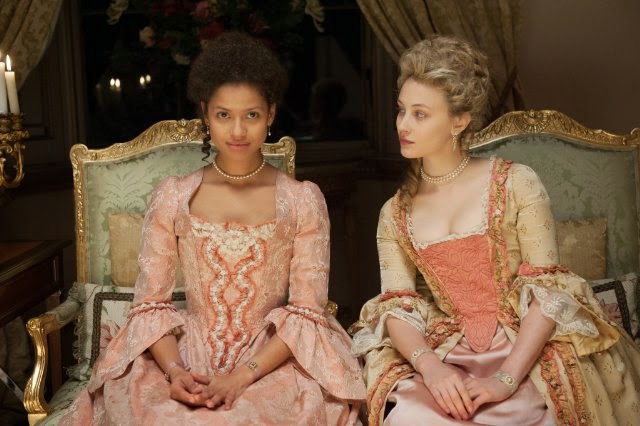
Belle recounts the true story (in broad strokes – little is known of her life) of Dido Elizabeth Belle, the half-black, bastard child of a Royal Navy Captain in 18th century (slave-trading) England. Her gugubellefather loves her deeply (as he did her deceased mother) and when he ships out to India, he appeals to his uncle to care for her in his absence. A Lord and Chief Justice, the uncle tries to raise her, along with another (white) niece, with the privileges she is due while teaching her the important barriers of her skin colour. “Too high in rank to dine with the servants, too low in rank” to dine with her family. She has enough to feel a sense of belonging, and just enough to feel left out. At court, her uncle must decide an important case about slaves as he resists acknowledging their similarity to his beloved niece.

I just watched Gugu Mbatha-Raw in Beyond The Lights and thought she was a stand-out, but this film makes clear that her career will be one to be reckoned with. She’s very subtle and belledeliberate and saves Belle from being merely a curiosity. Instead she is painted as a woman conflicted, a woman carrying the weight of her race for everyone to see. And this movie is also about class, and (perhaps even foremost) about gender. It would seem that her skin colour can be compensated for with enough money, but her gender leaves her with few options. She must either find a good husband or be invisible like her aunt (Penelope Wilton, tragic and invisible). In the film, Belle’s uncle (Tom Wilkinson, formidable) is challenged to draw a parallel between his niece (who is constantly referred to by the ugly word “mulatto”), and slaves insured as human cargo. Are they not worth the same? Is Belle Movieshe not worth the same as any other debutante? The film asks the same question of us but poses it too lightly. I can only imagine the controversy her presence in the family home must have caused, and yet I must imagine it because the script glosses right over the indecencies that certainly occurred. The story focuses on romance, or lack thereof, as befits their station and the time, and covers social implications inadequately. Belle lacks the self-starting spark that would make her the pioneer the script so badly wants her to be.

The script has been controversially attributed to Misan Sagay, despite director Amma Asante

The artwork that inspired the movie

The artwork that inspired the movie

having written 18 drafts over 3 long years. Sagay is an American member of the writer’s guild and took it to her union, which decided in her favour against non-member Asante (who is based in Great Britain). Wilkinson and Wilton have expressed ‘incredulity’ at the decision, because they had “only seen and worked from a script written by Amma”, With or without accreditation, this is an imperfect but impressive first full-length feature and Asante is sure to give voice to more great stories over time.

Edge of Tomorrow

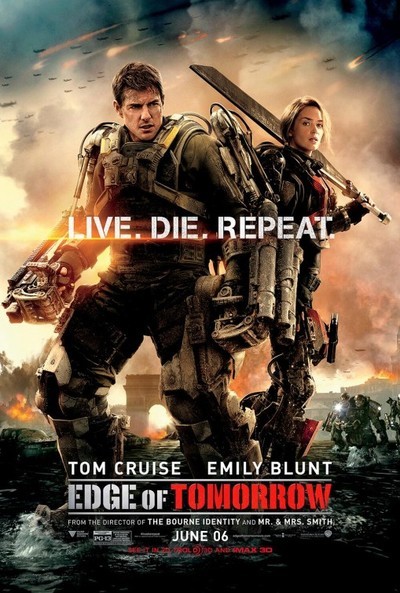
Tom Cruise plays Major William Cage, an officer used to in front of a camera rather than in the front lines. He is forced to join in combat against the invading alien race and is killed in the mission, though he “wakes up” to find himself in a time loop, repeating the battle in which he dies over and over again. It’s a military, sci-fi Groundhog Day with fewer jokes but buffer bodies. Cage teams up with Special Forces warrior Rita Vrataski (Emily Blunt) to improve his fighting skills so that he may live long enough on battle day to defeat the alien invaders. edge

I liked this so much more than I was supposed to. It’s an action-y-science-fiction-y movie that should appeal to Assholes like Sean, not Assholes like me. But it did. Probably because Emily Blunt is so fantastic, beautiful and feminine and tough as hell and totally believable as a feted warrior. And because for once, Cruise portrays this inept guy who has to be trained and guided by a woman in order to become the soldier they need him to be. It’s probably the most feminist action flick made in years. Or ever.

The movie is really cool to watch. The special effects contribute to a video game feel (and now that I mention it, I guess the constant re-levelling of the characters might have something to do with that too). The editing is pretty brilliant: the battle scene is overwhelming and unrelenting and although Cruise and Blunt relive it many times, it never feels as repetitive as it should. Actually, I felt moved and heartbroken by how much of their lives were spent on a mission no one would ever credit them for.

I mentioned earlier that this movie had fewer jokes than Groundhog day, and I stand by that statement, but this movie is not without its own brand of (dark) humour. And maybe we’re also slightly laughing at Tom Cruise, perma-action-hero, who in this one, has to take the back seat. It’s a war action movie that doesn’t glorify war. It’s got more storyline than weaponry. It feels like effort has been made, and for me, someone who doesn’t appreciate “cool” explosions for no apparent reason, this was a clever gem in the genre. It made me remember why Tom Cruise is a movie star and realize that Emily Blunt is just at the start of an amazing career.