
Hilary campaigners woke up with a tremendous political hangover on November 9th, 2016. Liberals began to realize that they’d been living in bubbles. They were fundamentally surprised by their loss, surprised that so many people across America could vote against their own best interests. Where had they gone wrong? And how do we begin to address that disconnect?
Democrat strategist Gary (Steve Carrell) is disillusioned, like a lot of us. He regroups and refocuses in conservative, smalltown (swing state) Wisconsin, USA where he finds an unlikely candidate in Col. Jack Hastings (Chris Cooper). Jack Hastings likely doesn’t know what it means to go viral, but he has, for an impassioned speech he gave to city council. Gary smells potential: Jack, a veteran, a farmer, a widower; you couldn’t build a better crossover candidate if you tried, and god knows they have. Jack’s a Democrat…he just doesn’t know it yet. It’s just one rural mayoral race, but maybe that’s a foothold the Democrats badly need to expand their base – a Democrat for the heartland, a “redder kind of blue.”
Writer-director Jon Stewart is a master satirist and for a long time he set the tone for how we voiced our discontent, how we parsed and digested the news, how we conquered our apathy and our hopelessness. He may have given up the anchor’s chair behind the desk of the Daily Show in 2015, but he’s clearly got more to say.
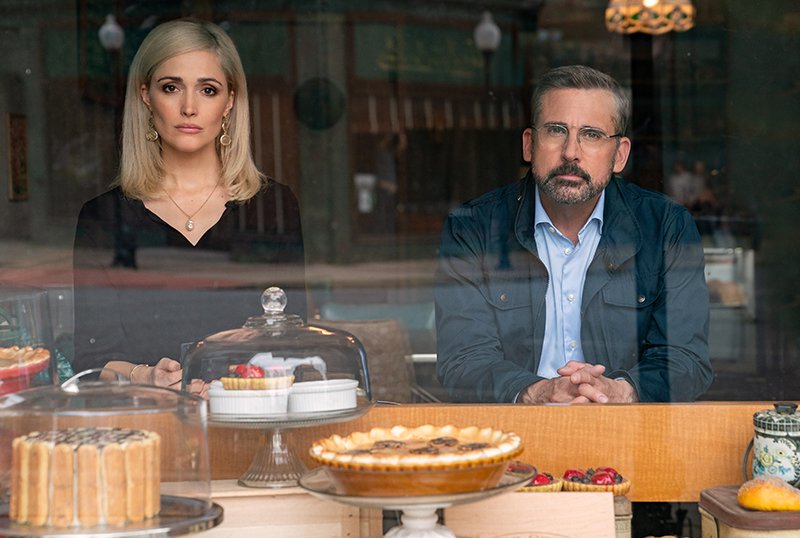
Irresistible is about the disingenuous handshake between money and politics. Mere seconds after Gary makes his move to Wisconsin, the other side sends rival strategist Faith (Rose Byrne) to even the odds. If anyone had any illusion that campaigns were about ideals, values, promises, or intentions, it was quickly, summarily, definitively dispersed. A campaign is about math: who has the most money, and how to turn those dollars into votes. It’s cynical as hell, but even with a glossy coat of Hollywood spin, it’s still not half as bad as real life. People don’t matter. They’re not individuals with specific needs and hopes, they’re reduced to “demographics,” a slick political term that divorces voters from their identity. Politicians don’t want to better your life, they want to trick you into believing in them for just long enough to cast a vote. And failing that, they want to trigger you into withholding your vote on the other side. Demographics are equations waiting to be solved, and campaigns hire lots of people to crack those numbers.
Jack represents a “redder kind of blue,” a shade of blue that people who are traditionally red would consider turning pink for. Except even children know that red and blue make purple, and that may be American democracy’s greatest failing. It forces 328 million people to contort themselves into one of two boxes: red, or blue. Both boxes suck and neither one fits anyone perfectly. Worse, though, it creates a dangerous “us” vs. “them” mentality. Its binary nature focuses on what divides us instead of what we share in common. It makes enemies of the other side, when in fact those people are our neighbours, our friends, our kin. We are capitalists. We thrive on choice. The pharmacy sells dozens of brands of toothpaste. The grocery store stocks even more brands of orange juice. You stand in front of the refrigerated case, and maybe you reach for the sweetest juice, or the one that’s locally sourced, or the one with the most vitamins, or the one with the most pulp, or the least pulp, or the cutest carton, or the most memorable commercials, or the healthiest ingredients, or maybe you just reach for whatever’s cheap. Or maybe you bypass the refrigerated section and buy a can of frozen orange juice, from concentrate. Or maybe you prefer the powdered stuff. Or the shelf-stable stuff. Or orange ‘drink.’ Or maybe, and yes this sounds crazy, but maybe you prefer cranberry juice. We need 87 orange juice options but only 2 political parties? Doesn’t that seem a little…crazy? But having that much choice means the brands have to be competitive. They have to care about what you, the consumer, wants. They have to bend to your will, not the other way around. If they want to make money, they have to be the most appealing and offer the very best. But the American political system forces you to choose between two disappointing options. Sure they could put some energy into finding out what you actually need, but instead they embrace the time-honoured American tradition of fear-mongering so you vote for them, or flinging mud so that you don’t vote for the other side.
Anyway, don’t worry, the movie doesn’t actually mention orange juice once. It’s just one of the tangents my mind follows when it’s been stimulated by something thoughtful, and interesting. While some critics didn’t care for it, I enjoyed Irresistible very much. I like Carrell’s charmingly pompous performance, and Stewart’s condescending liberal voice. I did wonder, for a while, what exactly was meant to be so irresistible, but of course the answer was right in front of me the whole time: money. To which Jon Stewart has just one simple message: resist.

 campaign gives it a crisp edge, and the constant allusions to Trump’s eventual win, thanks in part to his KKK ties, give it a sharp one. Damn it’s smart. And also depressing. And funny. Like, really funny. And so sad. Because as astutely-observed as this stuff is, it’s astonishing and disappointing to realize that 40 years on, we haven’t made much discernible progress. White people were horrified and baffled by 45’s election, which is funny because it was obviously white people who elected him. The two kinds obviously don’t talk. But nearly every black American I’ve spoken to was not overly surprised by the result (which is a far cry from being happy about it). They knew the country’s true temperature since they live with its consequences every day. And now those things have been outed, given permission to be voiced, and suddenly 2018 is resembling 1972 is some very uncomfortable ways.
 role in this production, openly mocking his boyband status. But the script leans way too hard on these jokes, making it painfully obvious there’s just little else to this so-called film. It’s raunchy but without edge. The material wears exceedingly thin after the first several minutes and then you’re stuck behind the scenes of a musical you wouldn’t see for free. Supporting actors Anne Heche and Taye Diggs fail to bring anything interesting to the table, and Rob Riggle is downright irritating. Riggle does ONE thing, and that thing is annoying as fuck. It’s beyond time for him to just go away already.
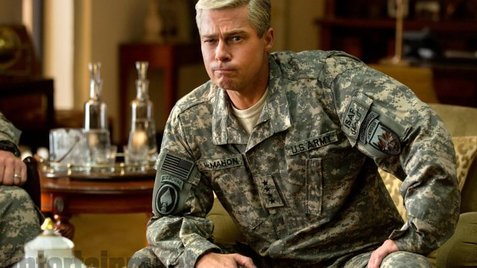 war, not men in uniform. Politicians run things but don’t bother to check in with the men on the ground, who are operating on the basis of “counter-insurgency”, a losing proposition each and every time. The soldiers can’t distinguish between the enemy and the people they’re trying to protect. The war is a clusterfuck but so is this lazy attempt at satire.

 ASSHOLES WATCHING MOVIES