Yearly Archives: 2016

Idiocracy

Natural selection should, in theory, favour the smartest and strongest, but what happens if it actually results in a dumbing down of the population? Evolution rewards those who reproduce the most, and in Idiocracy, intelligent people have become an endangered species.

I didn’t really care for this movie when it first came out, but waking up to a world in which Donald Trump is president brought this immediately to mind.
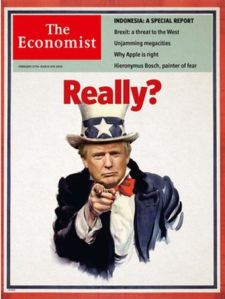
_88551016_trumpcoverLuke Wilson plays a very average dude waiting out his pension in an army library until he’s chosen to pioneer an experiment. Maya Rudolph, a prostitute, is also extremely average, and both have the added benefit of being completely friendless in the world, so no pesky family members to ask nosy questions when the army turns them into human popsicles in order to determine if humans can successfully “hibernate” for a year. Verdict: never trust the army, for starters. The experiment is neglected and its two subjects lay dormant for years. Meanwhile, humanity gets stupider at an alarming rate.

It’s a pretty dismal picture for the future of mankind, but as far as Idiocracy goes, it doesn’t go far enough. It fails to account for the reality TV  host of its fictional show “Ow, My Balls” not only running for president, but actually winning. That’s one little nugget that even Mike Judge couldn’t fathom, and he’s the guy that divined a Carls, Jr. burger-dispensing device that also confiscates children from unfit mothers. Reality is turning out to be even stupider than the most low-brow satire had the balls to portray.

The rest of the world is horrified. Nauseated. And not just at the 59 million racist, misogynist Americans who voted for a smug, clueless, unapologetic (boastful, even) rapist, but for the millions more who didn’t show up at all to stop him. Of course I’m heart sick and nervous about so many of my largeuncomfortably-close neighbours to the south harbouring such hatred in their hearts, but I’m almost as upset about the apathy, and what that apathy means. It means that a man can run a campaign on blatant lies, zero experience, and rampant xenophobia, and people will let him. It means Americans are not the people we thought they were. That progress is rolling backwards in that country. That now our own rational, credentialed, professional world leaders will be forced to treat Trump like an equal even though he has proven himself unqualified to open his own car door. We have embraced “sunny ways” up here in Canada but see nothing but dark days across the border. I wouldn’t have wished a Trump presidency on my worst enemy, and never wanted to believe that this Neanderthal would succeed. Would be allowed to succeed. Nevertheless, he is the president-elect, and maybe the president they deserve. It’s a wake up call to all of us. We are not without problems in Canada and as the U.S. is usually our cultural mirror, it’s safe to say we should all be taking a much longer look at ourselves and each other. We can do better than this. We ARE better than this. Even Idiocracy offers hope: in the end, the smartest man is elected. Order is restored. The righteous are vindicated.


Never underestimate the power of stupid people in large groups. – George Carlin

Before The Flood

I learned two major things watching Before The Flood:

  1. Leonardo DiCaprio’s parents really should have sprung for an interior decorator for his nursery.
  2. (North) Americans are goddamned hypocrites.

We all know the Earth is dying, and we’re the murderers. This is pre-meditated, Murder One, capital stuff. There won’t be any plea-bargaining at the end of the world because we’re guilty as sin.

We’ve seen this coming for 20 years or more. Unfortunately, climate change is accelerating at a greater rate than even predicted. We have very real, very frightening present-day consequences as it is. But we’re still not making changes. Oh sure we’re willing to do the small stuff, like recycling, or using lower-watt light bulbs, or bringing reusable bags to the grocery store. But the big stuff? Oh man. Don’t ask us to change our lifestyles! We’re very attached to those.

I’m attached to it. I’ll admit it. I treasure my back yard, which is why I live nearly 40km away from my work, so my car guzzles gas to make that daily round trip. I also live away from my family and my in-laws, so we’re either travelling 272km or 840km roundtrip to visit them – or 2646km if it’s my baby sister. And that doesn’t begin to include the 3 or 4 trips I take every year by air. It feels almost commonplace now to be able to get on a plane and land anywhere in the world, but it’s a luxury in how absolutely wasteful it is, how much energy we consume to travel long-distance. I know this. I feel guilty about it. But I’m still going to Hawaii in 3 weeks.

As privileged North Americans, we create 13 times as much ecological damage as someone in Brazil. One American consumes as many resources as 35 Indians, and 53 times more goods and services than someone from China. The sad fact is, we depend on the poor staying poor. If the people of India, China, and Africa caught up to our before-the-flood-leonardo-dicaprio-imageconsumption rates, the Earth would already be dead, and so would we. “Luckily”, poverty has stopped them from even accessing the kinds of resources that we have at our fingertips. If everyone had a light bulb in their home, a washing machine, a car in the driveway, a heat source for cooking…well, we’d be doomed. But the thing about developing nations is that they are in fact developing. They are making headway. They’re getting closer and closer to attaining our level of lifestyle everyday, and we’re PANICKING. We know it spells our demise. So we plead with them: don’t bother with coal or fossil fuels, go straight to solar power, India! Hey Kenya – why not go solar? Why not? Well, because those things cost more. Which is why we still haven’t adopted them ourselves. We’re the wealthiest countries and the most able to absorb those costs, but we haven’t.  We do not practice what we preach.

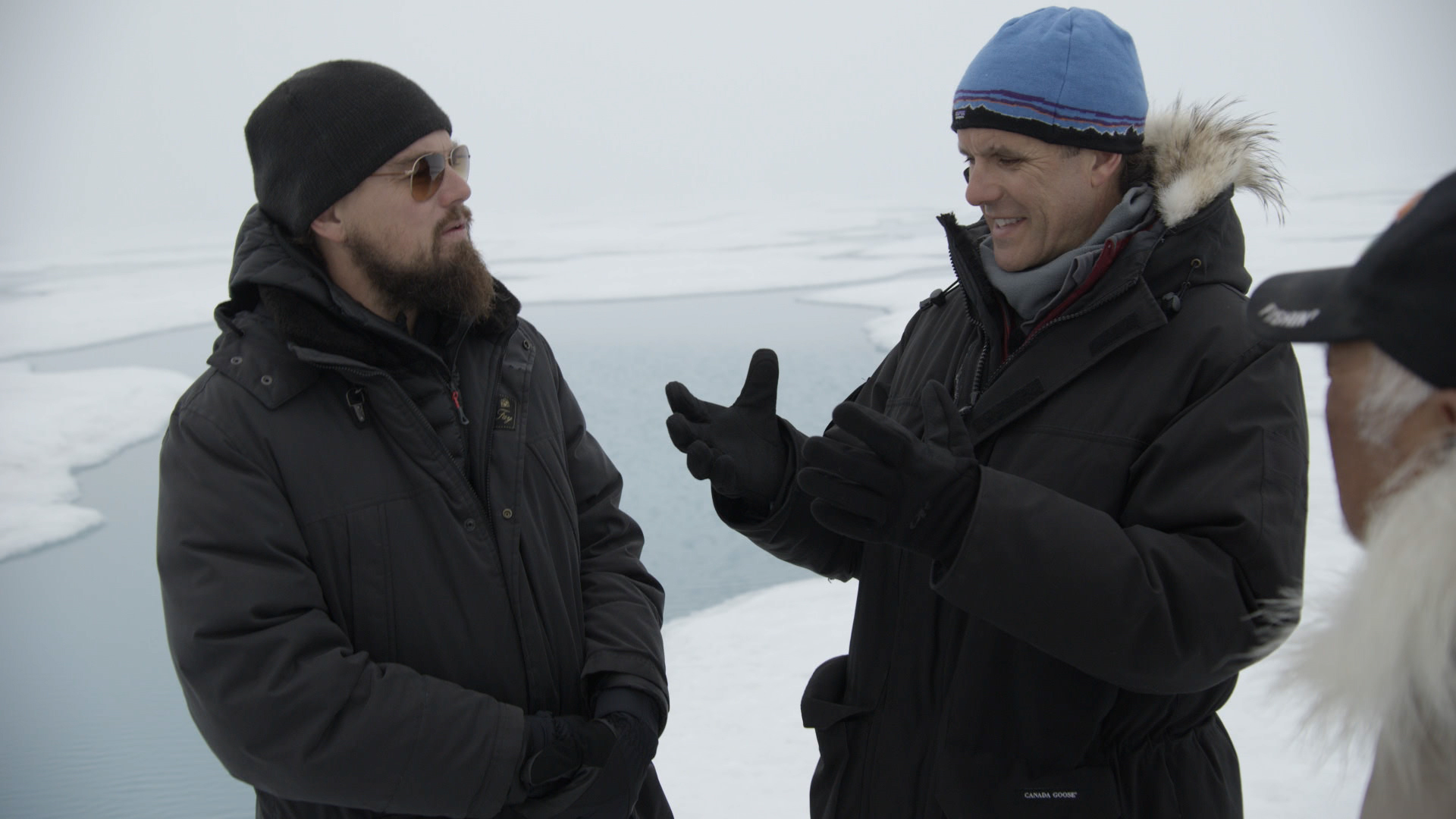
Fisher Stevens directs an urgent but humble documentary that keeps climate change advocate Leonardo DiCaprio front and centre, even as he questions his own credentials, and laments his carbon footprint.

Just a decade ago we saw America start a war over oil. In a not very distant future, those same wars could be fought over water. We’re already seeing climate change refugees – people forced to leave their homes because flooding or other “natural” disasters prompted by global warming. This won’t just be about the environment. This will quickly become an issue for national security.

There is hope. There are things we could and should be doing. You and I share a responsibility to lead by example. We need to start making wiser choices now, because we will be judged by future generations, and we need to decide whether we want to be lauded by them, or vilified.


Trumpland

I enjoy Michael Moore’s documentaries, but I’ve always thought they were largely unpersuasive because he preaches to the choir. He really only talks to the people who already agree with him. With Trumpland, and the stakes so high, Michael Moore finally attempts to identify with the other side, and this film is his plea to them.

colleen-oharaOfficially, Michael Moore is not exactly a Clinton supporter himself. He voted Bernie Sanders in the primary, and even voted against Bill in the 90s. But now it’s time to get real. Donald Trump was a good joke for a while, but now the threat is a little too real and he’s coming out swinging.

What this film, which is not in the normal style of  a Michael Moore documentary, but more just a filmed speech that he gave in the heart of Trumpland (Ohio), gets right is that he doesn’t waste time bashing Trump. Arguably, Trump does a good enough job of that himself. Instead, Moore looks toward Hillary as not just a viable alternative, but the only real choice.

Moore tries to justify the mystifying support of Trump by

a) Identifying the disenfranchised and understanding where they’re coming from. The current system has left some people (the former middle class) without dignity, and 160125114628-donald-trump-quote-shoot-somebody-super-169they’re pushing back, which is a normal response.

b) Speaking up for the angry, older white men (among which he counts himself) who find themselves going extinct and will not go down without a fight.

Of course, Trump is not the answer to either of those problems. Trump is going to make sure the whole country goes down in flames, whether you voted for him or not. But some people just don’t like Hillary, and to those people, Moore says: that’s okay. It’s okay to hate Hillary. You can hate her and still vote for her, for the love of your country, because you don’t want to see it destroyed, because you’re willing to make a sacrifice for the land you call home.


The Man Who Knew Infinity

India is crazy with population: 1.2 billion people or so. Why, then, does Hollywood think a man born in London is the only one for hire? Nothing against Dev Patel, but he can’t be the only brown person around. On the other hand, I hate to take work away from him because of course he’s only allowed to play Indian dudes, despite being British. Rant aside, I only half-enjoyed this movie, despite being originally pleased to find it on Netflix.

Dev plays Srinivasa Ramanujan, a poor, uneducated man in India who happens to be a math the_man_who_knew_infinity_2015_12516184prodigy. Of course, India rejects him because he’s from the wrong caste, and he has no degree and he looks like he sleeps in the street (to be fair, he does). So he writes a ballsy  note to professor G.H. Hardy (Jeremy Irons) of Trinity College, Cambridge, and Hardy’s just intrigued enough to send for him. It’s 1912 though, so Cambridge is not super friendly to brown-skinned people. And Cambridge is really unfriendly to self-taught brown people who think they’re better than them. So everyone hates on him and even Hardy stifles him. Ramanujan is just vomiting brilliance everywhere and no one wants to accept it.

Patel and Irons are great. You can’t knock the acting. But math is boring and this biopic is conventional as hell. Ramanujan was a real man who overcame real adversity and left behind a legacy only now begun to be understood. I don’t think the film needed to add a further layer of intrigue that involved him not being allowed to walk on the grass. I felt like he wasn’t served well by this documentary – not his life, not his work, not his memory. And that’s really too bad.


Short Films Galore!

Candy Skin: Ottawa’s own Kyle Martellacci has a short film that preys on our fear of the unknown. The protagonist, David, wakes up to find himself alone in a deserted world. Visibly alone at least  – something unseen is hunting him, but finding out may be more than he can handle. Watch the trailer here.

Lookouts: a team of young woodland scouts are training in order to defeat a mythical, Opening_Run_Master_2500_v2.jpgdangerous beast called a basilisk. Pehn depends on the guidance of his mentor and the memories of his mother to give him the courage to confront the monster he can scarcely define, let alone identify. Shot in lush coastal California forest, Lookouts is about as beautiful and accomplished a short film as I have ever seen and the acting is superb. It uses practical effects and real locations to elevate this period fantasy based on Penny Arcade’s Lookouts to something truly unique and special. Director David Bousquet has tapped into real magic, and you can share in it by watching the film here. You’re welcome. 😉

Pigskin: a cheerleader’s romance with a football player leads to a walking-nightmare manifestation of her body dismorphia. This body-horror short is stunningly shot, with beautiful, throwback cinematography that will hearken 80s nostalgia while communicating a present-day message about body consciousness, brought to you by the creative team of director\writer Jake Hammond and cinematographer\writer Nicola Newton.

Night of the Slasher: from director Shant Hamassian, this 11 minute short depicts a young girl determined to commit all the usual “horror movie sins” like drinking and dancing half naked in order to attract a serial killer. Why do such a thing? Well, that scar on her neck and the glint of revenge in her eye might serve as clues. Excellently executed and impressively shot in one take, Hamassian wants us to rethink the slasher genre and hopes to turn this short into a full-length, high-profile cinematic piece. You can watch it here, and see for yourself:

Doctor Strange

strangeMarvel did it again.  They took another obscure supporting character, built a movie around him, and made me eager to see his next appearance in the ever-expanding Marvel Cinematic Universe.  This time, that obscure character was Doctor Strange, Earth’s Sorcerer Supreme.
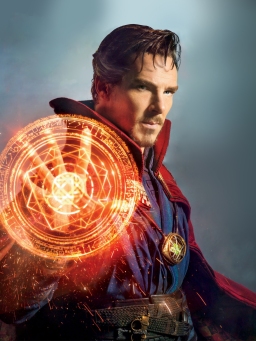
Anyone who’s read Marvel comics even sporadically knows who Doctor Strange is, because every so often he’d randomly pop up in your favourite hero’s comic to provide assistance or a few words of wisdom or encouragement.  As you may already know, my favourite hero was (and is) Spider-Man, and every ten issues or so I could count on Doctor Strange appearing through a portal, sticking around for 10-12 panels to move the story along, and then exiting as quickly as he entered.

strange-2But in this movie, because Doctor Strange is the star, we get to follow him through those portals and see what happens next from his perspective.  And it’s a hell of a ride.  Naturally, I could have done without the origin story but fortunately it’s injected with a welcome dose of humour that makes it speed by.  It helps that the opening scene features a battle that will leave the viewer wanting more and provides purpose and urgency to Strange’s magical training.
The special effects are spectacular and the visuals are glorious in IMAX 3D, just as last month’s sneak peek led me to believe.  It’s probably also tolerable in regular 3D or god forbid, stupid boring flat 2D, but I’ll never know, at least not until the movie comes to Netflix and I half-watch it while folding laundry.

The icing on the cake is that Marvel has assembled some first rate on-screen talent to supplement those trippy visuals, led by the Doctor himself, Benedict Cumberbatch, who is perfectly cast and does his usual baritone voice/good acting thing featuring a solid American accent.  If only I could do a British accent half as well (preferably cockney but I’m really not picky). Taking in a few more episodes of Sherlock can only help, right?

Add some Canadian flavour in Rachel McAdams, doing her regular accent as far as I know (honestly, if we don’t say “about” can you even tell we’re not American?), and a few more Brits in Chiwetel Ejiofor and Tilda Swinton (also both doing American accents even though their characters are worldly people currently living in Nepal), and by my count you’ve got one Oscar winner and three other Oscar nominees, whose talents really help sell silly comic words like Agamotto and Dormammu.  We’ve come a long way since the Stallone-Schneider superteam in Judge Dredd!

Doctor Strange is pure comic book joy.  It’s a welcome November blockbuster that will keep you entertained from start to finish.  I give it a score of nine spiritual goatees out of ten.

The Prestige

prestigeChristopher Nolan’s bad movies are better than most people’s good ones.  I count three of them (Memento, Inception and The Dark Knight) among my all-time favourites, and I have enjoyed everything else of his that I’ve seen (Batman Begins, The Dark Knight Rises, and Interstellar).  Noticeably absent from that list, until this week, was The Prestige, which usually appears near the top of critics’ “best of Nolan” lists.  So when The Prestige popped up on Netflix’s “recently added” row, I dove in immediately.

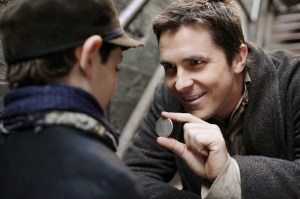
The Prestige is a tale of the ever-escalating war between two rival magicians, played by Christian Bale and Hugh Jackman.  Bale is the purer magician while Jackman is the larger commercial success.  As the stakes get ratcheted up, Bale is arrested for Jackman’s murder.  But in a battle of illusionists, can we really believe what we see?

Structurally, The Prestige is as complex as anything that Nolan has thrown at us.  This movie shouldn’t work as well as it does.  There are flashbacks within flashbacks but I knew at all times where/when a scene fit in with the rest of the film.  We’ve got enough examples by now of Nolan’s capabilities, but The Prestige is yet another display of his narrative mastery.  Basing the film on the three parts of a magic trick works very well, keeping the viewer on edge until the big reveal.

The reveal itself, though, left me disappointed.  It was a huge stretch that went completely against the movie’s prior suggestions that the secret of magic is setting up the trick and selling it to the audience.   I found the reveal of both Bale and Jackman’s methods problematic, in different ways, but Jackman’s big surprise was what really took the air out of the film for me.

Because of that, on my list The Prestige gets relegated to the lower tier of Nolan films, somewhere in Interstellar territory.   Make no mistake, though, that’s due to Nolan having made so many great films as opposed to The Prestige being a bad movie.  It’s still pretty damn good!

OIAF: Cafard

cafardCafard is the French word for cockroach.  But make no mistake, the animated film Cafard is not the French version of A Bug’s Life.  It’s a bleak, adult tale about the horrors of the first World War, from the perspective of a world champion wrestler who enlists in the Belgian army in 1914 after his daughter is raped by German soldiers.  Unfortunately for all involved, that terrible event is only the start of the awfulness.

Cafard’s story is told well but it didn’t thoroughly draw me in, and I wonder whether that is because I never related to the protagonist.  While well-meaning, his brute force approach did not translate from wrestling to the rest of his life, and his journey is unsatisfying as a result.

The film’s subject matter was likely a cause of my detachment as well.  This is a movie that is difficult to get close to, because it does not sugarcafardcoat any aspect of war’s horrors.  While that approach is commendable, it is that much more difficult to embrace Cafard.  I would have liked for the film to have offered something to offset its harsh subject matter, but there is no joy to be found in this world.  Any hint of happiness feels fleeting, like a consolation prize at best.
Fittingly, Cafard’s motion capture animation is harsh and eerily realistic, just like its storytelling approach.  The visuals fit the movie tonally but are at times distracting, particularly because Cafard by and large is almost photorealistic but there are occasionally very roughly drawn scenes that seem like they contain animation errors.  It is too bad because those moments are few and far between but that made them even more jarring when they appeared.

Despite those minor complaints, from an artistic perspective the film consistently reflects Cafard’s sad subject matter, and tells its story effectively and with purpose.  That is an achievement deserving of mention.  The film is thematically consistent and demonstrates the futility of war from start to finish.  Cafard hammers home that theme and I left the theatre feeling that the filmmakers might even be satisfied that I found the film so difficult to enjoy.  War is hell, after all, and Cafard delivers exactly that.


NHFF: Hunter Gatherer

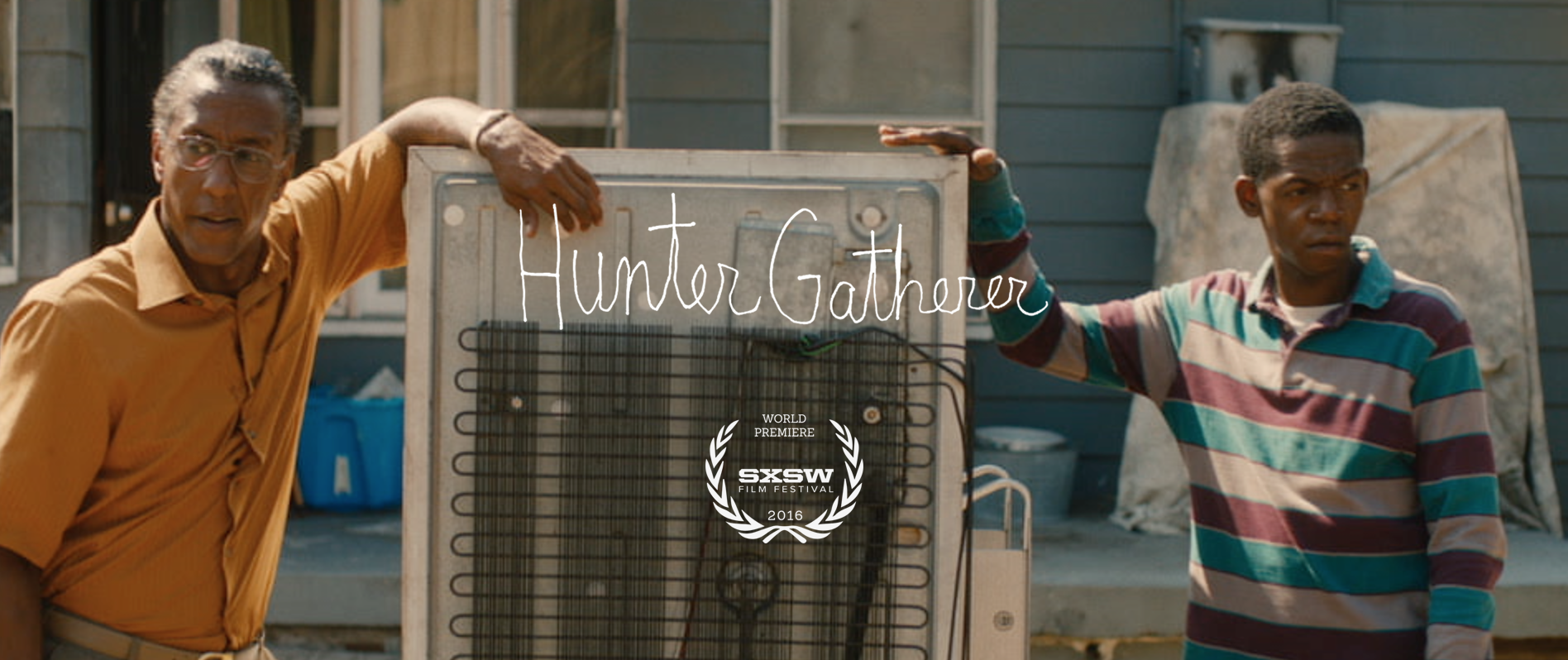
Hunter Gatherer is a little film that demonstrates the value of fully-realized characters.  It is not a flashy film or a high concept one, but it is powerful in its own way.  Through the misadventures of a man just released from prison, Hunter Gatherer illustrates the constant struggle we all face as we try to find our way in this crazy world.  The characters are a little exaggerated but not to the point of farce, and the film succeeds in large part because there is something real at their core.hunter-gatherer

The two protagonists are particularly memorable.  Andre Royo and George Sample III play off each other well and their actions, while often nonsensical to the viewer, have a certain logic that makes their antics believable.  Given the bizarre schemes these characters are involved in, writer/director Joshua Locy deserves a lot of credit for making the characters convincing.

Locy’s efforts pay off because as things turn for the worse, we feel these characters’ pain and understand their responses even if we would have done things very differently.  And we would have done things differently, because if either of these characters made even slightly rational decisions then the movie’s whole course, including its starting point, would have been completely different.  That it could have been avoided with a little common sense makes Hunter Gatherer’s ending all the more heartbreaking.

Like so many small indie films, Hunter Gatherer is unlikely to get a wide release, but it is making the rounds on the festival circuit.  If you have the chance to see it at one of those festivals, I would recommend that you take advantage of the opportunity.   As an aside, we do our best to post release information on our Twitter feed (@AssholeMovies) for all the films we review.  So if you’re not already following us there, now is a good time to start!

Saint Amour

Gerard Depardieu and Benoit Poelvoorde play a father and son, respectively, attending a livestock show.  Luckily for Poelvoorde, the fair also features a wine exhibition and he makes it his mission to sample everything.  Since there are a few days before the main event (the cattle competition), Depardieu suggests they widen the scope of the wine tour.   Poelvoode is all for it so the two hit the road with the help of cabbie Vincent Lacoste.

Saint Amour had me at “French wine tour”.  If anyone ever wants to organize a French road trip, count me in.  Jay will definitely come too.  There’s a joyous feeling as the characters move to the countryside and get their drink on.  The experience feels like it should, and as a viewer I wished I was more actively involved in the adventure.

Even Vincent Lacoste, who I instantly recognized as the title character in Lolo (likely the most detestable character I saw on screen in 2015), is entertaining as the cabbie/third wheel.  The beating heart of the movie, though, is the interplay between Depardieu and Poelvoorde.  They are both funny and surprisingly sweet as they try (and often fail) to reconnect over bottle after bottle of what I am sure was excellent wine.  Neither of them has a lot to say to the other, but as the story progresses we see it’s not for lack of trying.

Then the film swerves in the last ten minutes, leaving us with an ending I did not see coming, not even a little bit.  It’s not the worst ending but it’s quite bizarre, mainly because it didn’t fit with my feel for the father and son duo and left me feeling a bit flat.  On the other hand, the swerve was believable for Lacoste’s character but that could be my Lolo hatred resurfacing.  Me, I would rather have finished the wine tour.

Even with the bumpy landing, Saint Amour is an entertaining ride that goes down smooth.  Now to start dropping hints to Jay about a real-life tour of France’s wine regions, sans compromis.