The rich and famous are rich and famous for a reason – their unreasonable demands. Turns out actors are not immune. The following are actual clauses found in movie contracts.
Samuel L. Jackson has it in his contract that he gets a break during filming to play golf twice a week. Priorities!
The late Garry Marshall was so close to Hector Elizondo that he put a clause in his contracts stipulating that the actor was guaranteed a role in all Marshall films. Elizondo never knew about the clause but obviously benefitted, appearing in all of Marshall’s films, up until the director’s death last year.
Steve McQueen had a crazy grudge against Paul Newman. When the two starred in The 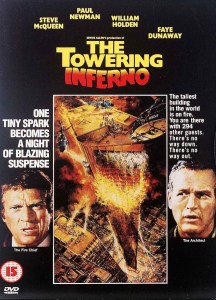 Towering Inferno in 1974, McQueen demanded that he not only have top billing, but also the exact same pay as Newman—and the EXACT SAME number of lines, which seems like a pretty shitty way to write a script. The two fought it out about the top billing and eventually producers settled on a compromise for the poster: McQueen’s name is first, but Newman’s name, while second, is slightly higher up. Also the picture of McQueen is on the left, but Newman’s picture is again slightly higher up. This coined the term ‘diagonal billing’ because you know movie stars have egos and this shit definitely has come up again.
While working on (the now defunct) Eloise in Paris in 2010, Uma Thurman insisted on receiving heavy discounts if she decided to buy any clothes and\or wigs used during the shoot. Also, “no other cast member [may] receive more favorable dressing rooms.”
Roger Moore asked for and received “unlimited” Montecristo cigars on his James Bond films – I mean, what better way to get into character?
Will Ferrell, who takes pride in being an ass, demanded the following:
1 Electric three-wheel mobility scooter
1 headset microphone (Janet Jackson style)
1 flight of stairs on wheels
1 fake tree on wheels
1 rainbow (can be painted on canvas) on wheels
Guinness beer
Smart Water or Fiji Water
Coke, Diet Coke, 7Up
Raw roasted almonds
Protein bars: Peanut butter chocolate Zone Bars, Peanut Butter Power Bars
Just the necessities, obviously!
Will Smith had a two-and-a-half million dollar trailer built for himself. His contract makes sure the trailer has a spot on every movie set. It sits on 22 wheels, has 14 televisions, and $30,000 worth of leather upholstery. It has a full kitchen with over  $100,000 worth of granite countertops. It has sliding doors like the Star Trek Enterprise, which lead to a wardrobe room. It has pistons that allow it to transform to have a second story, which houses a screening room for watching dailies. There’s a shower in a $25,000 bathroom that has a magic glass door, which can go between opaque and transparent with the push of a button. Sean and I saw this monstrosity on the streets of Manhattan while he was filming MIB3, and you bet the locals were complaining about its size and its generally fucking up traffic, and blocking out sunlight in the surrounding apartments. Charming?
Lindsey Lohan, known for being oh-so modest, demanded a private jet with a hairstylist, a makeup artist, and a manicurist onboard. She also insisted on a 1-year Russian visa, a Ritz-Carlton penthouse suite, and a meeting with President Vladimir Putin, and that was just to appear on a talk show. I think she may be overestimated her cachet.
While filming Gravity in Surrey, George Clooney insisted on a custom-made beach hut complete with hot tub, private landscaped garden, and basketball court built next to his trailer. He let production pick up the £100,000 tab while making $20M for the movie. Life is fair!
Tom Cruise’s “thing” is as weird as he is: thongs. He’s got thongs written into every contract – up to 50 of them per movie since he only wears them once. He feels they’re imperative for shooting action scenes, keeping him loose and unrestricted. I have a feeling that my underwear is not what’s holding me back. I also doubt the thongs are helping him out all that much, but it’s a nice justification for your fetish, isn’t it?
But just to leave you with something positive, not all contract riders are inspired by selfish greed. Robin Williams always wrote in his contract that on every film he made, production had to hire a certain number of homeless people and put them to work. Remember that next time you watch one of his old gems.

 You may not know Nico by name, but I bet you have heard of some of her friends, people like Andy Warhol and Lou Reed. Nico, born Christa Päffgen, was part of the Velvet Underground for their first album (getting co-billing in fact) and, as a musician, that would seem to overshadow anything else one might do from then on. Nico, 1988 joins Christa in 1986 as she tours in support of her latest solo album. Understandably, Christa would prefer to keep the focus on her new music, but the press keeps asking about her past.
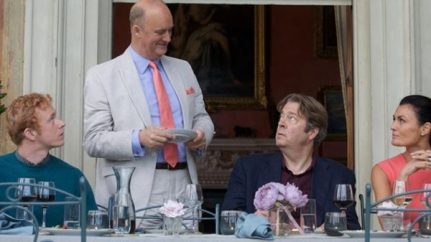 deathbed with cancer when she first went out to Swafford to convalesce in a peaceful setting. Instead, she experienced a miraculous recovery, her health and strength returning until she seemed to be in complete remission. She’s not the only one talking about these spiritual healings, so in addition to Ted, Swafford is welcoming all kinds of guests who are sneakily looking for their own miracles.
 she already has) stumble upon agent Strickland’s (Michael Shannon) latest capture, a humanoid sea creature reportedly worshiped as a god by the Amazonians. Set against the Cold War era, the Americans hope this scaly curiosity will give them a leg up against the Ruskies are and prepared to torture the secrets out of their prisoner – and worse. But sweet Eliza spots the creature’s humanity and her kind heart urges her to save him. She enlists a scientist at the facility (Michael Stuhlbarg) and her neighbour Giles (Richard Jenkins) in her daring escape plan, but Strickland isn’t going to let this career-defining prize slip through his rotting fingers.
 The world is overpopulated and in the very near future it will become untenably crowded: fact. We don’t have enough space to comfortably house all these people, we don’t have the ecosystem to support them, or enough resources to fund the lifestyles to which we have become accustomed. The rate at which these 7 + billion people consume means we are making waste and pollution like there’s no tomorrow – and if we continue doing so, there won’t be.
 Zookeeper’s Wife, and We Bought A Zoo, and more recently I was reading another book about a woman who led an underground railroad of sorts to smuggle Jewish children out of the ghetto, wherein the zookeeper’s wife was specifically mentioned. It was an especially brutal place to be during the war. Terrible, unspeakable things happened every day, and it’s kind of a miracle to see\hear these stories about ordinary people who couldn’t live with what was happening, so they didn’t [it’s sort of awful that these words sound very applicable even today].
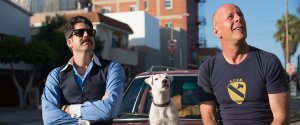 or he’d have more than $84 in his bank account. He has a young protege responsible for some very cheesy narration but mostly it’s just about him, getting into deeper and deeper trouble, then trying to dig his way out. His First and Biggest Problem are the gangsters who stole his beloved dog Buddy. Sure it’s a retaliatory act, but Buddy is Steve’s best friend (excepting John Goodman, who plays his human best friend), so apparently there’s no end to demeaning situations that Steve is willing to get into in order to recover his furry pal. There’s no excusing the most egregious stuff (ie, naked skateboarding, and using his asscheeks as a gun holster) which is not necessity but rather just establishes the kind of guy Steve is (ie, exceedingly immature). Anyway, things only get more madcap from there.
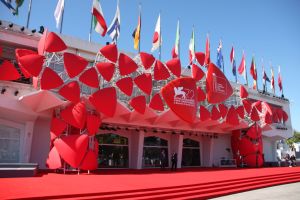 The very first film to be shown at the festival in 1932 was Rouben Mamoulian’s Dr. Jekyll and Mr. Hyde. A couple of years later they made it competitive, offering up the “Mussolini Cup” for best foreign film and best Italian film. [As you can guess, the festival underwent some bumpy times. Prior to 1938, political pressures distorted the festival. In the 1940s, there was pretty much a monopoly by movies and directors from the Rome-Berline Axis. But by 1946, things were back on track, the Mussolini Cup renamed once the dictator was ousted.] More recently, the prize takeaway is a Golden Lion (Leone d’Oro) for the best film screened in competition; the Silver Lion (Leone d’Argento) awarded to the best director; and Volpi Cups (Coppa Volpi) for best actor and actress. These are awarded via jury, this year presided by Annette Bening. Bening will be supported by Baby Driver director Edgar Wright; British actress Rebecca Hall; Hungarian filmmaker Ildiko Enyedi; Mexican filmmaker Michel Franco; French actress Anna Mouglalis; film critic David Stratton; Italian actress Jasmine Trinca; and
  Taiwan-born filmmaker Yonfan. John Landis will preside a jury judging the virtual reality competition. He’s also debuting something of his own – a 3D version of Michael Jackson’s Thriller (also screening at TIFF).
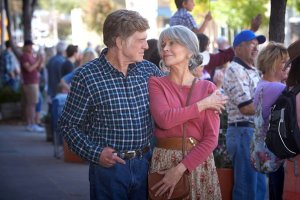 Actually, the programming is such that there are tonnes of not-to-be-missed films, including Netflix’s Our Souls At Night. Its stars, Jane Fonda and Robert Redford, will be receiving Lifetime Achievement Golden Lions at the September 1st screening.
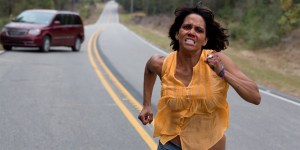 any angry mama bear she takes off on a parking lot tear, totally prepared to outrun the car if only she can, but of course she can’t. So she hops behind the wheel of her trusty mini van and the world’s slowest, most meandering, and good lord most repetitive chase begins.
 So off they drive in a stolen Mercedes. They have a cross-country adventure that only two people determined to die could possibly have: madcap, in a non-urgent way. The script doesn’t feel compelled to follow the usual formula for a road trip movie, so it’s sprinkled with surprising pit stops and hijinks. Kenny and Lolita have nothing to lose, so anything is possible.
 ASSHOLES WATCHING MOVIES