Yearly Archives: 2018

American Assassin

They make you wait 20 whole minutes before getting to Tom Cruise, and when they finally do, I realized I’d been duped. In fact, it was Michael Keaton being introduced, not Tom Cruise, and I’ve been mistaking American Assassin for American Made possibly for as long as either have existed.

American Assassin is about a kid who goes on vacation with his girlfriend and sees her and countless others get slaughtered on a beach. He does what any reasonable bloke would do: he grows regrettable facial hair, and decides to become a secret spy assassin. american-assassin-20172782Now, I can tell you in no uncertain terms that no dead girlfriend is worth growing that kind of tragic beard for. I can also tell you that this guy’s a doofus. I mean, a) his name is Mitch. Case closed. He’s played by that dude who’s in the Maze Runner movies, which is possibly why he believes he can just become a spy, and then does. He looks up terrorist on the internet, and then just shows up at their door. It’s just that easy. I mean, it doesn’t go well and he has to be emergency extracted by the CIA or whatever, but who’s counting? Revenge, baby! And then for some totally inexplicable reason, the CIA takes a liking to this renegade with pubic hair on his chin, and they decide to train him up so his spy game’s a little more on point. Cut to: Michael Keaton, who plays Stan, a tough as nails ex-NAVY seal who takes young Mitch under his grizzled old wing. They decide to become a lame crime fighting duo, and the bad guy is none other than Stan’s former protege, who coincidentally owns an atom bomb and holds a grudge, and together they put the ass back in assassin.

This genre is crowded as hell and the fact that I merged two movies with similar themes AND titles in my head is a bad, bad sign. Painfully generic. There, I said it. In fact, generic just texted me an angry face emoji because generic would honestly be a step in the right direction for this crap. Even Michael Keaton can’t save it, nor does he really appear to be trying. The script is just that bad. The maze runner, Dylan O’Brien is clearly  not his generation’s Tom Cruise, so  I guess I’m wondering….who is?
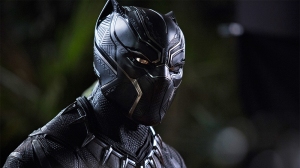
Black Panther

MLD-01496_R.JPGThe Marvel Cinematic Universe is so bloated at this point that Marvel usually crams as many superheroes as possible into the “solo” movies in between Avengers instalments.  For example, Iron Man pops up in Spider-Man: Homecoming, Falcon briefly gets in Ant-Man‘s way, and everyone other than Cap and Bucky in Captain America: Civil War are clearly uninvited guests.  The result is that every movie is more or lScrooge-McDuck-Money-Biness the same movie.  Clearly, that’s Marvel’s goal with a shared universe as that way, we movie-loving rubes have to see them all, and throw even more cash into Disney’s money bin (which by now must be bigger than Scrooge McDuck’s).
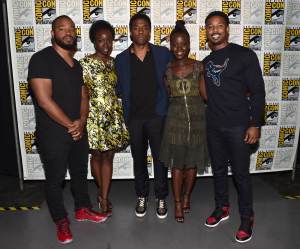
Black Panther is different than those other movies.  It feels fresh.  This is a side of the Marvel Universe we have not seen, with new characters, new challenges, and new disputes.  There are no distractions in the form of random heroes from other movies (full disclosure: there are two supporting characters we’ve seen before but I am willing to overlook that, because both felt like they belonged).  Instead, we are introduced to a whole host of new characters who we quickly feel like we’ve always known, thanks to director/co-writer Ryan Coogler’s stellar work (he’s now three for three in his young career, having already given us Fruitvale Station and Creed).  Refreshingly, none of these new characters are white, and the female characters are just as important as the men (and maybe even more so).

Best of all, this part of the MCU is not based on good versus evil.  Most of the “bad guys” aren’t bad at all, and the biggest bad, Michael B. Jordan’s Killmonger, is one of the most complex villains we’ve ever seen in a superhero movie.  I’d put him second only to Sir Ian McKellen’s Magneto (and that’s a largely unfair comparison because Magneto has been both hero and villain throughout his 55 year career) and well ahead of Heath Ledger’s Joker (who for all his awesomeness is essentially one-dimensional in that his goal was simply to destroy everything). Rather than having a standard comic-book focus, the conflict in Black Panther stems from a substantial philosophical and political question, the answer to which shapes your view of the world.  This is nationalism versus globalism, superhero style, which means that rather than choosing and lobbying elected officials who then debate and vote on these important issues, these weighblack-panther-comic-con-25jul16-02ty disputes in Black Panther are resolved through lots of punching and kicking (which, for all its flaws, is clearly a more efficient political system than the one the USA is currently using).
Black Panther does absolutely everything right.  This is essential viewing and, along with Wonder Woman, shows why diversity in Hollywood is so valuable.  It’s not about political correctness at all.  It’s because a fresh perspective and cultural diversity makes the movie-going experience that much more real and, moreover, provides vitality and energy to a genre that otherwise has been beating the same horse for the last ten years.

Darkest Hour

Darkest Hour should maybe be called Darkest Month. In 1940, Winston Churchill was asked by the King to take over as Prime Minister. It was a shitty time to get the job: Hitler was marching his Nazi army across Europe, and the threat of invasion was uncomfortably close. During this particular month, Churchill’s first on the job, he’s got an impossible task. He must decide whether to negotiate a treaty with Hitler, or whether to stand firm against the Nazis but in so doing risk his country. And he had to do this without his party’s support or the public’s understanding or any help from the King.

Winston Churchill is an iconic and influential figure in British history and he’s been portrayed with varying success by some truly venerable actors:  Albert Finney, lead_960Brendan Gleeson, Timothy Spall, Robert Hardy, and most recently by John Lithgow in The Crown. He is not a saintly figure. He was a great orator but had some problematic positions that hindsight can’t afford to be kind about. Portrayals of him often emphasize his omnipresent cigar, and his particular style of speech (his custom dentures helped cover up a lisp). Gary Oldman is the gentleman tasked with bring old Winnie to life in Darkest Hour, and though he’s seen chomping on the necessary cigars, he turns the performance into something truly remarkable.
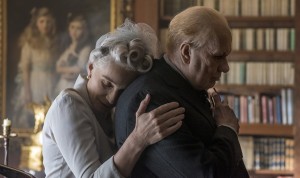
Oldman is transformed by makeup and prosthetics; his jowls are considerable. His tics and posture help render him unrecognizable. He dissolves into character. As Churchill he delivers some of history’s most famous and familiar speeches and he is electrifying. Kristin Scott Thomas as his tell-it-like-it-is wife, Lily James as his newbie secretary, and Ben Mendelsohn as the King help round out the cast but Darkest Hour feels like a one man show and Oldman is equal to the cast. Truthfully I don’t know many others who could carry 125 minutes of infamy, but Gary Oldman deserves his frontman status in all the Oscar pools. His portrayal is vigorous and complex and maybe even a little bit compassionate.

As for the movie itself, it’s not quite as formidable. The events are told simply, without a lot of cinematic flair, and it sometimes feels sluggish. There’s not a lot of imagination on display, and perhaps that’s an unfair criticism with the burden of historical accuracy weighing heavily, but director Joe Wright is more precise than entertaining. It’s Oldman who kept me in my seat, and I’m sure it’ll be Oldman bounding out of his on Oscar night to collect his well-deserved award.

All The Money in the World

In 1973, masked men kidnapped a teenager off the streets of Rome. He was the favourite American grandson of J. Paul Getty, the richest man in the world. Nobody gets that rich by being nice, and Getty is not. And of all the shitty things he is, miserly is one of them. You don’t get to be a billionaire by spending your money, after all. So when the kidnappers demand $17 million for him, Getty refuses. “Very little in life is worth paying full price for” he says, but he doesn’t plan to negotiate, he plans on just not paying. “It’s an awful lot of money for such a young boy.” But you can imagine how well that goes over with Junior’s mother.

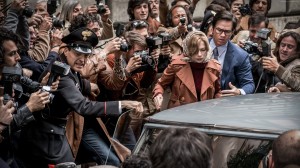
JPG III, 16 at the time of his kidnapping, has a strong-willed mother, Gail, and thank god. But Gail (Michelle Williams) has no money of her own and no access to her allthemoney2former father-in-law’s fortune. Getty (Christopher Plummer) is pretty set in his ways, and to avoid dealing with his mouthy daughter-in-law, he sends his “security guy” Chase (Mark Wahlberg) to do the dealing for him. But will this weird and uneasy alliance be enough to save Junior (Charlie Plummer, no relation)? If you were alive at the time you likely already know the answer.

If you’re alive right now and not willfully burrowing under some very thick boulders, you’ve probably heard that Kevin Spacey was originally tapped to play Getty Senior. Spacey’s creepy past caught up with him just a month before this film was to be released, which left producers scrambling. Ultimately, director Ridley Scott decided to reshoot Getty’s 22 scenes with another actor who had read for the part, Christopher Plummer. They filmed for 10 days and then frantically re-edited, and what results is a role for which Plummer received an Oscar nomination. Mark Wahlberg had costar approval built into his contract, and he refused to approve Plummer unless he got paid an additional $1.5M to come in for the reshoots. This eventually blew up in his face when it was reported that Michelle Williams only received her per diem of $800 per day. Wahlberg ended up donating the $1.5M to the #TimesUp campaign to stem the backlash. It’s fair to say this movie was under a lot of scrutiny before it was ever released, and I admit I wondered if Plummer’s nomination was perhaps just a reward to the film’s production crew for so quickly doing the right thing, but now I just think it unfairly overshadowed what is indeed an Oscar-worthy performance – by Michelle Williams.

All The Money In The World obviously has a lot to say about the soul-suckingness of money, at its centre is an old man with a corroded heart, but Christopher Plummer manages to play him with just a touch of warmth, which is an interesting surprise. There’s a compelling story here with great acting (with the exception of Wahlberg, who isn’t so much bad as just useless, extraneous), but the movie is just a little muddled (and a little fond of unadorned exposition). It flits between genres – family drama, crime, thriller. At its core though it’s really about this epic tug-of-war between a frantic mother and a cold grandfather, the struggle between love and money, and that’s a story that never gets old.

The Cloverfield Paradox

So this is what “straight to video” looks like in the Netflix age. Honestly, I am surprised at the drastic drop off in quality from 10 Cloverfield Lane to The Cloverfield Paradox, if only because I gave 10 Cloverfield Lane a 3 out of 10 and by comparison to Paradox, Cloverfield Lane is a masterpiece.

Basically, The Cloverfield Paradox is a less entertaining, less scary, and less interesting version of Event Horizon, a movie that really let me down 20 yeGDP-08575.rafars ago, and that I am sure has not improved over time. That The Cloverfield Paradox falls so far short of that (very) (very) (very) low bar is damning indeed.

For a “franchise” that I didn’t much care for in the first place, Cloverfield has managed to sink to new depths of awfulness with each new entry, especially with the two “sequels”, which were clearly written as standalone movies, then got stamped with just enough giant monsterness to justify the Cloverfield name.

At least at this point we can be fairly sure we’ve reached the end of this disappointing series. It is a sad state of affairs that I can’t totally exclude a reboot in five or ten years, but that’s a rant for another day (and one I’ve probably already written out three or four times in other reviews so I’m sure you can find it without too much effort!).

Geostorm

Geostorm takes incoherence to a whole new level, one I never thought possible. A guy dies on a space station for reasons that are entirely unclear and it seemed to me I had missed something. I rewound because I thought I missed an important detail, but I didn’t. It is just an unexplained and unexpected event almost 20 minutes into a 109 minute movie. The music cues told me this event was very mysterious, and eventually it ends up being a super important plot point begeostorm-1280-1508455954341_1280wcause it brings Gerard Butler into the mix (because he designed the space station in question). Come to think of it, Butler as a space station designer is one of the most believable aspects of this film.  That’s Geostorm in a nutshell.

Geostorm is a shameless ripoff of Armageddon, right down to tragedies in Asia and hail the size of basketballs, and Butler is asked to be both Ben Affleck and Bruce Willis. He is not up to the task to even being William Fichter (the guy with the gun in space). But rest assured, there is tons of drama to come, and it is set to the most over-dramatic and generic music imaginable. And the drama keeps on building as the scientists theorize that a Geostorm is on the way, and it turns out that Butler and his brother have quite a complex relationship, and a secret code, and lots of sciency gibberish to share with each other. At least I think these things were an attempt to add depth to these characters, but it all comes off as total garbage, and a pale imitation of other disaster movies that weren’t all that great in the first place. The worst part is, there’s not even a Geostorm for, like, ever, as we are forced to wait and wait for the disaster to actually occur while the scientists overhype it (by a lot).

I am quick to make fun of Michael Bay, because he makes lots of big, dumb movies that make little to no sense. Well, Geostorm made me feel kind of bad about having done that, repeatedly.  Mr. Bay, I am truly sorry for ever calling you a talentless hack because  Geostorm makes Armageddon look like 2001: A Space Odyssey.  In short, as a film, Geostorm is a disaster on a global scale. Fortunately, this is one disaster you can avoid all by yourself, without needing to prove that climate change is real.

Miles

Ron’s heart bursts while reading the Saturday morning paper in his lazy-boy. He leaves behind a wife, Pam (Molly Shannon), and a teenage son in his senior year of high school, Miles (Tim Boardman). His family is devastated, but not in the usual way. Miles is desperate to escape the confines of his small town for film school in Chicago next year, and Pam has been slowly asphyxiating in her crappy marriage for years. Turns out Ron wasn’t a very nice person, and he recently used his son’s college fund to buy his mistress a Corvette. The mistress is the only one without dry eyes at the funeral.

Pam copes by flirting with a widower (Paul Reiser) in her grief group, and by threatening the mistress, and the mistress’s mother. Miles copes by joining the girl’s volleyball team. Apparently it’s the only scholarship he’s eligible for.

The movie is set in 1999, which means the AV club consists of rolling a large tube TV around on a trolley and chatting looks boxy and pixelated and awful. But it still encompasses a pretty big chunk of the plot. There’s really to recommend setting the movie in 1999 except it’s based on a true story, which is also an awkward implication.

But anyway: we’re going to rock the boat in small town wherever, circa 1999, when boys didn’t play on girls teams and coming out to your parents was still an occasion. So maybe there’s still room for this kind of courage, whatever that means. There’s an effort here to be relevant but the truth is, our protagonist is narrow-minded in his own way. He sees only his own needs and wants, not the larger picture, so it’s hard to really extrapolate the kind of meaning that would make this film feel satisfying.

Goodbye Christopher Robin

I wonder in what ways the world would have been different if Alan Milne had not married a perfectly horrid wife. Daphne is an excellent socialite but not terribly prone to marital bliss. She waited for her husband to come back from war and is not impressed with the man who comes back. Her advice to just “not think” about the war is not exactly practical, and then she has a son she doesn’t want or know how to love to cheer him up, and that doesn’t work either!

But of course it’s their son, C.R., aka Christopher Robin, aka Billy, whose stuffed animals and wild imagination inspire the very thing he’ll become known for. And it’s his wife’s abandonment of the family that allows father and son to spend meaningful time together, time enough to write the stories that will enchant the world and change their family forever.

goodbye-christopher-robin-domhnall-gleeson-slice-600x200

Domhnall Gleeson plays the famous author A.A. Milne, a man ravaged by war, confused by his wife, haunted by the characters he created. Winnie the Pooh is a beloved story for children, but the people behind it are much darker than I’d imagined. This is not really a happy story. Margot Robbie plays his flitty wife, a woman easy to scorn but Robbie humanizes her, has compassion for her. Kelly Macdonald plays the woman who actually cares for young C.R., a nanny her charge calls Nou but the world will know as Alice, from the books. She’s the one who bears the burden placed upon a little boy upon whom the whole world has expectations. The cast is quite wonderful; even the little kiddo (Will Tilston) playing Christopher Robin is good, as he must be.

But as you can imagine, it’s difficult to flick back and forth between the horrors of war and the child-like wonder that inspired a favourite picture book. It adds little pops of whimsy to lighten the mood, but make no mistake: it is a dark mood in need of lightening. At times the movie really hits the right note, but it’s a tone that’s hard to keep – especially since the point is not really Winnie the Pooh OR war, but the nasty consequences of celebrity. Goodbye Christopher Robin surprised me and moved me, but it’s not a water-coloured, feel-good picture, just the sad truth behind a story you thought you knew all too well.

Flatliners

Courtney is a medical student in a competitive hospital. She’s not content with just being the best, she wants to be a pioneer, and she’s got her eye on quite the break-through: she wants to be an expert in the afterlife. To that end, she recruits a few brave colleagues to do some top-secret experimenting in the hospital’s basement. She somehow convinces them to stop her heart for a full minute before resuscitating her. When she wakes up, her brain is re-wired, keyed up to excel, to remember everything, to reach further, better, higher. So of course her fellow students are jealous, and curious, and lineup to have their hearts stopped.

Ellen Page is kind of the coolest. I respect her. She makes everything she’s in better. Flatliners-stillBut you can hardly make something better if it isn’t remotely good to begin with. The thing is, the idea behind this movie is probably solid. But this movie takes an interesting premise and immediately flushes it down the nearest toilet. It takes philosophy and science and turns it into a party drug, giving lots of opportunity for shirtless dancing but not a whole lot else. It’s supposed to be a horror movie and it does lazily throw some things at the screen in order to startle you, but it doesn’t try hard enough at anything. I don’t even think the original was all that great, but trying to make a second cup of tea from the same old tea bag makes for a very weak cuppa.

The most character-building the movie strives for is to give each student a name, and a haircut. Basically they’re all greedy, selfish, horny little pricks. Shouldn’t med students know better than to intentionally die?

Newsflash, guys: bringing stuff back from the dead is rarely a good idea. It’s funny that the director made a movie about this but never took the lesson to heart.

Professor Marston And The Wonder Women

William Marston was a professor of psychology; his wife Elizabeth was an equally and likely superior mind, but being female, was relegated to assistantship. Professor Marston  (Luke Evans) was developing lots of new ideas about behaviour, and had a new theory based on  dominance, inducement, submission, and compliance. He and Elizabeth (Rebecca Hall) were looking among their students for a young apprentice, and found what they were looking for and more in Olive (Bella Heathcote).

The Marstons both fell in love with her, and a polyamourous relationship was born. They had children together and continued to work and invent together – the modern lie detector test is thanks to them. But what may be most remarkable about this MV5BNzMwYmUzZjItNDVjMy00YWE5LWE0MWUtNWZlYThlNmQ1NTQ1XkEyXkFqcGdeQXVyNDg2MjUxNjM@._V1_SY1000_CR0,0,1499,1000_AL_relationship, taboo and reviled in the 1930s and 40s, was that it inspired the creation of the Wonder Woman comic. Marston’s original stories (written under a pseudonym) incorporated the feminist ideals embodied by his wives. Wonder Woman was a strong woman who needed no man. His early comics also involved a fair amount of bondage and submission, which he pursued in his own bedroom and thought more young men should be turned onto. You can imagine the sort of censorship and uproar he faced.

With Wonder Woman so fresh in our cultural memories at the moment, it’s interesting to witness her birth, to see the surprising and sometimes literal inspirations that Marston drew upon. The performances are strong and the three have a nice chemistry that, despite accusations of “sexual perversity,” feels very honest and sometimes nearly wholesome. Rebecca Hall in particular shows the conflict and the consent and the curiosity that pushes her character toward an unconventional life. I must say, however, that I’m a little disappointed in the title. Though the film makes clear enough that Marston is bested by his lovers, they still seem to take second seat in this story, and that feels like a let down to our hero, and her real counterparts.