Remember when the Fast & Furious gang were street racers who dabbled in highway robbery? Because the franchise’s writers seem to have totally forgotten. The street races are long gone, replaced with international espionage, world-devastating weapons, and an ever-growing cast of action heroes.
Two of those additional action heroes, Hobbs (Dwayne “The Rock” Johnson) and Shaw (Jason Statham), are now spinning off from the main storyline and saving the world without any help from the rest of the franchise’s former street racers. This time, Idris Elba plays the unstoppable cyborg bad guy who’s racing against Hobbs and Shaw to track down a supervirus that Shaw’s superspy sister (Vanessa Kirby) injects herself with. Luckily, the supervirus takes 72 hours to take effect, giving Hobbs and Shaw a chance to find a way to extract it…if only they could put aside their differences and find a way to work together.
Of course Hobbs and Shaw will find a way to work together, but it takes longer than you’d expect. Probably because Vin Diesel isn’t around to remind everyone that they’re family. That’s Hobbs & Shaw in a nutshell: a very competent (though brainless) action movie that more than anything will make you miss Diesel and the rest of his Fast & Furious family.
No matter how many explosions or dune buggies are involved in a showdown with the villain’s helicopter, Hobbs & Shaw doesn’t measure up to the other instalments in this franchise. At best, it’s a teaser trailer for Fast & Furious 9, but the energy that went into Hobbs & Shaw probably would have been better spent on something involving the whole crew. Because when it comes to big, dumb action films, bigger is better, and that’s a lesson I thought this franchise had learned a long time ago.
Eleven is such a precious age. You’re straddling the cusp of childhood and adolescence. You’re feeling big in your britches but the world’s still treating you like you’re a little kid.
I remember going to Denny’s once, and the waitress brought me one of those paper kid’s menu-placemat hybrids with 3 crayons so I could choose between the grilled cheese or the chicken nuggets. I was insulted. Beyond insulted. The kid’s menu was for 12 and under and I was 9. Nine! Practically a grown-ass woman, I thought. How dare she. I have never been back to a Denny’s. That’s a true story. I hold a grudge. The point being, those tween years are tough. They didn’t even call us tweens back when I was a tween. In fact, my little sister gave me a homemade card calling me a “teeny bopper” which makes it sound like I grew up in the 1950s – actually, that’s just a word she got from my grandfather, but it stuck. I didn’t care much for that either, but surprisingly, I still speak to both my sister and my grandfather, though I do sometimes still harbour dark doubts that they deserve it.
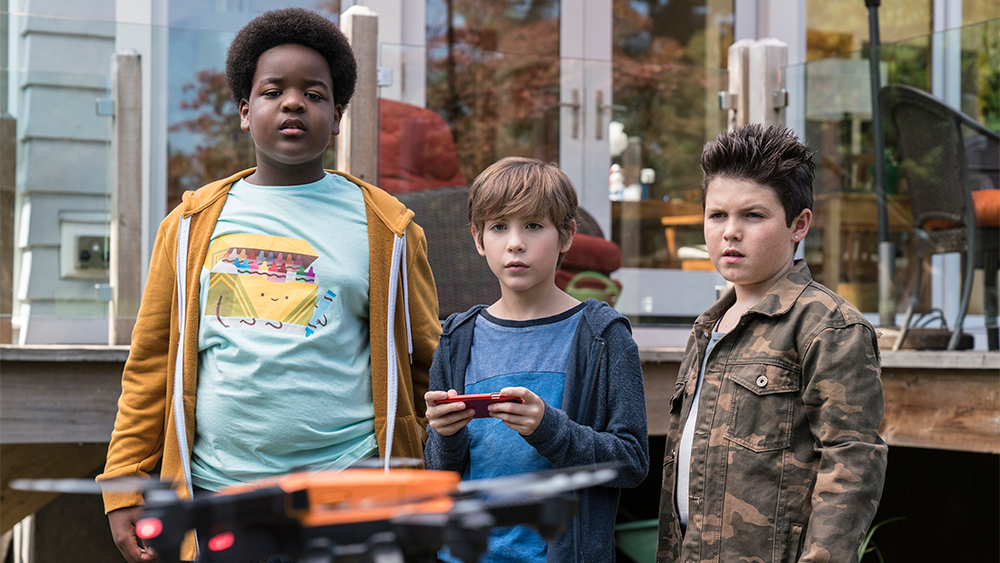
Max (Jacob Tremblay) is the undisputed leader of the bean bag boys, a trio including golden-voiced Thor (Brady Noon) and nervous nelly Lucas (Keith L. Williams). They have just unlocked the most coveted of achievements: they’ve secured an invitation to cool kid Soren’s (Izaac Wang) party, a kissing party with girls and everything. None of them know how to kiss, which is a problem, but not insurmountable. Between the 3 of them, they come up with quite a plan for learning how, but their brilliant plan falls apart when they lose Max’s dad’s work drone to a couple of teenage girls, then steal their drugs in retaliation, then spend the rest of the movie in an epic quest to make things right.
I loved the characters from the start. The script really captures the line they’re straddling between youth and adulthood. The kids are just beginning to think about sex but haven’t got a clue. They talk big and swear hard, but their innocence is always quite apparent. As a grown-up, you just want to clasp your hands to your heart and declare them precious, but doing so would probably have them die of embarrassment. Oh lord it’s hard to be eleven.
All 3 kids are well-cast and have a great rapport. You believe them as a unit, even as they’re starting to realize that they may not be destined to be best friends forever as previously believed. The script is a magnet for vulgarity, and perhaps embraces it a little too heartily, but for all its gross-out humour, it has a lot of heart. I especially love how much the kids have internalized the concept of consent. It gives me hope. Good Boys reminded me of my own awkward transitional years, but mostly it made me think of my oldest nephew, who will turn 8 in a couple of weeks. I cradled him in my arms the day he was born, he peed on me while I gave him a bath, he’s clung to my neck when he had a booboo. But every day he’s getting bigger, and thinking more for himself, and growing apart from the very adults that he used to want nothing more than to play with on the living room floor. It’s nearly impossible for me to stop seeing him as a little guy, but since I’ve known him, all he wants to do is grow. I remember when his biggest goal in life was to weigh 40 lbs so he could go from car seat to booster seat. And then he wanted to be just tall enough to ride the Vortex water slide at the Great Wolf Lodge. Now he wants to be old enough to watch End Game. Meanwhile, who among us doesn’t occasionally wish we could hit pause? Have him stay cute and cuddly forever, sweet smelling and polite?
Good Boys made me laugh, but more than that, it made me smile.
That’s the sound of Netflix scraping the bottom of the barrel. When they’re borrowing the very worst ideas from the 1990s, you know we’ve hit peak terrible. Insert: Marlon Wayans. Not to shit on Marlon Wayans exactly, but has anyone wondered what he’s been up to? No. Has anyone been clamoring to bring this dude back? Certainly not. But ever since Tyler Perry retired Medea, there’s been a hole left in cinema, a hole that perhaps should have been filled in quickly and never again spoken of, but Netflix has instead decided to jump right into it without consulting anyone. Marlon Wayans, aka, the poor man’s Tyler Perry, didn’t need to be asked twice.
And that’s how you get a movie like Sextuplets, a movie that makes you wish for Adam Sandler’s quality programming. It’s just Marlon Wayans playing 6 roles, each one nastier and more cliched than the last.
Alan (Wayans) is expecting a baby with his wife. She comes from a good family who are concerned that he brings little to the table, “generationally” since he grew up in the foster system. It seems a weird thing to get uppity about, an indefensible thing, but the whole movie hinges on Alan really taking it to heart, so he does. And even though his wife is 8.75 months pregnant, he goes off on a road trip to find his birth mother.
And you might want to sit down for this, but *spoiler alert* he instead finds 5 siblings. And each sibling is just Marlon Wayans doing an uncomfortable caricature. Lots of fat suits involved, which are of course cringe-worthy, but even when he runs out of fat suits (male AND female), he only gets more offensive. So brace yourself. And even though his White Chicks self must have been yearning for a little white face, the closest he gets is with a “ninger” and you know I am NOT going to define that for you, but I will let your wildest imagination scold him for even thinking it up. Ugh.
Sextuplets is like a black hole of laughter. I was mad less than 90 seconds in, and he hadn’t donned a single derogatory costume yet. His performances get more and more wild as he desperately searches for a laugh but the truth is, all he hits are sour notes. It’s ugly.
It’s actually nearly impossible for me to believe I haven’t reviewed this one here yet because it’s such a treasure, one that continues to impress me in new ways every time I watch it. Coraline is 10 years old now and it’s safe to say the world of animation has changed in its wake. With Coraline, Laika showed that animated films could be more than just cartoons for kids. With gorgeous, artful sets, thoughtful stories, and dark themes, Laika has distinguished itself as a cut above, and Coraline has set the bar for so much that has come since. They weren’t the first to do this, of course, but they’ve certainly made the biggest impression on American box offices.
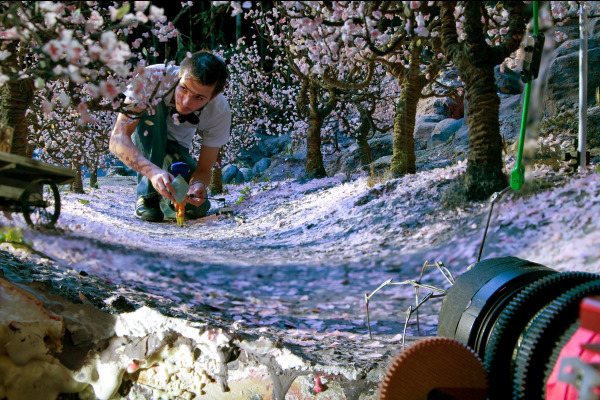
I happen to love stop-motion films because it feels like we’re so much closer to the artwork. 24 character puppets were constructed for Coraline, which kept 10 artists busy for four months. The Coraline puppet at one point shows 16 different expressions in a span of 35 seconds. When you stop to think about what that series actually means, the careful minutiae, the attention to detail, the willingness to expend so much work for a few seconds of film, you start to really appreciate the possibilities of stop-motion. Of course, there was no single Coraline puppet, there were 28 made of her alone, in different sizes for different situations. Her face could be detached and replaced as needed. The prototype would be molded by a computer, and then hand-painted by the modeling department. Each jaw replacement was clipped between Coraline’s eyes, resulting in a visible line later digitally removed. There were exactly 207,336 possible face combinations for her character. Just her character! Over 130 sets were built across 52 different stages spanning 183,000 square feet – the largest set ever dedicated to this kind of film.
I like to think about the different people on the set of a movie like this. One person was in charge of making the snow (the recipe calls for both superglue and baking soda, if you’re interested; leaves are made by spraying popcorn pink and cutting it up into little pieces). Someone laid 1,300 square feet of fake fur as a stand-in for grass. Another was hired just to sit and knit the tiny sweaters worn by puppets, using knitting needles as thin as human hair. You have to really LOVE doing this to dedicate your life to knitting in miniature. Students from The Art Institute of Portland had the opportunity to help out – what an amazing induction to a burgeoning industry.
Coraline is an 11 year old girl, recently moved to a new home, and her parents have little time for her. So perhaps she can’t entirely be faulted for falling for a grass-is-greener situation when she finds a secret passageway in the new house and follows it to an alternate universe where her Other Mother is attentive and loving. Of course, all is not as it seems – the Other Mother is trying to keep her there, permanently. It’s dark, but also magical, spell-binding. It absorbs you into this world, which remains in a state of disorienting metamorphosis. The Other World seems inviting at first – utopian, even, to a young girl. But as it unravels, the world looks and feels increasingly hostile; Other Mother herself begins to wear clothing and hairstyles more forbidding and harsh. It reveals itself in a dizzying, undeniable way, the best use of the medium, an unforgettable piece of film.
Remember in the 90s when they tried to make Adam Sandler and Damon Wayans the next big thing in buddy cop movies? No, you don’t. Nobody does, except little Jay, who had this forgotten artifact on her garage DVD shelf because she harboured a bonafide 90s crush on Adam Sandler from about 1993-2003, roughly. But they weren’t no Gibson & Glover, or Tucker & Chan, or Smith & Lawrence, or Tom Hanks & a series of dogs in the role of Hooch, namely a Dogue de Bordeaux named Beasley and his stunt double, Igor.
It was Sandler’s idea; Wayans hosted SNL in 1994 and Adam got it into his head that the two should do an action movie together. He soon sent him this script.
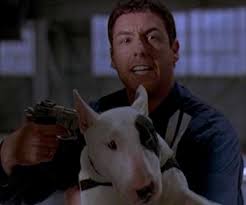
Keats (Wayans) and Moses (Sandler) are best friends and criminals, in that order. Until a deal goes wrong and Moses finds himself on the wrong end of an arresting officer – Keats, an undercover cop, insists on bringing his buddy in himself, safely, but things go even wronger and before you know it, Keats has a bullet in his head and Moses is on the lam.
Cut to: a year and a lot of rehab later, Keats is tasked with bringing Moses in yet again. This time he’s an important witness, turning state’s evidence against drug kingpin Colton (James Caan) who doesn’t take too kindly to betrayal. Cue a crazy roadtrip that goes wildly off the rails. Think exploding planes and flying bullets and a lot of dead agents and double crosses. Only it’s an Adam Sandler film (sorta – these were the days before his Happy Madison production company, so it’s not written and directed by his cronies), so also be thinking along the lines of toilet humour and crass sex jokes.
Is this a good movie? Of course not. You’d have to be Adam’s mom, or his secret tween girlfriend, to love it. And I bet his mom hasn’t even seen it. I heard an interview once where he said that when his new comedy album came out (yes I owned them all), he took his dad out to his car to listen to it. So his mom wouldn’t overhear. He protected her from his own vulgarity. His father is gone now, but if you’ve seen any of his Happy Madison films, you’ve seen and heard Mr. Sandler – he’s their logo. If you’ve seen any of Adam’s movies, you’ve likely recognized some faces; he’s extremely loyal. I could say his family is no exception, and that’s clearly true, but I believe his family is where his attitude originates.
As for the awkward homophobic bent of the film? I mean, no, it has no business being there. But it’s broad comedy, meant to elicit a tone-deaf guffaw from young men circa mid-90s. If Keats and Moses have to share a hotel room, why not insert gay joke? Don’t worry – we, the audience, paid for this directly when Adam released Chuck & Larry several years later. It placed him firmly in the “gay is okay” camp while decidedly not absolving him from the “makes shitty movies” camp down the street.
Anyway. You don’t need to be convinced not to watch this movie. You already didn’t watch it. Good for you. Continue exercising your good judgement. That is all.
This is going to sound strange, so deep breath in, and bear with me. The problem with High Fidelity is John Cusack.
There, I said it. I feel much better now.
You can disagree with me if you want. You’re wrong, but you can disagree. It is physically possible. It’s just not intellectually advisable.
There’s nothing wrong with John Cusack. He was just miscast. I mean, I get how Rob Gordon might seem like the grownup version of Lloyd Dobler, but he’s not even close. Rob Gordon is actually a pretty pathetic guy, but because he’s played by Cusack, some accidental, unintentional coolness is rubbed off. And I get how some underachieving young men might misguidedly put him on a pedestal. Rob is the ultimate fanboy nerd, but he’s the least losery of his friends, the least socially inept. And he puffs himself up by being snobby about his pop culture obsession. Fine. But the thing about Rob Gordon is: he’s not a good guy.
Nick Hornby makes that pretty damn clear in the book, and the character tells us this repeatedly himself in the film: “I am a fucking asshole,” he tells us, but then Cusack flashes those deep brown puppy dog eyes and we feel conflicted. He’s doing and saying pretty shitty things, but it’s Cusack, so he MUST be likable, right?
He’s not likable. He’s an ungrateful little shit. He’s a womanizer with a serious case of (male, as if it needs to be said) entitlement. He skulks about being a rude human being, a stalkery ex, and a very bad boyfriend. But Cusack is such a charmer, and he’s got such a sweet, sympathetic history with cinema, that we ascribe way more positive feelings toward this guy than the character actually deserves.
At one point, when he’s on a self-serving rampage of reconnecting with ex-girlfriends in order to reassure himself that he’s basically blameless, Penny tells reminds him that in fact, HE broke up with HER because she wouldn’t have sex with him (“I wasn’t interested in Penny’s nice qualities, just her breasts, and therefore she was no good to me.”). Her heartbreak led to what basically amounts to rape, and years of sex phobia, and he’s so relieved and satisfied with that answer that he’s spurred to pursue even more ex-girlfriends, never mind the fact that the one right in front of him has just run out of the restaurant in tears. The man is a sociopath and I’m not even kidding. The next ex-girlfriend he visits is thickly mired in depression, and he practically asks us to pat him on the back for not taking advantage of her.
Rob is jealous and possessive and harassing. He is the stuff restraining orders are made of. And he doesn’t even learn a lesson. In the end, the woman who dumped him takes him back because, having just suffered the death of her father, she’s simply too tired, too beaten down by his coersion, to fend him off. That is not a getting back together story that anyone should feel good about, and almost as fast as they can reconcile, he’s off chasing yet another manic pixie fantasy cunt because he can’t even for 10 seconds actually be the nice guy he pretends to be. This is the height of toxic masculinity, but because it’s wearing a cute and cuddly John Cusack body, we fail to see it. We root for him because he’s less of a greaseball than Tim Robbins’s Ian. But being 10% less of a douche doesn’t make you not a douche. It doesn’t make you a nice guy. It doesn’t make you deserving of anyone’s love. Rob Gordon is not a hero. He’s a romantic failure and a social liability and if we made a follow-up to the movie today, he’d be living in his mom’s basement screaming at her to make him some Hamburger Helper as he trashed-talked 12 year olds on League of Legends.
After a lovely sojourn at the cottage, Sean and I came home to no internet. No internet! So after a nice vacation of living off the grid by choice, we are immediately and understandably enraged that we are now forced to continue doing so IN OUR OWN HOME. And guess what: the Bell guy (internet provider) says they can’t fix it until September. SEPTEMBER. Which is not this evening. It’s next month! Which is a long way of saying there’s a reason there’s been a dearth of reviews on the site lately, and that some of the past reviews were random cottage finds (see: The Hitchhiker’s Guide to the Galaxy) and many of the future ones will be pulled off the dusty shelves of our DVD collection, which has been housed in the garage ever since DVDs became obsolete. And yet here we are, watching movies like “a homeless person” (I’m quoting myself here, in a moment of admitted hyperbole).
Anyway, there we were on a Saturday night, which is to say, a Sunday morning, watching The Big Lebowski. And no, you’re not having a stroke. That’s not the same title as the one up top. We were maybe 90 seconds into the film when Los Angeles is referred to as the City of Angels. That’s not endemic to The Big Lebowski, it’s a pretty common if misleading nickname for L.A. but at any rate, it DID remind of the 1998 romantic classic City of Angels (I know, not a big leap) and as soon as I learned that Sean never saw it (clearly he was terminally single in 1998), I insisted that Sean go out to the garage to find a copy of the movie I was 36% sure I owned and 98% sure I hadn’t seen this century.
And here’s how that panned out.
First I am shocked to recognize Captain Raymond Holt (Andre Braugher). Actually, it took me a while to convince myself I was actually recognizing him – it looked like him, sorta. A younger him to be sure, but really the problem is that Brooklyn Nine-Nine’s Capt. Holt is the world’s most deadpan character AND HE NEVER BREAKS. I’ve never seen his face express emotion before. I’ve never seen his lips do that slight curling upwards thing known as a smile. Even his voice was different; Capt. Holt is serious, and monotone. Braugher is my favourite part of the show, and he has transformed himself so wholly for the role that I could barely recognize him even though this film does nothing to obscure his identity. Watch carefully and you’ll also see a brief cameo from Ron Swanson (Nick Offerman), so all your TV idols really did start off in a Nicolas Cage movie. Just kidding. That’s not a saying. Gross.
I’m actually very surprised that there’s a 1998 version of me that liked this movie. I was young, but was I really that dumb? I pretty much loathe Nicolas Cage and it’s hard to imagine that there was a time that I did not. And this movie gives you LOTS of reason to hate him. Dear god.
Nicolas Cage plays an angel, in a city that is chock-full of them. They creepily hover around people in order to better swoop them away at time of death. Seth (Cage) is doing exactly that, and exactly as creepily, during a man’s heart surgery. His surgeon, Maggie (Meg Ryan), loses him on the table, and unaccustomed to loss, she starts to fall apart. Seth starts to fall in love. Usually invisible to the living, he’s convinced she somehow saw him as he lurked about her operating room. And so he makes it so: he appears to her, and compels her to fall in love with him, and just when it starts to feel crazy for a human who saves lives and the angel of death to be in a romantic relationship, he becomes human for her. He takes the fall from grace.
I remember being a kid in full meltdown mode for like HOURS after this movie. HOURS. Oh the hormones pumping through my little body.
This time I just can’t get past Nic Cage’s cadaverous skulking about. I feel insulted on Meg Ryan’s behalf. Cage is in no way suitable for a romantic role. Deranged psychopath? Sure. I buy that. I still don’t like him. I still think he’s a terrible actor. But I’d buy it. Here? Not for a second. I keep wanting to yell at Meg Ryan that there’s a vampire waiting to eat her face! And frankly, when they kiss, I can’t help but feel like my suspicions are confirmed.
Even though my eyes were extra extra dry at the end of the film this time around, I still had to explain the ending to Sean, who is a robot. He doesn’t get stuff about love and sacrifice and forever. Sean’s review would consist solely of a shrug. Mine is likely far more hostile. This thing just isn’t holding up.
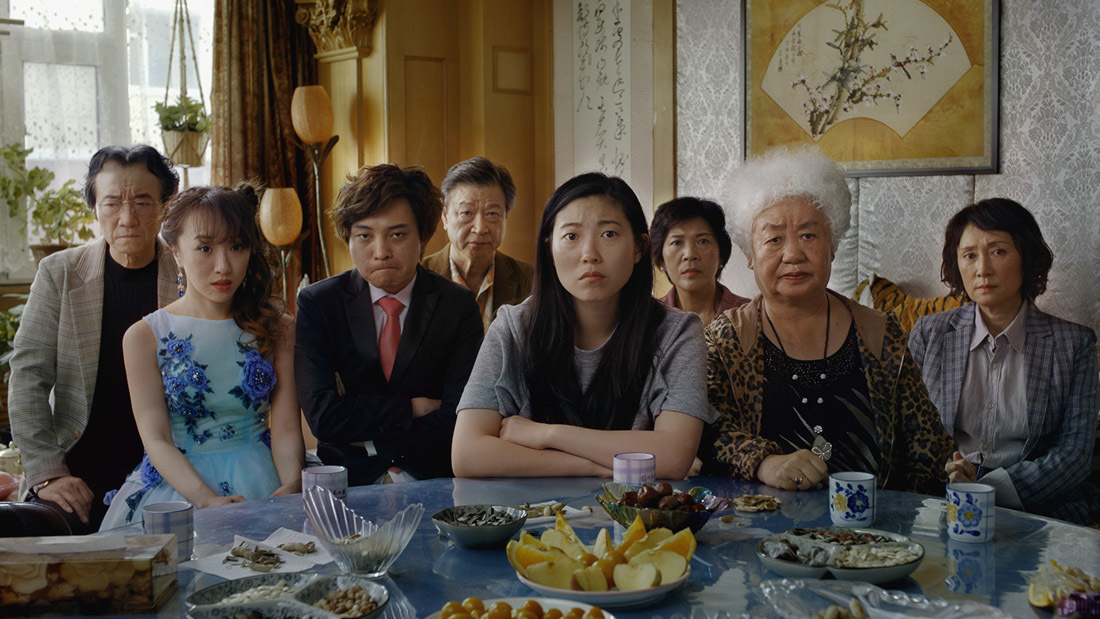
Billi (Awkwafina) is barely scraping by, trapped somewhere between her parents’ disapproval and her need for their continued financial support when she’s blindsided by the news of her grandmother’s cancer diagnosis. Grandma, aka Nai Nai ( Shuzhen Zhao), is in China, and totally oblivious to her health status. Billi’s parents, Jian (Diana Lin) and Haiyan (Tzi Ma) moved to America when Billi was 6, but she’s always managed to stay close to her grandmother. She’s disturbed when she finds out her parents are willing to keep the secret from Nai Nai, and even more dismayed when she learns they, and the rest of the family, will be travelling to China to say goodbye under the guise of a wedding. But Billi, known for being awfully emotional, is not invited. One look at her teary eyes would tip off Nai Nai for sure.
She goes anyway.
What follows is lyrical, moving and a thoughtful tribute to family, and the nature of goodbye. But it’s also a meditation on some of the differences between East and West. In China, it’s common practice to hide this type of diagnosis from a loved one. Billi feels conflicted about this choice, and reminds people that in America, it would be flat-out illegal for medical professionals to hide someone’s medical status from them. But Billi’s uncle insists that in Asia, family trumps everything, and it is their job to bear this emotional burden for her, so that Nai Nai’s last months or weeks or days are not wasted on sadness and regret.
And certainly, the film is not wasted on sadness or regret. The family throws a wedding so that all Nai Nai’s friends and relatives can gather round her one last time without arousing her suspicious. A very obliging girlfriend of just 3 months goes along with it and wins good sport of the year for the next dozen years. So now the onus is on Billi to say goodbye in a non-obvious way.. And it turns out she’s not just saying goodbye to Nai Nai, but to her last real link to China.
The ensemble cast is uniformly terrific. They really create a dynamic that is utterly believable as a family, and that’s why the movie works so well. It could easily melt toward the sentimental but manages to stay firmly away from the overwrought. That said, the writing is good. Very good. it rings true and feels relatable. Awkwafina is of course the light and joy of the film, but don’t expect her usual goofball act. The Farewell is not a comedy. It is subdued, and tragic. But Lulu Wang’s writing and direction keep it authentic and filled with compassion, the kind of film that unites us in our humanity.
Martha (Diane Keaton) is dying. She has no partner, no children, not even a cat. Just a NYC apartment full of stuff she doesn’t need and one niggling regret. After selling off most of her worldly possessions and relocating to a senior’s retirement community in Georgia to die in a warm climate (where stupid hats are NOT optional), she knows exactly how she’ll spend her remaining days: cheerleading.
Sure it’s unconventional. But quilting and baking and playing bridge don’t really appeal to a woman like Martha. She’s been haunted her whole life by a childhood ambition that went unfulfilled, and if she doesn’t do it now she never will. And when she holds tryouts, it turns out that at least 7 other women wouldn’t mind humiliating themselves along with her – Jacki Weaver and Rhea Perlman included. And also Pam Grier, who quite possibly could never humiliate herself – she is a queen among peasants. No knock against anyone else, but Grier is the accidental sun in this solar system.
In many ways, this is a silly and frivolous film, one that won’t make any lasting impression on the world of cinema, and didn’t really make a dent in terms of sales. But I bet if you’re over 65, it might be nice to see an older person on film who isn’t just waiting to die, or to dispense their life’s advice to the young protagonist, but who is instead still pursuing dreams, still the protagonist in her own life. You may have heard that Anjelica Huston for some reason felt the need to take a shot at the film, which is unfortunate, because there are a lot of older ladies in Hollywood, and only about half a role to split between them. You’d think she might be a little more supportive. Perhaps she and her creaking hips were just jealous? I know why I’m jealous: there’s an old lady on the cheer squad who does the splits. And it’s pretty impressive that she can do the splits at her age, but it’s REALLY impressive that she can get back up out of the splits afterwards, unassisted. That’s who I’m jealous of. I’d be stuck FOR DAYS.
And I guess I’m jealous of anyone who knows their expiration
date is approaching, and instead of living in fear, they just live. Martha uses
her time. Instead of stewing in regret, she chooses joy.
The director, Zara Hayes, also chooses to slip some subtle messaging into the film about how we police women, and especially elderly women. How we default toward infantilization. While some older people will of course require care, they also, unfailingly, deserve respect. And it feels far too easy for an older woman to become disenfranchised and lose her power.
Poms is a sweet, well-intentioned film. The ladies make dreadful cheerleaders. I’m sorry, but it’s true. The movie really doesn’t glamourize old lady cheerleaders. Their moves are tame and lame and underwhelming, exactly as you’d expect them to be. But it’s the women’s verve and vitality that shines through. They’re not setting the world on fire with their dance moves or athleticism. But they’re not going gently into that good night. Until they’re dead, they’re alive. And in that way, it’s a very inspiring little film.
Three mothers, originally friends because their sons were
friends, have stayed in each other’s lives even after their sons have all moved
away. We meet them at a mother’s day brunch they’ve thrown themselves because
their lousy sons always forget (if any one of them had a daughter, or even a
daughter-in-law, this movie wouldn’t exist; daughters are not allowed to
forget). Not content to just sit around bitching and whining about their lives,
they decide to inflict their neuroses on their grown sons, uninvited. So they
pack themselves into the world’s most hostile road trip and storm New York City
to make their problems someone else’s.
You likely know a mother or two just like this, and if it’s
your own mother, well, god bless you. This kind of mother wants it both ways:
she decides she MUST become a mother because her life is incomplete, but then
she spends her kid’s life telling him or her that it was a completely selfless
act that requires a well of gratitude whose depth cannot be measured as it is
bottomless and unending and nothing will ever be enough. And when the child is grown,
the mother is lost and without purpose because motherhood was everything and
now she is nothing. And improbably, all three female characters in this film
are suffering from this affliction.
Personally, I know tonnes of mothers who have managed to
maintain a balance between forging a career, having their own life, nurturing
friendships, and being better mothers because of it. I don’t imagine that’s
easy, but it’s life, and the last time I checked, motherhood IS optional. But
these women are acting like life is over because their grown sons don’t
immediately reply to their inane and constant texting.
It must have been difficult for Netflix to promote this
movie since one of the three women is Felicity Huffman and she’s not exactly
winning any motherhood prizes right now (if you’re just poking your head out
from underneath a rock, she’s one of the parents accused of believing that her
kids are such profound idiots that they could only get into college with the
help of large, illegal bribes, and that they still deserved to be there,
perhaps taking the place of your own kids, who would have otherwise merited the
position, because their mother is rich and famous and quite possibly she just
wanted them out of the damn house). Leaving her aside, Netflix managed to
convince both Patricia Arquette and Angela Bassett to join the ranks of the
pitiful. And frankly, Arquette does nothing to dispel the pity party. She’s
gotten a little too comfortably playing the kooky, offbeat, perpetually single
mother. When she breaks into her son’s apartment to bake for him, it’s
uncomfortably believable. When she fails to learn a lesson about meddling and
instead declares that the only problem was that she didn’t meddle soon enough,
you believe that too.
Bassett, on the other hand, is an asset. Her character has
certainly invested too much of herself into living for the men in her life (her
husband and her son), especially when those men haven’t deserved it, don’t
return it, and don’t even want it. But because it’s Basset, her character doesn’t
feel pathetic. She holds her head high. She clearly has strength. And she DOES
learn her lesson, and earns herself a better life; in the end, she’s the only
one we’re really rooting for.
I think a lot of women, and perhaps parents generally,
struggle with the transition from parenting a child to parenting an adult. But
the truth is, that role is always changing. A newborn baby is a round-the-clock,
soul-sucking (and hopefully soul-nourishing) job; a two year old is a battle of
wills; a twelve year old is an exercise in diplomacy; a fifteen year old is a
test of nerves. You never stop being someone’s mother, but mothering stops being
invasive and starts being supportive at some point – if you’ve done it right. Not
everyone gets it right, and that’s okay too, because we’re all human and we’re
all learning on the job. You might even have to be someone’s kid while also
being someone else’s parent. But neither of those things should subsume your entire
identity.
Otherhood isn’t a great movie but it’s possibly worth
watching just because there isn’t enough Angela Bassett in the world as it is.
Stories about women are worth telling. We don’t always get them right. We’re
all fumbling around trying to figure shit out. And if you haven’t recently been
federally indicted on charges of conspiracy to commit fraud, punishable by up
to 20 years in prison, you’re probably doing okay.








 ASSHOLES WATCHING MOVIES