
Only a few minutes into Monsieur Mayonnaise, my brain’s got an itch. Something about this feels familiar but it can’t be the movie as it’s making its Canadian premiere at the Toronto Jewish Film Festival. Rather it’s the man himself, artist Philippe Mora, who I’ve lately seen in Three Days in Auschwitz, about how his mother narrowly escaped being  sent to Auschwitz. Philippe Mora is an artist of all mediums; while he did not direct this particular documentary, he did write and illustrate the graphic novel of the same name.
Monsieur Mayonnaise is about Mora’s father, a member of the French resistance. He earned the code name Monsieur Mayonnaise when he suggested the resistance smuggle important documents inside sloppy, mayonnaise-filled sandwiches, after he observed Nazis avoiding greasy foods in order to keep their pristine gloves clean. His father’s position allowed him to protect and shelter the family of the young woman with whom he was quickly falling in love. After the war, fearful of another, Mora’s parents fled to Australia, where they made their home, raised a family, and opened several restaurants which would feature hand-made mayonnaise prominently.
These are the reminiscences that inspired the colourful artwork that makes up Monsieur 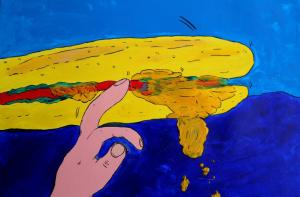 Mayonnaise, both the comic and the film. Director Trevor Graham films the madcap artist as he careens around the world, meeting up with heroes, villains, and the ordinary people still alive today because of his father’s efforts – teamwork improbably involving Marcel Marceau – smuggling Jewish children across the border.
Mora is practically a subject unto himself, and if his flightiness is mirrored in the documentary, so too is his exuberance.
You can catch a screening of this film on the following dates:
Thursday 11 May, 3:30 PM – Alliance Francaise (Director Trevor Graham will Skype in for a Q&A)
Sunday 14 May, 1:00 PM – Cineplex Cinemas Empress Walk 9
 sister also got one, a brunette named Valerie, which I felt was unfair because she’d done nothing to deserve it besides poop and scream and steal my parents’ love.
 this stuff at the time, but I have certainly been aware of them in retrospect. These bubblegum comic artists tapped into a vein of childhood rebellion and ended up making lasting work.
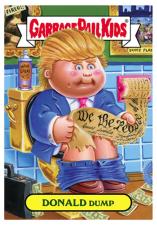 He’s got a bag of rice, and a bag of flour that looks almost identical to the bag of rice. How these are fun toys I have no idea. We usually pile them on Lightning McQueen and race. But Brady’s own counter culture is already budding at 5 years old: Shopkins are parodied by the Grossery Gang, the same basic shitty toy, but disgusting (ie, mouldy cheese). I don’t get it, but adults aren’t meant to. It’s kind of cool that he’s got his own little act of rebellion, but if you’re in the mood for some throwback rebellion, here’s a hint: the Garbage Pail Kids are back.
 up some hangers-on (Jenny Slate among them) and proceed to have a very weird weekend.
 She plays the mother of sons, a hard thing to be in 1942; Marcus, who is off to war (played by Jack Quaid, Ryan’s actual son), Homer (Alex Neustaedter) who struggles with being the 14 year old man of the house now that his father (Tom Hanks) is gone, and little Ulysses (Spencer Howell) who doesn’t remember anything different.
 there, she finds that he’s also helping the Palmach to smuggle Holocaust survivors into Palestine. This only makes her love him harder, but his reality is very different from hers, a drama student and theatre lover who is reluctant to give up a life of creativity. Her love is strong enough to make the necessary sacrifices, but the turbulent state of things in Israel means that love will not be enough to overcome all.
 Shiners gives a good sense of the universality of pride in one’s work. However, it is also clear that the profession is not viewed the same from one country to the next. In America it is being reclaimed by hipsters who deride the neglect of older crafts. In Japan we see a lot of honour in the skill, in making something old new again. But in other places, it’s seen as degrading work, and the shiners work on the street, earning little money and even less respect.
 If you’ve seen more than 5 movies, then you already know what’s going to happen: she’s going to hate the hell out of Jeffrey Dean Morgan right up to the moment when she falls madly in love with him. She will ditch her fiance, who is not a bad guy, whose only flaw seems to be believing his girlfriend isn’t a complete whack job.
 How do donkeys cry? Do they tremble inside? Do they dream? These are the types of insights and reflexive cues provided by poetic narration provided by Willem Dafoe. We might spend several minutes just gazing upon a bunch of donkeys eating communally from a trough. We may consider the different utterances we hear and attempt to interpret each one. The donkeys are communicating – are you listening?
 He had an unconventional childhood and perhaps not a happy one, travelling extensively with his parents who exposed him to culture and glamour while largely forgetting he existed. Food became his friend and companion, and he’d gluttonously study the menus of all the great restaurants he visited, making friends with the kitchen staff in all the best dining establishments in the very best of hotels.
 In The Whole Truth, Keanu does indeed play a lawyer who is defending the son of a former colleague and longtime friend. The son is accused of killing his father, that very same former colleague and longtime friend. I’m sure Keanu would like to believe that his client is innocent, but his client isn’t talking. And his client’s mother (Renee Zellweger) is mostly weeping, and begging Keanu to save her son’s life.
