Author Archives: Jay

Muscle Shoals

muscleshoalsThis documentary isn’t terribly structured but it does offer some brilliant insight into the making of some of the best records of all time: Percy Sledge, Aretha Franklin, Wilson Pickett, The Rolling Stones…and what do they all have in common? They were all produced and recorded in small town Muscle Shoals, Alabama. You may not know the studio, but you definitely know the music.

Everyone gives lively, reminiscent interviews, including Bono, who just loves to hear his own voice because in actual fact he never recorded there. But everyone who’s anyone has, and most showed up to praise the sound coming out of the south.wilsonpicket-4_3

What struck me the most was that, without any effort, just born out of one musician’s respect for another, more was done for race relations on vinyl in those studios than anywhere else. Black and white musicians worked together to make a cohesive sound that both describe as “funky.” This was rural Alabama in the 1960s but what was happening out there couldn’t mess with what was happening in the studio. It was magic.

Cake

I actually worried whether I was the worst person to review this movie, or the best, which would crush me. Jennifer Aniston plays Claire, a woman who suffers from chronic pain, a condition which is not unknown to me.Cake Movie

Claire attends a support group for chronic pain sufferers where the members are currently dealing with the recent suicide of one of their own (Anna Kendrick). Claire is unwilling to share in group but is haunted by visions of her dead friend.

Jennifer Aniston is absolutely the reason to see this film. Her performance is very touching because it’s raw and real and visceral. It’s hard to watch, or it was for me. Soon we start to see that there’s a lot more to her pain than just the physical, though the script remains maddeningly vague on these parts. Actually, the story feels anesthetized, like it doesn’t quite want us to feel what we know must be there.

cakeI worried about what it would be like to see the private struggles of my life up on the big screen, but I came away not thinking of myself, but of my husband. In the movie, Claire’s husband (Chris Messina, love him) is estranged and it’s not hard to see how she’s managed to push away all the people in her life. Her pain makes her angry and acerbic, but it’s also a clever strategy for getting rid of people she doesn’t want to deal with. She wants to be in pain, be alone with her pain. Being in pain makes sense to her. Her maid, played lovingly by Adriana Barraza, is her only remaining caregiver, one with seemingly infinite patience for the pills and the bitterness and the constant setbacks. But the brutality of Claire’s expression weighs on her heavily, as it must. This is actually a very sweet and savvy exploration of the relationship between domestic and employer.

The story of what happened to Claire unfolds too slowly, and allows the audience to connect the dots before the big reveals, diluting their punch. But the full story is never wholly understood, so the emotional payoff, both ours and Claire’s, is lacking.

Mr. Turner

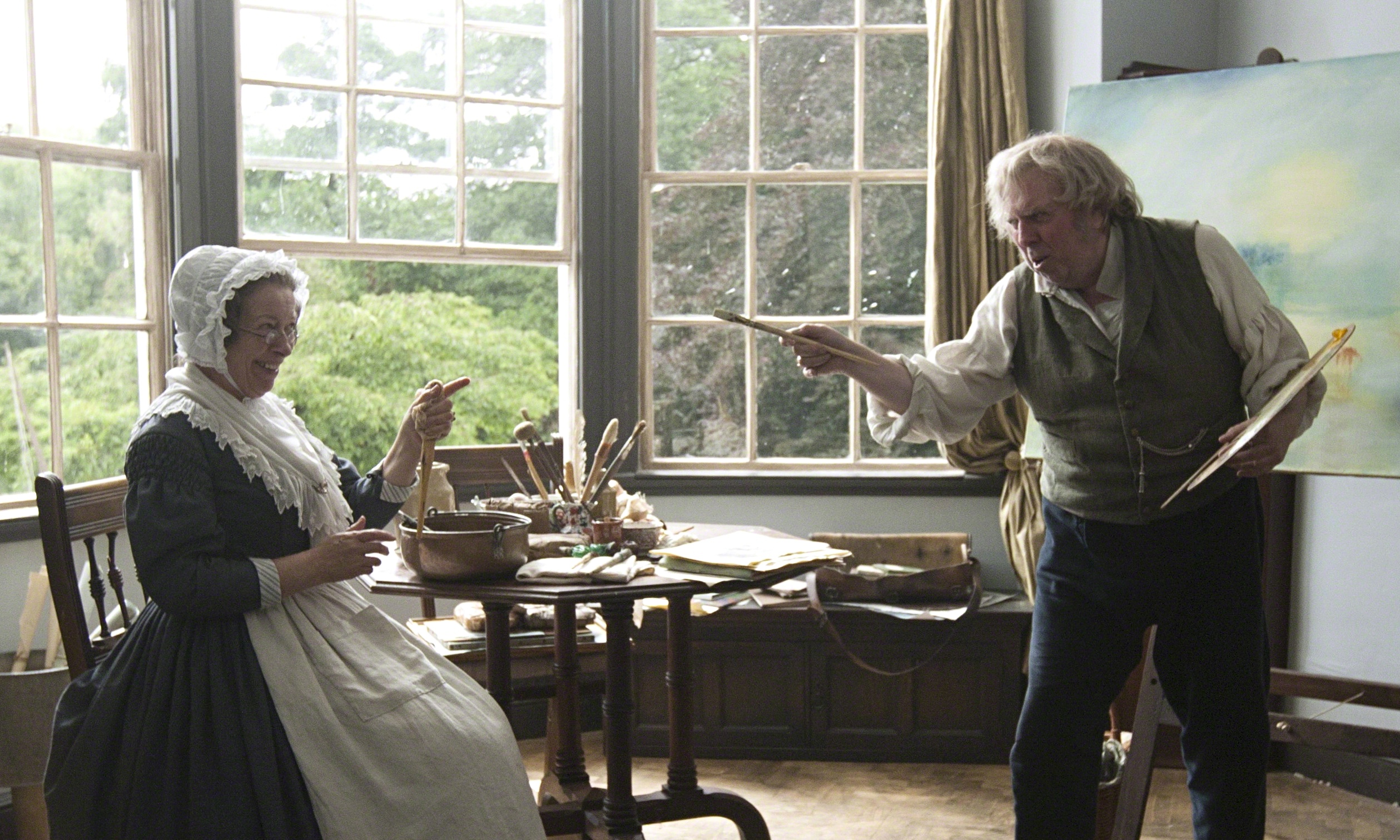
Earlier this week, Matt and I went to the Bytowne, a historic old cinema with a vintage red velvet curtain, conveniently located in downtown Ottawa, to see Mr. Turner. At 3:30 in the afternoon, we sat among a sea of gray hair, the audience makeup largely retirement-aged, discount-wielding seniors here to see “the show”. What show? The early bird show, that’s what! No matter which specific film is showing, it’s all the same if a) you’re going to talk loudly throughout the whole thing, as old people so often do, and the ones directly behind us certainly did with vigour if not with understanding, or b) you’re going to sleep throughout the whole thing, as the old man sitting beside Matt did, his light snores drowned out by the shouting behind us, and his MR TURNERsleeping body obscuring our access to the aisle when we’d finally won our freedom.

Mr. Turner is a biopic about the famous painter J.M.W. Turner, a man far more complex than I ever would have guessed. I’m finding it hard to review a film that I simultaneously felt was very, very good, but also a yawn, so instead I’m passing the buck and forcing Matt into an interview of sorts.

Jay: Mike Leigh is known to be scrupulous in his research and has recreated the last quarter-century of Turner’s life quite faithfully. What this means is this movie is relatively free of conventional “plot.” How did you deal with this as a viewer, and do you believe it was an asset or a detractor to the film?

Matt: I think Leigh’s attention to detail was both Mr. Turner’s strength and its weakness. It made for a production design that was almost above reproach and that was almost always interesting to look at. mr-turner-timothy-spall-3His commitment to historical accuracy was admirable and to his credit, I never felt talked down to as I often do when I got to the movies. Quite the opposite. I think he might have given me too much credit. The danger is a movie can sometimes get so bogged down in these details that it can alienate the viewer and Mr. Turner alienated me. Mr. Turner didn’t just take its time, it was slow and all the facts seemed to get in the way of telling a story.

Jay: Yeah, I thought some of the asides, like the little rant about slavery, kind of took you out of the movie, and definitely added length but not illumination. Other scenes, like when a young Queen Victoria visits the Academy and he overhears her spurn his work, are so much more vital. We see Turner stung by the Queen’s rejection of his work and then lampooned by music hall comedians for his move toward abstraction. He wants to please the public and yet isn’t prepared to compromise his vision to do so. Do you think director Mike Leigh sees himself in this character?

Matt: I don’t know much about Leigh except that I’ve sat through several of his films. Sometimes it’s a pleasure, sometimes it’s a chore. Even my favourite of his films unfold way too slowly for mainstream North American audiences. He seems to tell the stories he wants to tell without compromising his vision and isn’t afraid to alienate viewers with shorter attention spans. So, in tha way, I can see how he would identify with Mr. Turner and that would explain why everything about this movie feels like it Mr Turner scene from filmwas the one that he has been waiting his entire career to make.

Jay: I think it was in the works for years and years, actually. That being said, I imagine that to pour so much of yourself into a movie, you’d want as many butts in the seats as possible. Movie directors aren’t normally known for making art for art’s sake. He works with a lot of his long-time collaborators, like Dick Pope (or Poop, according to the Oscars), his amazing cinematographer, and this time he also cast his own romantic partner as Turner’s romantic partner, Mrs. Booth. Turner not only neglects his family, but outright denies them to most others who ask. Why do you think that was and why did his attitude toward family seemingly change once he met Mrs Booth?

Matt: Well, this movie threw a lot of information at me so I’m not sure but I interpreted that as shame and embarrassment over having neglected his family. I thought it was easier for him to start over with a new family than repair the damage that he did to his first one.imagesCAC12HG6
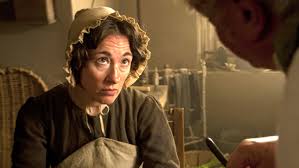
Jay: I felt like he genuinely just didn’t care. Like the art was the only thing that mattered to him. He didn’t have time or interest in relationships, except for his father, whom he cherished yet seemed to treat as a servant. There were so many seemingly contradictory aspects of the character that I can’t believe Spall pulled it off, and with grunts half the time rather than words! Timothy Spall has received many accolades for his portrayal of Mr. Turner, including best actor from the London Film Critics, the New York Film Critics, and the Cannes Film Festival. Usually known as more of a character actor, how do you feel about his failure to earn an Oscar nomination?

Matt: Well, I wouldn’t call it a failure because it was one of the best performances I’ve seen all year. He’s an actor I’ve always admired and Leigh is the only director I can think of who would have the balls to cast Spall as a lead. I think the Academy snub is mostly due to 2014 just being a particularly competitive year when it comes to male lead performances with David Oyelowo already being one of the most controversial Oscar snubs in recent memory. I think the main difference between the Oscars and the awards that Spall has already won is that the Oscars are a huge television event and they have to walk that fine line between being “prestigious” but also putting on a good show. So they want Bradley Cooper and Benedict Cumberbatch to show up. I think the Oscars try to find a balance between the tastes of critics and the tastes of audiences and I think Spall’s snub mostly boils down to Mr. Turner’s failure – or lack of effort – to connect with the general public.

MrTurner1_495_305_c1Jay: Agreed. It WAS a great year to be a man in the movies, but then again, isn’t it always? I mean, it’s great to be a male artist period, as evidenced by Turner himself. He lived the life he wanted while abusing the various women in his life. I like how Leigh presented this to us without judgement. Here is a man, who is both great, and deeply flawed. And I loved how the whole movie took on a glow, like it was a painting come to life. Actually, many of the many scenes n Mr. Turner open in long shot, with this huge, gorgeous landscape and Turner barely visible down in the corner, just a solitary outline of a figure. It kind of reminded me of the “hidden” elephant in one of his canvasses. Tip of the hat to all the film makers who made that feeling possible.

Unbroken

I was cynical about this movie because critics told me to be. “It’s bad”, they wrote, “don’t bother.” But I watched it and thought: it’s not so bad. Good, even, in some parts. Basically redundant I suppose, but not bad. So why then was it panned? And why then did I feel much the same way upon viewing The Monuments Men, also derided by critics – maybe it wasn’t great, but it also wasn’t the disaster I’d been lead to believe.unbroken-movie-angelina-jolie

So now I’m worried that critics are taking pot-shots at “celebrity” directors. There’s almost nothing conventionally roastable about George Clooney, yet Tina Fey and Amy Pohler still found a way to mock him for making what I thought was a decent movie. He pretended to be a good sport about it, but they hit him where it hurts. If Kim Kardashian was standing behind the camera, fine, open season. But Angelina Jolie has paid her dues and proves it with a movie that is technically sound, and both made movies this year that contribute to a proud historical record for their country. Clint Eastwood, another actor-turned-director did the same with American Sniper, and though I’d say it’s the weakest of the three, it’s being hailed (although not uniformly) as the best.

UNBROKENUnbroken tells the story of Louis Zamperini, a true tale that’s been simmering in different Hollywood pots for the past 70 years. He was an Olympic runner who competed in the Berlin Games and then joined the army just a few years later after the Pearl Harbour attack. As a bombardier in world war two, he and his fellow crewmates were sent out on a search and rescue mission on a plane that couldn’t hack it, and went down due to mechanical failure. One of only three survivors, he then spent more than 6 weeks at sea, barely surviving only to be washed onto Japanese soil where he brutally treated as a POW for the remainder of the war.

You can see why people thought this would make a good movie; it moves episodically from one unbrokenmoviehuge hurdle to the next, a great showcase for the human spirit (and for American spirit in particular). In fact, it’s a relic, the kind of war movie that casts the Japanese as “the enemy” pure and simple, and its indomitable American protagonist as the uncomplicated hero. But what should have been great turns out merely to be good. It’s beautifully shot but generic – we’ve seen the castaway thing a million times, and the POW thing a million more. Jolie adds nothing of her own to these events.

Jack O’Connell impresses again in a physically demanding role (he’s even better in Starred Up) and the cast is strong, but no one is given much more than the standard paces to work with, the unbrokenscript being surprisingly traditional after a Cohen brothers treatment. The movie opens with some nerve-wracking battle scenes in the sky, but from the moment the plane splashes down, we’re drowning in misery and degradation.

While Zamperini’s story is one of redemption and forgiveness, Unbroken shows only despair. Zamperini’s character is lost, a sense of triumph unearned, and the movie stirs emotion only by default.


Maps to the Stars

Well…that was interesting. Not quite what I’ve come to expect (and fear) from David Cronenberg, but not your typical Hollywood fare either, though that’s exactly what it’s satirizing.

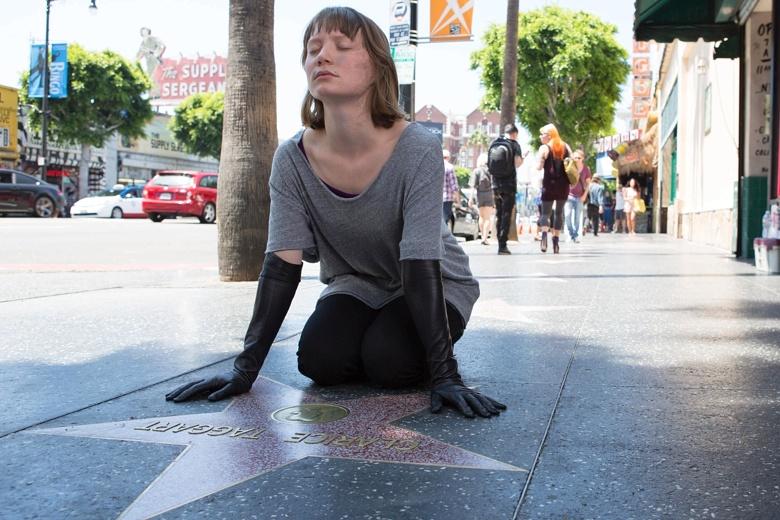
John Cusack is the family patriarch, a successful therapist\coach of some sort, with a book deal a mapstothestarstalk-show circuit and an awful lot of bullshit. His wife acts as the agent for their spoiled child-start son, fresh out of rehab which he entered at the age of 9, and who’s still the “good kid” and certainly the bankable one, compared to a sister (Mia Wasikowska ) who’s just finished an involuntary stint in a sanitorium and now works as a “chore whore” (personal assistant) for an aging diva still aching for parts (Julianne Moore).

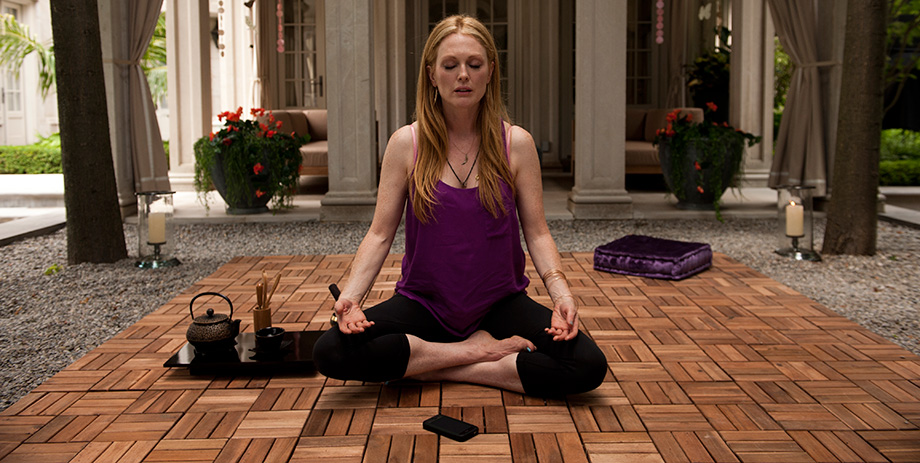
I confess that I didn’t always know where this is going, and I’m still not sure where it went, but the performances, Moore’s especially, were so strong, it hardly mattered.  It occurs to me that an ode to Julianne Moore is long overdue here – in this movie and in so many others, she just goes for broke. It’s not always pretty but she’s one of few actresses not deterred by the unflattering. In this she goes from raw and wounded to vacuous and self-absorbed, but she does it in a way that’s not unsympathetic. The misery and sorrow feel real and thus it’s maps to the starsimpossible to really hate her. Moore somehow manages to humanize her characters and put a real spark into them.

The script is less than brilliant. It’s easy to point fingers at Hollywood, to laugh at the yoga and the dysfunction, but it’s already been done dozens of times. This is just another fresh layer of fucked-up.

In Canada, we used to honour cinematic achievement with a Genie award (they’ve now merged into the “Canadian Screen Awards”). They’re irrelevant as ever (Cronenberg has 5) but if you’ve ever wondered what else they’re good for you, boy are you in for a treat.

The Monuments Men

Based on the “true story” of a motely gang of art historians, museum curators, and the occasional sculptor for balance, who risked their lives to save and protect major works of art that were stolen by Nazis during the second world war, The Monuments Men, as they were called, feels a little like a war-themed Ocean’s 11.

Critics were pretty hard on this movie, but having finally watched it, I feel like that’s unfair. the-monuments-men-2013-movie-title-bannerArt expert Franks Stokes assembles a crack team just as impressive as any of Danny Ocean’s – Matt Damon, John Goodman, Jean Dujardin, Hugh Bonneville and Dimitri Leonidas all give strong performances though they compete for screen time. Bill Murray and Bob Balaban are probably my favourite duo; they play off each other fabulously. The trouble with The Monuments Men is with the tone: this wants to be a light-hearted caper, like Ocean’s 11, but Clooney feels too much reverence for the subject and so throws in another lecture rather than a joke. Truthfully, when George Clooney lectures, I’m going to listen. That man has the twinkliest eyes short of Santa Claus. But this is not exactly playing to his cast’s strength, or his audience’s expectations.

The Monuments Men arrive mostly as the war is winding down, so there aren’t a lot of battle scenes, which is not to say there is no blood. Anyone looking for a typical, action-driven war movie will be out of luck, though it certainly looks like one, with beautiful, crumbly post-war Europe shot and framed with care.  This one is more of an intellectual exercise, with a moral question at its heart: is a human life worth a piece of art?

George Clooney;Matt Damon;Bill Murray;Bob Balaban;John GoodmanClooney’s character answers this rather touchingly, in the end, with an older version of himself visiting a monument he recovered in the 1970s. “Yeah,” he says, eyes twinkling. I wondered for half a second if this was perhaps the real Frank Stokes but it was the twinkle that gave it away. Must be a Clooney, I thought, and so it was (Nick, George’s dad).

George Clooney knows this is a story worth telling, and seeks to honour the men who made it possible. It just feels like maybe this is the wrong medium to do it. Even at two hours, he just barely manages to give each of his actors one big “moment.” The monuments are pretty well served, but to really know the men, maybe a miniseries would have been more appropriate. Next time, George, take it HBO.


Men, Women & Children

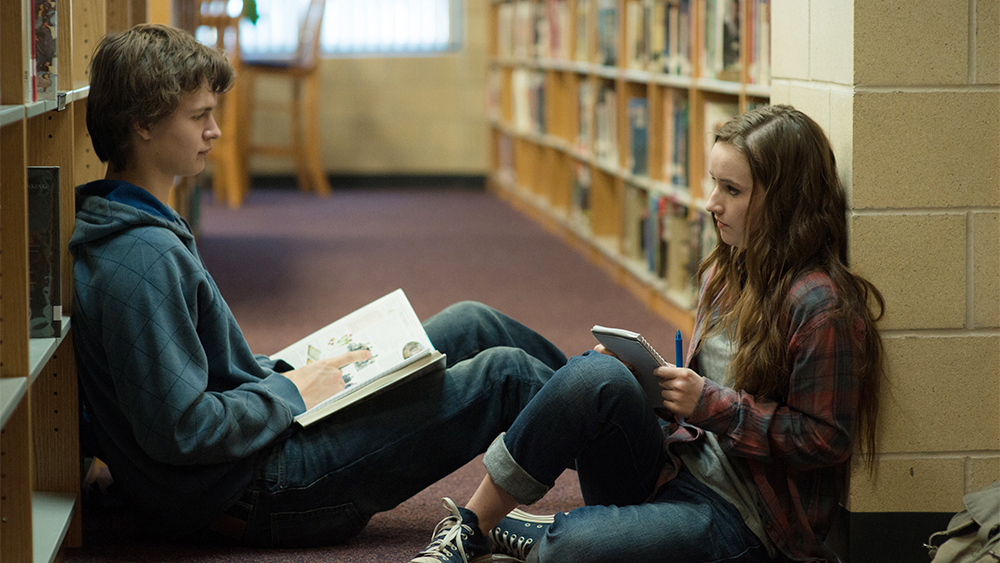
Just when you thought Jason Reitman could do no wrong, along comes Men, Women & Children, 2014’s movie we loved to hate.MEN, WOMEN & CHILDREN

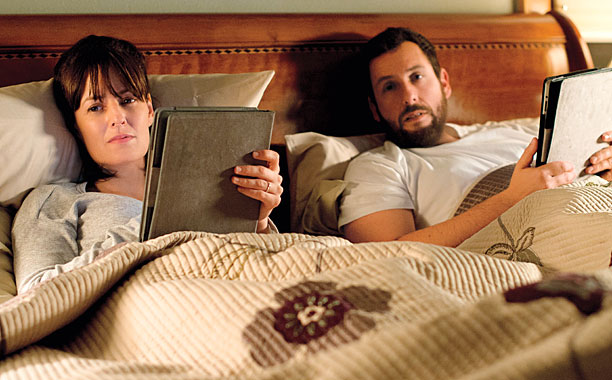
But why did critics pan it and audiences avoid it? It’s not really an objectionable premise: a bunch of teenage kids, and their square parents, realize that the internet is colouring and changing their interactions and relationships on every level. It’s got a big cast of talented people. But it all just feels so sad. So infinitely sad.

men-women-and-children-movieThe characters are all connected but the movie feels disconnected.  As a necessity, everyone’s reacting to their screens and not to each other. The internet’s destroying us! – not exactly an original idea –  but Reitman goes at it ambitiously, and vehemently.

For a script about technology, which is rooted firmly in the now, from a director who’s usually fairly with-it (witty teenage abortion with Juno, recession fallout in Up in the Air), this movie feels awfully stodgy and seems to miss the point. Plus, every single scenario, each character in the movie, exists not to tell a story but to tell a cautionary tale, one that will bash you over the head with its obviousness.

But the biggest crime that Reitman commits is that he fails to see that all of this internet-is-evil menwomenchildrenproof on offer in this film actually makes the opposite case. Eating disorders predate cellphones. Cheating on your spouse came before the internet. Exploiting children? Adolescent heartbreak? Parents worrying about teenagers? All very possible even without the help or the hindrance of technology. The weird thing about this movie is that the greatest evil seems to be when technology’s in the hands of the parents, not the kids. They’re the ones making the biggest mistakes, and shouldn’t they be the ones to know better?

Jason Reitman took a big swing here, but he missed by a mile.


Penguins of Madagascar

Sidekicks can steal the show – just ask the minions of Despicable Me,  and now, belatedly, the Penguins of Madagascar, in their very own spy thriller!penguinsmadagascar

The movie opens on a March of the Penguins-like origin story for this band of ragamuffins, and a documentary film crew (voiced brilliantly, in part, by Werner Herzog!)  show them to be, let’s say, more bumbling than brilliant. This proves true once they’re grown as well – they escape the circus from the last movie but land themselves right in the hands of a nemesis they didn’t know they had (John Malkovich), an old zoo-mate from their Central Park days. This nemesis, also known as “Dave”, has it out for penguins in general and these ones in particular – their cuteness took the crowds away from his own zoo exhibit and he’s been harbouring a grudge ever since. The penguins seem to be in a little over their heads but an agency called the North Wind (a wolf voiced by Benedict Cumberbatch, a neurotic polar bear, a sarcastic seal, and a sexy snow owl) swoops in to take over the rescue operation.

penguinsofThe traditional animation isn’t ground-breaking and the story’s not exactly scintillating, but I can see how this will work for kids. It’s full of fun visuals, simple puns, and wacky sight gags -“Melons, dead ahead!” It’s very hard not to have fun watching this movie, and if you’re a littlun all sugared up on snack bar, all the better – the pace is frenetic! I’m not sure it has much to keep adults captivated – too silly and earnest – but you should at least be able to sit through it with the kids. And if you’re missing King Julien, then just sit through about half a Pitbull song (if there’s a better musical representation for this empty-but-flashy animation, I don’t know it) during the credits, and whoop, there he is.


Annie (2014)

I hate to beat a dead horse but.

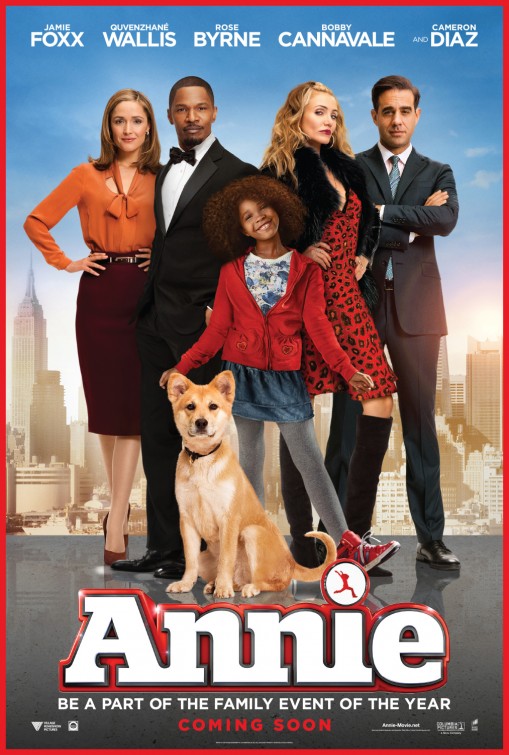
This is a very dead horse. And with such potential! I thought refreshing Annie’s story, bringing annie2014her into the 21st century, plopping her down into Harlem, and casting her as the lovely and fresh-faced Quvenzhane Wallis were all very wise and exciting decisions, so why then, does the movie have no charm?

Annie lives with mean foster mom Miss Hannigan (Cameron Diaz), who in this version is a C+C Music Factory has-been. I wondered if they would drop the drunk act, which always feels so inappropriate to me, but nope, Cameron slurs and stumbles through her routine, not quite selling the terrible things coming out of her mouth (though she does excel at the more flirtatious\salacious bits). Annie is recruited to go live with New York’s richest man, William Stacks, owner of a successful cell phone franchise, who just happens to also be running for mayor and his shrewd campaign manager (Bobby Canavale) sees her as a potential boost in approval ratings.

No one in this film should be doing a musical – with the possible exception of Jamie Foxx, who’s done well enough before, but you’d never guess it if this was your only proof. The old songs are mistreated, and the new ones are flat. And the choreography, if you can call it that? So lacklustre it’s awkward. Director Will Gluck has no business doing a musical. Neither does Cameron Diaz, and if you can recall her stunningly bad karaoke performance in My Best Friend’s Wedding, then you know she’s the first to admit it. Why then, does her song “Little Girls” steal the show? Not because it’s good, because it isn’t, though Sia’s re-worked it so complements Diaz’s lack of vocal range and talent. But she owns it. At least her sloppiness is intentional.

Wallis is adorable though, and works as an antidote for all our pent-up political cynicism. That’s when the movie teeters into “just okay” status, up from its usual “totally blah”. Looking back, the version of Annie that I loved as a kid doesn’t quite pass muster either, but there’s pluck and spirit and goddamn Carol Burnett! This one just isn’t trying hard enough.

Citizenfour – Discussion

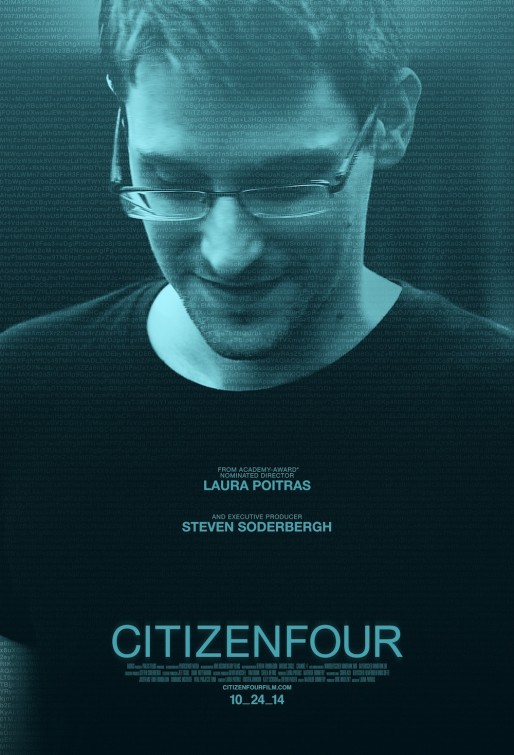
Citizenfour is a great documentary, maybe not in terms of movie making, but certainly in terms of the discussion it generates. If you’ve followed the case, then you’ve learned nothing new: Edward Snowden surreptitiously contacts Laura Poitras, the film’s director, and asks to meet. She flies to Hong Kong and films him over the course of 8 days, as Glenn Greenwald of The Guardian interviews him and breaks the story on the extent of NSA’s pervasive spying on its own citizens. If you’d like to learn more about this movie, please see fellow Asshole Matt’s review of the film. If you’ve seen it and would like more in-depth discussion, then keep reading.

Why you should care: One thing this movie does well is that it makes the case for why should citizenfourwe all care. It’s easy enough to brush it aside, thinking that since we having nothing to hide, nothing nefarious in our texts or emails, then we’re “safe”, no one will be kicking in our doors. And that’s true. But it’s also true that every single day, these people are infringing upon your rights. They are looking over your shoulder at things we used to consider “private” – phone calls to our friends, emails to our mothers, messages from our doctors, banking we did online, books we’ve borrowed, movies we rented, things we bought, passwords we mistakenly believe are ‘secret’, every single thing we’ve ever searched for on Google. Think about that for a second. Our histories, our personal blueprints, are available for analysis. If this was a dystopian sci-fi flick, we’d be creeped out and outraged on behalf of the protagonist. But those scenarios are already happening. It’s already here. But since it’s illegal and since people might just be mad about it, the government does it in secret – and outright lies about it when called out. It uses all the technology developed for flushing out terrorists and uses it against YOU. It has turned spy against its own citizens, every last law-abiding one of them. You don’t need to be suspicious. You don’t need to have a record. You don’t need to have motive, or to associate with known criminals, or use words like “bomb” or “jihad” or “Ebola”.

What does privacy mean to you? Make no mistake, this data collection is a weapon and one that will be used to oppress you. Citizenfour and Glenn Greenwald in particular seek to impress us with this fact: PRIVACY IS FREEDOM. I think it’s important to think of it in terms of control: your own control over your privacy, and others’ ability to control you using obtained private information. There is no freedom without privacy. That’s why we vote by secret ballot. Privacy allows freedom of conscience and diversity of thought. Sure, the government has seriously abused this data yet, that we know of. But why should we be content to wait until that happens – and it will happen – it is being collected in order to be used, not for you, but against you.

Is Edward Snowden a hero or a traitor? Poitras doesn’t really touch on this, unfortunately. Her film is more a portrait of a man, but whether you call that man a whistleblower or a traitor tells a lot about you and about the world you think you live in. The truth is, he is responsible for one of, if not the, largest security breaches of American state secrecy. Why did he do it? The film paints him (and he paints himself) as self-sacrificing, conscience-directed, a do-gooder of the greater-good. He assured us he expected and was willing to be punished for his actions, but won’t return to US soil to stand trial. And for all his protestations, I felt he did court attention. He didn’t reveal the secrets himself, he sought out famous film and print journalists to bring “his” story to light. But he was an established (if closeted) libertarian for pretty much his whole life, believing that the government should defend its citizens, not encroach upon their rights. Few news stories, this documentary included, have been able to separate Edward Snowden, the personality, with the information he uncovered, and even though Poitras claims she was working on this film before Snowden contacted her, we see little evidence of this in its finished product. Those eight days in Hong Kong are the meat of the movie, but I was surprised that she merely recorded it passively rather than asking any questions. I was left wondering – is Snowden operating purely from an ethic of responsibility, or does he have other motives at play? And does it even matter, since the information is all true? Can you be held above the law if the information you leaked shows the corruption of the lawmakers themselves?

Has Citizenfour succeeded? Snowden tells us that what we can do at home to protect our privacy is to encrypt, to block our ISPs, to use personal clouds, to leave no trace. I’m not sure this is practical for every user of the web, and is it even enough? Citizenfour excelled at showing us just how seriously they took they spying. There’s an escalating sense of paranoia – from Snowden’s use of physical barriers to Greenwald’s reluctance to speak out loud – the camera focuses on his feverishly scrawled notes, methodically shredded. They take no chances but I do wonder – has the average viewer of the movie seen this as a call to arms? Have you changed the way you use the internet or cell phone?