Author Archives: Matt

Slash

Neil, a shy 15 year-old who is questioning his sexuality, has trouble connecting with his classmates until he meets Julia an out-spoken and rebellious 16 year-old. They may not seem to have much in common at first glance but they bond over their love of writing slash-fiction.

slash

Don’t worry if you don’t know what slash-fiction is, neither did I. Slash-fiction is basically like any online erotic fiction except it features characters from pre-established sci-fi or fantasy who would ordinarily not be naked together. Ever wondered what it would be like if Dumbledore and Gandalf had wizard sex? Someone’s thought about it, someone’s written about it, and that’s slash.

Neil’s got some real talent, although his limited life experience makes it hard for him to write sex convincingly, but he lacks the confidence to post it online. Julia, who’s already posted 38 raunchy stories about an elf named Fain, happens to accidentally get a peek at his work and sees potential. Mostly though, she believes that real writers want their work to be seen. So she encourages/pressures him to publish his stories as the two develop an unlikely friendship and a complicated mutual attraction. Hoping to participate in a live read for slash-fiction writers, they journey to ComicCon on a mission to sneak into the Adults Only event.

slash 2

I can’t endorse this well-intentioned indie as much as I’d like to. Quirkiness seems inevitable in a story like this but writer-director Clay Liford does his best to keep it grounded and believable. It’s a delicate balance that I’m not sure he ever got quite right. And, elf sex and space orgies aside, Slash doesn’t bring much new to the story of a lonely teenager coming of age.

That being said, I’d rather focus on what works. Lirod wisely resists the temptation to judge or mock a subculture that could have easily made easy targets. By respecting his characters, he gives them room to grow and, in most cases, doesn’t let a single trait define them. Mostly, it comes down to the casting. Michael Johnston, as Neil, seems a little one-note at first but grows on you, especially in his scenes with Julia. As Julia, Hannah Marks is quite a find. Her quick wit and outer confidence mask Julia’s hidden insecurities. She reminded me of a young Mary Elizabeth Wintead.

Slash isn’t the next Juno but if you are curious about sci-fi porn and wonder about the people who write it, you might find yourself charmed by this little film.

Familyhood

Go Ju-yeon (extremely well-played by Kim Hye-soo) is pushing 40 and running out of ways to feel young. Despite plastic surgery, affairs with younger men, and a faithful and well-meaning entourage that protect her from unflattering headlines, Ju-yeon has finally reached the point where she has to admit that the public just doesn’t adore her anymore.

It’s a tough pill for any actress to swallow but it’s even worse for someone so needy and self-absorbed. Not ready to be forgotten just yet, Ji-yeon makes one last desperate attempt at being loved. She’s going to have a baby. Or, more accurately, buy a random middle-schooler’s baby and try and pass it off as her own.

It’s actually quite terrible and, as her stylist reminds her more than once, illegal. Dan-ji (Kim Hyeon-soo) has nowhere to go except live with her neglectful big sister and sure could use some money for art school, a fact that Ju-yeon is quick to take advantage of. Dar-ji is quickly hidden away in a stranger’s house during the most confusing nine months of her life.

This movie really didn’t work for me. The comedy comes, as you’d expect, mostly from Ju-yeon’s lack of self-awareness and the outrageous misunderstandings that her charade inevitably brings. It just isn’t very funny. I found it very broad and, worse, obvious. Director Kim Tae-gon excuses the implausiibilities and all the selfish behavior as “satire” of celebrity, “the cult of youth and beauty”, and the hypocrisy and double standards surround teen pregnancy. When it comes to Familyhood’s satire of celebrity and youth, its target is too easy and its tone not nearly subtle enough for it to be effective as satire. Tae-gon does, however, have some interesting and worthwhile things to say about the shaming of pregnant teen girls. It was a nice surprise but seems to show up out of nowhere towards the end of a film that seems to have realized that it wasn’t really about anything and just blurted out “teen pregnancy” in a panic.

I just didn’t like it. I’m not sure why. The crowd at the International Premiere at this year’s Fantasia Festival responded with delight to every tired joke. So maybe I was just having an off day and you’d enjoy it as much as they did. But I can’t help thinking that Familyhood seriously missed its mark.

Seoul Station

Standing outside Seoul’s central subway station, two young men are having a nice liberal chat. “I think there should be universal welfare,” one says  to the other. As if on cue, an old homeless man who is covered in blood comes staggering by. Concerned, one of the two men run to check on him but is quickly recoils from the smell. “I thought he was bleeding but he was just homeless,” he tells his friend.

So begins Seoul station, the first Korean animated zombie movie that I’ve ever seen. Though I was unsure of what to expect at first, it became immediately clear that this hilarious yet disturbing picture would have a lot more to say than the average episode of The Walking Dead. Because acclaimed director Sang-ho Yeon’s version of the zombie apocalypse seems to start with those who rely on the Seoul Station subway tunnels as a place to sleep, no one really seems to care at first and the infection is allowed to spread quickly. Unlike most zombie movies I’ve seen, we see the fall of civilization entirely through the eyes of pimps, prostitutes, and the homeless.

There aren’t many Zombie Kills of the Week in Seoul Station but the animation alone- surreal enough to be unique but realistic enough to keep it grounded when it counts- makes it stand out. As much as it has to say about the struggles of Seoul’s marginalized, this is not a movie without it’s guilty pleasures. There are enough close calls, creatively claustrophobic suspense, and hilariously over-the-top voice acting to work as a fun popcorn movie. It’s only unsettling once you let it sink in.

Psycho Raman

I can probably count on one hand the number of Indian films I’ve seen. And I KNOW I canraman 2 count on one finger the number of Indian films I’ve seen that were about serial killers. Which brings me to the appropriately titled Psycho Raman.

To expose yourself to foreign cinema can be a bit of a culture shock at first. I remember when I first started watching European movies I was thrown off at first by the storytelling, pacing, and acting that felt strikingly different from what I’d become accustomed to watching American movies. So with Psycho Raman, I braced myself for a style of filmmaking that would be completely new to me.

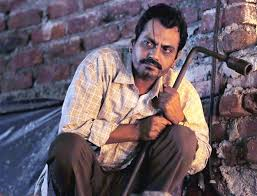
I was quite looking forward to seeing what this new (to me) voice could bring to the tired serial killer genre, and- bad news first-, was a little disappointed how much director Anurag Kastyap’s film reminded me of so many American crime films that I’ve seen. The magnetic Nawazuddin Siddiqui plays Ramanna, a poor man in Mumbai with a taste for killing people with his giant metal pipe. Before he can escape from the scene of his first crime, he witnesses a drug-addicted cop (Vicky Kaushal) stealing from his victim and committing a murder of his own. Raman immediately sees a kindred spirit with this crooked cop and sets out on a two-year mission to help him embrace the killer inside him.

raman 3The symbiotic relationship between cop and killer is nothing new and I feel like I’ve seen every version there is of the “You complete me” speech but Kastyap shows us enough memorable images and packs enough suspense into Psycho Raman’s best scenes that his film is well worth watching. Mumbai is a compelling setting for this familiar story and, as the Fantasia Film Festival website notes, shows a side of India that most of us aren’t used to seeing.

Raman, as played by Siddiqui, clearly has a very screws loose but- like all of our favourite movie psychos- is actually quite insightful. He’s a fun character and Kastyap enjoys filming him walking in slow motion to the beat of a pop song so much that it’s easy to get the sense that he seems him as the hero of this gruesome story. It almost feels like the start of a Raman franchise.

Kastyap enjoys his serial killer so much that he often neglects the equally if not more raman 4important character of Raghavan, the cop with a dark side. The film is divided into ten chapters and way too many of them don’t feature Raghavan at all. Not that I’m complaining. Kaushal doesn’t bring anything new to the drug addict or the angry cop and his scenes are often tedious. Still, the battle over this man’s soul is the whole point and Kastyap needed to put in a little more time developing this character.
A better film would have been about 20 minutes shorter and used that time more effectively. Still, though Kastyap always cuts away before the violence becomes gory, he doesn’t pull his punches. Psycho Ramanh is a dark and uncompromising movie and you may find its villain/anti-hero tough to shake.

The Witness

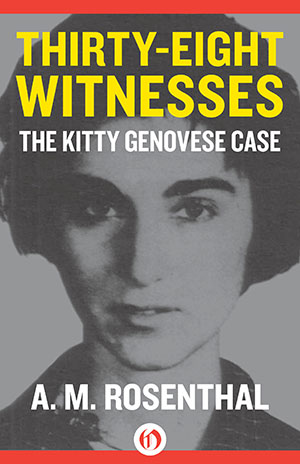
Bill Genovese was 16 years old when his big sister Kitty was stabbed to death in Queens, New York. Her 1964 murder shocked and scared the nation as news got out that 38 of Kitty’s neighbors watched and did nothing to intervene as the 28 year-old screamed for help and fought for her life.

It’s actually a horrifying image that has always stuck with me ever since I first read about it in Social Psych. How could 38 people watch from their apartment windows as their neighbor was in such immediate danger? This question inspired a new subfield of social psych research and was one of the main reasons why I continued to study (and pursue a career in) psychology. It inspired Bill Genovese to enlist in the Marines when the Vietnam War began because he vowed to never be the guy standing by and doing nothing. And I just found out that it’s a fucking lie.

Obviously and tragically, some of what I learned about Kitty Genovese in college was true. Yes, she was brutally murdered by a stranger outside her building as she screamed for help. Yes, police later interviewed 38 witnesses to the attack. But the claims that 38 people knew what was going on and (shockingly) even that no one tried to help her are erroneous products of some sensationalist and irresponsible journalism published in the New York Times.

The Witness follows Bill Genovese over a ten-year period as he attempts to separate fact from urban myth in the death of his sister. For forty years, the Genovese family believed the same fiction that I did. What that must have been like, to not only lose a daughter and sister to such a brutal attack but to believe that her own neighbors stood by and did nothing, I can only imagine. For a long time, the subject of Kitty’s death (even her life) was too painful for them to even talk about. Until one day Bill can’t take the silence anymore and starts looking for answers.

Sure, the Genovese case received national attention which may have brought about some real positive changes. And, no, that may not have happened had the story been reported as it actually happened. But The Witness makes a fairly strong case that the truth- in journalism as well as in healing from personal trauma- is always important. At some point while watching this documentary, you’ll probably start to wonder if Bill’s obsession with finding the truth is getting a little unhealthy. But by digging deeper into the details of his sister’s life and death, he’ll come to feel closer to her than ever and he honours her memory by reminding all who see it that Kitty was so much more than the last 30 minutes of her life.


.

Popstar: Never Stop Never Stopping

Popstar isn’t an easy movie to review.

First of all, here’s what we’re dealing with…

I dare you not to hum that on the bus later.

While some of the songs may get stuck in your head though, the movie may not. It didn’t for me. I watched it less than twelve hours ago and the memory is already fading fast.

Being forgettable is Popstar’s biggest and only real problem. This is partly because it packs so many jokes and cameos into less than 90 minutes that it never slows down long enough for you to really process much of it. Luckily, the jokes land with impressive efficiency even if they don’t stick.

As if it matters, Popstar is to The Lonely Island (Andy Samberg, Akiva Schaffer, and Jorma Taccone) what This is Spinal Tap was to Spinal Tap. If you’re not familiar with The Lonely Island, the video I posted will give you a pretty good idea. Made semi-famous by their SNL Digital Shorts, they’ve been spoofing pop and R&B for nearly a decade with songs like Dick in a Box, I’m on a Boat, and I just Had Sex. This film mockuments their rise, fall, breakup, and reunion.

Taking aim at easy targets, Popstar’s satire may not be necessary but it sure is welcome. Rarely does a joke miss its mark and it’s the rare R-rated comedy that never gets stuck in an ill-advised gross or bizarre gag that it can’t seem to find its way out of. As for whether or not this will become a modern quotable classic like Anchorman or Superbad remains to be seen and the fact that I started to forget the movie almost as soon as I left the theater may not be a great sign. I have no idea how well it will hold up to a second viewing but Popstar’s first viewing will not disappoint and it DEFINITELY will not bore you.

The Nice Guys

2016’s summer blockbuster season is just getting started but is already getting crowded. With competition between franchises getting fierce, is there really room for a stand-alone action movie from an original screenplay? How about an R-rated comedy that is in no way connected to Judd Apatow?

Apparently not so much, considering its unremarkable performance at the box office so far, despite generally good reviews and two big stars. It can be hard to find the time to see everything that’s out there and I know priority has to go to seeing the latest installment of all your favourite franchises but I am quite sure you won’t regret making some time for The Nice Guys.
A thug-for-hire with a heart of gold (Crowe) and a cynical private eye (Gosling) team up to search for a missing girl who seems to be connected to a murdered porn star and has somehow caught the attention of the justice department. And it all takes place in 1977 Los Angeles with an excellent sense of time and place.

After A Good Year, Crowe’s last attempt at headlining a comedy, it’s a pleasure to see one finally play to his strengths. The Nice Guys uses his tough guy image to its advantage instead of trying to make us forget about it. Paired with the ever-versatile Gosling, they are just as hilarious as writer-director Shane Black’s previous pair of  detectives in Kiss Kiss Bang Bang.

The Nice Guys works because the escalating insanity rarely feels contrived or forced. As a team, Crowe and Gosling are just dysfunctional enough to be funny but competent enough to be almost believable. Best of all, the movie has just enough darkness to it that it’s not easy to forget.

X-Men: Apocalypse

When I first saw X-Men: First Class in the theater, I was frustrated by Hugh Jackman’s cameo as Wolverine. “That’s so stupid,” I told my friends. “How can he show up in the 60s and look the same  as he does in the present?”.

Okay, so clearly I don’t know much about the X-Men universe. But I have since seen all the movies and tend to enjoy them. After Days of Future Past, which I thought was the strongest entry in the series by far, I had pretty high hopes for Apocalypse.

Nine films in a series can start to blend into one so I can’t always remember what happened in which but I am pretty sure that Apocalypse is my submission for the worst- certainly most boring- X-Men movie so far. What could have gone wrong since Bryan Singer’s triumphant return to the franchise two summers ago?

I can’t help feeling that Wolverine is the most important element of Future Past that is missing from Apocalypse. Sure, Hugh Jackman’s Wolverine is one of the best performances that I can think of in any comic book character ever but that’s not even what I’m missing. Future Past was told mostly from the perspective of Wolverine so we were introduced (or, in many cases, reintroduced) to most characters as they became relevant to Wolverine’s mission.

Like Days of Future Past, Apocalypse has A LOT of characters. Even by superhero movie standards. But without picking a single character’s perspective to focus on, it jumps around a lot. In fact, it probably spends a good half hour on each character’s separate introduction. Like Batman v. Superman, Apocalypse has a habit of cutting away to an unrelated scene just when it’s feeling like it’s starting to get good.

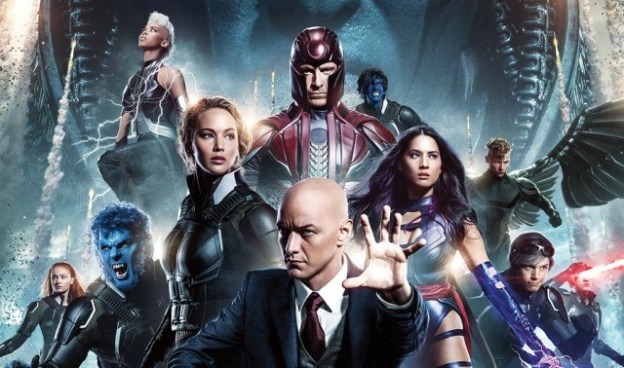
X-Men: Apocalypse is disappointing but does manage to benefit from both the past and future films in the series. Professor X and Magneto, both in their respective story arcs and in their relationship with each other, coast on their strong starts in their last two films and continue to captivate thanks to strong performances by James McAvoy and Michael Fassbender. Everyone else is fine- even good- but these two are clear standouts in a crowded cast where you need to be great to even be noticed.

Having so many new characters necessitate a lot of scenes that feel more like obligatory preamble than part of the story. But just as the returning characters benefit from the smart choices made in previous installments, the new characters (Cyclops, Storm, Nightcrawler, and Jean Gray) benefit from the promise of better movies in the future. They’re well-cast and likeable, giving hope that they’ll be better utilized next time.

Aim for the Roses

“It’s going to be a long 102 minutes”. This was my first impression of Aim for the Roses, which made its world premiere at the Hot Docs Film Festival in Toronto.

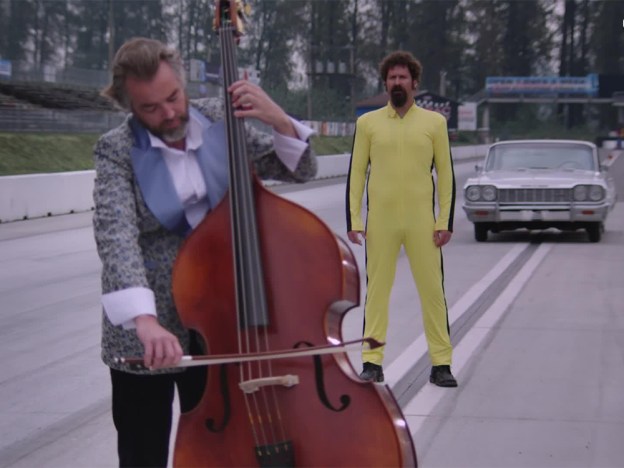
John Bolton’s documentary opens on a reenactment of Ken Carter (played by actor Andrew McNee with a yellow jumpsuit and terrible 70s beard) proclaiming his destiny to become the greatest of all daredevils. I was disoriented at first by the double bass player standing next to Carter on the fake ramp but his presence would still be explained.

Apart from a single reference to a Roger Waters concept album, Aim for the Roses is about as Canadian as it gets. In 1976, Montrealer Ken Carter declared his crazy ambition to jump over the Saint Lawrence River (literally from one country into another) in a rocket-powered car. In 2008, Vancouver-based composer Mark Haney got the crazy idea to make a double-bass concept album to pay tribute to “the daredevil stunt to end all daredevil stunts”. Finally, filmmaker John Bolton got the crazy idea that all this would make a good documentary. Basically, Aim for the Roses is a movie about Canadians doing crazy knuckleheaded things.

Visually, Bolton (the filmmaker) has a bit of a problem. There doesn’t seem to be nearly enough archival footage of Carter (the daredevil) to fill a whole movie and, as interesting as Haney’s music may be to listen to, it obviously doesn’t give us much to look at. Bolton’s solution is inspired. He turns Haney’s album into a music video, playing it over a reenactment of Carter’s feat filmed on a reconstruction of his takeoff ramp.

Bolton’s reenactment is bizarre. Maybe a little too bizarre. Haney’s soundtrack doesn’t help. His concept album has already been called “utterly amazing and completely fucking ridiculous” by the Georgia Straight. Passing off exposition as song lyrics, his music- as haunting as it is- can seem a little silly. But featuring McNee in that costume on a fake takeoff ramp with Haney playing base behind him is a little too much.

Fortunately, you don’t have to like Bolton and Haney’s musical to be fascinated by this documentary. Aim for the Roses is about the people who come up with crazy ideas and stubbornly pursue those ideas no matter how many puzzled looks they get. Haney , who is interviewed extensively in the film, is quick to point out the parallels he sees between his own life and that of Carter’s. He suggests that making the most ambitious concept album of your career is a lot like jumping a rocket-powered car over a river. It doesn’t matter what your ambition is. The best daredevils are artists and the best artists are daredevils. I wouldn’t be surprised if Bolton feels a certain kinship with these two men himself.


Sing Street

In 2007, writer-director-musician John Carney released one of those ronceare films that literally everyone loves. Sure, Once featured unprofessional actors and didn’t have much going  in the way of plot but the music and characters struck such a chord mostly because of the unpretentious sincerity that everyone involved seemed to bring to the project.

In 2014, Carney tried to top himself in the acoustic meet cute musical  genre with Begin Again, which had a considerably bigger budget and an all-star cast. Though not without its charms or hummable songs of its own, Carney’s second film about writing and recording songs just wasn’t nearly as relatable as his first effort, largely due to the presence of Keira Knightley and (worse still) Adam Levine.

sing street 3Carney does his best to get back to basics, returning to Ireland with mostly unknown actors, in Sing Street. Cosmo (Ferdia Walsh-Peelo) has just started at a new school and, though he hasn’t made any friends yet, instantly falls for an older girl (Lucy Boynton) who aspires to be a model. Based in part on Carney’s own memories of the mid-80s, Cosmo decides to start a band inspired by The Cure, Duran Duran and Hall & Oates. For Cosmo, this project is mostly an excuse for him to film music videos starring his crush at first but the opportunity to write and play his own music soon becomes about much more. Music, he’ll soon learn, can be the perfect outlet to express his feelings about the tension between his parents, their financial troubles, and the restrictions at his strict Catholic school.

Sing Street is no Once.

Maybe that’s a good thing. While Once had a more improvised feel, Sing Street has a moresing street insightful and considerably funnier script. (I laughed myself into a coughing fit twice and I don’t even have a cold)..It is much better acted and more imaginative. The dream sequence of Cosmo’s ideal video for Drive It Like You Stole It is my favourite scene by far but there are so many perfect moments in Sing Street.

But it doesn’t always feel like a good thing.Ironically, for a movie about the agony and the ecstasy of first love, Sing Street underestimates the attachment that so many of us feel to Carney’s first attempt at the indie-rock musical. Once may not have been perfect but it felt real. Its dialogue never distracted from the story by being either too lame or too witty, it just felt natural. With more experience and a bigger budget, he has clearly made a more polished film with Sing Street. But I prefer the rawness of his first effort.