

 The residential school system is not the only black mark on our country but it has to be the darkest stain. We and our government could not have done worse by our indigenous people if we tried. We should have known from the start that this imperialistic plan would go horribly wrong. After all, we chose to put the Catholic Church in charge of many of these awful residential schools (and not just the Catholic Church, but a bunch of others share the blame, including the Anglican, Presbyterian, and United Churches of Canada), because it wasn’t enough to tear children from their families and literally beat their culture out of them, it seemed appropriate for some reason to facilitate child molestation too, feeding 150,000 potential altar boys and girls to more than a few insatiable priests over the lifetime of the program. 150,000!
Not surprisingly, the end result of this utter disaster was the destruction of generations upon generations of indigenous people, something we cannot ever be ashamed of enough. And this is not something we can blame on our long-dead racist ancestors, since the last residential school did not close until 1996. 1996!
Indian Horse tells the story of one of those unfortunate kids who was sent to residential school, a boy named Saul Indian Horse. Saul happens to be a natural at hockey, quickly becoming the star of the school’s team. But for some reason, despite his hockey-playing prowess, Saul is clearly struggling to find his place. Could the reason for his struggles be that he and everyone he knew were subjected to horrific abuse every single day?
You don’t have to watch Indian Horse to learn that yes, all those years of abuse hurt Saul really, really badly. And you don’t have to watch Indian Horse to grasp that his story is just one of 150,000 about those who were directly and irreparably harmed by residential schools, not to mention the thousands more who were harmed just as badly by the loss of their family members to the schools, and not to mention the subsequent damage caused by attendees of the schools when, surprise, surprise, after being removed from their families and their culture as kids and abused by those who were supposed to take care of them, they were unable to even care for themselves, let alone their children, a cycle that we still haven’t been able to break. But you should watch Indian Horse anyway.
You should watch Indian Horse to remember that to the extent that Saul or any other survivor of residential schools fell short, it’s not for lack of will or effort on their part. It’s because the Canadian government, and by extension the white Canadian majority, failed them monumentally. Indian Horse demonstrates our country’s massive failure clearly and effectively despite its shoestring budget, while at the same time paying tribute to the inner strength of one survivor who, but for his race, would have been a hockey-loving Canadian kid on his way to stardom.
So here’s to Saul and to each of his friends. I’m so sorry for what you had to suffer through, and I promise not to ever forget it or let anything like this ever happen again. I know that’s not enough to right these wrongs and nothing ever will be. But hopefully it is a step in the right direction after hundreds of years of horror. It is truly a shame that the Pope doesn’t feel that way, but hardly surprising the Catholic Church won’t acknowledge any of its wrongdoings – we’ve seen that movie already.
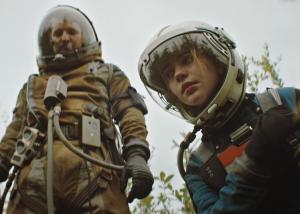 Hard science fiction is a tough sell, especially cinematically. Soft sci-fi is far more exciting and eye-pleasing. It lets us hop around the galaxy at faster-than-light speed, meet aliens at every space station, and have luxury accommodations in the starships on which we’re travelling. Conversely, hard sci-fi travel is slow and cramped and space is largely empty. Prospect is a hard sci-fi movie that remains resolute in the face of the obstacles posed by its chosen genre, and by and large overcomes them.
 Julia Hart, the director and co-writer of Fast Color, almost had me fooled. She introduced Fast Color to the SXSW crowd as a story about motherhood, and in a way that’s true. Of course, in a way it is also true that the original Superman comics are about the experiences of Jewish immigrants. I mention Superman because both Fast Color and Superman use superheroes to tell their stories, although the movies’ respective approaches to the genre are worlds apart.
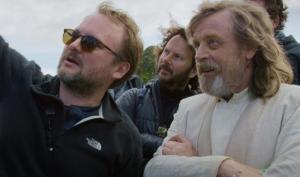 When I was a kid, I had a behind-the-scenes book detailing how they filmed the space combat in Star Wars, and I loved it. I could think of nothing better than to get to play with the spaceship models and the huge Death Star set used for the climactic scene. I found it fascinating to see how the movie was made.
 American Animals is billed as a true story, and I have no reason to doubt that claim. The problem for me is an ethical one. I don’t feel good about helping people profit from their illegal activities, because it feels I am encouaging them and others to repeat that behaviour. On a related note, I also don’t want to spend any time with people who commit crimes, get caught, and then sell their stories, because they give assholes a bad name.
 There are very few immutable truths in this world, but here’s one: if you don’t like Steven Spielberg’s movies, then you don’t like movies. The brilliance of Ready Player One (and it is brilliant) is that it’s a Spielberg movie through and through, only because its source material references Spielberg repeatedly, the result is something exponentially more Spielberg than you could ever have though possible. Ready Player One is a true blockbuster and a worthy addition to Spielberg’s list of classics.
 on and a standout) because, honestly, they’re almost always really stupid. The Strangers: Prey at Night is a very good example of “really stupid”, and that is about the nicest thing I can say about it.
 For me, the most memorable scene in Mute was a few-second long callback to director Duncan Jones’ debut, a marvelous little movie called Moon, starring Sam Rockwell, that you should track down immediately if you haven’t seen it yet. Apparently, Mute is intended to be the second entry in a very loose trilogy, an approach that Netflix seems to be very keen on at the moment (as evidenced by
  Are people being drawn to Mute because it’s related to Moon? Did anyone choose to watch Mute because of that link who otherwise would not have? Is Rockwell such a big box office draw that his inclusion got Mute off the ground? I have a hard time believing this one little throwaway scene helped Mute and yet, why else even bother?
 The Marvel Cinematic Universe is so bloated at this point that Marvel usually crams as many superheroes as possible into the “solo” movies in between Avengers instalments. For example, Iron Man pops up in
  ess the same movie. Clearly, that’s Marvel’s goal with a shared universe as that way, we movie-loving rubes have to see them all, and throw even more cash into Disney’s money bin (which by now must be bigger than Scrooge McDuck’s).
 ty disputes in Black Panther are resolved through lots of punching and kicking (which, for all its flaws, is clearly a more efficient political system than the one the USA is currently using).
 ars ago, and that I am sure has not improved over time. That The Cloverfield Paradox falls so far short of that (very) (very) (very) low bar is damning indeed.
 ASSHOLES WATCHING MOVIES