Author Archives: Sean

Unknown's avatar

About Sean

I'm an asshole! assholeswatchingmovies.com

Uncle Drew

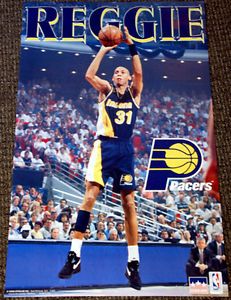
If anyone was going to love Uncle Drew, it would have been me. After all, in the early 90s my bedroom walls were covered with posters of Shaquille O’Neal and Reggie Miller, among others (Michael Jordan’s posters covered the most real estate, of course). Also in the early 90s, I watched Chris Webber call a timeout he didn’t have (after travelling first) and cost his team a championship (which would have been lost either way since that team has been erased from the NCAA record books).

Many years later, I got to watch Kyrie Irving take on Russell Westbrook live in Oklahoma City, as Kyrie made everyone besides Russ look like they were standing still.

And like most basketball fans, I never sought out Nate Robertson or had any of his posters, though I am sure I saw him win a few dunk contests (somehow he won more of those than Jordan).

Kyrie Irving plays Uncle Drew, an old guy who’s still got game, and who gets recruited onto a streetball team by Get Out’s Lil Rey Howery in order to beat a team coached by Howery’s childhood nemesis, Nick Kroll. Uncle Drew has one condition: Howery has to help reunite Uncle Drew’s old team. Reluctant but out of options, Howery agrees and heads out on a road trip to search for a bunch of old guys made up to look slightly older (the three all-time greats I mentioned above, along with Robinson).

From L to R: Shaquille O’Neal, Chris Webber, Nate Robinson, Reggie Miller and Kyrie Irving on the set of UNCLE DREW. Photo courtesy of Lionsgate.

Seeing Shaq, Reggie, and C-Webb team up with one of the most exciting players in today’s NBA should have been enough for me to somewhat enjoy this movie (with superdunker Aaron Gordon and WNBA/Team U.S.A. legend Lisa Leslie as added bonuses). But it wasn’t. The basketball scenes really weren’t exceptional, and with such a skilled roster, they should have been. They NEEDED to be, because as hard as Howery, Kroll and Tiffany Haddish try, the attempts at comedy in this movie fall flat. So all that’s left is the basketball, which is not even Blue Chips quality (at least Blue Chips features prime Shaq instead of Uncle Drew’s heart attack Shaq).

The Uncle Drew concept made for an entertaining Pepsi ad because Kyrie Irving made highlight-reel plays wearing several coats of old man makeup. Not surprisingly, that concept wears very, very thin when stretched to feature length. The old man gimmick and a bit of nostalgia are really all that Uncle Drew (the movie) has to offer, so it’s simply not strong enough for me to recommend, as much as I wish I could.

On the Basis of Sex

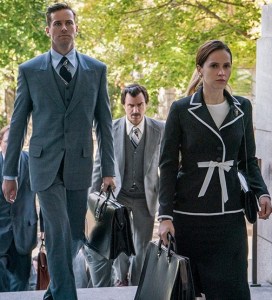
Ruth Bader Ginsberg (a.k.a. the Notorious RBG) broke through the glass ceiling before that term had even been coined. As a young mother, she was one of the first women to attend Harvard Law School (though she graduated from Columbia because sexism). As a law professor and litigator, she was a leader in striking down discriminatory laws, even though no firms would initially hire her due to her gender (a word she brought into use in the legal realm). And then she was the second woman appointed to the Supreme Court of the United States, where she remains at the age of 85, still fighting for a level playing field for women, minorities, and even, when necessary, middle-aged white men.

Why was it necessary for an equal rights lawyer to help middle-aged white men? Because that was the best chance to have the American courts actually enforce what seemed to be plainly written in the Fourteenth Amendment to the U.S. Constitution, namely that everyone should have equal protection under the law. Of course, prior to 1954 those nice-sounding words didn’t apply to black people, and prior to 1970 they also didn’t apply to women. We have Ruth Bader Ginsberg and her late husband, Martin Ginsberg, to thank for the latter, and on the Basis of Sex tells the story of how they won that fight.

On the Basis of Sex takes a few liberties with the facts, but does a commendable job of laying out the ground rules for the dispute, particularly in illustrating the power of the principle of stare decisis. That principle is the defining characteristic of the common law legal system, and it requires similar cases to have similar results. The effect of stare decisis is that precedent (i.e., previously decided cases) is the main source of law in the legal system used by most of Canada, and all of the U.S.A. and basically every country that was ever a British colony.

Accordingly, if the first U.S. equality case involving a women denies equality for women (which it did, in the late 19th century), then the starting point in every subsequent U.S. women’s equality case is that the woman should lose. Which is highly problematic if you actually stop and think about it. Common law is an adversarial system that is not built to take account of the larger picture. So it takes a visionary like RBG to unstick the system, by striking down outdated ideas and bad case law, by finding the perfect set of facts to use in her legal arguments. And what better case to take before a panel of white male judges than the sad tale of a white man denied a tax exemption available almost exclusively to women?

On the Basis of Sex is a better movie than it needs to be. Even this small portion of RBG’s career is compelling, and it’s only one item on the long list of her contributions to women’s equality and American society. But like RBG, On the Basis of Sex aims higher in telling its story. In addition to showing where our society has been, the film also shows how far we still have to go. For example, for every 1950s comment to RBG about how lucky she is to be married to a smart man, there are five similar comments made this decade to my brilliant wife, who I literally have never caught being wrong (to the point where I should know to stop trying to, if only I was as smart as her). On the Basis of Sex works both as a tribute to an icon and as a reminder that can’t come often enough: we need to aim higher to achieve equality, because as much progress has been made, there is much more work to do.

Aquaman

How do I even deal with the atrocity that is Aquaman? You probably know already that Aquaman is about a plot by the Atlanteans to attack the people who live on land, and so Aquaman has to become their king to save the world. But what you may not know is that this film is racist.

The only two black people in the movie are criminals (and also father and son). The black dad blows himself up when Aquaman (Jason Momoa) seemingly foils their attempt to steal a submarine from a bunch of white guys (Russians, as it happens).

Then that same submarine reappears to fool some of the Atlanteans into thinking that MV5BMzZjZTU2NjEtZTEzMC00YmRkLWIzZjUtMDczMWI4MDU4ODAxXkEyXkFqcGdeQXVyNTc5OTMwOTQ@._V1_the surface world is attacking them to obtain enough votes to attack the surface world. Turns out, one of the Atlantean human-shaped leaders had hired the black guys to steal the sub and fool another Atlantean human-shaped leader. Except then it also turns out that the leader who seemed to be fooled by the sub attack was actually aware it was fake news the whole time and went along with it anyway (and in case it is not clear, all the human shaped Atlanteans we see are white men, every last one, other than Aquaman’s love interest and Aquaman’s mom who are white women).

Then the surviving black guy is hired again by the Atlanteans to kill Aquaman and his love interest in Sicily, and the black guy is willing to go along with it because he blames Aquaman for his dad’s death. That plan fails, with the black guy apparently being killed by Aquaman, and also two non human CGI underwater leaders are either killed or maimed by the white underwater leaders who do not attempt any type of stolen submarine trickery on them at all.

So, to summarize the repeated, overt, MAGA-level racism (on the level of “Look at my African American over here!”):

1. The black son is called “Black Manta” so even when he wears a full suit of armor you can be sure that he’s not white.

2. No effort at all was put into fooling the two CGI leaders who weren’t on board with the plan to kill all humans. Again, those disposable leaders are the two that aren’t white men (and blond, blue eyed white men at that) – one is a merman voiced by a black guy and the other is a big brown CGI crab-man. So you might say the CGI leaders were less worthy of respect than the white ones or perhaps you’d say they came from “shithole” countries, if you were a racist.

3. The Atlanteans are really concerned with following certain rules, namely ones that prohibit going to war against us without four votes, while those same Atlanteans have no problem doing awful things to get those four votes, like killing the CGI underwater leaders who won’t vote the way you want in order to install a new leader who will. Which suggests a set of niceties for white guys that don’t apply to non-whites. Or that the nonwhites were asking for it by looking scary and not giving into what the white guys wanted. Po-tay-to, po-tah-to.

4. If the Atlanteans hadn’t bothered to steal the sub for fooling reasons, we wouldn’t have needed the black humans to steal anything. But then we’d have missed an opportunity to perpetuate the stereotype that black men are criminals.

Does it matter at all that the racist Atlanteans are the bad guys and they lose in the end? I don’t think it does. This movie is so dumb generally that it is not capable of coherent social commentary, and incoherent social commentary is worse than not saying anything. Further, if the film had wanted to make a point about the dangers of a racist political leader, it needed to make the racism a rallying point for Aquaman and those opposing that leader. In other words, for this movie to be on the right side of prejudice (i.e., against it), the racist Atlanteans needed to lose because of their racism. The non-racists needed to object to the racists’ offensive conduct and resist for that reason, but that never happens in Aquaman.  Instead, Jason Momoa’s character seems to buy into the same stereotypes as the Atlanteans when he leaves the black dad to die because the black guys killed some of the all-white sub crew.

Admittedly, Aquaman later says he learned a lesson from that experience but his application of that lesson is to provide mercy to the all-white Atlanteans. Which means Aquaman does not actually learn the RIGHT lesson, so neither does the audience.  As a result, the harmful stereotypes in Aquaman are perpetuated and normalized, and that’s very, very bad anytime but particularly bad in a film that is targeted at white males.

There’s so many other problems here but I won’t get into them because trafficking in stereotypes is the real issue here. Aquaman is intolerant and intolerable and you should avoid giving DC one more dime for this hugely problematic film.

Spider-Man: Into the Spider-Verse

What’s better than Spider-Man? TWO Spider-Mans (or is it Spider-Men?)!  Either way, take that thinking to its conclusion, like Lego Movie co-writer Phil Lord did, and you end up with Spider-Man: Into the Spider-Verse, a cinematic universe to end all cinematic universes.

MV5BMjA0MTgwNTM5MV5BMl5BanBnXkFtZTgwOTgyODI4NjM_._V1_SX1777_CR0_0_1777_744_AL_.0Spider-Man (Jake Johnson) has hit a bit of a rough patch in middle age, as has teenager Miles Morales, who just got bitten by a radioactive spider and is going through some changes as a result on top of struggling with fitting in a his new school. Right after being bitten by that pesky spider, Miles stumbles into a science lab where another Spider-Man (Chris Pine) is trying to stop the Kingpin (Liev Schreiber) from opening a dimensional portal.  During the battle, Kingpin kills that Spidey but not before the first Spider-Man, the middle-aged one, is sucked through the portal that the Kingpin’s machine created.

Confused? You should be, but the most amazing thing about Spider-Man: Into the Spider-Verse is that this jumble of Spider-Mans (Men?) makes perfect sense on-screen. And that’s a compliment in two ways. First, because there is so much happening in this movie that it has no right to make sense, and second, because there are a whole lot of other amazing things about this movie.

Spider-Verse’s animation, particularly the art style, is stunning. A number of other superhero films have taken inspiration from the comics, whether in using captions,  multiple panels, or bright colours.  Spider-Verse takes that to a whole other glorious level, owning its comic book roots and jumping off the screen even in classic 2D.

Spider-Verse is also remarkably accessible. This is not a solo superhero film with only two or three familiar  characters to track. Spider-Verse is chock full of obscure one-offs, alternate takes that faded away, including an entire “Ultimate” comic book line that was canned by Marvel in 2015 due to lack of interest. All of that can sit comfortably in the background but no prior knowledge of anything is necessary, even of Spider-Man, to understand and enjoy this film.


Creed II

Since Ryan Coogler was busy making Black Panther, Sylvester Stallone took back the writing responsibilities (with Juel Taylor) for the eighth instalment of the Rocky franchise. As a result, Creed II is as much a continuation of 1985’s Rocky IV as a sequel to 2015’s stellar Creed and as much Rocky’s story as Adonis Creed’s.

In Creed II, Adonis Creed (Michael B. Jordan) has won six bouts in a row and is about to fight Danny “Stuntman” Wheeler for the world title.  Creed wins the fight and then, shortly after, proposes to his girlfriend Bianca (Tessa Thompson), and she says yes!  At that point, Creed should be on top of the world but he’s about to learn that creed_iithe championship belt is heavier than it looks, because he’s now the target of a bunch of wanna-be champs, including a Russian whose father killed Creed’s dad in Rocky IV. Creed will need Rocky’s help to beat the younger Drago, who so far has brutally beaten every boxer he’s gone up against.

Rocky’s part in this story is an important one.  In fact, several pivotal events that happen to Creed are shown from Rocky’s point of view, suggesting this is Rocky’s franchise again. Which makes sense when Rocky himself is writing the story.

Is that a bad thing? Kind of, which is hard for me to say  as a fan of the Rocky franchise. There’s something magical about the super cheesy and entirely predictable Rocky lovefests from Rocky II through to Rocky Balboa (Rocky is excluded because being the original, it is only predictable in retrospect). And Creed II captures that same magic at all the right moments. It’s a solid addition to this four-decade-old franchise.

But it’s a step back from Creed and that regression is further proof of Ryan Coogler’s genius (as if we needed any). With the first Creed, Coogler took the Rocky franchise in a new direction and included a ton of callbacks that riffed on the original formula without feeling derivative.

Unfortunately, Creed II doesn’t ever get to that same level because it is content to recycle the tried and true Rocky formula: a win at the outset, followed by a setback at an opponent’s hands, and then after a super-sweet training montage, a well-earned victory over that same opponent. Creed II executes that formula as well as any of the Rocky-titled films, but it never separates itself from that pack.  Rocky fans will leave Creed II satisfied, but fans of Creed may be in for a bit of a letdown.

Ralph Breaks the Internet

For the life of me I cannot get the title of this movie right.  I’m so used to Wreck-It Ralph wrecking stuff, not breaking it.  So I’m trying to adjust to this relatively small change, but it’s been tough, and that must mean I’m getting old.

In related news, my knee started hurting this week for no reason at all.  Granted, it worked out just fine because I used my knee pain as a convenient excuse to storalph-breaks-the-internet5p cleaning the kitchen and start playing Red Dead Redemption 2, but still.  Making me feel even older is that I just learned it has been six full years since Wreck-It Ralph was released and I never would have guessed it had been so long.

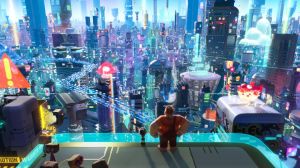
Just like in the real world, six years have passed for Ralph (John C. Reilly), Princess Vanellope von Schweetz (Sarah Silverman) and the rest of the gaming gang, who have all settled into comfortable routines inside Litwak’s Family Fun Center & Arcade.  Sure, the routine may be a little boring, but Ralph is happy with his predictable days and nights, wrecking (sorry, breaking) Fix-It Felix’s building by day, and hanging out with Vanellope at night.  Vanellope, on the other hand, feels trapped by her routine, having mastered the three available race tracks in her game.  When Ralph tries to alleviate Vanellope’s boredom by building a new track, things get both wrecked and broken, and Ralph and Vanellope are forced to explore the arcade’s newly-installed internet in search of a new steering wheel for Vanellope’s game.

Of all the things in the world besides my knee (which is feeling much better, thanks for asking, though if Jay asks tell her I need a few more days off to fully recover), there is probably nothing that makes me feel older than not knowing any of the memes that have come out in the last decade, except for the select few that Jay has taught me about after realizing I had no idea that (insert hilarious meme) was a thing.  And, as you may have guessed, there are a lot of memes referenced in Ralph Breaks the Internet.  The nice thing is, I felt like Ralph (with some minor help from the creative team) went out of his way to ensure I didn’t feel old for not knowing that (bee puns) were a thing.  Ralph simply made me laugh at his bee pun, and at all of his aprincesses4ttempts to help Vanellope get her new steering wheel.

Ralph’s antics would have made for a decent sequel just on their own, but Ralph wasn’t alone.  Every one of the supporting players in Ralph Breaks the Internet make their own contribution to the comedy.   I was particularly impressed at how the Disney princesses were incorporated, not (just) as a shameless product placement but as a way to teach Vanellope about her hidden princess talents.

The only criticism I might make is that the movie probably included a few too many characters and references, and ends up a bit long as a result.   But don’t ask me what I would have cut out, because everything that’s here is consistently good and often great.  Ralph Breaks the Internet is a very clever and accessible comedy that will provide plenty of laughs for everyone, regardless of age and regardless of whether you’ve ever heard of a screaming goat.  What a wonderfully comforting thing that is (the accessible comedy, not the goat’s screams).  It made me feel young again, a feeling that should last until my next random ache.  Meaning I may need to see this one again very soon.


The Top Ten Best Car Chases

There’s nothing better than a frantic, fast-paced, pulse-pounding car chase.

The kind that sticks you directly in the middle of the action at a hundred miles an hour, keeping you at the edge of your seat as the mayhem unfolds.

The kind that keeps you coming back to re-view (and in my case, “review”) time and again,  just to relive it.

The kind that brings something new to a very crowded genre.

The kind that I’m crazy for not including in my top ten list.  Well, did I miss any?

10. Bank Heist (Fast Five)

This would rank even higher if two Mustangs had been involved instead of two Dodge Chargers, but it’s still fantastic to see Vin Diesel and Paul Walker double-team the streets of Rio de Janeiro with a gazillion ton bank safe in tow.

Bonus points for the fact that when the safe opens, it’s to Danza Kuduro so I’m reminded of every Caribbean vacation I’ve taken since 2010.

9. Mall Escape (Terminator 2)

Normally, if you’re choosing between a dirt bike and a big rig tow truck for chase purposes, you’d take the terminator2truck, right?  But what if the dirt bike also comes with an assist from Arnold Schwarzenegger’s T-800?

What makes this chase all the more awesome is that if you go in to this movie cold, you cannot be sure which killer robot is on little John Conner’s side – a masterstroke by James Cameron which the movie’s trailers spoiled for anyone who’d seen them.

8. Mall Break-In (The Blues Brothers)

You expect a crash or two as part of a chase.  Maybe a car even flips over once in a while.   The Blues Brothers took crashes to an entirely different level.

A total of 103 cars were wrecked during the film, many of them during Dan Ackroyd and John Belushi’s wild ride through a shopping mall.  That triple-digit destruction was a record until Blues Brothers 2000 deliberately smashed one more car during its production.  But it’s the original receiving the crown that matters, namely a spot on this prestigious list.

7. San Francisco Tour (Bullitt)

Steve McQueen takes a spin in maybe the most iconic Mustang ever and tames the bullittstreets of San Francisco and a rival driver in a Dodge Charger.
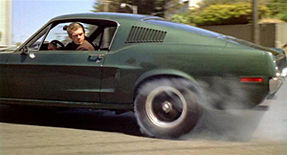
But it’s not only the car, it’s also that McQueen made sure to keep his head in view of the camers so you knew it was him doing the heavy lifting the whole time.

6. World’s Worst Valet (The Rock)

This is mostly about the car, as Nicolas Cage borrows a beautiful yellow Ferrari F355 Spider to chase down Sean Connery in a Hummer H1.  And fucks it up badly.

Michael Bay puts his own spin on a San Francisco chase, complete with a runaway trolley car, and reminds us that at Bay’s peak his set pieces were as good as anyone’s.

5. Catching the Train (The French Connection)

french connectionThe French Connection’s chase is iconic for good reason.  This claustrophobic subway/car chase was filmed without a permit in real Brooklyn traffic, causing real car crashes that were left in the film (the producers paid for the repairs, but still).

While the choice to film on uncleared streets is one that would never be allowed by a Hollywood studio today, the camera angles used by director William Friedkin and his crew are still being used today.

4. Bellbottoms (Baby Driver)

It’s rare to have a car chase open a movie, but when it’s done right,  why not?

Here, Edgar Wright gets the opening chase scene SO right, in part because he’d been dreaming of making this very car chase (complete with accompanying song) since the 90s.  It was worth the wait!

3. Chasing a Black…Tank (Batman Begins)

Christopher Nolan can do it all, can’t he?  You’d think the streets of Gotham City would be perfect car chase fodder but only Nolan got it right.batman

Nolan also got a Gotham chase right in The Dark Knight, but for my money the chase from Batman Begins is the best one since it shows us how bewildering it would be for the cops trying to keep track of a superhero’s black…tank as it defies the laws of physics.

2. Fourth Quarter Magic (Drive)

As good as Baby Driver’s opening is, the opening sequence in Drive wins out for Nicolas Winding Refn’s patience and subtlety.

This chase feels like it actually could have happened, and more importantly sets the tone for the rest of the film with its gritty realism, a hint of the pulsing synth soundtrack, and amazing attention to detail (only after seeing the chase play out do we understand why Ryan Gosling’s character is such a big basketball fan).

1. The Whole Enchilada (Mad Max: Fury Road)

Mad Max: Fury Road is FURY ROADessentially a two-hour long chase scene, so on that measure it has to be number one.

But what is most impressive is that I couldn’t pick just one short sequence of that chase to focus on because it’s all fantastic.  The madness and desperation in Max’s world lend an unmatched urgency to the chase, and George Miller never takes his foot off the accelerator even for a minute – fitting for the best car chase scene of all-time.

Bad Times at the El Royale

The title promises “bad times” and that’s exactly what this film delivers.  In saying that I am not criticizing Bad Times at the El Royale.  It’s a well-made variation on the multiple perspective crime genre (think Pulp Fiction) and it will keep you guessing until the end as each character is introduced and additional information is gained from each new perspective.  But while Quentin Tarantino mixed a fair bit of humour into Pulp Ficton’s dark brew, writer-director Drew Goddard’s El Royale is a long row of tequila shots without a chaser.  It starts slowly but even then, right from the start, the tense atmosphere tells you that a lot of bad shit is coming.

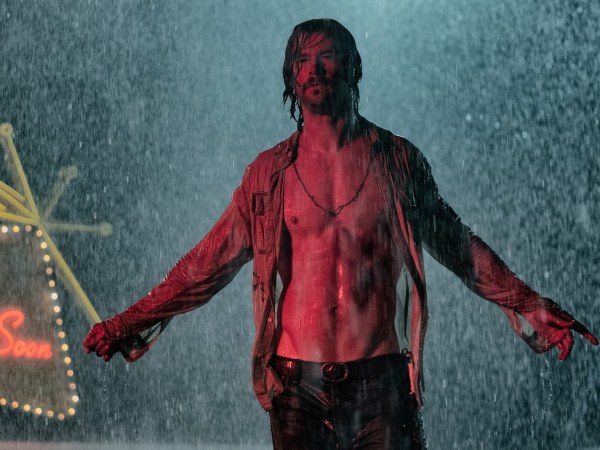
__5b18c1af51a71The main events in Bad Times at the El Royale unfold over the course of one rainy night on the Nevada-California border.  The El Royale is literally split in half by the state line, so the first challenge for each guest is to decide in which state they’d like to stay.  Unfortunately, things have gone downhill at the El Royale ever since it lost its Nevada gaming licence, so the hotel is essentially deserted.  Ringing the bell doesn’t summon the desk clerk; it takes several seconds of beating on the “staff only” door to wake him.  Once he’s up, the guests are able to check in – there are four at first, and two more will show up before the night is done.  Hardly any of the guests are what they seem, and only a couple of them will live long enough to check out in the morning.

While the movie doesn’t quite reach “classic” status, the solid premise and excellent cast still make this film worth watching.  It’s absolutely packed with talent, as demonstrated by the always-excellent Nick Offerman being relegated to a blink-and-you’ll-miss it role (though he does get to do some woodworking, of sorts, so that was probably reason enough for him to sign on).  Bad Times at the El Royale gave me a tense, suspenseful night chock full of hardboiled twists and turns, and that’s all I could have asked for before the sunrise.

When Lambs Become Lions

Northern Kenya is a very dangerous place for elephants.  Hell, maybe there’s no safe place on Earth for an animal whose front teeth are worth more on the black market than my whole body, but Northern Kenya is particularly deadly ground.  Every day, the elephants are stalked by poachers, who in turn are pursued by park rangers.  But it’s hardly a fair fight when the park rangers haven’t been paid by the government for months, while the poachers stand to make more from one elephant than the rangers have made in the past year.When+Lambs+Become+Lions

When Lambs Become Lions documents the ongoing battle between poachers and rangers from a very interesting perspective: it follows two family members on opposite sides of the fight and shoots the heart of the action, as poachers pursue elephants and as rangers pursue poachers.   Because of its dual focus, When Lambs Become Lions manages not to take sides or judge these relatives as they try to provide for their families.  That is a useful perspective because really, the poachers aren’t the true reason for elephants’ status as an endangered species.  The poachers are the tool of the ivory dealers, and both exist because many of the world’s rich people want to pay lots of money for tusks.  Those people are the villains here.  The poachers are simply trying to get ahead rather than living day-by-day doing whatever odd jobs can be found.

As a result of the film’s judgment-free, up-close approach, When Lambs Become Lions feels more like a narrative feature than you’d expect.  I was curious to see how the story would end and enjoyed the twists and turns along the way.  As it turns out, poachers and rangers are not like oil and water.   They mix, they intermingle, and they can at time seven switch from one side to the other.  Even though rangers are authorized (and expected) to shoot poachers on sight, there’s a respect for their opponents’ circumstances and humanity that feels so very foreign, quaint, and refreshing in contrast to the western ultra-partisan, hyper-adversarial approach to conflict.

What’s the cause of those differing attitudes to one’s ideological opponents? Is it that we’ve had it too good for too long to remember what it’s like to make hard choices to survive?  Are we afraid to engage with those who have different opinions than ours?  Why can’t we see past those differences that are so minor in comparison to the divide between than these two relatives, one of whom is expected to feed the other to crocodiles when both are on duty?  I’m not sure but it’s something for us to figure out because, like rangers say about poachers, that story is unlikely to have a happy ending.


Marks of Mana

According to Samoan legend, two goddesses intended to give tattoos, traditionally called “tatau”, to the Samoan women, but on their long swim to Samoa from Fiji the goddesses got confused and gave tattoos to men instead.  Marks of Mana offers a look at a number of women who are now reclaiming the art of tatau for themselves as well as for the memories of their ancestors, and reporting these tattooing ceremonies as being a life-changing experience.marks of mana

This documentary begins in Samoa, naturally, as we meet a female chief and her family of seven (grown) children.  One of her five daughters is about to get her malu, which is a thigh tattoo only for women that is both a coming-of-age moment and a ceremonial recognition and affirmation of a woman’s connection to her ancestry.  Meeting this family emphasizes the historical standing of women to Samoa’s indigenous people, as equals and leaders rather than as less than men.  Similar longstanding “progressive” attitudes are on display at other South Pacific locations as well, such as Papua New Guinea, as it’s a consistent theme that women’s tattoos signify their knowledge and power within their societies.

Of course, the power that women traditionally possessed in those societies was suppressed, stymied and rejected by the island’s colonizers, who saw no problem with imposing their backwards, misogynistic cultures on the Samoans.  The absurdity of that transaction and the colonizers’ arrogance in forcing their values on the Samoans and others is subtly displayed by this film in each of its segments, and nicely displaces the false narrative that colonizers were welcomed by the colonized because they improved the colonized societies with their intrusion.

The version of Marks of Mana shown to me was unfinished (the main omissions were subtitles and one segment out of five).  Having seen the work in progress, I am eager to see the finished product because what has been created so far is a valuable, enlightening and uplifting look at the ceremonial aspect of Polynesian tattoos and the healing power of reclaiming one’s cultural traditions.

Marks of Mana is screening as part of Toronto’s ImagineNATIVE Film & Media Arts Festival on October 19, 2018 at 11 a.m. at the TIFF Bell Lightbox.