
Category Archives: Kick-ass!

The highest honour we can bestow on a film. Anyrhing in this category is a must-see.

Searching

Searching Pie

1999. It was the summer that I graduated high school, started preparing for CEGEP, and took my first trip across the country without the parental units. If ever there was a summer that felt like I had my whole life ahead of me, that was the one and- even though it was that same summer that I saw The Goddamn Matrix for the first time, the movie that really brings me back to that feeling- the movie that I saw four times- was American Pie.

Looking back on that scene where three teens repeatedly scream “MILF” at a picture of Stiffler’s Mom, I’d call it misogynist. But 19 years ago, that didn’t stop my friends and I from laughing our asses off. And to this day (and I’m sure this would make him so happy) I can’t look at John Cho without thinking of “MILF’ Guy #2. (Wait, who was “MILF” Guy #1 then?).

It’s almost depressing to think about how long ago that was. Times have changed and a lot of those changes are good. Jason Biggs doesn’t have to watch scrambled porn anymore and Cho can find work without having to lick a framed photo of Jennifer Coolidge. And I’m proud that my sense of humour has gotten a little more sophisticated and hopefully a lot less sexist. Still, I don’t know many people who love thinking about how many years have passed since high school while they weren’t looking and in his new movie John Cho is back to remind me of just how old I’ve gotten by playing the father of a 16 year-old girl.
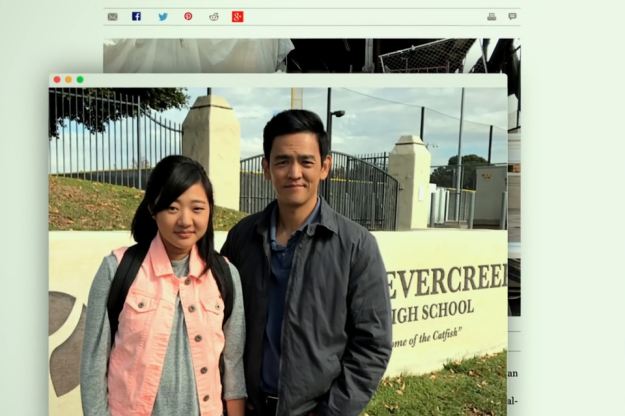
Searching 1

That Cho is now old and mature enough to carry a tense thriller about a father’s desperate search for his missing teenage daughter isn’t even the most obvious way that Searching reminds us of what a strange and different world we’re now living in. First-time director Aneesh Chaganty shot the entire movie from the point of view of a mock computer screen. So as Cho’s David Kim talks to his daughter’s friends and searches for clues on her laptop, the whole story is told through Google searches, text history, Facebook posts, Skype, and YouTube videos.
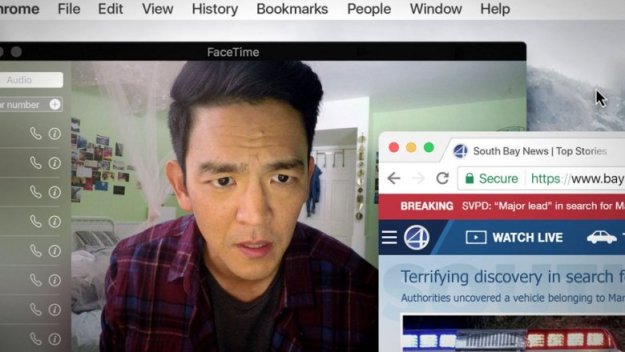
Searching 2

My first response to Chaganty’s experimental approach during the first few minutes of Searching was “Alright. I’m impressed so far and am on board for now but can easily see how this can get old pretty quickly”. It’s a testament to Chaganty’s storytelling that the novelty never wears off and is rarely distracting. It’s not a perfect film. I’m not sure all of the laughs it got at my Fantasia screening were entirely intentional and as a thriller one or two of the twists may be a little too far-fetched.

Not all of the changes since 1999 are great and Searching is at its best as an exploration of what a double-edged sword the internet can be. It shows how it can make it easier both to reach out and to retreat into our. How easy it is both to reveal and conceal our true selves. And, most importantly, how useful a tool the internet is for concerned parents and stalkers alike.

Despite its flaws, Searching is a much more gripping and emotionally satisfying experience than you’re probably imagining and Cho nails what I can only imagine must have been a challenging role. I highly recommend it.

The Vanished

When director Chang-hee Lee saw Oriol Paulo’s 2012 film, The Body, he enjoyed it, but he also saw how he would make it differently, and perhaps more importantly, how he could inject it with some Korean spice. Chang-hee Lee introduces the film to us at Fantasia Film Festival, and appears overwhelmed to have traveled all this way for his first feature film, awed at the reception, abashed at the applause. After greeting us in French (garnering immediate rock star status), he reassures us that this is not so much a horror film as a thriller, and so of course the opening scene causes me to pee just a teeny, tiny, barely perceptible bit. It was hella scary.

OF COURSE it’s scary: a night security guard goes down to the basement DURING A BLACKOUT on a rainy night BY HIMSELF armed with only a flashlight TO A MORGUE where he sees – what? a woman? a body? a ghost? We don’t know, because someone (or something) shadowy gives him a crack on the head, and when the police arrive it’s not really the security guard who grabs their attention, but the empty drawer in the morgue.

Yoon Seol Hee, newly dead, formerly a young, successful CEO, has gone missing. Well, her corpse has. Bad-boy detective Woo Joong Shik is on the case, and he’s cynical as hell and casts an accusatory eye at her “trophy husband”, Park Jin Han, although he’s more concerned with murder than mere body snatching. Of course, since Park and Yoon run MV5BOTk0ZDAzOTMtMTg3NS00Y2Y3LWI4ZDYtNjE2MGU3NTRkNTc4XkEyXkFqcGdeQXVyNzI1NzMxNzM@._V1_with an elite crowd, the higher ups are cautioning Detective Woo to back off – but he’s much too much a loose canon to respect authority, isn’t he? You know he is. Meanwhile, if Park is looking inadequately grief stricken, he’s overly concerned about his wife’s missing body. And pretty soon he’s frantically claiming that she’s responsible for her own disappearance, and is somehow still alive.
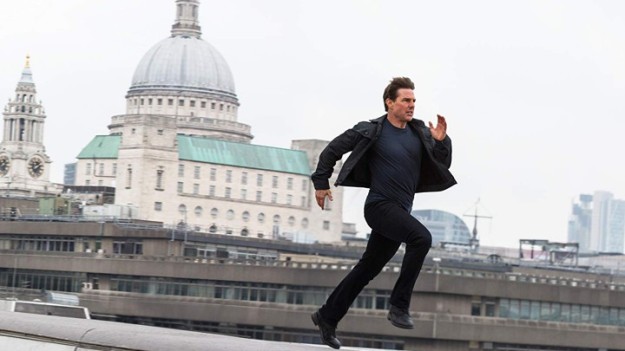
The cool thing about this movie is that it takes place over the course of just one night, which gives it a real sense of urgency. Movie detectives are often of this variety, the old “renegade cop” trope, the guy who plays by his own rules. He’s tough, a bit of a cowboy, a definite anti-hero, often with a side of alcoholism or anger (mis)management. But there’s something about seeing this Detective among his much more restrained, polite, effacing, perhaps more stereotypically Korean colleagues that’s intriguing and fresh. No one quite knows what to make of him, and he definitely shakes up the investigation.

Even if you’ve seen the original Spanish version, you’ll still get a kick out of The Vanished; the Korean setting of course makes for quite a change, but circumstances and even outcomes have been rearranged as well, for your viewing pleasure. And to be honest, it was quite a pleasure. I can’t believe this is a first feature for the director. It looks slick and cool and there are lots of visual details to admire, we get a sense of his style and aesthetic and the whole thing just glows. The cinematography is beautiful. As I mentioned, this film takes place over the course of a single night, so DP Lee Jong-youl coats it in a cold blue wash that lends just a touch of creepiness to an already creepy scenario. But in flashbacks he floods us with warm, natural lighting, which is a bit cruel actually – it gives us a false sense of comfort when really we should never let our guard down.

The thing about The Vanished is, it’s a very compelling puzzle. And even if you’re very clever and you manage to slot all the moving pieces into just the right places, you’ll find it’s one of those trick puzzles that only look complete – actually it just unlocks like 3 more puzzles to solve! The veteran cast (Kang-woo Kim, Hee-ae Kim, and Sang-Kyung Kim as the rumpled Detective) close ranks and draw us in with their institutional politeness – but something stinks in this morgue, and it’s certainly not the dead body. Because, you know, it’s missing. And maybe not even dead.

Mission: Impossible -Fallout

lead_720_405Aside from the awkward colon in the title, the most annoying thing about the Mission: Impossible series has always been Tom Cruise’s massive over-reliance on rubber masks (yes, even moreso than his ridiculous excessive arm-pumping while running). While Mission: Impossible – Fallout doesn’t totally avoid the rubber mask cliché, it tweaks it enough to feel fresh. And every once in a while, despite how familiar the M:I formula has become after six attempts, the movie will sneak one by you, winking as it does.

In Mission: Impossible – Fallout, Ethan Hunt (Tom Cruise) and his team (Ving Rhames and Simon Pegg) are tasked with saving the world (again) by recovering a bunch of stolen plutonium before a terrorist group can use it in nuclear weapons. The stakes are high so Ethan and his crew need to be at the top of their game, and doubly so when we’ve seen them in action so many times already.

M:I-F is up to the challenge in all respects. This is the best entry in the franchise so far. Not because it does anything surprising or anything we haven’t seen before, but because it delivers exactly what it promises and because it’s flawlessly executed, without a single misstep.

Action-packed and entertaining from start to finish, M:I-F is better than I expected, better than it has any right to be, and better than it ever needed to be.  This is 2018’s best summer blockbuster, hands down.

Cam

Mostly, we’re very lucky to travel the world, attend film festivals, and see great movies eons before any of you jerks. But, to be honest, there are a few downsides. Popcorn isn’t a food group. It’s hard to take notes in the dark. There’s only so many times you can sincerely shake Matt Damon’s hand and say “Pleased to meet you.” But worst of all: sometimes you see a really great, or really interesting, or really controversial film and all you want, in fact NEED, to do is talk about it with fellow film fanatics but you can’t because literally no one else has seen it yet. I remember seeing La La Land at TIFF, my eyes stinging as I went from my dark corner of the theatre to broad daylight, sobbing as I walked through downtown Toronto to my next film, and walking straight into Arrival. Back to back massive, amazing films that I needed to discuss and debrief – but with whom? And then I saw Jackie and Lion and Loving and The Lobster, 4 or 5 movies a day for 10 days, at the end of which, I’m punch drunk. And then I have to sit on all this movie madness for anywhere from 3 months (lots of Oscar contenders are aiming for Christmas releases) to 3+ years (if the festival fails to bring in offers for distribution). Thank goodness I drink; if my memory were any better, I’d probably be fucked.

Cam is one of those movies that I’m dying to talk about, and it proves that a press pass is a nice thing, but 17 press passes for my 17 friends would be much nicer. Of course, I MV5BNjI1MTQ2YWEtYmE0OS00NzJkLWFhMDgtNmM3OTJkYzFlZDYwXkEyXkFqcGdeQXVyODc4ODY5Mzc@._V1_SX1776_CR0,0,1776,998_AL_come home and stare at this white, white screen, trying to distill my thoughts, keep them straight, not confuse them with any of the other 32 trillion movies I’ve seen, and find a way to sort of talk about them with all of you. And that’s possibly the hardest part for me because I’m a bit of blabber mouth but a review is not about telling, it’s about hinting, hinting just enough so that you have an idea whether you should see it or skip it or read some other, more cohesive review that doesn’t waste 400 words complaining about having seen a terrific film.

I buried the lead there. Surprise: Cam is a terrific film!

I’m so glad I got that off my chest. I was playing it so cool during that first paragraph, trying to distract us both with all my reminiscing (I’m pretty sure those are my  memories anyway – of course, I wouldn’t swear to it. Not on my mother’s life. Not even on yours – no offense, of course, but I don’t even know the lady).

Cam is about a sex worker named Alice – though her fans know her as Lola. She’s a cam girl. She works for a website where men can live-stream women for “free” – although getting her to do pretty much anything requires a lot of “tipping.” Lola is quite popular. She’s able to maintain relationships with several men outside the chatroom – not in the real world per say, but in other digital venues, where they’re encouraged to spend more money, and even send gifts, for a more personalized show. Alice (Madeline Brewer) is a surprisingly ambitious sex worker, and she’s smart too. She pushes her shows to the limit, choreographing, staging, and even faking gruesome suicide scenes which her horny, horrible customers seem to gobble up. Alice has her eye on the top: she wants to be the #1 camgirl. But that pride in her work only extends so far – her mother don’t know shit about how Alice pays her rent. She keeps her two lives separate and firmly on lockdown – and that works, until it doesn’t.

One day she finds herself locked out of her account, and stranger still, someone else is using it. Well, not someone else. It’s still her. It’s just not her her. Who is this impostor? How is this sneaky, thieving lookalike even possible?

Cam descends into this pulsating vortex where we must question everything. What is digital identity? At this point, is it even separate from our “offline” identity? How valuable is it? How do we prove it? How do we safeguard it?

Alice is a many-flavoured protagonist, and Madeline Brewer will FREAK YOU THE FUCK OUT. Damn she’s good in this, in a can’t-watch, must-watch kind of way. Fierce and fearless, she’ll turn you on, she’ll mess you up, she’ll  haunt your dreams.

Cam is a smart, timely movie about sex work, but it’s also this swirling, confounding, complicated piece of cinema that manages to look stylish and cool even as it challenges some pretty core notions. I like its subversive nature, how it pokes the bear in sly and cool ways, how it opened me up to an underground world I’ve never really seen before. I was “lucky” enough to be in the audience for its world premiere at Fantasia Film Festival, but I won’t be truly happy until you’ve all been infected with it also, so I can finally dissect it the meaty, enthusiastic way it deserves.

The Man Who Killed Hitler And Then The Bigfoot

Sam Elliott knows he’s recognized for roles in Tombstone or The Big Lebowski. And he’s instantly recognizable too, from his trademark mustache to his deep, commanding voice. But as anyone who’s hit the film festival circuit lately knows, Elliott has shown a preference for independent film in the later stages of his career, and indie film loves him back. In fact, not that long ago he had a role written especially for him – it suits him like a lustrous patch of facial hair. It’s called The Hero, and you should definitely check it out.

But at this year’s Fantasia Film Festival, Sam Elliott is playing a different, and more specific kind of hero: he’s playing the man who killed Hitler, and then the Bigfoot. These bigger-than-life events serve to bookend the man’s career. When we meet MV5BNjdkNzYwNjYtZDc3MC00Y2Y2LTgzYTctMjkxYTJkYzY1ODE3XkEyXkFqcGdeQXVyMTk4ODI4ODE@._V1_Calvin, he’s a tired old man, safe in his routine, happiest at the bottom of a bottle. But one night the FBI shows up at his door, with a delicate problem on their hands. It’s the Bigfoot. He’s patient zero for a world-ending virus, and he’s already decimating populations up in Canada. Calvin, with a reputation for excellent tracking and a specific immunity to the disease, is a last resort. If he can’t stop the Bigfoot, the president is going to nuke Canada to keep himself safe.
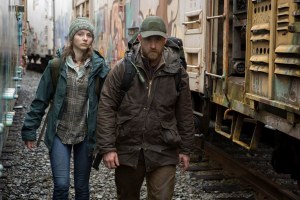

I realize that the title alone spells out two really big scenes that you can’t wait to watch (Aidan Turner plays a young Calvin), but the truth is, it’s what’s in between that really matters, to us and to Calvin, who downplays his heroism and manages to come across as a normal, if heartbroken, man. But it’s the specific ways in which he’s broken that’s interesting. It’s the pain in his face, the pain in his body, the way he loses focus and we get drawn into another intense flashback, and after being inundated by all these memories, we start to realize what life has been like for Calvin in between bouts of adventure, and it’s not a beautiful life.

First time director Robert D. Krzykowski evokes the headline of an obituary with his splashy title, but the story focuses more on aging than on adventuring. This is the winding down of a big life and the toll such a life has taken on a man who is, after all, just a man. Sam Elliott is perfect casting, and I have to imagine to a first time director, it’s also dream casting. There’s something deeply satisfying and not a little cathartic in Elliott’s stoic, deadpan acceptance of some pretty absurd situations. And Krzykowski, in love with process, and detail, is more prone to showing the little moments than making a big spectacle. So the most shocking thing about a movie involving the plot to kill humanity’s embodiment of evil AND a mythic monster infected with a doomsday virus is that it’s really not shocking at all. It’s a moody, bittersweet little indie film with a lot to say about every day things.

Leave No Trace

This is a special breed of movie. In a summer of blockbusters, this quiet movie is a stand-out, a necessary refuge from the storm of testosterone and TNT playing at the local cineplex.

It’s about an army vet, Will (Ben Foster) who has made a home for himself and 13 year old daughter Tom (Thomasin Harcourt McKenzie) in a national park, where they read books, grow and forage food, and live a peaceful, low-stress existence. Until, that is, a small mistake trips them up and they are apprehended by park rangers and social services. Though Tom is obviously well-cared for and has been MV5BMjExNWUzZDItMTdmMS00ZjQ5LThlZTktYTE0Y2RhNzEzOWRkXkEyXkFqcGdeQXVyNzM1MTc3ODg@._V1_educated beyond her grade level, she should be in school, and have a roof over her head. At least that’s what the social worker says. But once housed and employed, things get sticky. Tom is a curious and lively teenager, making friends and thriving in her new environment. Her dad struggles to assimilate, and he’s largely unable to cope.

Trust me, I know the description sounds ordinary, but the execution is flawless.

  1. The casting is impeccable. Ben Foster isn’t a big, bankable name but he’s every casting director’s wet dream. He brings intensity and gravitas to every role he encounters, and the stoic approach he takes with Will is perfect, though few other actors would give themselves permission to try such subtlety. Opposite him, Thomasin McKenzie is fabulous. The movie is all about their dynamic and it only works if both halves of their little family unit is working in synchronicity. Tom is obviously bright but McKenzie gives her such a sense of vulnerability that we never lose sight of what’s at stake.
  2. The script, by Debra Granik and Anne Rosellini, is such a luxury. They find so much value and beauty in simplicity that I’m astonished at how much I felt for what amounts to a fairly sparse script. The difference is, they’ve edited carefully, they’ve pared it down to the essentials, and tuned them ever so carefully. What’s left is a lot of room for the actors to be comfortable and take ownership. Room for the director to make her mark. It’s so smartly-written. It would be easy to find melodrama in these circumstances but instead Granik and Rosellini consistently find empathy and dignity and it makes weepy just to write about it.
  3. The cinematography is astonishing. At times it looks like an expensive nature documentary – one that fits seamlessly into a feature film. Someone (Michael McDonough) took a lot of care with this. He films the park with such loving and patience we get the sense of how at home the characters are in this special place. By contrast, the city looks colder, less inviting.
  4. Granik’s direction is flawless. As you may be surmising from everything written so far, there isn’t much in the movie, not even silences and blank spaces, that aren’t actively working for the plot or the characters. And by keeping things trim, it forces the audience to be active too. The keys are all there, and the deft direction encourages us to pick them up, sort them out. This movie respects its characters and its audience – objectively, the events and circumstances are tragic, but they’re communicated with such restraint. It’s easy to have sympathy when no one is asking for it. Will and Tom do not describe their situation as homelessness, and the movie lovingly backs them up in this.

This movie is so thoughtful and caring and it shows a different model for living and loving with no judgment. There’s no malice, no villains. Even the social services are shown to be well-intentioned. But Will and Tom are hardly the only outcasts, and Leave No Traces embraces them as well. It has room in its heart for everyone and even though there is much to be sad about, the film is so sweetly assembled that I left the theatre with a little pocket of hope in my heart. There are no easy answers, but Granik’s gaze is fair and honest and I’m just bowled over by every inch of this movie. It’s a rare and precious thing, and though it may be called Leave No Trace, it actually leaves quite a mark.


Sorry To Bother You

Well.

I hardly know how to talk about a movie like this.

It’s radical.

Ostensibly it’s about “telemarketing” but that’s like saying Toy Story is about single parenting. It’s really about racism and assimilation and wage slavery and identity – by way of telemarketing, at least to start.

Cassius Green (Lakeith Stanfield) is thrilled to get a shitty telemarketing job, working for commission. There’s almost no way to actually succeed doing this kind of work, but Cassius stumbles upon the secret, magic key: a white voice. A persuasive, approachable, overconfident voice, like Tobias Funke’s, perhaps. Using this voice, Cassius shoots straight to the top, rocketing past his buddies and even his girlfriend Detroit (Tessa MV5BMzNjZTZlZmYtODU0ZS00NzFkLTkyZGEtOTI5M2Q0YTZmNzg3XkEyXkFqcGdeQXVyNDg2MjUxNjM@._V1_SY1000_SX1500_AL_Thompson) who are trying to organize a union that will help the little guys make a living wage too.

On top, Cassius is of course hypnotized by the wealth and privilege, but now that he’s rubbing elbows with “the man”, he’s finding it’s a little different than he’d imagined. “The man” is of course Armie Hammer, like you ever fucking doubted it. Hammer was literally born to be typecast as a slave owner – his great-grandfather was a legit oil tycoon and philanthropist, and the family is worth somewhere in the neighbourhood of $200M. So yeah, he’s got owning slaves in his blood, and we can all read it in his cheekbones. In Sorry To Bother You, he plays a CEO who is “saving the world” by enslaving all the poor people and making them thank him for it. Signing a contract, they agree to work wage-free for him forever in exchange for housing (which looks surprisingly like prison cells minus the bars but with double the roommates) and food.

And everything is just gently pushing you. Pushing your boundaries, almost imperceptibly. In the beginning, things are near normal but they escalate, asking us to accept just one more inch of absurdity. It is THE best kind of satire, uncompromising but plenty challenging.

First-time writer-director Boots Riley has made a film that is gutsy and experimental. It feels like this is a guy who isn’t sure he’ll ever get to do this again, so he’s not leaving a single idea on the table. He takes huge risks and when they pay off, hot damn. Sorry To Bother you zigs and zags in unexpected places but the super talented cast helps this thing stay grounded. Riley is full of piss and vinegar and a comic outrage that’s infection. This is bold stuff, exciting to watch, fearless, outrageous, and I want more. Not for the faint of heart.

Eighth Grade

What was eighth grade like for you? Sweaty palms and horrible class photos and nerve-racking social encounters? A bad haircut, perhaps? An unrequited crush? Does anyone ever feel cool in the eighth grade? Is that even possible?

Kayla does not. She’s wading miserably through her last week of the eighth grade, friendless and sort of petrified, living a double life. At home she creates Youtube content teaching others to be confident like she is – although at school, of course, she is not. She knows classmates would describe her as quiet if they describe her at all, but that’s not how she feels inside, even if she can never quite communicate this gregarious alter ego to anyone, ever.

Kayla is portrayed by Elsie Fisher, who is so good and so talented she’ll take you right back to your eighth grade shoes. And boy are they awkward shoes. But it takes great MV5BZDYxZWY4NjQtYzM2Ni00YmE0LTlmZDItNTZlZGMwYWVkZWI0XkEyXkFqcGdeQXVyNDg2MjUxNjM@._V1_SY1000_SX1500_AL_wells of courage in an actor to be as vulnerable as she is up on that screen, so raw and real that we are instantly transported to our own childhoods. And Fisher is indeed a very young woman herself, (otherwise best known as the voice of Agnes from Despicable Me, for which she improvised that delightful little tune about unicorns) which makes it even more impressive that straight out of the box, she’s amazing and transcendent.
Eighth Grade is about that tender age, around 13, when kids are transitioning to young adults. To when everything feels big and important and all-consuming. When a spot of unhappiness feels like it might last forever. But in reality, things are changing so fast, and life is lobbing surprise after surprise, and it’s really only in the looking back that we can pinpoint all these little episodes that helped make us who we are. The Eighth Grade itself probably felt like it went on for decades, but it’s something we all have in common, and it’s the reason like someone like Bo Burnham, who as you might have guessed is a man, can still relate so well that he’s made a pretty accurate account of that time in a young person’s life. And even if Elsie has slightly different trappings: iPhones and Instagram and FMO, her base desires and fears and neuroses are universal.

Elsie is a brilliant character. Despite her social failures, she is sweet and smart and resilient. We see ourselves in her, but we also want to befriend her, mother her. She is the sun and we orbit around her, experiencing her different angles until all are exhausted and all we want is to hug her, to tell her it gets better.

We didn’t all have the same voyeuristic roommate at University, we didn’t all have the same embezzling first boss, we don’t all have dads who are dentists/truck enthusiasts, but we were all knobs in the 8th grade. Bo Burnham has captured this gracefully in this feature; Eighth Grade is a movie for all of us. Except, of course, for eighth graders themselves, who can only watch a movie about themselves when they are old enough to take it. Yeah, let’s just sit with that one for a minute. This movie is rated R, for language, for some teen drug and alcohol use, and some sexual material. All things the typical 8th grader will encounter in their every day lives but cannot be trusted to witness in movies. Which is kind of fucked up. So if nothing else, this movie reminds us all how hard it is to be that age, to be in tricky situations that we aren’t really prepared for, to have the burden of expectation without the benefit of experience. If you know an eighth grader, this movie will have you wanting to cut them just a little extra slack. Life is hard. Kindness costs nothing. Set a good example.

Summer of 84

All year long I wear the badge of wimp proudly. It’s made out of bubble wrap and bandaids, and is attached with safety velcro in order to never risk the prick. I DO NOT WATCH HORROR MOVIES. I do not. In fact: I cannot. I even turned my cowardly back on Hereditary despite its starring one of my all-time-favourite actresses, and I stalk her from beneath her floorboards 4 days a week. I don’t watch em. I can’t do it. They don’t just make me scared, they make me mad. And not just husband sleeps with your best friend on your birthday mad. Oh no. I’m talking REALLY mad. Mad that I have ALLOWED myself to feel this bad. So I sit there seething. Self-loathing. And so scared I might pee – and that’s not an expression, it’s an alarmingly real possibility.

But.

But in July, I make an exception, an exception called The Fantasia Film Festival. It shows an incredible lineup of genre films, which takes me out of my comfort zone and challenges me as a movie lover, watcher, and reviewer. It’s got odes to action, horror, sci-fi, and loads besides – the most frontier-pushing stuff from Japan, South Korea, and more, and stuff to inspire fresh nightmares for a year. Truly something for every sicko out there, and I love it.

And this isn’t the first time I’ve let myself be pee-strength scared. As a kid I remember that a simple game of hide-and-go-seek would strain my 7 year old heart into cardiac arrest territory. Relocate that game to the woods, and set it at night, and I was a cowering, quivering mess. Did anyone else put themselves through these MV5BNWNjOTNkNTAtOTQwNi00MzM0LWE0OTktY2VmYzE2NDdiY2Q2XkEyXkFqcGdeQXVyNTU4ODA4MTg@._V1_neighbourhood games of hell? Obviously someone must derive pleasure from being on the brink of abject horror, and at the beginning of Summer of 84, we meet 4 such young fellows. Davey and his friends are 15 in the summer of 84, mere shadows of mustaches playing on their upper lips, and haven’t yet outgrown their midnight game of “manhunt.” I think it’s creepy even before the big news is revealed: the Cape May slayer is on the loose in their community. With 13 confirmed kills and a preference for teenage boys, Davey and his buddies should rationally be concerned about this serial killer but they’re kids, hornily hovering about the precipice between childhood and growing up, and instead they think it’s kind of cool.
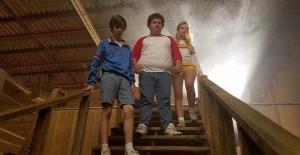
Kind of cool until Davey (Graham Verchere), an amateur conspiracy theorist, convinces Eats (Judah Lewis), Woody (Caleb Emery), and Farraday (Cory Gruter-Andrew) that his next-door neighbour Mackey (Rich Sommer) fits the serial killer’s profile, and that Mackey’s job as a cop is nothing more than the perfect cover. So even though there’s a beautiful girl next door, a couple years older and rocking a side pony, Davey is single-minded in his surveillance and suspicion of Mackey. Which makes me hyperventilate on at least two fronts: 1. If Mackey IS the killer, Davey et. al are drawing an awful lot of attention to themselves, and 2. If he is not the killer, then the killer is on loose, and the boys are very distracted, which makes them easy targets. 

This is the most recent offering from directors RKSS (Roadkill Superstar), a trio of talented young Canadians otherwise known as Anouk Whissell, François Simard, and Yoann-Karl Whissell. Summer of 84 is inevitably being compared to Stranger Things, but that comparison isn’t really fair, just a lazy nod to the 1980s nostalgia they both evoke. Summer of 84 more like The Goonies, a childhood adventure movie, but with higher stakes. RKSS is not afraid to let some kids meet with some pretty real-world consequences.

As you can imagine, this movie is brimming with barely-awakened testosterone, and enough tension to blow the roofs off several treehouses. 105 minutes is a long time to be barely containing the urge to scream “Get out of there!!!!” in a theatre full of heavy-breathing moviegoers. My notebook reveals that I survived the ordeal by sketching people’s shoes. But I also survived by being pleasantly surprised by the production value in this movie. RKSS know and love their gore, but they’ve also crafted a movie that looks terrific. It certainly looks levels above what their budget must have dictated, and it’s rooted in an 80s realism you’ll identify as “grandparent’s rec room chic” rather than the too-slick, glossy, neon, facile and over-stylized way many other directors are dazzled by. Of course, it’s rather ironic since the film makers were not likely even born yet in the summer of 84, but who’s counting?

The four young actors are all quite good; Verchere has an honest and earnest face that’s hard not to root for, and Emery’s face is probably already familiar to you. There’s an easy and genuine camaraderie between the boys, which makes it easy to care for them even if their characters aren’t exactly well-developed. And getting us to care for the lambs being left to slaughter isn’t something you can take for granted in a horror movie. Blood comes cheap, but RKSS pays full price.


Miss Stevens

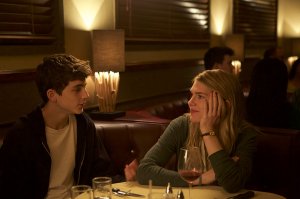
Miss Stevens is a 29 year old high school English teacher taking 3 students on a weekend away for drama club. Student Sam (Anthony Quintal) is bright and sensitive and dedicated. Margot (Lili Reinhart) is studious and uptight. Billy (Timothee Chalamet) is “having trouble caring about a lot of things” – a kid with behavioural problems Miss Stevens is supposed to keep an eye on, but actually he’s the one she most relates to. And it doesn’t seem like she relates to much these days. Outside of the classroom, Miss Stevens (Lily Rabe) is sloppier, less responsible, more potty-mouthed. And on this drama outing in particular, she seems to let her guard down.

Julia Hart is a super talented director who I might never have known if not for MV5BMjA5MTc2Njg4OV5BMl5BanBnXkFtZTgwMzY1MzMwMDI@._V1_SX1500_CR0,0,1500,999_AL_touring around to various film festivals. She makes beautiful, sad, detailed films about strong women. Miss Stevens is such a character. As chaperone, she’s discovering that this whole “coming of age” thing isn’t just for teenagers – you do it first when you actually become the age of majority, and a second time when your adulthood really takes. For Miss Stevens, it is perhaps only truly gelling now, on this trip, as the only grown-up jumping on the hotel bed.

Life is hard. Miss Stevens is fragile. But the fact that she’s navigating these conflicting things, and the spongy, tricky thing that is friendship between students and teachers, means she is growing and learning and becoming the self she’s supposed to be. And it’s kind of amazing to see something so authentic on the screen. This movie is small but perfect in its smallness, uniquely positioned to bring out those tiny intimacies that string us together in life.

Lily Rabe is terrific in this, heart breaking and complex and frustrating and real. Timothee Chalamet proves that he’s got star-making stuff up his sleeve. Everyone and everything just comes together to make this movie mature and fascinating, balanced and natural, intimate but familiar. Check it out.