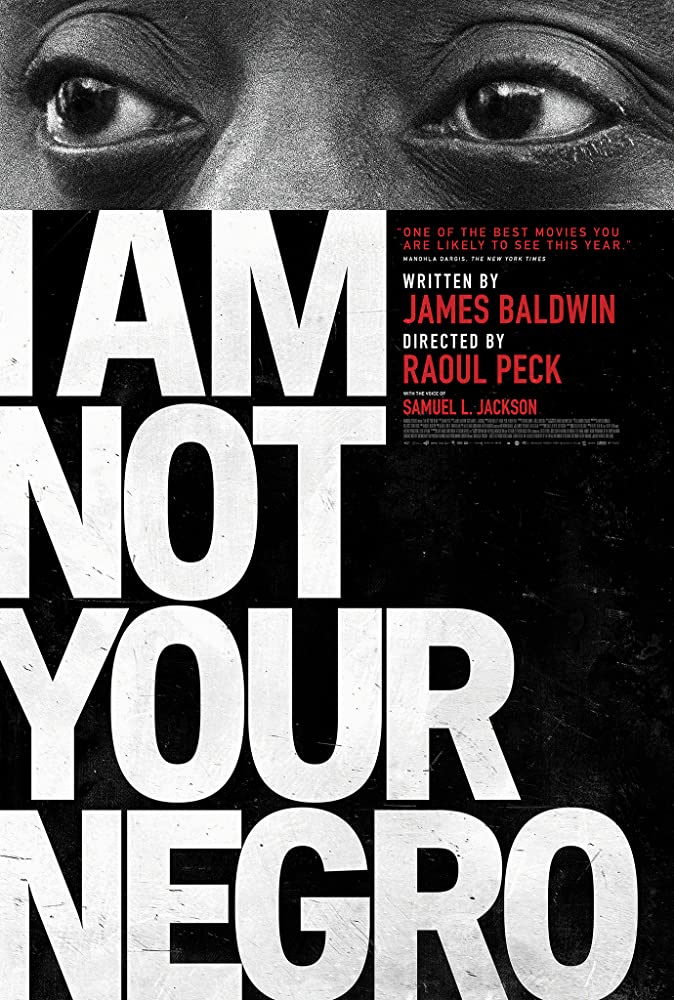
In 1979, James Baldwin wrote a letter to his agent describing his next book, “Remember This House.” It was to be a revolutionary, personal account of the lives and assassinations of three of his close friends: Medgar Evers, Malcolm X and Martin Luther King, Jr. But when Baldwin died, he’d only managed about 30 completed pages of this manuscript. Filmmaker Raoul Peck delivers a stirring documentary as an ode to the book James Baldwin never finished, a work that enmeshes the civil rights work not only of these 3 great men, but that of Baldwin himself.
Samuel L. Jackson narrates some of the strongest and most poetic words – which will not surprise you if you’ve read Baldwin before. He had his finger on the pulse of America, his America, the oft-forgotten America, and he reported on his people with undeniable lyricism, beauty, and confidence.
The documentary expands on his thoughts with archival footage, which is used most effectively when bridging words he wrote 40 or 50 years ago to images of modern conditions and protest, which still apply. I Am Not Your Negro is about civil rights, but it’s also an expression of identity, of unrest, of passion, of hope. He wrote about his people because he saw beauty there, even in the struggle. He was buoyed by it, as much as they were by him. They shored each other up, and as these same issues continue to be fought for even today, it is no wonder we still turn to his words of wisdom and of utter poetry.
Cineplex is offering Canadians a whole bunch of movies that speak to the black experience for free this month – check here for a complete list – and this is one of them, as it should be. I hadn’t seen it since it was released in theatres and Sean hadn’t seen it at all.
It’s been 7 years since this movie came out, but I still remember how deeply it had moved me, saddened me, enraged me, which is why a part of me wasn’t super keen to revisit it. And another part of me was disgusted by that part’s response: the suffering and inherent iniquity of my fellow human beings makes me uncomfortable because IT SHOULD. My ancestors helped create this mess, my privilege benefits from it, and my inaction maintains it.
Oscar Grant III was just 22 years old when he was shot by a white cop while lying face down on the ground. It’s been nearly 12 years since his death signaled a significant problem in policing, and nearly 12 years since we’ve continued to allow our darker skinned friends to die for their melanin. The problem has of course existed as long as policing has; American law enforcement was built in the wake of slavery as a new way to round up black bodies and extort free labour from them, but only in this century has the presence of cellphones allowed these shootings to be captured on film. Grant’s name joins a long list of black men and women murdered by police.
Fruitvale Station is the first feature length film by director Ryan Coogler and his first collaboration with Michael B. Jordan – but not his last. His next film, Creed, gives Rocky fans (and Rocky himself) a strong black protagonist to root for, an extension of Apollo Creed’s (Carl Weathers) legacy, but also a modern American hero for a new audience to look up to. Coogler’s next film takes that premise to an even greater height with Marvel’s first black super hero movie, Black Panther. Through Wakanda, Coogler explores themes of responsibility and identity. He casts Jordan as Killmonger, the fearsome but ultimately sympathetic villain. He helps T’Challa realize that Wakanda’s relative strength and power means they owe something to their neighbours in need, a message that seems not to permeate stubborn white audiences.
Cineplex and other streaming services are also offering another Michael B. Jordan super hero movie for fee this month: Just Mercy. Bryan Stevenson is a real-life African American lawyer who helps wrongfully convicted death row prisoners. Just Mercy is further proof that Michael B. Jordan is himself a black idol, and a major, bankable Hollywood star, living up to his name’s GOAT status.
Black Lives Matter: because of course they do. It’s a statement that feels crazy to have to make, which only makes me realize to a further degree how crazy it must be to have to live it. We support the movement 1000%, without reservation. We are only a little movie channel and we are trying to be better allies by listening and learning. To that end, we humbly offer up a few movies, many of which can be streamed for free, that focus on the black experience.
Bart Bromley is an Aspie; he’ll tell you as much in one of his many long-winded, one-sided “conversations.” Bart (Tye Sheridan) lives with his mother. Well, not so much “with” as very much separately, but in her basement. She (Helen Hunt) leaves his meals on the top stair, and he eats them alone, while watching his filmed-in-secret videos, studying and imitating the people he tapes. Wanting to be like them, or at least pretend more convincingly.
Bart is a hotel night clerk, which, not coincidentally, is a great place to hide a bunch of cameras and really get into voyeurism for real. He doesn’t mean to do anything bad, it’s just that observing people is how he learns to live among them. Inevitably (it seems), one night he checks in a woman who is then murdered in her hotel room. Bart is at home, watching it happen. He sprints back to work and arrives just in time for the detective (John Leguizamo) to find him covered in blood, standing over her body. Not a good look, and Bart’s demeanor doesn’t exactly exude innocence. Transferred to another hotel, he checks in Andrea (Ana de Armas), an even more beguiling guest, one who he can actually talk to. So it kinda sucks when it seems she might end up the next victim.
Sheridan and de Armas are actually quite good in this, which is frustrating because the movie itself is…not. Sheridan’s put in the work, and his performance is convincing, even if I’m not thrilled by how his Asperger’s is portrayed. The real problem is that for a thriller – for a murder mystery! – there are no thrills whatsoever. Not even a frisson. And even though there’s a murderer unaccounted for, we don’t really care. There’s no tension, no real worry. The detective is the most chill, low-key cop you’ve ever met, the mother is strangely hands-off, Bart’s boss is surprisingly accommodating, and Andrea is an understanding and receptive romantic interest. Never has being a murder suspect been so easy breezy!
Writer-director Michael Cristofer doesn’t find anything interesting beyond his basic premise, and he fails to make a significant connection with his audience.
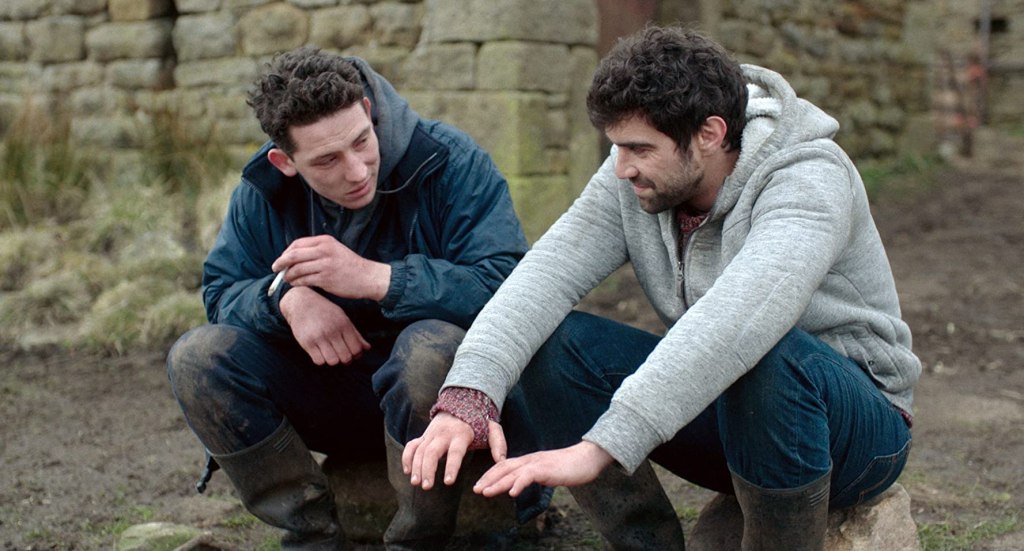
God’s Own Country is the poor man’s Brokeback Mountain. Well, that’s not fair. It’s not just the men who are poor, even the mountain is more of a hill, or just, you know, fairly flat land, maybe?
It is spring on the Yorkshire farm where Johnny (Josh O’Connor) works from dawn until dusk. It is perhaps not anyone’s first choice to waste one’s youth doing backbreaking work on an isolated farm, but for Johnny, there’s not much choice at all. The family farm is in disrepair and he’s the only labour, the only other inhabitants being his disabled father Martin (Ian Hart) and his elderly grandmother (Gemma Jones), who shower him with love and gratitude. Just kidding. What would be the movie in that? Johnny toils ceaselessly only to be met with criticism and an ever-growing list of tasks. It’s no wonder he escapes into town at night, to numb his frustration with shots and casual sex. He’ll be wrecked in the morning, and take abuse for it, but there is literally no other joy in his life.
And then lambing season comes. Johnny will spend it camping in whichever remote location the ewes have chosen. They hire Gheorghe (Alec Secareanu), a Romanian migrant worker, to help out, and as we know from Enis Del Mar and Jack Twist, those cold and forbidding nights inevitably end in some hot hot heat. They fall upon each other roughly, their early lovemaking looking a lot like rodeo calf roping, as only sex between cowboys and farmers can. Their initial passion is hungry and desperate but eventually makes way to an intense but intimate relationship.
Writer-director Francis Lee is speaking to us from experience. His story is not about forbidden love or being different, or searching for acceptance. His theme is much more universal: it’s about loneliness. It’s about how love can give meaning to your life if you let it. It’s about the bravery necessary for letting love in even when you feel like a garbage person. I’m paraphrasing of course, but Johnny doesn’t feel ashamed to me, or all that concerned about hiding. Mainly he seems broken and helpless and angry.
The setting is of course thrillingly authentic, painted in graphic, gritty detail. Cinematographer Joshua James Richards does amazing work, allowing Johnny to literally come into the light.
O’Connor and Secareanu give performances filled with achy longing; even as they repair holes in the farm’s fencing, they are dismantling their own barriers. Francis Lee delivers his romance with a dose of reality; we don’t smell roses, we smell manure. But there is beauty in honesty, and underneath the grime and filth is transformative vulnerability.
Despite my initial impression, God’s Own Country is not some poor relation of Brokeback Mountain. It is its son, born of a generation more hopeful and more tender. Jack and Enis would be proud.
If your memory needs refreshing, Punch and Judy are traditional puppets who have been entertaining crowds in the UK and beyond for over 400 years. They started out as marionettes in Italy; Punch was derived from the Neapolitan stock character of Pulcinella, which was anglicized to Punchinello and eventually just Punch when the show made the jump over to Great Britain, and the marionettes became hand puppets out of convenience or laziness or both.The show costarred Mr. Punch’s wife, Judy, and a cast of rotating characters. Much like a soap opera, the story wasn’t fixed, but it always featured some key elements: their baby, mishandled by Punch, a hungry crocodile, an officious policeman, a prop string of sausages, a generic hangman named Jack Ketch. The show was a series of scenes in which various foes come for Punch, but each is eventually victim to his slapstick (note: though Mr. Punch does an awful lot of clowning around, his slapstick is indeed a large stick used for slapping people, often to death). Mr. Punch will then utter his famous catchphrase “That’s the way to do it!” which is how the expression “pleased as punch” was derived – from his sense of gleeful self-satisfaction. Despite the numerous murders, a Punch and Judy show is a comedy, often provoking shocked laughter.
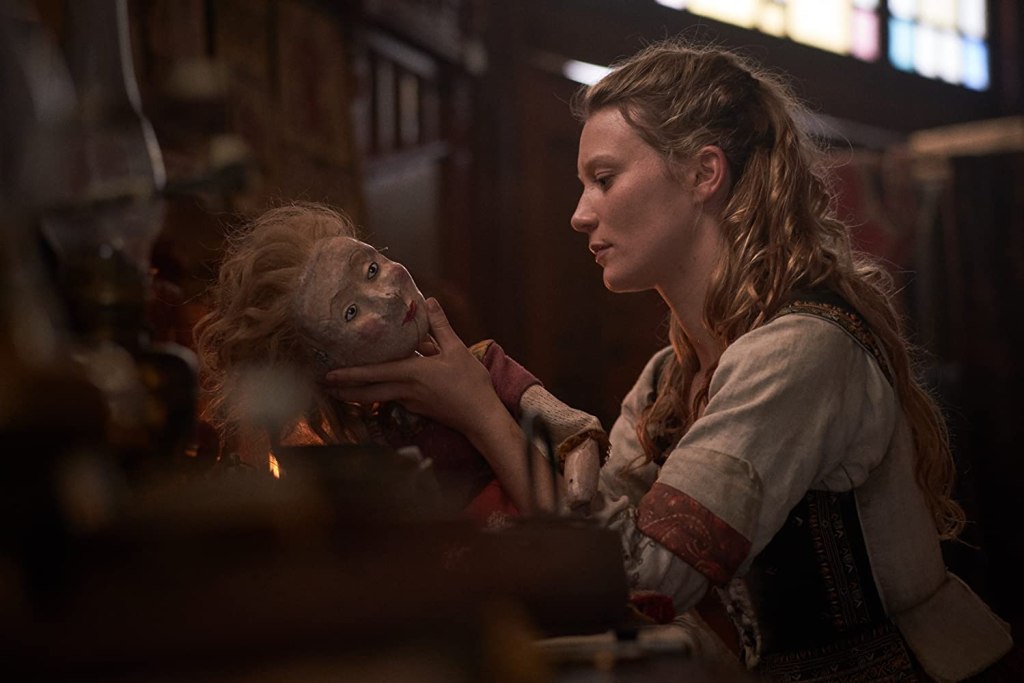
Cut to 2020 when writer-director Mirrah Foulkes re-imagines the show’s origin story in her own sordid tale, called Judy & Punch. In the tiny 17th century English village of Seaside (actually nowhere near the sea), Punch and Judy entertain the villagers with their weekly puppet show. The violent show is right at home among these people, who satisfy their bloodlust with public “stoning days” where their anarchic mob rule interprets random coincidences as witchcraft, condemning their neighbours to die – unless of course the crime is though to be particularly heinous, wherein they might just be hanged immediately.
At home, Punch (Damon Herriman) is a drunk and Judy (Mia Wasikowska) his hard-working and long-suffering wife. One day while she makes a quick trip to market, Punch accidentally kill their baby during a drinking binge. Judy has been gone but an hour and is understandably heart broken to find her baby murdered but her sobs only enrage Punch, who then makes her a victim of his slapstick. He disposes of both bodies.
Allow me to interrupt myself here to say this: when the baby dies, it is under circumstances so perfectly orchestrated, so perfectly designed and directed that I uttered a single “Ha!,” followed by a horrified silence as I processed that the baby is in fact dead. If you were not familiar with the particular and very specific brand of dark humour found in a traditional Punch and Judy show, you might think that this movie has a serious problem with tone. But understanding the history means you cannot fail to admire Foulkes’ ability to find what has to be the very slimmest of veins wherein a baby’s death can be both funny and cruel, and executing it to perfection.
In the film, Judy narrowly survives the beating, unbeknownst to Punch, and hides among a band of outcast heretics while she heals. Together they plot revenge not just on Punch but indeed on the whole town who have so successfully driven out or eliminated anyone with a difference. In this way, Foulkes is able to explore the kind of atmosphere where such a show could have proliferated. Punch is undoubtedly a bad man. Each show usually includes a scene wherein Punch lays out the bodies of each and every one of his victims for the audience to count, yet they still cheer when he bests the hangman, or indeed even the devil himself. These were cruel times fueled by fear: if not them, then us.
Mia Wasikowska delivers a strong performance as a woman with talent, brains, and resources, yet so few options that she must hide in the forest for fear that her survival may be interpreted as witchcraft. Herriman pulls off an even harder feat as damned Mr. Punch: a fool, a predator, a charmer, a pretender. The thing about puppets is that whether dancing with their wives or bludgeoning them, their expressions never change. Perhaps a painted-on grin helped the audience swallow his violent attacks. But our Mr. Punch is a man, a puppeteer. Herriman has to be believable as both the bumbling buffoon chasing after a dog who’s stolen his sausages, and mere moments later, a father who has not only charbroiled his own baby, but pinned her murder on elderly innocents. And he is!
I am reminded of a time back in 2016 when I reviewed a “black comedy” that I felt was SO black it merited a whole new category, so I invented the Vantablack comedy, Vantablack being in fact a colour that is blacker than black, absorbing all but 0.035% of light; a black so black our human minds can’t actually perceive it. I would like to unroll this categorization once again, in honour of Judy & Punch, Mirrah Foulkes’ audacious directorial debut.
Judy & Punch is available digitally on Apple/iTunes as well as VOD services.
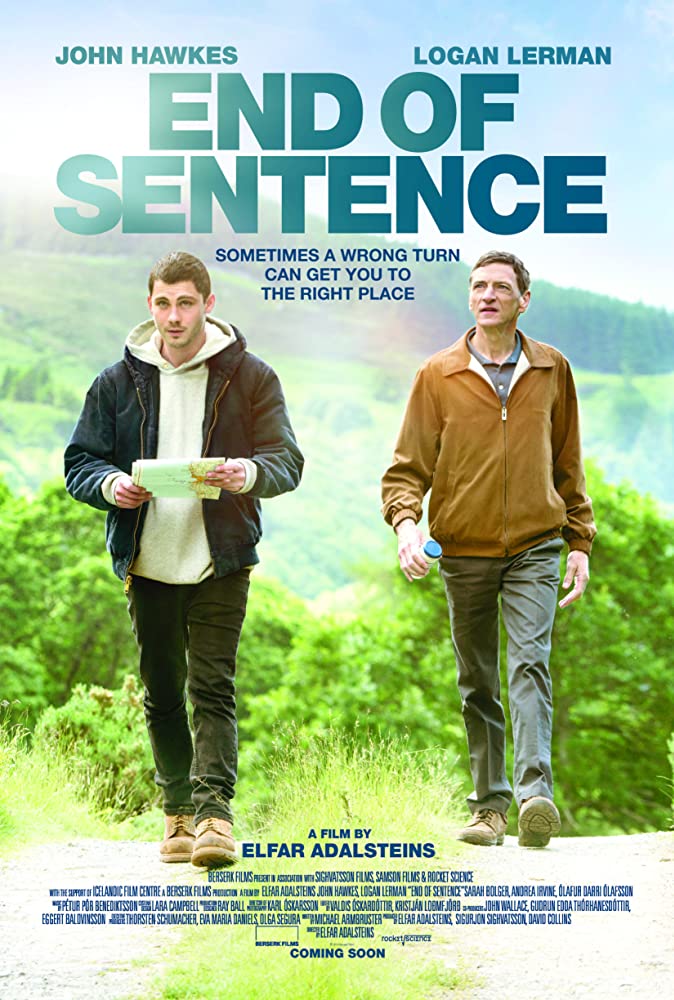
Frank (John Hawkes) is recently widowed when he picks up his estranged son Sean (Logan Lerman) from prison. Neither is exactly keen to spend time with the other, but Frank’s late wife’s last wish was for her son and her husband to travel to Ireland together to scatter her ashes in a special lake. Frank is determined to honour her wish, and Sean is determined to be in California in five days time. A deal is struck – Frank promises to deliver Sean to California by way of Ireland – and two reluctant travel companions, plus the ashes of their only common bond, are on their way east – very east.
In Ireland, Frank will come to understand his dearly departed wife a little better, while Sean will come to understand his distant father. None of these will be easy lessons. In fact, long before the mission is either accomplished or abandoned, you and I will start to suspect that the dead wife orchestrated the trip not so much out of preference for her final resting place but perhaps as one last attempt to reunite the two men in her life from beyond the grave. Of course, as in life, so in death: Frank and Sean share a complicated and painful history, and the Irish countryside, beautiful as it may be, is not a magical cure.
Michael Armbruster writes a story that is sensitive but not sentimental about two men who share the same grief but process it side by side rather than together. The story is about men, and how they will relate to each other now that their moderator/interpreter/buffer is gone. It is quite possible that Frank and Sean have never been in a room just the two of them before, and quite clear that this is their preference. And yet – mother knows best? Certainly in her last days she must have worried about them, about her son already careening down the wrong path, unlikely to succeed upon release without the one person who always believed in him, and about her husband, so unable to connect, so solitary and cold in his default demeanor. The script here is brilliant because it allows us to read and explore these things through action and inaction rather than constantly looking back, and director Elfar Adalsteins reinforces this idea by showing rather than telling. This leaves room for the audience to see a bit of themselves in this dynamic: bits of their own grief, their own fraught relationships, their own pain, desire, comfort, and hope for the future, and the story becomes that much more relatable, that much more resonant.
I knew nothing of this movie when we came upon it for rent on VOD, but it turned out to be one of those unexpected cinematic gems just waiting to be mined.
Picture it: small town New Mexico, sometime in the late 1950s. On this particular evening, the whole town is crowded into the high school gym to watch a basketball game. It’s literally standing room only. The players’ shorts are very short; the cheerleaders’ skirts are very long. The town’s streets are all but deserted. The only two people who seem not to be at the game are a couple of intrepid teenagers – fast-talking Fay (Sierra McCormick) is the town’s telephone switchboard operator and charismatic Everett (Jake Horowitz) is hosting a live radio show. Fay is of course very faithfully tuned into the radio program and notices the broadcast is briefly interrupted by a strange audio frequency.
Few witness it of course, most people being at the game, but one man who does calls in with quite a story. He’s heard these tones before. And boy does he have some theories. From there, Fay and Everett get caught up in a night neither will ever forget.
The Vast of Night is a pretentious title for a film eager to live up to that insinuation. Stylistically it’s reminiscent of The Twilight Zone; a retro sci-fi throwback that strains the limits of its (low) budget but proves good ideas trump production value when it comes to building a watchable, suspenseful film. Most of all I enjoyed the dynamic between the two young actors. McCormick in particular has a massive job handling a demanding long take but handles it like a true professional. The two really convey a sense of immediacy that contributes richly to the film’s ominous atmosphere.
Despite some very strong elements, I never quite liked the film as much as I wanted to. I didn’t really enjoy the film’s conceits, or director Andrew Patterson’s self-conscious attempts to use all the tricks in his bag in one go. And some of his choices are just confounding: why the black screen, for example? During a long exchange with a caller during the live radio broadcast, we mostly focus on Everett’s face as he absorbs the story, but sometimes the camera cuts away to…nothing. A totally black, blank screen. And then back to Everett, who continues to listen intently, sitting perfectly still, hardly giving anything away on his face, and then back to black. I’ve thought a long time about this choice and though I’ve come up with a few plausible scenarios, I don’t like any of them. It feels more like a mistake than a choice. Later on in the film, when two people are running across a field, the camera spends multiple lengthy takes focusing on knees down. This is likely a budgetary concern, either the shot cost them enough that they had to use it a little too liberally in order to justify it, or they simply couldn’t afford to show anything that might have happening thighs and above. Either way, I don’t want the line item to be so glaringly apparent on the screen.
What I do want is another film from Patterson, who’s clearly got some potential if he hasn’t already burned all his bridges (one of the items in the film’s IMDB trivia section is a list of all the film festivals who rejected the movie – a particularly ungracious display of privilege from a first-time white, male director, and some pretty juvenile sour grapes), and some better material for McCormick, who deserves to showcase her talent.
Everywhere, there are rainbows, co-opted to bring hope and cheer to a world self-isolating from a deadly virus. Normally, a rainbow spotted in June meant Pride Month was being celebrated and acknowledged. This June, however, things are more sedate. Pride events have been cancelled, or moved online at best, to be observed virtually, from one’s home computer. Except home isn’t always a safe space for queer folk. Many have been forced back in the closet, or back into the wrong gender’s clothes and pronouns for the duration, not daring to risk being caught on the wrong website, further isolating an already marginalized population. This pandemic has deprived the queer community of the few safe spaces they can comfortably exist in their own skin: queer bars, sexual health spaces, support groups. Worse still, many of these spaces were already teetering on the brink of inadequate funding when COVID forced shut downs. Many will not reopen. In fact, many queer and trans services rely on Pride Month events for essential fundraising, especially since members of the LGBTQ community were already at higher risk for unemployment, food insecurity, and lack of insurance even before the pandemic hit.
Most of all, though, a pride event is about visibility. It’s about celebrating the victories and honouring the sacrifices and acknowledging the gaps. It’s about giving people a sense of community and belonging. There are still countries where homosexuality is illegal, and even punishable by death. But even many “progressive” countries are still getting it wrong; Trump’s Affordable Care Act rule would allow health care to discriminate against LGBTQ people, the Supreme Court is deciding whether employers can fire people just for being queer or trans, the UK’s Women and Equalities Minister has considered revising the Equality Act to keep trans women out of women’s spaces.
If you are cis and straight, do your part to create and maintain safe online spaces for queer people. Reach out to queer friends and ask if they are really okay. And check out some queer stories because yes, representation matters.
Bear with me: I am about to attempt to describe the plot of a cartoon, which is deceptively hard work.
A chaos pearl, birthed from primordial essences, manifests as a giant crystal monster, is sucking up energy to feed its seemingly infinite potential for destruction. The Primeval Lord of Heaven, Tianzun, sends two of his disciples, Taiyi and Shen, to subdue it, but it just keeps siphoning energy, growing bigger and stronger, so the Primeval Lord Tianzun has to separate the pearl into two opposite components: a spirit pearl and a demon orb. The spirit pearl is meant to be reincarnated as a son to Li Jing, while Tianzun curses the demon orb; it will be destroyed in 3 years’ time by a powerful lightning strike. Tianzun gives them to the care of Taiyi and promises him a seat at his heavenly table if he performs well. This makes Shen insanely jealous of course, so he steals the spirit pearl, which means that Li Jing’s pregnant wife Lady Yin is possessed by the demon orb instead. Poor Lady Yin has been pregnant for 3 years and now gives birth to a demon child, Ne Zha.
If you’re following even 25% of what I’m saying, you deserve a silver medal (sorry, I’m reserving the gold for Lady Yin’s marathon pregnancy).
Ne Zha is born with unique powers, as you might expect, and he’s known (and feared) in the village as being incredibly destructive, which makes him a lonely outcast. Taiyi brings him to a universe inside a painting to train him and his progress is astounding, even if his discipline is lacking (note: this is an extremely advanced toddler). Meanwhile, Shen takes the stolen spirit pearl down to the Dragon King. The dragons are angry because they’ve been banished underwater as hell’s gatekeepers. The Dragon King believes that a son of his born of the spirit pearl would mean dragons would finally be worthy and could ascend to heaven, so he gives birth to an egg OUT OF HIS MOUTH and names the kid Ao Bing.
Against the odds, Ne Zha and Ao Bing meet and make friends, but as we know, they’re actually enemies, and they’re going to have to meet in battle on their third birthdays.
Written and directed by Yu Yang, the movie starts out with some shaky story-telling, and as you can tell by my synopsis, there’s quite a bit of vital information to parse rather quickly (we had to pause the movie, compare notes, and restart). Once it gets going, the problems get largely ironed out by some pretty compelling animation. The action scenes are of course commendable but I was also rather dazzled by the universe contained within the painting. Yu Yang takes full advantage of the perks of animation, allowing bold action sequences to communicate character, engaging the audience and fueling the film’s momentum. Kids will delight in the low-brow humour (and by low-brow I of course mean disgusting) and everyone can appreciate the visual spectacle of it all.
In China it was released exclusively in IMAX 3-D and I can imagine this would have been an excellent use of the medium. We watched the English dub on Netflix (we also had the subtitles on, which made for a mind-bending exercise as the two NEVER matched); if you do the same, make sure to check out mid- and post-credit scenes which introduce a new character and set up a sequel. The sequel was actually due to be released January 2020 in China but was postponed indefinitely due to COVID-19.



 ASSHOLES WATCHING MOVIES