Category Archives: Movie Reviews

Our reviews and thoughts on the latest releases, classics, and nostalgic favourites. Things we loved, things we hated, and worst of all, things we were ambivalent about.

Operation Finale

This movie is a tribute to the unsung heroes of post-WW2 Nazi hunting.

When notorious SS agent (the architect of the final solution, no less) Adolf Eichmann suddenly pops up on the radar, Israel puts a crack team of secret agents on the case. Peter Malkin, in particular, is the loose cannon of the operation, but ten short years after the war, emotions run high for the whole team because everyone who wasn’t in a camp personally lost someone, or several someones, or everyone to Germany’s ethnic cleansing machine.

MV5BNGQ0YmVkMWItOGVlYS00ZWE2LWFhOTgtYzk1ZTAyZGQ5ZjFjXkEyXkFqcGdeQXVyNTc5OTMwOTQ@._V1_Malkin (Oscar Isaac) and company manage to pick up Eichmann (Ben Kingsley) thanks in part to his indiscreet son who still hates Jews all the way from Argentina. They sweat it out in a safe house. For safe travel they require Eichmann’s signature, and Malkin vows to get it. The interrogation is heated; Eichmann is emotionally manipulative and he knows exactly which buttons to push. The agents have agreed to bring him back to Israel for a public trial, but not killing him proves to be a very big challenge for almost every single one of them. Eichmann knows this trial is not likely to rule in his favour, so he delays endlessly, which is also to the benefit of the Nazi rescue party determined to find him.

Oscar Isaac is terrific, of course. Malkin plays it cool, almost sympathetic, but he’s always on the verge of an emotional outburst. Isaac draws a haunted man, bent under the weight of his own grief, and the loss of a whole nation. Ben Kingsley strikes the exact right chord – reprehensible. His hypocrisy rankles. I felt it so personally it was easy to feel for the agents and to admire them for their restraint. But overall, director Chris Weitz’s ability to humanize his characters makes for some very watchable performances.

The scenes between Isaac and Kingsley are the best the film has to offer. Operation Finale is otherwise a little still, a little familiar, a little predictable. It has good intentions but you see them coming from a mile away.  At times it can be surprisingly complacent for a ‘thriller’. It’s an Argo wannabe that doesn’t quite achieve its potential, but it’s nice to hear from this side of history, and it’s fantastic to see Kingsley do what he does best.


Transformer

Janae Marie Kroczaleski was just going about her business in 2015 when she was publicly outed by a Youtuber without her consent. Her parents disowned her, her sponsors dropped her: overnight her life had been decided for her. Born Matt Kroczaleski, she had known for a long time that her true identity was female. Matt joined the Marines to help “push down the feminine stuff.” He married and had 3 children. But Matt never felt right in his skin. If he had to live as a male, he had to be the biggest, strongest guy he could be, and he was. A power-lifter known to his fans simply as ‘Kroc,’ Matt became the strongest man in the world for his size.

Still, he thought constantly about living as a woman, and didn’t feel authentic in his body. Over a period of 10 years, he began transitioning many times. He didn’t quit VWrtDx-gbecause it was difficult, or because he was unsure. He’d quit because he couldn’t reconcile the two halves of himself: the need to be strong AND be a woman. In his male skin, he needed to be the biggest, the most muscular, but as a woman he wanted to be petite. When he cut weight, dieted and stopped lifting, he deprived himself of his friends, his support system, the world he knew and the lifestyle he loved. Muscles were a security blanket of sorts. It’s hard to let those go.
Director Michael Del Monte makes a fascinating documentary because he’s chosen a subject who is open and accessible. Janae is courageous and enlightening. It may not have been her idea to go public, but she embraces it bravely. I loved her willingness to speak candidly about failed transitions. I adored scenes with her family – her sons are terrific people who are not only supportive but engaged in her transition, asking intelligent questions while treating her in the same loving way they’ve always treated their father – they know this is the same person, only happier and more honest. These young men have a lot to teach adults twice their age.

The documentary bracingly follows Janae as she makes this transition her last. She’s going to learn that all women are strong, by necessity, no matter what they look like on the outside. Matt Kroczaleski went through a lot in his life, but Janae understands that her path will be hardest to follow. In this documentary, she loses her job, encounters protesters, has “elective” surgery that for her is life-saving, life-embracing, is a supportive and knowledgeable judge at transfitcon, and evaluates her ass in a pair of skinny jeans. The world is complex. Janae is realistic. Transformer doesn’t speak for all transgendered people, but it speaks wonderfully to one woman’s experience. It’s personal, it’s intimate, and it’s a beautiful portrait of a life in transition and a woman coming in to her own.


Furlough

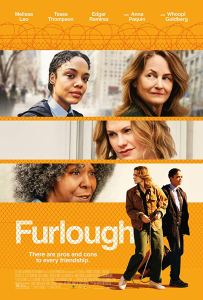
It’s a bad time for corrections officer Nicole Stevens (Tessa Thompson) to get away. It’s always a bad time. She lives with her mother (Whoopi Goldberg) and cares for her round the clock when she’s not at work. But go away she must. A prisoner’s mother is dying and Joan (Melissa Leo) has a 36 hour death bed visitation furlough coming – supervised by poor, beleaguered Officer Stevens.

C.O. Stevens is distracted, and Joan is a master manipulator, determined to squeeze every MV5BZmJhOGNiZWMtNmVhYi00YmJhLTkzMzEtZDEwNjRjMDg4NjcwXkEyXkFqcGdeQXVyMTMxODk2OTU@._V1_SY1000_SX675_AL_last drop out of this respite. The trains and buses upon which they rely are predictably unpredictable, and Stevens is just a little too trusting, a little too good-hearted. Joan does not have this problem.

You watch this movie with dread, knowing something is going to happen, something bad, and you almost don’t want it to. Despite Joan’s self-centered assholeness, you kind of buy into this ultimate odd-couple road trip. It will be sad to see it end.

Tessa Thompson is all kinds of wonderful. She’s overwhelmed by the assignment but too dutiful to refuse. She’s a caretaker who wants to see the best in everyone. Joan has lived a hard life, the details of which are only hinted at. We don’t know how long she’s been locked up, but she sucks in fresh air like it’s in limited supply, so I believe it has been a while. She’s shifty and nervy and she pushes Stevens’ buttons. She pushes MY buttons. And yet Leo gives her just enough charm that we can’t quite write her off. Whoopi has a smallish role but it’s kind of great to see her on screen.

Director Laurie Collyer knows she’s got us hooked based on the cast alone, and the movie doesn’t quite live up to its promise. It feels slight. It does a gender flip and a race flip but still winds up feeling less than 48 Hrs. Leo isn’t really up for the over-the-top comedy, and the movie fails to shift gears to accommodate dramatic moments. It’s a good try that doesn’t quite pan out. For me, it’s totally worth it to bask in Thompson’s radiance for an hour and a half, and since it’s on Netflix, there’s not much to lose.

Seder-Masochism

When director Nina Paley’s father was on his deathbed, she and he had conversation about Passover that turned into a discussion about her long-ago decision to drop out of college to pursue her art, and how he wished she would have found a way to increase her savings.  It strikes me as a typical conversation between a father and daughter, particularly a Jewish father and daughter.  But it becomes much less typical when animated into a conversation between seder masochisma bearded dollar bill and a goat.  Those pieces form the heart of Seder-Masochism, a unique look at the story of Exodus from the perspective of a couple lapsed Jews.

In between, the story of Moses is told as a musical, with the Jews dancing their way through oppression in Egypt and then chaos in the desert to a collection of toe-tapping classics, one of which, naturally, is “Go Down Moses”.  Underlying the whole thing is the reality that in escaping from under the Pharaoh’s thumb, the Jewish patriarchy remained a source of oppression for women.  Paley admits that she had no idea how to seder masochism 2resolve the conflict between the Jewish God and the goddesses, but she does an excellent job of highlighting that conflict in the sunniest way possible.

The animation, all done by Paley, is unbelievably cheerful and bright, contrasting in every way with the subject matter.   That cheery art style, combined with the upbeat soundtrack, ends up making the film feel even darker as we see these awful events depicted as if in a Saturday morning cartoon, enhanced with the largely upbeat (and unlicensed) music.  Paley was up front about not having paid for the music in order to keep costs down while using the songs that best fit her vision.  The strongest scenes from the film, though, are those featuring the conversation between Paley and her father, as they are funny and starkly honest at the same time.

Whether or not you know anything about Judaism or Exodus, Seder Masochism is a well-made, charming, and surprisingly personal film.  And once Paley has completed the festival circuit this fall, she plans on making this movie available for free, so you’ll soon be able to see Seder Masochism yourself even if you aren’t able to catch it on the festival circuit.

Your Highness

Prince Thadeous (Danny McBride), who smells like sheep scrotum, is his brother’s lesser in every way. Prince Fabious (James Franco) is more handsome and more accomplished, kinder and a better brother. He’s even brought home Belladonna (Zoey Deschanel), the most beautiful woman in all the land, to be his bride. But his wedding day is interrupted by a Leezar (Justin Theroux), a powerful warlock upset about his dead cyclops and stolen virgin. He comes to seek revenge and fulfill an ancient prophecy, leaving with Belladonna and thus, Fabious’s heart.

Their father, the king, orders the inept Thadeous to accompany Fabious on his quest, god knows why. And so begins an adventure. Had Fabious gone alone it no doubt MV5BMTUxNzMwODc5MV5BMl5BanBnXkFtZTcwODQ4MTA4NA@@._V1_SY1000_CR0,0,666,1000_AL_would have been a five minute drive up the road, wit both he and his bride making it back in time to cut the cake at their reception. Throw Thadeous into the mix and all you’ve got is a stoner period piece that’s a vehicle for Danny McBride. I mean, Your Highness looks pretty great, truth be told. It’s got a big enough budget to go through the motions. But McBride’s humour is stunted. It’s like he’s always writing for 12 year olds. And, sure, the first time you hear milady say the f-word it makes the tips of your ears blush, but you can’t build a whole movie on just out of place rude humour. Well, okay, point taken – apparently you can, and apparently Universal will pay you 50 million dollars to do it – but there isn’t a mammal on Earth who shouldn’t have seen this flop coming a mile away.

How, then, does such a movie garner such a high-profile cast? Natalie Portman has been adamant about distancing herself from it. She says she only did it because she wasn’t sure Black Swan would be green-lit by a studio and she felt she could use this paycheque to self-finance the film herself, if need be. However (and perhaps, for her, unfortunately), Black Swan got green-lit fairly easily, but the contract was already signed and she had to go through with Your Highness anyway, and stumble over great lines like “burning in my beaver.” James Franco has been less circumspect, saying the film “sucked,” which is still a kinder review than the one I’m writing, but then, if I had earned $2.5M for it, I might be a little more defensive too. As it is, I have zero sympathy for a movie that can’t have even sounded good on paper, not even on RAW, unrefined rolling papers, the kind you light on fire and allow to go up in smoke.


Monogamy

A bored wedding photographer sets up a side business – ‘Gumshoot’, where he’ll surreptitiously photograph his subjects without being seen. Kind of like a private eye (hence the clever name), except he’s actually been hired specifically to do this. One day Theo (Chris Messina) arrives at a park to photograph a woman known only to him as ‘Subgirl’ and what he finds there, at 9am, is a beautiful woman touching herself. He takes her picture from behind his grassy knoll. He takes a whole bunch.

At home, he takes his time perusing them, and his fiancee Nat (Rashida Jones) can’t help but notice the close-up crotch shots. They share an intimate moment together, inspired by the wantonness of the photos. And maybe that would have been nice had Theo left it f0a9f8c6bd1adb17_monogamy-trailerthere. But does he? Oh no. He does not. He becomes obsessed, scrutinizing the photos for every tattoo, every freckle, every…clue?  And then he takes more pictures. Subgirl (Meital Dohan) leads an interesting life that seems to get more and more perverse. Would that excited you? Are you an exhibitionist like Subgirl? Or are you a voyeur like Theo? What would it be like to stalk someone with your camera? To film them in such compromising poses? To know that in a way, they are performing just for you. Sexy? Creepy? Both?

I confess I’ve always had a thing for Chris Messina. He’s dark and brooding and kind of an asshole. Why do we always fall for the assholes? To be clear, I don’t even know Chris Messina. I just lust after his character on The Mindy Project, and then fantasize about breaking all his limbs for all the terrible things he’s done to my precious MindyWhoCanDoNoWrong. My Rashida Jones crush is possibly even stronger. Does she actually emit the light of a thousand suns or have I just soaked for too long in Leslie Knope’s love for best friend extraordinaire, Ann Perkins?

Anyway, I guess you can only photograph cock sucking for so long before your own relationship starts to suffer. So too does his mental health, I think.

But this movie isn’t just about a Brooklyn hipster. It’s about the fraudulent wedding industry, and the stereotypically male knee-jerk reaction to marriage (and its inherent mysogyny), and the sad sac, boo hoo, woe is me, self-pity-party of the man’s end of a breakup. On the head, as my brother-in-law would say (as in, nailed it).

Don’t Worry. He Won’t Get Far On Foot

John Callahan was a dedicated alcoholic when he had a life-changing accident that left him paralyzed.

Post-accident, the path to sobriety isn’t exactly direct. Between the struggle to accept his new limitations, learning to live in a chair, caring for his broken body, and searching for the mother who gave him up at birth, there are a lot of reasons to drink. Of course, there’s always a reason to drink. Only when he truly embraces the value of AA, with the help of group leader Donny (Jonah Hill), does he start to imagine a future for himself. And he finds a healthy way to channel his anger and his energy and his wonderment: cartoons.

MV5BMjMyMTY2MzYxN15BMl5BanBnXkFtZTgwMTEwNDgyNDM@._V1_SX1500_CR0,0,1500,999_AL_Callahan is injured enough that he cannot grasp a pen but he manages somehow to manipulate a felt-tip pen between two mangled hands and he finds inspiration in his life to create funny, and often controversial cartoons. His student paper sees fit to publish him and from there he develops a national following.

Don’t Worry, He Won’t Get Far On Foot is a line ripped from one of his own cartoons; the movie is adapted from Callaghan’s memoir. Director Gus Van Sant wants to say something about the healing power of art but the movie itself reads more like a tribute to support systems and the importance of forgiveness without dipping into the considerable well of inspirational cliches.

It’s a dark comedy, as you can imagine, but between Jack Black, Jonah Hill, and an orange-haired Joaquin Phoenix wielding his wheel chair like a bat on wheels, there’s some appreciated levity to all the drama. It’s an off-beat comedy about an off-beat guy. Phoenix is irrepressible.

Sean didn’t care for the movie – he felt not much had happened. I liked it well enough – I liked the unexpected performances from the likes of Beth Ditto, Carrie Brownstein, and Kim Gordon. I liked that Callaghan’s dark vein of humour is kept in tact throughout transformation, that he doesn’t become some sort of saint, merely the same caustic guy with a new lease on life. I liked that his past is never treated like an excuse – not that I’m not sympathetic to his victimhood but I like that he finds his salvation elsewhere, that he’s allowed to not solve the puzzle of his childhood before finding peace in his present. The 12 steps are not equally cinematic, but I felt Phoenix’s charismatic performance carried us through. Obviously Sean disagreed, so I guess I’d call this a mixed-bag review. It’s not for everyone.


++


Private Life

Rachel and Richard are a couple their niece Sadie looks up to – their tiny NYC apartment has cachet because of they live and work in the arts. When she drops out of college, it is natural for her to turn to them for support and a place to crash – much cooler than her parents’ place in the suburbs.

But as Sadie’s parents know, Rachel (Kathryn Hahn) and Richard (Paul Giamatti) aren’t exactly living a carefree life. They are deep in the throes of a fertility struggle. They’ve tried everything, and they’re still trying multiple strategies at once, which requires MV5BMTUyNTMyODc4Nl5BMl5BanBnXkFtZTgwMjk5ODg1NDM@._V1_SX1500_CR0,0,1500,999_AL_careful juggling and judicious lying (the adoption people want to hear that IVF is behind you). Like any couple wanting a baby they can’t have, they’ve suffered heartbreak. As the technologies and treatments proliferate, so too does the potential for loss. These people have suffered in ways my privileged uterus hasn’t even heard of – including a catfishing scam I can only wonder at. Still, Rachel and Richard persist, even in the face of their family’s disapproval and the strain on their bank account and the stress on their marriage. But they balk when the doctor suggests an egg donor – or Rachel does, feeling cut out of the deal. But then the young woman living in their home starts to feel like an option – it’s just a delicate matter of how to ask the vulnerable, tetherless niece to do something that will affect her profoundly for the rest of her life? Is that even fair?
This is a movie about fertility, but even more so, it’s a movie expressing rage against the lie that women can have it all. Rachel has delayed kids for career and the price is high. Her husband is sympathetic but ultimately this is her worth as a woman being questioned and her body betraying them, even as she ravages it with attempt after attempt. Private Life is about the ebb and flow of hope and what it does, long-term, to a marriage.


22 July

22 July 2011. Anders Behring Breivik triggered a car bomb in the government district of Oslo that killed 8 and injured 209. Two hours later he had ferried over to the island of Utoya where a summer cap for the youth division of the Labour Party was held. You likely heard about it on the news, at the very least. Breivik was dressed in a police uniform and armed to the teeth. He opened fire on the group of teenagers and killed 69 more, injuring another 110. The kids were like sitting ducks, and Breivik shot them one by one for the political affiliations of their parents.

The film, by Paul Greengrass, is difficult to watch, especially the beginning, which recreates the attack. Later it focuses on the survivors, and on the court case that wouldMV5BM2RkYThlMDQtZDZlMi00ZGVhLThiYWYtZWJlNzQ4YmQ2M2QzXkEyXkFqcGdeQXVyMDA5NjIzMg@@._V1_ keep Norway rapt. Breivik, who orchestrated the attacks to protest immigration and other stupidly racist, extremist right-wing bullshit, claimed insanity in order to avoid prison. But he also desperately wanted to stay in control of the trial, demanding the prime minister be called as a witness, and insisting that he have the opportunity to address the court to spout more of his hate, and so after “playing a role” for court-appointed psychiatrists, he decided to retract and change his plea.

As you can imagine, with 1 in 4 Norwegians in some way affected by these attacks, the whole country was fraught. The lawyers tasked with defending him were targeted themselves. But the movie’s beating heart is one kid, a survivor shot 5 times, who finds the courage to stand up and face his worst nightmare in court. He doesn’t want to let Breivik see his vulnerability, but feels the weight of all the voices who cannot speak for themselves.

It’s a moving film, of course. I said before that the first part was particularly difficult to watch, but for me, Breivik’s cold, rational, hateful testimony in court performed by Anders Danielsen Lie was even harder. Film has more or less desensitized us to horrific violence, but nothing can prepare you for looking into the eyes of a person we know exists, who really carries this hate in his chest in the cavity where a heart usually resides. That’s the tough part: reconciling ourselves with the fact that this villain has walked among us.

Thankfully, a thoughtful and humble performance by Jonas Strand Gravli balances this out. He is not just the spokesperson for the victims; he’s a stand-in for the horrified audience as well. Director Paul Greengrass has made these sorts of films his niche lately (Captain Phillips, United 93) and it’s a god-awful corner to have painted himself into, but I must admit he’s got it well sorted, but the movie’s attempt at dividing up the story gives it a sense of imbalance. It sputters a bit in the middle when it doesn’t quite know which movie it is. But it’s worth the watch. It’s an act of remembrance.

Hotel Artemis

Picture it: Los Angeles, 2018. The city is in its third day of violent riots. The people are demanding access to clean water. The power is flickering, a curfew is in effect, rich people are sending servants to deposit “lootable” goods at the bank. Which means there’s all the more for a bank robber (Sterling K. Brown) with an entrepreneurial spirit to steal. Unfortunately he and his gang of merry men escape with both bullet wounds and an accidental $18M in diamonds that ruthless mob boss Wolf King (Jeff Goldblum) is definitely going to come searching for.

But first things first: with his own brother bleeding in his arms, our intrepid bank robber checks in at the Hotel Artemis, a “dark room”, or a high-security, members-only hospital for the criminal underground. I believe they’ve ripped this idea directly from the John Wick movies, but it’s a good one. There, the doctor, who is called Nurse (Jodie Foster) is guided by a very strict set of rules:

1. While on the premises, no fighting with or killing other patients.

2. No disrespectful words or actions allowed against Hotel Artemis staff.

3. No guns or any type of weapon permitted through the gates.

4. Membership must be paid for, full and in advance.

5. Prior but lapsed members will not be admitted

6. No photography or video allowed.

7. No outside food or drink.

8. Absolutely no visitors.

9. If member is found to have compromised, or led to compromise of location, membership will be revoked.

10. Hotel Artemis rules are final and non-negotiable.

Tonight, with both the police, the rioters, and the Wolf King’s men bearing down on them, the brimming with injured criminals, no-vacancy hospital will come under siege, its only protector a dedicated health care practitioner named Everest (Dave Bautista), and every one of these rules will be broken.

MV5BNzllMGFmMTktMmZiYS00MDc0LWIzNDUtYWM5YzBjN2M4OTM1XkEyXkFqcGdeQXVyNjg3MTIwODI@._V1_

With such a potent premise and an A-list cast, Sean was curious as to why he was only hearing about this now. Usually, there’s only one answer: it’s no good. But actually, it’s not bad. Maybe not good, but it depends what you’re looking for. At times it reminded of Ben Wheatley’s High-Rise with all these people stuck in a building that’s starting to resemble hell. But Hotel Artemis has more modest ambitions, and if you start to get an inkling of an allegory, well, it’ll be dashed soon enough so don’t expend too much brain power on it. Sit back and enjoy the villainous Jeff Goldblum (which is THE BEST Jeff Goldblum, isn’t it?) and the kick-ass Sofia Boutella and Jodie Foster in an actual role, an actual meaty, outside-the-box role (her first since Elysium!). Of course, the downside to a cast like this is that we don’t spend oodles of time with any of them (the movie has a trim 94 minute run-time) but when Bautista calmly unclips his hospital badge from its prominent breast-pocket display and pockets it, oh hell, you know you’re in for some fireworks and it doesn’t matter if we’ve gotten to know all the players because they’re about to become hunks of meat only suitable for stewing.

So maybe it’s disposable. Fuck it. You’re not watching for the depth of the satire, are you? No, you’re watching it because someone’s about to get PAPER-JAMMED TO DEATH (wait for it) and goddamn if you can’t look away from that.