Category Archives: Movie Reviews

Our reviews and thoughts on the latest releases, classics, and nostalgic favourites. Things we loved, things we hated, and worst of all, things we were ambivalent about.

Cornered in Molenbeek

Few things are more ubiquitous than a group of old men chatting about life in a local barbershop.  Cornered in Molenbeek starts innocently enough as it drops us, seemingly randomly, into one of those barbershops.  Sure, the customers are speaking Arabic, but they are also speaking about things that I might talk about with my barber (sorry, stylist).

The shop closes for the day and then, in an instant, everything changes.  News breaks of a terrorist attack on Paris.  It’s November 13, 2015 and when the cornered_in_molenbeek_1dust settles, 130 people are dead and 413 more are injured in a series of coordinated attacks at a number of locations throughout the city.  The investigation quickly determines that the attackers are from Molenbeek, Brussels, the very neighbourhood where this barbershop is located.  Of course, the attack becomes the main topic of conversation here, just like it was everywhere else.

Not surprisingly, this barbershop collective has no real answers as to what made the attackers do what they did.  Because guess what?  I have no real answers either.  The lack of answers here is revealing, though, particularly as the collective’s attempt to find an explanation weaves through a wide variety of possible causes, often looking for someone or something to blame, such as government, poverty, and the attackers themselves, with one notable exception: these people do not try to place blame Muslims as a group for these attacks, because they are Muslims themselves.  Contrary to the torrent of right-wing nationalist propaganda that is so often shouted at me online by a host of faceless idiots (oh, and also by the President of the United States), this group of Muslim acquaintances in this barbershop are just as innocent, just as angry and just as confused about the attacks as the rest of the world, and maybe more so because their religious and geographical association with the attackers draws them personally into the aftermath, exposing them to significant consequences that most people don’t have to worry about.

The phenomenon of terrorism is worthy of examination, and it was a refreshing approach to do so through the familiar lens of this barbershop, which otherwise would be functionally closed to me as a uni-lingual white Canadian (Arabic and French are the only two languages being used in these conversations).  The film’s structure serves to enhance the fly-on-the-wall feeling by letting us experience the barbershop’s normal environment before the attack happens.  The stark contrast in what is being discussed before the attack as opposed to afterward clearly shows that these types of attacks affect everyone regardless of their religion or native language, and really, we all need to be involved in this discussion on terrorism in order to stop it.  Cornered in Molenbeek does its part to start the conversation, and it’s up to us to keep it going.

Chef Flynn

Flynn McGarry, 15 in the documentary, has been “cheffing” since he was 10. I’m not talking about peanut butter toast, this kid is the real deal, sourcing ingredients most people wouldn’t recognize as food, preparing it in ambitious ways, plating it with finicky precision to detail. His mother Megan, once a film documentarian herself, has no shortage of home video of his meteoric rise to culinary stardom, and this film uses that footage liberally. We see him hosting a 12-course “supper club” for family friends in his home at age 13, with a kitchen full of children to do his bidding, and transitioning to professional pop-up restaurants in New York, with trained staff underneath him, just a few short years later.

Chef Flynn is replete with food porn sure to make foodies happy, but this documentary doesn’t exactly focus on the culinary side of things. Instead, director article-2269130-1733455C000005DC-923_634x422Cameron Yates focuses on the unusual relationship between mother and son. Meg McGarry allowed her son to drop out of school to focus on his passion. Now, nearing 16, he’s ready to move away to pursue his career. As a mother, we see helicoptering, permissiveness, indulgence, and an incredible amount of creative nurturing. But we also find a woman who has lost herself in her son’s shadow. Pursuant of her son’s great passions, she’s forgotten hers, and now that he’s ready to leave her behind, what will become of her?

Yates shows a little of the familial friction but that’s as far as he’s willing to go. This is otherwise about as thoughtful as any home video: with almost no input from outside the family, it’s hard to judge how good Flynn really is, or what place he has among top chefs. Plenty of pro chefs balk about even calling him a chef, but we never get to hear from the opposition. I think his talent and enthusiasm are in earnest, but the truth is, this is a privileged white kid whose parents indulged his whims and bought him his biggest dreams. His childhood bedroom housed more high-end appliances than my grown-up kitchen. He hasn’t paid any dues. He didn’t have to work for this. Chef Flynn is interesting, but it’s a one-sided story, all sweet with no salt, which any chef should know makes for a boring meal.

The Hollars

I’m really struggling to write this review. I’m even struggling to tell you why I’m struggling with the writing. The thing is, I quite liked the movie, liked it a lot for a movie that is perhaps not meant to be ‘liked.’

It’s about a family that comes together awkwardly when things go bad. Matriarch Sally (Margo Martingale) falls ill – a tumor in her brain requires surgery. Her husband Don (Richard Jenkins) thought symptoms including numb extremities and partial blindness were due to her weight, and sent her to Jenny Craig. Their son Ron (Sharlto Copley) has just been fired from the family business where his dad was his boss, and is living in his parents’ basement. John (John Krasinski) leaves his job and pregnant girlfriend (Anna Kendrick) to be by his mother’s side but it’s immediately obvious why this family doesn’t come together more often. The dynamic is a MV5BMjIwMTEzNjY3OV5BMl5BanBnXkFtZTgwNjg2OTY1OTE@._V1_SX1500_CR0,0,1500,999_AL_little…sticky. And perhaps in the days before a serious surgery, The Hollars could use a little less hollering and a lot more making amends.

You’ll already have noticed that this movie has a super stellar cast, and everyone’s acting like their jobs depend on it (haha – movie joke). But this could easily have just felt a little light-handed and a little familiar, but between writer Jim Strouse and director Krasinski, they manage to keep it light but not superficial.

What I adored about the film is its characters – every single one flawed. And yet even Don is sympathetic, perhaps not caring for his wife as he should but absolutely terrified of life without her. These people feel real. I feel like I’ve sat in waiting rooms with them. Crises do not bring out the best in them. They still do the wrong thing and say the wrong thing and they don’t have picture-perfect moments around the old hospital bed. Real life doesn’t work like that, and neither does this movie.

So that’s what I liked about The Hollars: the connection. Somehow it opened a creaky door to my dusty heart and beamed a bittersweet chunk of real life straight in. Dysfunction doesn’t magically iron itself out just because someone has a brush with death, but in hospitals round the globe you’ll see families trying their best to muddle through, putting on brave faces, eating vending machine junk food instead of dinner, navigating the complicated familial fault lines of in-laws and exes, making good decisions and bad decisions, wiping away secret tears, hassling doctors, re-reading the same page of a magazine twice, three times. It’s what we do. It’s not particularly dignified or graceful or entertaining, and it’s not usually the stuff movies are made of. But once in a while they sneak one through, and it’s how we know we are not alone, that other people look just as bad in bathrobes, that other families have embarrassing conflicts, that other sons have survived seeing their mothers vulnerable and scared, and lived to tell the tale.

Tiny Shoulders

Barbie has been a controversial figure since her inception. Before Barbie, little girls played with dolls that looked like babies. These dolls encouraged nurturing, mothering instincts. But then along came Barbie, a doll that had been “sexualized” with large breasts and hips, a distinctly adult doll that inspired little girls to dream about their own futures, to project their own aspirations.

I played with Barbies as a little girl. In fact, in a family of 4 sisters, we easily had over 100 Barbies between us. Probably over 200. Sometimes we’d get gifted 2 or 3 of the exact same, which was never a problem at all: “Twins!” we’d squeal gleefully.

Despite her figure, Barbie has always been somewhat of a feminist figure, albeit one FJF70_Viewerbased on conspicuous consumption. She held jobs that real life women were still dreaming about. She wasn’t saddled with kids. She drove her own car and owned her own home, independently, without the help of Ken, who was little more than another accessory. But no matter how many astronaut Barbies existed, she was still tall, blonde, blue-eyed, thin, with impossible, top-heavy measurements. Sleepover Barbie came with a scale permanently stuck at 110lbs and a diet book that simply said “Don’t eat.” Needless to say, real-life feminists could never quite embrace her, even as their own daughters flocked to toy stores to buy her up.
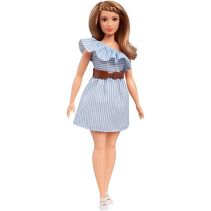
My sisters loved to play “family” but I had zero interest in play-acting motherhood. I was born this way: there was never a time when I didn’t know myself to be a childfree kind of gal. So Barbie was it for me. Barbie had the life I imagined for myself – a fabulous wardrobe, a cute convertible, a handsome boyfriend, a serious profession. The only problem was, she didn’t look a thing like me.

Tiny Shoulders, Rethinking Barbie documents the 2016 launch of a line of different-sized Barbies, FJF41_01including tall, petite, and curvy. Curvy Barbie has a thicker waist and no thigh gap. It seems like a no-brainer now, but for the people working at Mattel, it was ulcer-inducing times. Would feminists finally be appeased? Would they be derided for waiting too long? Would children embrace a “fat” Barbie, one that didn’t fit into the outfits they might already own? They were anxious to steer the narrative but were wise enough to know that social media would own them – and that a Time cover story would largely dictate her early adoption or lack thereof.
I would have embraced a thicker Barbie had she existed when I was a kid. Heck, I just checked out the catalog right now to see if the Curvy line includes one with pink hair and lots of tattoos (it doesn’t). Representations matters.

Barbie has never been just a toy. She’s an icon, with a place in our culture. Even Gloria Steinem has a thing or two to say about her in this doc. Director Andrea Nevins looks at Barbie’s reinvention from every angle, seemingly missing nothing. This is a moment in time worth documenting, and she has. And it also turns the tables on Barbie’s critics. Yes, this move was probably long overdue, but seeing things from the business side makes us realize what a gutsy move this truly was, with possible million dollar repercussions. Barbie will always have it just a little tougher than most if not all of her fellow toys just by virtue of who she is, what she represents, and what we project on to her. People are keen to find fault. Today she reflects a greater diversity – not every body, and not every ethnicity, but progress is progress – and not only is that worth applauding, I also think it deserves the careful consideration granted by Nevins and crew.

The Rachel Divide

Rachel Dolezal: I bet you know her name. She’s the white woman who passed herself off as black and became the head of her local N.A.A.C.P. chapter. And in fact, she doesn’t just pretend to be black, she claims to really believe that inside, she is. She has called it transracial, perhaps to piggy-back on the recent (and limited) success of the transgendered community to gain acceptance. Transgendered people are born in the wrong body. Their biology may present as one sex but they feel very much like the other, and may even undergo reassignment surgery in the pursuit of having their bodies match their identities. But is transracial the same thing? Is it even a thing?

I definitely had opinions about Rachel Dolezal before I ever watched the MV5BYmMzZGRhMjctYTA4My00YWQ3LWJlZjUtZjZmZjU2NjI3NWMzXkEyXkFqcGdeQXVyNjc5NTc1MTg@._V1_.jpgdocumentary. It was hard not to have a knee-jerk reaction to this thing that felt wrong, felt maybe even racist, though we couldn’t quite articulate why, other than the fact that it necessarily deals in stereotypes. But on paper, it’s harder not to see her point. And in practice, it’s impossible not to feel compassion for her children who are being punished for the sins of their mother.

Laura Brownson has a fascinating documentary that really challenges your beliefs, and to me that’s the ultimate mark of a good documentary. Why did Dolezal lie? Why does she continue to hold her ground? Why does she cry about her notoriety but chase it with a book deal and now a documentary? Why was she singled out for accolades when so many actually-black women were passed over? Should her contributions to the cause be forgotten or ignored?

Brownson offers no real answers but asks enough intelligent questions that it really gets your brain juices bubbling. She doesn’t let Dolezal off the hook but does treat her like a human being, which makes her the rare exception. And I’m still not certain where my own beliefs stand, but my thoughts are a little more evolved, and a little reflection never hurt anyone.

Candy Jar

Lona and Bennett have been rivals their entire high school careers. In their senior year, with Lona (Sami Gayle) applying to Harvard and Bennett (Jacob Latimore) gunning for Yale, the pressure on them to do well is enormous, and they are dismayed to learn that as debate co-champions and debate co-presidents, debate isn’t going to give either of them the edge over the other. And while their ambitions drive them on, their respective mothers may hold them back. His (Uzo Adubo) is an affluent, accomplished state senator, and hers (Christina Hendricks) is a single mother with three jobs and a chip on her shoulder. And of course they too were once high school rivals.

I wondered if Candy Jar was going to do for debate what Pitch Perfect did for glee club: it’s not. First of all, debate club sucks. Clearly things have changed since I was in high Candy-Jarschool. Apparently debate is now mostly loud, fast shouting. Like auctioneer fast. The arguments are spit out in such a high-speed string that they are not even distinguishable. So it’s really not all that fun to watch. As in, not remotely fun, so I wonder if the director just invented the fast pace in order to basically fast forward the most boring parts of his movie. Which is not exactly a vote of confidence, is it?

Meanwhile, their guidance counselor (Helen Hunt) is more concerned about them getting dates and going to school dances and other borderline creepy things than about their academic futures. Basically, these two are co-champions on paper but co-losers in life.

The cast is pretty solid and I’m particularly happy to see Uzo Adubo go from Crazy Eyes to State Senator. Girl is versatile! And while the kids have important lessons to learn about disappointment and loss and perspective (and perhaps their parents even more so), it feels like director Ben Shelton lacks a specific vision. If you’re going to contribute to the vast oeuvre of high school movies, maybe try not to suck so much. Well, suck is a harsh word. Bland is probably more accurate, but nearly as damning, I think.

Also, for the record, Sean suffered a personal disappointment when he discovered the movie to be titled Candy Jar and not Cookie Jar. So we’re holding that against it too.

The Week Of

Have you ever been 23 and so deeply in love that getting married is the only answer? The only answer even if your family thinks you’re a little young, and a little crazy? And doesn’t love always make you a little crazy, no matter how old you are?

Sarah and Tyler are indeed getting married, and if they’re a little crazy, their family is a LOT crazy. His father is a wealthy heart surgeon (Chris Rock) who spent more time in the operating room than in the family room, and her father is a humble contractor (Adam Sandler) willing to spend money he doesn’t have to give his baby girl her special day.

Sandler is quickly surrounded by all manner of family, and you know how family is. And if you’ve ever been married, you know how weddings are. You spend a huge chunk of MV5BMjMyNjU4NDIzMF5BMl5BanBnXkFtZTgwMzUyMzE3NDM@._V1_SY1000_CR0,0,1499,1000_AL_money in order to assemble the biggest nuts in your family just to see which ones will crack under the pressure. And oh  my god they crack in such spectacular fashion. I bet your own wedding was not without disaster: tell us about it in the comments! But every wedding has its own brand of chaos, and with Sandler co-penning the script, you know you’re in for some moans and groans, if perhaps not of particularly imaginative variety.
Sandler and Rock are not at their best here, and it seems they’ve decided they don’t really have to be. There’s an extensive cast on hand, including Rachel Dratch and Steve Buscemi, everyone contributing some nonsense on a sliding scale. The bits I liked best are when the whole family is assembled, everyone talking over one another, the old biddies with their insistent ignorance and the younguns there against their will. It felt like a real family, like my family almost, except we’d have fewer deli sandwiches and a lot more beer nuts (not to mention beer). Both Sandler and Rock get drowned out in those scenes, and I don’t think it’s a coincidence that those are the ones that work best.

Anyway, The Week Of has a few forced laughs but it’s in no way a good movie – just a tolerable one if you’re flipping through Netflix in the need of something light and brainless.

Avengers: Infinity War

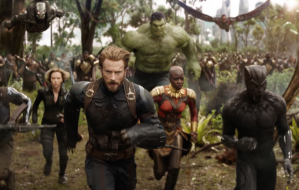
Avengers infinity warAssholes Assemble!

Matt, Jay and I all took in Avengers: Infinity War last night and I expect you can guess how that went.  I loved it, Jay hated it, and Matt liked it but would have preferred to be at a DC movie instead.  Of course, it is clear that Matt backed the wrong horse in the DC/Marvel race, as Marvel continues its streak of good movies.  Marvel’s so hot they even managed to resurrect the Spider-Man franchise for Sony along the way and might soon get the rights to use the X-Men and other characters currently being held hostage by Fox.

Whether adding more characters to this already bloated roster is a good thing is something we can (and will) argue about, but for a Marvel fan like me, the best thing about an Avengers movie is seeing all my favourite characters team up to save the world just like they’ve done in the comics a hundred times previously.  It’s particularly sweet now that Spider-Man is helping Iron Man and Co. on a regular basis (and fantastic that Spidey gets about as much screen time as anyone in Infinity War).

Even better, in Thanos, Marvel has found a threat big enough to require these countless heroes to team up to fight.  Finally, we have an Avengers movie that doesn’t have to use internal conflict as a plot point.  Past grudges are quickly put aside as we jump right into the fight, where literally half the lives in the universe are at stake.  Though the film is two and a half hours long, it didn’t feel like there was ever a lull in the action, not even for a second.

But.

But.

But.

I don’t ever expect Jay to like the superhero movies I drag her to, but she hated this movie much more strongly than I had anticipated.  In hindsight I should have seen this coming and prepared her for it.  Anyone who has read the Infinity Gauntlet crossover event will not be surprised by how the movie plays out, and anyone who has read comics in general knows that rule #1 is no one ever stays dead.  But when anyone can (and almost everyone does) come back to life in the comics, and in this movie, it makes death feel cheap.  Without getting too deep into spoiler territory, let’s just say there is at least one on-screen death that feels like it is going to be undone in the next Avengers movie (and when I say at least one, I really mean every single one).  That resurrection expectation takes away from this movie significantly because it doesn’t mean anything if everything gets reset.

The writers should have found a better way for this film to play out, one that didn’t feel like any hero’s death was just a temporary setback, particularly because the MCU can afford to lose several dozen characters – if it did then we might actually have enough screen time for heroes like Ant-Man and Hawkeye!

I could overlook the inevitable resurrection issue because that’s my expectation of comic books, but it is not going to be so easy for most to deal with.  And really, whether you can get past it is almost secondary, because it would undeniably have been so much better for the MCU to have risen above that trite comic book convention and given our heroes a loss that felt irreversible, instead of one that we feel certain is going to be undone within a year.   Avengers: Infinity War is still an enjoyable, fan-pleasing blockbuster even with this problem, but due to the perceived lack of permanent consequences, Infinity War is missing the dramatic heft that should have followed naturally from a battle over the fate of the universe.

Dude

I’m glad that teenage girls are finally having their moment as three dimensional characters in film. Shopping and boys, that was the John Hughes model. Teenage boys were the hunters and girls their prey, and it’s taken until 2018 to flip the script, first with Blockers, which dared to show young women actually in charge of their own sexuality. Dude follows in its footsteps.

Lily (Lucy Hale) and her friends are in their last year of high school. That’s all that I knew going into this film that recently popped up on Netflix. That, and they were stoners. Not promising, I thought. So colour me surprised when, in between masturbating and getting high, they made friends with me.

Amelia (Alexandra Shipp), Chloe (Kathryn Prescott), and Rebecca (Awkwafina) have MV5BMTk5MDk1NTQ0NF5BMl5BanBnXkFtZTgwMjM4ODk5MzI@._V1_been super tight as far back as they can remember, and can hardly envision a future that doesn’t include each other – like, on a daily, hourly basis. So the ultimate theme of this movie is not so unusual: it’s letting go. Letting go in more ways than one, sure, but it’s not exactly groundbreaking stuff.

But what is remarkable is the depth to the characters and the way the script (by director Olivia Milch) refuses to infantilize them. These ladies are EMPOWERED. Their virginity isn’t idolized. They can smoke pot AND be valedictorian. These girls are me (like 4 minutes ago, when I was in high school). Portraying young women as they are shouldn’t feel so monumental, so brave, but it is. This may be how lots of girls act, but it’s not how society wants to see them, and so we don’t. We pretend that girls don’t want these things because it threatens the status quo.

The cast is good, with Awkwafina being a particular stand out for me: I’m crushing hard. And I can’t wait to see literally everything Milch does for the rest of her life. But most of all I’m just kind of feeling all puffy-chested that a movie like this can finally exist. And that you can still find diamonds amongst the usual Netflix coal. And that someone, somewhere, is willing to take a risk on a movie like this.


I Feel Pretty

When the trailer for this movie came out several months ago, it hit a wall of backlash. This was NOT the moment for a movie with any kind of body-shaming. It appeared to be about a woman (Amy Schumer) who suffers a head injury and then wakes up believing herself to be beautiful. And since Schumer is already a conventionally pretty person, critics felt this merited a culture-wide eye roll. And while they’re not wrong, they don’t quite have the premise of the movie down pat.

What really happens: yes, there is a head injury that leads to Renee’s believing herself to be beautiful. But nobody is pretending that she wasn’t perfectly fine before – only that she suffered from low self-esteem and didn’t realize this herself. Which is a common enough thing.

So while the backlash may have been inspired by misconceptions, it’s not entirely wrong. Renee gains esteem not by empowerment but by delusion. She gets a new job MV5BNzE2NDUxMzctOWYwNC00MTkxLThkODctOGQwMTI4MzRjM2M3XkEyXkFqcGdeQXVyNDg2MjUxNjM@._V1_SY1000_SX1500_AL_(at a fashion magazine, working for squeaky-voiced Michelle Williams) and a new boyfriend (the perpetually bearded Rory Scovel) and attributes her newfound success to her newfound beauty. And her actions start to reflect those beliefs: she shames her friends (Busy Philipps, Aidy Bryant) for not emphasizing attractiveness and is less than faithful to her ‘nice’ boyfriend when she gets attention from a ‘hot’ guy. So is this purely a positive message? No it is not. But there’s a good intention somewhere in there about how anyone, no matter how they look (*cough*Emily Ratajkowski*cough*), can suffer from low self-esteem. And it’s confidence, not looks, that actually attract good things your way.

Written and directed in a joint effort by Abby Kohn and Marc Silverstein, I can’t help but feel weird about the mixed messages on screen. Like, obviously we’re not supposed to judge a woman’s worth by her looks, and yet we’re encouraged to laugh at Schumer’s “bikini body” as she writhes around on stage. It’s played for laughs. But it’s also pretty powerful commentary if you consider how much that scene makes you uncomfortable. Because societally, we somehow don’t believe that someone who looks anything short of perfection should have body confidence. We shame women for not covering up their flaws. We don’t think that someone who looks like Schumer, who, let’s remember, IS actually living up to conventional beauty standards, even belongs in a beauty pageant or a bikini contest because that’s for one kind of very, very limited beauty that is all but unattainable.

Messaging aside, is this a fun movie to watch? I’d say yes, but it’s inconsistent. I had two REALLY big laughs that I’m ashamed to even admit to, because one was just a computer noise that struck me as totally tragic and genius. But if the message lacks conviction, so do the jokes. In North America, we’ll forgive almost anything if it’s funny enough. I Feel Pretty is not. Sure it doesn’t tell us that looking 19 and weighing less than 120 is the be all and end all, it just tells us that if you’re confident despite those things, it’s funny as hell. Being a woman is tough enough as it is. I just don’t have the 19 year old abs to laugh at this stuff anymore.