Category Archives: Movie Reviews

Our reviews and thoughts on the latest releases, classics, and nostalgic favourites. Things we loved, things we hated, and worst of all, things we were ambivalent about.

Poor Agnes

Men murder whores; women murder their babies. Where the fuck does that leave Agnes? Sure she’s a serial killer but she’s alarmingly adept not just at murder but at slow, meticulous torture. She surveys a therapy group that meets about their hostage experiences, and takes notes.

Her most recent victim is chained up in her basement right now. Mike (Robert Notman) is a private detective who ironically came asking after a former victim from a decade ago. Now he’s in chains, starving to death while she plays games with him. Agnes sees beauty in other people’s pain.

This movie is fucked up, totally, totally fucked up. But if you have the stomach for it, the writing is exceptionally good for this genre of film. Lora Burke, as Agnes, is perfectly cast. fantasia2017-Poor_AgnesAgnes is a psychopath but Burke never overplays her. She’s deeply disturbed but can come off perfectly sane and reasonable. Even more astonishing, she can say the most distressing things so pleasantly it takes a moment before your ears truly catch up to what they’re hearing.
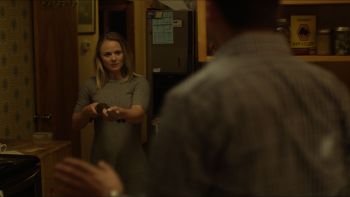
Over time, Agnes and Mike form a bond that defies categorization. The film zings between victimization, sadism, cruelty, and remorselessness. Abu Ghraib’s got nothing on Agnes. She does abuse and mind-control like nobody’s business. But it’s not as brutal to watch as you might think; the one scene that made me GOL (gasp out loud) involved off-brand processed cheese, and believe me, that’s enough.

The most interesting thing about this movie is your reaction to it. Burke’s performance is so measured, it’s a struggle not to root for the bad guy. And she’s a very bad guy.


To The Bone

The first image from the film is a trigger warning and believe me, take heed. To The Bone is a serious, unflinching look at eating disorders that will absolutely be upsetting to each and every one of us, but particularly to those suffering from or recovering from eating disorders themselves.

Lily Collins, herself a survivor of eating disorders, plays Ellen, a young woman still very much in the throes of anorexia. The film shows her getting treatment in a centre run by Keanu Reeves, which should tell you all you need to know about how inauthentically the healing is portrayed. In reality, treatment is heavily regimented, usually in a medical setting. Eating disorders are the most deadly of mental to-the-bone-sundance-e1495026297494illnesses, no one’s going to let an emaciated Lily Collins push a fish stick around her plate for dinner. And they’re also very difficult to treat because unlike drinking, you can’t simply give up food. You have to learn to eat in moderation. Eating disorders are often (but not always) about control. Often there is some type of childhood abuse that accounts for someone wanting very much to exert control over their bodies now.

This both is and isn’t the case with To The Bone, but the family dynamics are a strong point of the film. Ellen’s family situation is sad and disjointed. Family therapy does not go well. Her father is absent, her mother can’t deal anymore, so support is provided by a step-mother who maybe doesn’t have the closest of relationships with her husband’s tiring and trying daughter. Some of you may find this movie enlightening. Certainly I believe that Ellen and her disorder have been portrayed empathetically. But it’s a tough watch that could definitely be a hardship for some, and may glamourize a terrible disease for others. This is a film to be watched only with care, and preferably in the company of others.

Based on writer-director Marti Noxon’s own experiences with anorexia as a teen, the film forced Collins, in recovery for eating disorders, to lose 20lbs. She did so with the “help” of a nutritionist, but there’s nothing healthy about a young woman already on the brink of being too thin being asked to lose up to a fifth of her body weight. I hate that movies do that and I can’t imagine that graphic shots of protruding bones and skeletal characters is putting anything but negativity into the world. And it doesn’t help that none of the other characters are put into any kind of context. They help show that eating disorders are not just the stuff or rich white girls, but by keeping those characters one-dimensional, we do them a disservice. The thing is, even with good intentions, sharing stuff like this can be dangerous. Details about how to purge or count calories can come across as tips; Collins’ skin-and-bones frame can be seen as aspirational. And I suppose this is where we ask ourselves: is this film doing more harm than good? What is responsible film making? Without knowing the answers, I do know that I am not comfortable recommending this film without some heavy caveats.

Chasing Coral

The ocean only has to warm about two degrees for coral to die, and guess what? The ocean is warming and the coral is dying. Much of it is dead already. It’s not just sad because we’re losing a beautiful animal; coral is vital to our ocean’s ecosystems, and when coral dies, so do many other species in the ocean, and it’s only a matter of time before we ourselves feel dire repercussions. Coral are the trees of the ocean, and their extinction en masse cannot and will not go unnoticed. The question is: will we notice before it’s too late?

One diver, Richard Vevers, realizes the ocean has a bit of an advertising issue: it’s out of sight, and largely out of mind. But if he could find a way to show us at home what’s going on beneath the waves, might we pay attention? Inspired by the film Chasing Ice, which captured the receding glaciers through years of time-lapse, Richard thought the same MV5BODA5ODAyNjk5M15BMl5BanBnXkFtZTgwNzQ3NTE5MDI@._V1_SX1777_CR0,0,1777,785_AL_technique could be applied to the reefs, so he called up director Jeff Orlowski, and an idea was born.

Underwater time lapse meant nothing short of a new invention was necessary. A whole team built special cameras that could exist in salt water for months a time, in the cold, under great depth and pressure, subject to storms, and needing not only to be wiped clean regularly, but to host a router that would send the images back. This is how they meet Zackery Rago, who’s part of the camera building team but also has a secret passion for coral. They position their cameras in the reefs of Hawaii, the Bahamas, and Bermuda, but nature and technology conspire against them. In the end, it’s necessary for them to go down and record this massive bleaching event themselves.

Another lesson learned: watching a beautiful animal die is hard. Watching them practically go extinct is wrenching. 2016 was a bad year for coral. 29% of the Great Barrier Reef died in 2016 alone. In 30 years, we could lose it all. White coral is a shock, of course. The white is the coral’s exposed skeleton. Death is imminent. Dead coral is even sadder, devoid of any life or colour.  While the time lapse originally meant that they could observe this happening from a distance, the modified plan of divers capturing the footage themselves means they are confronted with this death and dying in person, and they find that quite devastating. I think you will too and I think you should watch anyway.

Kristen Bell recorded a song specifically for use in the film. She feels strongly about the film’s message, but I think the hope is that we all will, and feel galvanized into action. You can start with Vever’s The Ocean Agency and suggestions found at Chasing Coral. But I think just not turning away from this is the important thing.


Museum

Detective Hisashi Sawamura (Shun Oguri) of the Tokyo Metropolitan Police is having a rough go. He’s tired. His overworking, long a point of contention in his marriage, has finally culminating in his wife and young son leaving him. And now he’s got a serial killer on his hands.

A few things about this serial killer, because he’s unlike anything you’ve seen in film GAGA_C&C_A4_frontbefore, and yet draws from many familiar sources. The serial killer only works in the rain. He plans elaborate, gruesome kills that seem to be some sort of punishment to his victims. And – how do I put this – he also appears to be a man with a frog head. There. I said it. Moving on…technically, the source material here is the manga, Museum: The Serial Killer Is Laughing In The Rain. But you’ll find the movie remind you of Seven, Saw, and maybe even Oldboy. I can’t say that Museum is that caliber of film, but it’s plenty bloody.

The first half works much better than the second does. Once the serial killer is “unmasked,” for lack of a better word, a lot of the fun and the sizzle leeched out of the movie for me.  I worried that the frog head would seem cartoonish and silly but I did find it rather sinister and regretted it when we lost it. Some of the acting, though, veered toward cartoonish, and that’s particularly hard on North American audiences who are more used to subtlety.

Still, the Assholes managed to enjoy this one, more or less. It has a frenetic energy to it thanks to manic editing. And if you just give in to the weirdness, the slight foreignness, it’s a little fun to watch the whole thing go down. Montreal’s Fantasia Film Festival focuses on “genre” selections, which means you always get something special. We get exposed to titles we’d otherwise struggle to find, and it’s honestly a lot of fun to be pushed out of our comfort zone once in a while.

The Lost City of Z

Percy Fawcett is a hard-working man but promotion eludes him due to his “unfortunate choice of ancestors.” This provides the desperate motivation in him agreeing on a mapping “adventure” deep in the Amazonian jungle. If disease doesn’t kill him, the hostile “savages” are likely to, but to restore his family name and support his family, off he goes…never to return.

I’m getting ahead of myself. Percy Fawcett (Charlie Hunnam) was a real British explorer who did get sent to the Amazon. While surveying there he believed he found a previously unknown, unfathomed advanced civilization. Back home he is ridiculed by his peers, but he’s obsessed, not just with a potentially huge discovery, but with proving himself. His fire is lit, his wife (Sienna Miller) supports him and his aide de camp (Robert Pattinson) enables him until one day he just disappears into the jungle.

Shooting a movie in an honest to blog jungle is difficult and uncomfortable. Director James Gray asked Francis Ford Coppola (who did the same for Apocalypse Now) for advice, and he was told “Don’t go”, which, incidentally, is the same thing Roger Corman told Coppola. Nobody listens, but it’s probably solid advice. If you do disregard it and trek to the steamiest of locations, make sure you don’t plan to film digitally. Gray was shooting 35mm thankfully, as the humidity shut down all the laptops and would have done the same to digital cameras. The actors and crew withstood and great deal of hardship – was it worth it?

The Lost City of Z (it’s pronounced Zed, you filthy Americans) has a meandering pace that reminds me of the epic adventure movies of 50 years ago or more. I can’t justify its runtime (141 minutes!) and I know exactly what I would have left on the cutting room floor, but I do love lots about the movie. I love the complexity that Hunnam brings to the role. I love the subtlety and the refusal to exploit that Gray insists upon. I love the authenticity of the script, the honest portrayal of sacrifice, the bold ambition of the story. There aren’t exactly a lot of surprises to be had. It’s about finding oneself while literally losing oneself. But there’s a lot to enjoy along the way. The jungle itself plays a stunning role; tip of the old safari hat to cinematographer Darius Khondji who captured things no CGI could hope to emulate.

The Love Punch

When Richard’s company gets bought out by a bigger company, he and his colleagues see their retirement fund disappear overnight. With the prospect of not being able to support his daughter just off to college, Richard (Pierce Brosnan) and his ex-wife, Kate (Emma Thompson) appeal to the young new director who – surprise! – doesn’t give a shit. So they hatch a little plan to steal their money back in the form of the very large diamond lately dangling from his fiancee’s neck.

the_love_punchRichard and Kate, who haven’t spoken much in years, now find themselves travelling to France together to the perfect cover to their crime: the high-society wedding between the director and his blushing bride. Kate gets relegated to some hen party high-jinks while Richard naps, but her intel is good: a foursome from Texas, business partners the director has not yet met in person, are expected to attend. All they need are two more accomplices. So they call up their good suburban neighbours Pen (Celia Imrie) and Jerry (Timothy Spall) who are for some reason pretty game to join in this merry heist.

Then follow the obligatory jokes about retirement-aged folks planning the perfect crime: weak bladders, low endurance, the need for naps, har har har. If you’ve always wanted to see Emma Thompson in Dallas-era hair and a twangy accent, this is your chance. A couple of James Bond references make the movie a little cheeky and the talent between the four leads means an awful lot of charisma. Emma Thompson shines in everything. But this material is beneath her, beneath them all and they can’t save a clunky, predictable scrip that is frankly a little insulting to anyone over the age of 60. And that’s too bad because I really enjoyed director Joel Hopkins’ Last Chance Harvey, also starring Thompson and Dustin Hoffman who enjoy a late-in-life romance. Watch that one instead.

A Ghost Story

ghost-storyFilm as a medium is almost infinitely flexible, universal and personal at the same time. Film is capable of so much emotion and yet it’s also capable of conveying the complete absence of it. Beauty or lack of it.  Terror or peace. And, as A Ghost Story proves beyond any doubt, film can make you feel so fucking uncomfortable and voyeuristic that you would give anything for the director to just yell “cut” already!
Put another way: how long do you think you could bear watching someone eat pie? Think carefully before you answer. For the full A Ghost Story experience, write your response down on a little scrap of paper and hide it in your house (or underneath a rock if your house is just a couple of pegs in the ground).

Whatever you think you can bear now, the inescapable truth is that no amount of tolerance for pie voyeurism will be enough to survive A Ghost Story unscathed. In one strange, haunting scene, A Ghost Story makes its mark, and there are lifetimes of other achingly lonely scenes for you to digest (but only if you can stomach it).

A Ghost Story plods, skips, stops, philosophizes, winks, and does whatever it wants, conventions be damned. It is a wonderfully strange, unique and brilliant experience that I cannot recommend enough.

By the way, see A Ghost Story in a theatre if you can, because there is a magical dichotomy in the mixture of loneliness and comradery that should result from experiencing this film with others. That contrast is yet another example of film’s versatility, and doubles as a valuable touchstone if you ever happen to become a ghost. It will all make sense in the end, and that is a comforting thought, isn’t it?


Last Vegas

I wish movies about seniors weren’t so goddamn awful and condescending. I know people over 65 who are robust, interesting, engaged. I know seniors with rich social lives and sharp minds, who may suffer from bladder issues but manage to keep from talking about for hours, even days at a time. Apparently screenwriter Dan Fogelman does not. Hollywood seems to think that the only thing worth noting about seniors is their doddering foolishness, and that’s too bad, because I think they’re finding that there’s a bigger and bigger senior audience, and someone’s got to start writing for them – perhaps even a senior citizen him or herself. Wouldn’t that be novel?

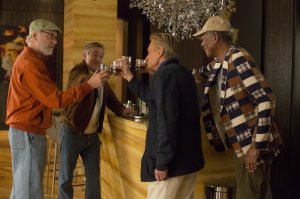
Last Vegas assembles a foursome of our favourite old guys – Michael Douglas, Morgan Freeman, Robert DeNiro, and Kevin Kline. Michael Douglas faces down his own mortalityMV5BMjIzODA5ODA4OF5BMl5BanBnXkFtZTgwMzQxMzE1MDE@._V1_SX1500_CR0,0,1500,999_AL_ at a friend’s funeral by proposing to his very young girlfriend in the middle of the eulogy. His friends congregate in Las Vegas in order to throw him a bachelor party wild enough to pay tribute to a man who’d managed to stay one for over 70 years. Morgan Freeman has to escape from his strict and overly concerned son, DeNiro has to be coaxed out of apartment where he wallows in widowerhood, and Kevin Kline is all too eager to escape Florida, basically death’s waiting room.
But you know what? These old guys still have some life left in them. Director Jon Turtletaub waters the whole thing down though, like it’s the 38th sequel to The Hangover, and nobody thinks old people deserve or are capable of their own wild and crazy antics. Instead we’re treated to a litany of bad hip jokes. This quartet is quite charming, and even the cringe-worthy cliches they’re forced to deal in don’t completely negate that. But I know a 90 year old who danced with Elvis and did shots at my wedding. That’s not a script, that’s real life. Now well into her 90s, she still travels the world and paddles her own canoe. Not everyone is lucky to be in such good health but there’s a whole spectrum when it comes to aging, one that Hollywood seems loathe to explore. I think these venerated actors deserve better, and so do the people buying the tickets, whether or not they’re claiming a senior’s discount at the box office.

Bokeh

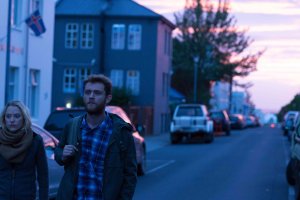
A young American couple is on a romantic getaway in Iceland when the impossible happens: everyone in the world disappears, except for them. They wake up alone on the planet. Well, presumably, since they find no other survivors but also have no way to communicate with the world.

Riley (Matt O’Leary) seems to embrace their aloneness as a challenge, and sets about building primitive tools to keep the water running. He enjoys the freedom to shop MV5BNmI3MWU2N2UtNDJmOC00YjdiLTgzYmEtZmI1NzBiYTNmY2ViL2ltYWdlXkEyXkFqcGdeQXVyNTE0NzEyMzE@._V1_SY1000_SX1500_AL_without paying and help himself to cars without stealing but he’s a little reckless in his adventuring, which irks his girlfriend Jenai, who points out that should he get hurt, there’s no more 911 to call. And she’s right. But she’s also contorted with anxiety. Jenai (Maika Monroe) misses her family. She searches obsessively for other survivors. She seeks understanding, not just of what happened, but of its greater, spiritual meaning. Have they been chosen, or left behind? What is their purpose here? She and Riley drift apart over these issues, which is extra tragic since they don’t have many other options.

On paper (or technically, a computer screen) this movie sounds interesting. But oh no it is not. It’s the slowest, most boring, most plotless post-apocalypiptic movie you’ll ever see. There are only two things Bokeh is good for: 1. the terrific Islandic travel porn, and 2. torturing yourself with bleakness and existential defeatism. So yeah, if you’re researching beautiful places to kill yourself, definitely consider Iceland. But I’m guessing that wasn’t their intention in making this movie.

Take Me

Ray (Pat Healy) is an unconventional entrepreneur: he runs a simulated kidnap business where he abducts people and holds them hostage for as many hours as they’ve paid for. He thinks he’s hit pay dirt when a beautiful young woman (Anna, Taylor Schilling) is willing to pay for a whole weekend’s worth of captivity and is prepared to throw in a little extra for some rough stuff.

But Anna’s abduction doesn’t go as smoothly as all the others: someone’s reported her MV5BM2Q5ZWUzMGYtOWEzNS00N2IzLTlhNTItM2RjN2ZhZDBlOTg4XkEyXkFqcGdeQXVyMTE2NzA0Ng@@._V1_disappearance to the cops, for one thing. And Anna’s claiming that whoever hired him, it wasn’t her. So now her kidnapping is for real, Ray’s in trouble with the law, and he can’t let her go until he sorts it all out. Too bad Ray’s not exactly the brightest bulb. Bumble, bumble, bumble.

First time director Pat Healy creates an interesting atmosphere that’s half tension, half farce, and the two leads toe the blurry line well together. It took me a while to get into this because it’s not your typical crime thriller; Ray is not a criminal mastermind, he’s actually just not very good at his job. Tonally, you might find it more in the vein of Mindhorn than Taken. It’s quirky, there are some great gags, the character study is fascinating. It explores this seedy fantasy\role play underground culture while keeping a fairly light, jovial tone. But at 83 minutes, it also feels like it’s stretching to make an interesting premise into a feature-length idea. It feels thin in places. So while it’s an interesting experiment in film, it doesn’t quite work the way you wish it would.